Student Name: Ekaterina S.
Student I.D: S111111
Area of Specialization: M.Ed. - Advanced Teaching at the Elementary, Middle School and Secondary School specialization
Contents
Introduction 3
Example 4
Artefacts Organized by Course 5
EDUC 5010 Education in Context 5
EDUC 5210 Learning Theory 6
EDUC 5220 Curriculum Design 7
EDUC 5240 Creating Positive Classroom Environments 8
EDUC 5270 Instructional Techniques – Elementary* 9
EDUC 5271 Advanced Practices ELEM Literacy 10
EDUC 5280 Instructional Techniques – Secondary** 11
EDUC 5281 Advanced Practices SEC Literature 12
EDUC 5410 Child Development* 13
EDUC 5420 Adolescent Development** 14
EDUC 5440 Assessment and Evaluation 15
EDUC 5710 Understanding Barriers to Learning 16
EDUC 5711 Teaching for Diverse and Inclusive Classrooms 17
EDUC 5810 Living and Learning Globally 18
EDUC 5470 Research in Education 19
Philosophy of Teaching Statement 20
Introduction
Welcome the UoPeople Master of Education Portfolio Template. As a Master of Education student, you are required to create a portfolio that you start in your very first class and submit near the end of the program. You’ll contribute a minimum of three artefacts to your portfolio in every class you take (although you can add more rows to save more if you wish). At the end of your portfolio, you will also complete a Philosophy of Teaching Statement. This allows you to save useful readings and reflect on previous work when you’re teaching so that you can continue to draw on what you learned.
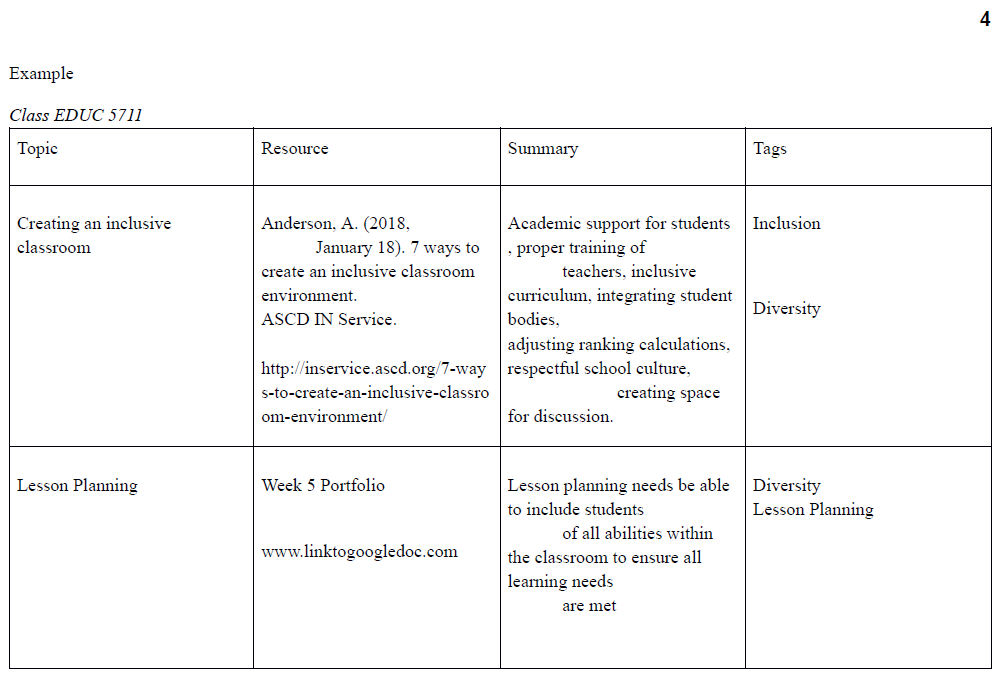
An example has been included at the beginning of this guide to help illustrate how artefacts need to be formatted. All materials need a topic, a way for the instructor to review the resource (such as a link), a summary, and tags to help indicate how the resource can be used later. By following this template and consistently gathering pertinent materials, you'll not only enhance your understanding of the course material but also streamline the process of assembling a comprehensive and well-organized portfolio.
NOTE: Students should select the artefacts they wish to add to their portfolio. However, the following must be included:
1. Artefact related to developmentally appropriate curricula
2. Artefact related to learning environments and diversity of learners
3. Lesson Plan (any topic)
4. Artefact related to developmental instructional across various ages*
5. Artefact related to pedagogical practices and resiliency**
*required for elementary specialization
**required for secondary specialization
Master of Education
EDUC 5220 - Curriculum design and Instructional Decision Making
Curriculum reform – a guide to implementing positive changes in curriculum
Instructor: Dr. Rochelle Massingill
Group 0005B: Dewald Alberts, Ekaterina Chshyogoleva
Syeda Areeb Fiza Bukhari
July 26, 2022
Curriculum reform – a guide to implementing positive changes in curriculum
Philosophy of Teaching Statement
Teaching as a hobby
Before my studies at University of the People, I did not feel like a full-time teacher. In fact, I graduated in 2005 with a bachelor's degree in linguistics and a specialization as a reference translator.
When I was looking for a job, it was like a funny story. I found an ad in the newspaper that required ... a psychologist. I called the company and they said they needed an English teacher. I offered to try me out and they invited me to give a 15 minute lesson on the simple past tense in front of a small group of students. I thought it was a nice experience and my future employers said I had talent. That's how I started working in English courses.
However, all the groups of students I was assigned to stopped coming to class after a couple months. No one had taught me teaching methods, so I just didn't understand how to behave with students. I had no knowledge at all about how to teach other than the ability to use English.
When my colleagues explained to me that I was a bad teacher and lacked experience, I decided to go to a public school. There I got acquainted with a huge team of German teachers, equipped my English classroom and wrote my first research paper on foreign language acquisition at the elementary stage of education.
Years passed and during this time I got a lot of different certificates. I tried to attend as many different professional development courses as possible to get acquainted with my colleagues, their methods and learn from their experience. But until 2022, I still felt that I was not a teacher and my work was a kind of paid hobby.
The process of realizing myself as a teacher
When I entered University of the People I was ready to drop out at any moment. I had two young children and had moved from Kazakhstan to Russia. Sanctions cut off the ability to pay for university remotely from Russian bank cards, and the courses themselves seemed complicated and ... insanely interesting. I was lucky that my first course was 5010 Education in Context. Then I met Dewey (Perez, 2022) and realized that I had a lot of discoveries ahead of me. Each course made me more aware and confident in myself and my abilities, so Learning Theory helped me understand Social learning and constructivist approaches, and Curriculum Design made me rethink my approach to curriculum design. I used to just take the textbook that was the main textbook in school and write a plan for the year based on the topics in the textbook. Now I realize that I need to take the main topics that students need to learn during the year, and the textbooks can be picked up later.
The Creating Positive Classroom Environments course helped me realize that the classroom environment is built not only on the relationship between teacher and students, but also through grades and the ability to compromise. That is why I chose Assessment and Evaluation as my next course to learn more about this topic. A revelation for me was our group work in which we looked at assessment as one way to teach.
In fact, all of the group and project papers during the course have become my favorite artifacts regardless of grades. These papers are the quintessential summation of all the material learned in each course.
Since I have two young children, I studied Child Development and Adolescent Development with great interest and engagement. It is actually difficult for parents to observe their children scientifically for various reasons. I consider myself fortunate to have the necessary knowledge to calmly and enjoyably observe the changes in my children as they grow. And I feel like I am ready for their teenage years thanks to these courses.
Instructional Techniques - Elementary and Instructional Techniques - Secondary have been essential courses for me to understand the work of the Instructional Technicians who adapt topics from the curriculum and create the lesson structures that teachers will use next. This work is very important as it helps the teacher to work on the lessons. Every teacher is faced with the need to prepare a future lesson plan, and when there is a ready template and a clear algorithm for working with this plan, the preparation becomes a more creative process.
The Living and Learning Globally course on moderate consumption gave me not only food for thought, but also arguments to explain my lifestyle choices. This course became a starting point for me to interact with the outside world without feeling uncomfortable about saving money in various areas.
After the Teaching for Diverse and Inclusive Classrooms course, there was so much sadness left that it took me a long time to agree to the next course Understanding Barriers to Learning , so I chose it alongside Advanced Practices ELEM Literacy. It was almost physically painful to read about the problems of children and adolescents, but I love literature. And the constant switching between courses helped me keep my sanity.
And the most important gift for dessert was the Advanced Practices SEC Literature course. I've been working with exams since 2015. Back then, I had completed a course to prepare students for IELTS, but I categorically lacked knowledge of American school writing. This course made me feel ecstatic every week. Every book or lesson plan was the most enjoyable experience I've had in all my years of studying.
The Research in Education course was the starting point for me to choose a future research topic. Out of many different options, I am interested in two questions:
● can artificial intelligence replace a human teacher when learning a foreign language
● whether a student can learn the rules of grammar or any other discipline through game exercises before the teacher directly explains the topic.
I don't have much data on these questions yet. But I am planning the steps of the research which will look like this ( Chow et al., 2021) :
1. Gathering information on the question of interest
2. Recruitment of an experimental group of up to 50 participants
3. Dividing the group into two subgroups to conduct experiments
4. Analyzing the results obtained
5. Conclusions
I hope that my research will help me to answer my questions more accurately and adjust my teaching methods according to the new data.
My own path or formed philosophy of education
So today I was thinking about my own educational philosophy.
To begin with, I decided to take two tests: Personality Quiz Educational Philosophy (2014) and What Is Your Educational Philosophy? (n.d.). And got the following results:
“ Your Result:
Social Reconstructionism
A student-centered philosophy has a feel of a community-focus philosophy where the purpose of learning is to make the world a better place. Its focus is on the community's social, political, and economical needs and how schools can address them by teaching certain skills and values. The teacher presents activities that have a "call-to-action". Students are asked to consider multiple perspectives and are coached to handle controversy for the sake of viable resolutions. Educational leaders that fit into this philosophy include George S. Counts, John Brameld, and Jane Roland Martin.”
And the second test showed that I have a predominance of Progressivism (Perez, 2022).
Reflecting on the results I have to agree with them. This is primarily due to my own way of self-learning. I am not at all afraid to start something new in which I have no experience yet. On the other hand, by gradually improving my skills and knowledge I really change the world around me and help my students to achieve the desired results. No matter where I work at English courses, at school or as an online tutor, I always remain a teacher who teaches, provokes development, educates, helps to adapt to any situation and supports the student's faith in themselves and their own strength.
References
Chow, B. W.-Y., Hui, A. N.-N., Li, Z., & Dong, Y. (2021, January 30). Dialogic teaching in English-as-a-second-language classroom: Its effects on first graders with different levels of vocabulary knowledge. Language Teaching Research, 27(6), 1408-1430. https://doi.org/10.1177/1362168820981399
Educational Philosophy . (2014). Uquiz.com. https://uquiz.com/quiz/QPjH8A/educational-philosophy
Perez, D. (2022). Chapter 6: Progressivism. Kstatelibraries.pressbooks.pub , 6 . https://kstatelibraries.pressbooks.pub/dellaperezproject/chapter/chapter-5-progressivism/
What Is Your Educational Philosophy? (n.d.). https://www.andrews.edu/~ggifford/edal/EDAL570/Sum02Chp1/Edphil.pdf