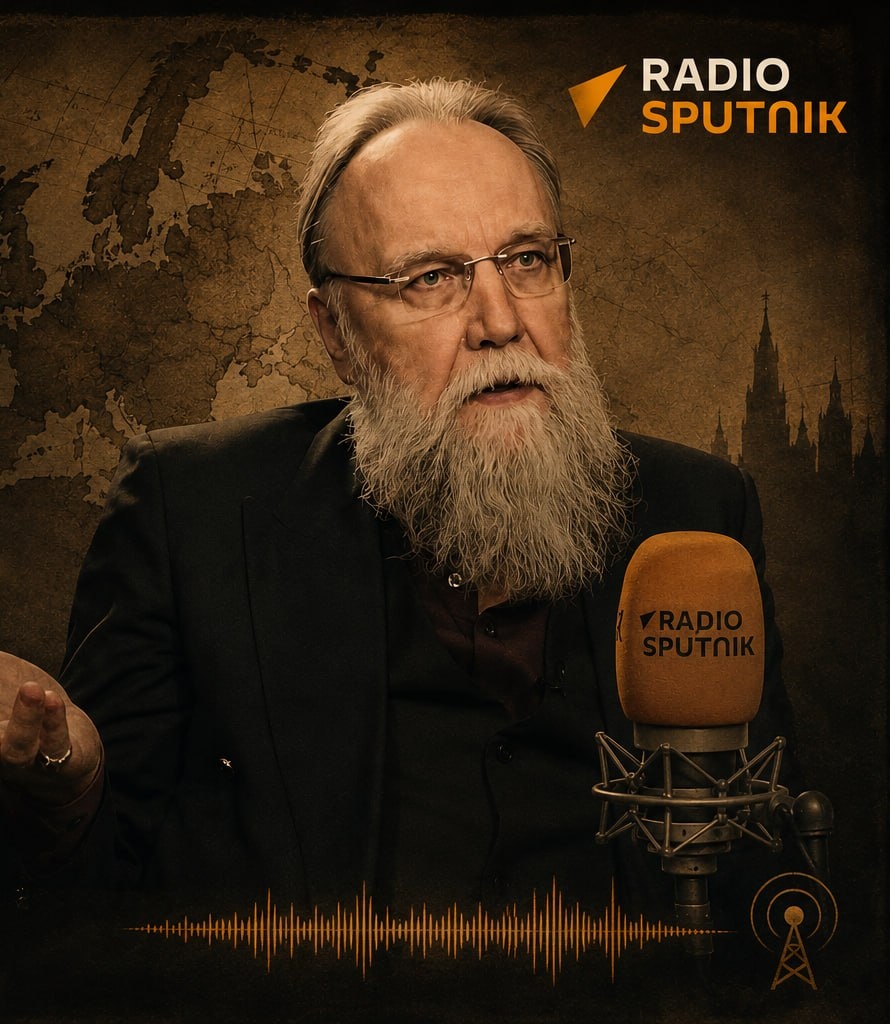
Host: Last week, the conference “Philosophy of the Future: Ideas and Meanings” took place. In his welcoming letter, the President of the country, Vladimir Putin, noted the following, and I quote: “There is a growing need for a deep and responsible philosophical analysis of current events and contemporary challenges.” Therefore, I suggest we begin our conversation with the role of Europe in these contemporary challenges. You noticed a lot in the behavior of the West at this conference, so I’ll ask this question: is philosophical analysis in general characteristic of those who sit in Brussels today? Why do current politicians consciously choose the path into the abyss, if you’ll allow me that assessment?
Alexander Dugin: The thing is, it’s all a bit more complicated if we don’t simply write them off as idiots acting spontaneously without understanding the consequences of their actions. In reality, we don’t fully understand the metaphysics of the modern West. But it does have one. It’s just unexpected for us, because in the last 30–40 years, Western philosophical thought has largely broken with the tradition of the Enlightenment, with humanism, with placing man at the center — the very things it used to boast about and which, to some extent, gave it strength in the previous era.
Of course, one can argue about how sincere it was even back then. Double standards are very characteristic of the West: they spoke of progress while creating slavery, they spoke of equality while colonizing other peoples, they spoke of justice while organizing the genocide of entire countries and societies. So double standards are one thing.
But what’s interesting is this: over the last 30–40 years (and this was covered in detail at our conference in the “Lomonosov” cluster at Moscow State University across various sections and from several angles), modern Western philosophy has become openly anti-human. It is openly nihilistic, it carries no seductive image of the future whatsoever, and it essentially trades in horror. This is a philosophy that has completely and finally severed its ties with humanism, with sacred values, with tradition. It has immersed itself in this liberated, free, flowing-into-nowhere purely technical time and has completely reinterpreted all the notions it previously operated with.
That’s why it was so important at this conference to think about time and the future. Because what we’re dealing with is not a glitch in the program — we’re dealing with a certain fundamental tendency, embodied, for example, in the philosophy of accelerationism — the acceleration of time. But acceleration toward what? Acceleration to where? As soon as you pose these questions, as soon as you place them in an intellectual context and examine Western authors, their theories, object-oriented ontology, their ideas about time, temporality, and history — it becomes truly terrifying.
In essence, many modern Western philosophers consciously view the near-term prospect of the destruction of life on Earth, mutations, nuclear explosions, and man-made catastrophes not as a possibility to be avoided, but as a desirable outcome. It’s very hard to imagine, hard to believe that such theories exist. In our section and others, there were presentations, even testimonies from English philosophers themselves.
Read the full interview here:
https://www.multipolarpress.com/p/the-splitting-of-time-and-the-end-of-anchorage