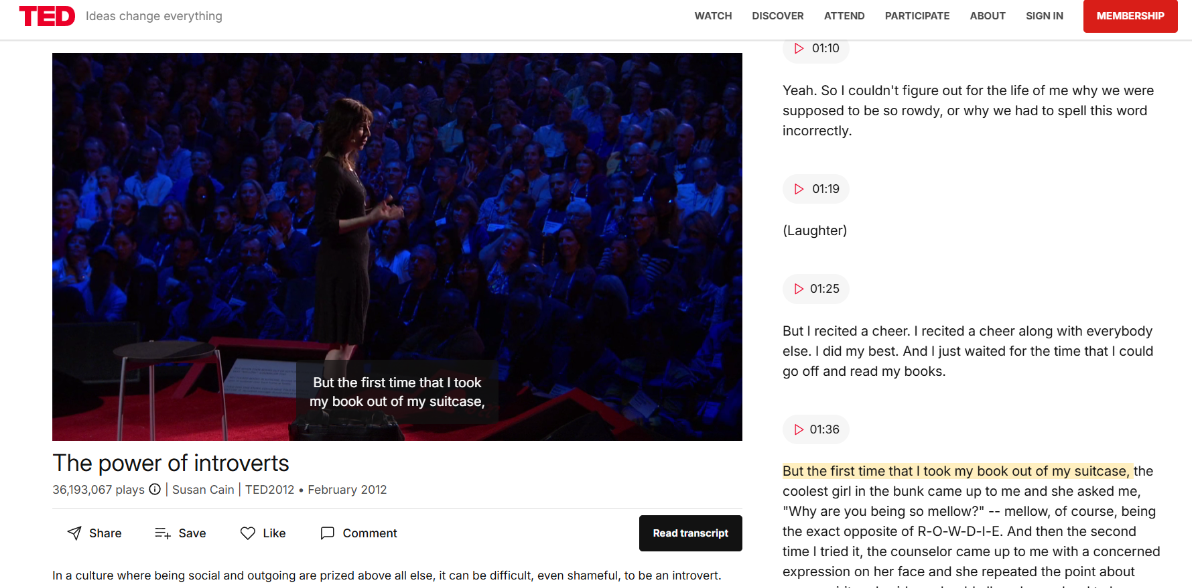
In a culture where being social and outgoing are prized above all else, it can be difficult, even shameful, to be an introvert. But, as Susan Cain argues in this passionate talk, introverts bring extraordinary talents and abilities to the world, and should be encouraged and celebrated.
Transcript (English)
00:03
When I was nine years old,
I went off to summer camp for the first time.
And my mother packed me a suitcase full of books,
which to me seemed like a perfectly natural thing to do.
Because in my family, reading was the primary group activity.
And this might sound antisocial to you,
but for us it was really just a different way of being social.
You have the animal warmth of your family sitting right next to you,
but you are also free to go roaming around the adventureland
inside your own mind.
And I had this idea
that camp was going to be just like this, but better.
00:36
(Laughter)
00:38
I had a vision of 10 girls sitting in a cabin
cozily reading books in their matching nightgowns.
00:43
(Laughter)
00:45
Camp was more like a keg party without any alcohol.
And on the very first day,
our counselor gathered us all together
and she taught us a cheer that she said we would be doing
every day for the rest of the summer to instill camp spirit.
And it went like this:
"R-O-W-D-I-E,
that's the way we spell rowdie.
Rowdie, rowdie, let's get rowdie."
01:08
(Laughter)
01:10
Yeah.
So I couldn't figure out for the life of me
why we were supposed to be so rowdy,
or why we had to spell this word incorrectly.
01:19
(Laughter)
01:25
But I recited a cheer. I recited a cheer along with everybody else.
I did my best.
And I just waited for the time that I could go off and read my books.
01:36
But the first time that I took my book out of my suitcase,
the coolest girl in the bunk came up to me
and she asked me, "Why are you being so mellow?" --
mellow, of course, being the exact opposite
of R-O-W-D-I-E.
And then the second time I tried it,
the counselor came up to me with a concerned expression on her face
and she repeated the point about camp spirit
and said we should all work very hard to be outgoing.
01:57
And so I put my books away,
back in their suitcase,
and I put them under my bed,
and there they stayed for the rest of the summer.
And I felt kind of guilty about this.
I felt as if the books needed me somehow,
and they were calling out to me and I was forsaking them.
But I did forsake them and I didn't open that suitcase again
until I was back home with my family at the end of the summer.
02:22
Now, I tell you this story about summer camp.
I could have told you 50 others just like it --
all the times that I got the message
that somehow my quiet and introverted style of being
was not necessarily the right way to go,
that I should be trying to pass as more of an extrovert.
And I always sensed deep down that this was wrong
and that introverts were pretty excellent just as they were.
But for years I denied this intuition,
and so I became a Wall Street lawyer, of all things,
instead of the writer that I had always longed to be --
partly because I needed to prove to myself that I could be bold and assertive too.
And I was always going off to crowded bars
when I really would have preferred to just have a nice dinner with friends.
And I made these self-negating choices so reflexively,
that I wasn't even aware that I was making them.
03:11
Now this is what many introverts do,
and it's our loss for sure,
but it is also our colleagues' loss
and our communities' loss.
And at the risk of sounding grandiose, it is the world's loss.
Because when it comes to creativity and to leadership,
we need introverts doing what they do best.
A third to a half of the population are introverts --
a third to a half.
So that's one out of every two or three people you know.
So even if you're an extrovert yourself,
I'm talking about your coworkers
and your spouses and your children
and the person sitting next to you right now --
all of them subject to this bias
that is pretty deep and real in our society.
We all internalize it from a very early age
without even having a language for what we're doing.
03:54
Now, to see the bias clearly,
you need to understand what introversion is.
It's different from being shy.
Shyness is about fear of social judgment.
Introversion is more about,
how do you respond to stimulation,
including social stimulation.
So extroverts really crave large amounts of stimulation,
whereas introverts feel at their most alive
and their most switched-on and their most capable
when they're in quieter, more low-key environments.
Not all the time -- these things aren't absolute --
but a lot of the time.
So the key then to maximizing our talents
is for us all to put ourselves
in the zone of stimulation that is right for us.
04:32
But now here's where the bias comes in.
Our most important institutions,
our schools and our workplaces,
they are designed mostly for extroverts
and for extroverts' need for lots of stimulation.
And also we have this belief system right now
that I call the new groupthink,
which holds that all creativity and all productivity
comes from a very oddly gregarious place.
04:57
So if you picture the typical classroom nowadays:
When I was going to school, we sat in rows.
We sat in rows of desks like this,
and we did most of our work pretty autonomously.
But nowadays, your typical classroom has pods of desks --
four or five or six or seven kids all facing each other.
And kids are working in countless group assignments.
Even in subjects like math and creative writing,
which you think would depend on solo flights of thought,
kids are now expected to act as committee members.
And for the kids who prefer to go off by themselves or just to work alone,
those kids are seen as outliers often
or, worse, as problem cases.
And the vast majority of teachers
reports believing that the ideal student is an extrovert
as opposed to an introvert,
even though introverts actually get better grades
and are more knowledgeable,
according to research.
05:49
(Laughter)
05:51
Okay, same thing is true in our workplaces.
Now, most of us work in open plan offices,
without walls,
where we are subject to the constant noise and gaze of our coworkers.
And when it comes to leadership,
introverts are routinely passed over for leadership positions,
even though introverts tend to be very careful,
much less likely to take outsize risks --
which is something we might all favor nowadays.
And interesting research by Adam Grant at the Wharton School
has found that introverted leaders
often deliver better outcomes than extroverts do,
because when they are managing proactive employees,
they're much more likely to let those employees run with their ideas,
whereas an extrovert can, quite unwittingly,
get so excited about things
that they're putting their own stamp on things,
and other people's ideas might not as easily then bubble up to the surface.
06:39
Now in fact, some of our transformative leaders in history have been introverts.
I'll give you some examples.
Eleanor Roosevelt, Rosa Parks, Gandhi --
all these people described themselves as quiet and soft-spoken and even shy.
And they all took the spotlight,
even though every bone in their bodies was telling them not to.
And this turns out to have a special power all its own,
because people could feel that these leaders were at the helm
not because they enjoyed directing others
and not out of the pleasure of being looked at;
they were there because they had no choice,
because they were driven to do what they thought was right.
07:14
Now I think at this point it's important for me to say
that I actually love extroverts.
I always like to say some of my best friends are extroverts,
including my beloved husband.
And we all fall at different points, of course,
along the introvert/extrovert spectrum.
Even Carl Jung, the psychologist who first popularized these terms,
said that there's no such thing as a pure introvert
or a pure extrovert.
He said that such a man would be in a lunatic asylum,
if he existed at all.
And some people fall smack in the middle of the introvert/extrovert spectrum,
and we call these people ambiverts.
And I often think that they have the best of all worlds.
But many of us do recognize ourselves as one type or the other.
07:57
And what I'm saying is that culturally, we need a much better balance.
We need more of a yin and yang between these two types.
This is especially important
when it comes to creativity and to productivity,
because when psychologists look at the lives of the most creative people,
what they find
are people who are very good at exchanging ideas
and advancing ideas,
but who also have a serious streak of introversion in them.
08:21
And this is because solitude
is a crucial ingredient often to creativity.
So Darwin,
he took long walks alone in the woods
and emphatically turned down dinner-party invitations.
Theodor Geisel, better known as Dr. Seuss,
he dreamed up many of his amazing creations
in a lonely bell tower office that he had
in the back of his house in La Jolla, California.
And he was actually afraid to meet the young children who read his books
for fear that they were expecting him this kind of jolly Santa Claus-like figure
and would be disappointed with his more reserved persona.
Steve Wozniak invented the first Apple computer
sitting alone in his cubicle in Hewlett-Packard
where he was working at the time.
And he says that he never would have become such an expert in the first place
had he not been too introverted to leave the house
when he was growing up.
09:09
Now, of course,
this does not mean that we should all stop collaborating --
and case in point, is Steve Wozniak famously coming together with Steve Jobs
to start Apple Computer --
but it does mean that solitude matters
and that for some people it is the air that they breathe.
And in fact, we have known for centuries about the transcendent power of solitude.
It's only recently that we've strangely begun to forget it.
If you look at most of the world's major religions,
you will find seekers --
Moses, Jesus, Buddha, Muhammad --
seekers who are going off by themselves alone to the wilderness,
where they then have profound epiphanies and revelations
that they then bring back to the rest of the community.
So, no wilderness, no revelations.
09:57
This is no surprise, though,
if you look at the insights of contemporary psychology.
It turns out that we can't even be in a group of people
without instinctively mirroring, mimicking their opinions.
Even about seemingly personal and visceral things
like who you're attracted to,
you will start aping the beliefs of the people around you
without even realizing that that's what you're doing.
10:18
And groups famously follow the opinions
of the most dominant or charismatic person in the room,
even though there's zero correlation
between being the best talker and having the best ideas --
I mean zero.
So --
10:31
(Laughter)
10:33
You might be following the person with the best ideas,
but you might not.
And do you really want to leave it up to chance?
Much better for everybody to go off by themselves,
generate their own ideas
freed from the distortions of group dynamics,
and then come together as a team
to talk them through in a well-managed environment
and take it from there.
10:54
Now if all this is true,
then why are we getting it so wrong?
Why are we setting up our schools this way, and our workplaces?
And why are we making these introverts feel so guilty
about wanting to just go off by themselves some of the time?
One answer lies deep in our cultural history.
Western societies,
and in particular the U.S.,
have always favored the man of action over the "man" of contemplation.
But in America's early days,
we lived in what historians call a culture of character,
where we still, at that point, valued people
for their inner selves and their moral rectitude.
And if you look at the self-help books from this era,
they all had titles with things like
"Character, the Grandest Thing in the World."
And they featured role models like Abraham Lincoln,
who was praised for being modest and unassuming.
Ralph Waldo Emerson called him
"A man who does not offend by superiority."
11:50
But then we hit the 20th century,
and we entered a new culture
that historians call the culture of personality.
What happened is we had evolved an agricultural economy
to a world of big business.
And so suddenly people are moving from small towns to the cities.
And instead of working alongside people they've known all their lives,
now they are having to prove themselves in a crowd of strangers.
So, quite understandably,
qualities like magnetism and charisma suddenly come to seem really important.
And sure enough, the self-help books change to meet these new needs
and they start to have names
like "How to Win Friends and Influence People."
And they feature as their role models really great salesmen.
So that's the world we're living in today.
That's our cultural inheritance.
12:36
Now none of this is to say that social skills are unimportant,
and I'm also not calling for the abolishing of teamwork at all.
The same religions who send their sages off to lonely mountain tops
also teach us love and trust.
And the problems that we are facing today
in fields like science and in economics
are so vast and so complex
that we are going to need armies of people coming together
to solve them working together.
But I am saying that the more freedom that we give introverts to be themselves,
the more likely that they are
to come up with their own unique solutions to these problems.
13:12
So now I'd like to share with you what's in my suitcase today.
Guess what?
Books.
I have a suitcase full of books.
Here's Margaret Atwood, "Cat's Eye."
Here's a novel by Milan Kundera.
And here's "The Guide for the Perplexed" by Maimonides.
But these are not exactly my books.
I brought these books with me
because they were written by my grandfather's favorite authors.
13:46
My grandfather was a rabbi
and he was a widower
who lived alone in a small apartment in Brooklyn
that was my favorite place in the world when I was growing up,
partly because it was filled with his very gentle, very courtly presence
and partly because it was filled with books.
I mean literally every table, every chair in this apartment
had yielded its original function
to now serve as a surface for swaying stacks of books.
Just like the rest of my family,
my grandfather's favorite thing to do in the whole world was to read.
14:15
But he also loved his congregation,
and you could feel this love in the sermons that he gave
every week for the 62 years that he was a rabbi.
He would takes the fruits of each week's reading
and he would weave
these intricate tapestries of ancient and humanist thought.
And people would come from all over to hear him speak.
14:36
But here's the thing about my grandfather.
Underneath this ceremonial role,
he was really modest and really introverted --
so much so that when he delivered these sermons,
he had trouble making eye contact
with the very same congregation that he had been speaking to for 62 years.
And even away from the podium,
when you called him to say hello,
he would often end the conversation prematurely
for fear that he was taking up too much of your time.
But when he died at the age of 94,
the police had to close down the streets of his neighborhood
to accommodate the crowd of people who came out to mourn him.
And so these days I try to learn from my grandfather's example
in my own way.
15:19
So I just published a book about introversion,
and it took me about seven years to write.
And for me, that seven years was like total bliss,
because I was reading, I was writing,
I was thinking, I was researching.
It was my version
of my grandfather's hours of the day alone in his library.
But now all of a sudden my job is very different,
and my job is to be out here talking about it,
talking about introversion.
15:46
(Laughter)
15:50
And that's a lot harder for me,
because as honored as I am to be here with all of you right now,
this is not my natural milieu.
15:59
So I prepared for moments like these as best I could.
I spent the last year practicing public speaking
every chance I could get.
And I call this my "year of speaking dangerously."
16:10
(Laughter)
16:12
And that actually helped a lot.
But I'll tell you, what helps even more
is my sense, my belief, my hope that when it comes to our attitudes
to introversion and to quiet and to solitude,
we truly are poised on the brink on dramatic change.
I mean, we are.
And so I am going to leave you now
with three calls for action for those who share this vision.
16:33
Number one:
Stop the madness for constant group work.
Just stop it.
16:39
(Laughter)
16:42
Thank you.
16:44
(Applause)
16:46
And I want to be clear about what I'm saying,
because I deeply believe our offices
should be encouraging casual, chatty cafe-style types of interactions --
you know, the kind where people come together
and serendipitously have an exchange of ideas.
That is great.
It's great for introverts and it's great for extroverts.
But we need much more privacy and much more freedom
and much more autonomy at work.
School, same thing.
We need to be teaching kids to work together, for sure,
but we also need to be teaching them how to work on their own.
This is especially important for extroverted children too.
They need to work on their own
because that is where deep thought comes from in part.
17:21
Okay, number two: Go to the wilderness.
Be like Buddha, have your own revelations.
I'm not saying
that we all have to now go off and build our own cabins in the woods
and never talk to each other again,
but I am saying that we could all stand to unplug
and get inside our own heads a little more often.
17:42
Number three:
Take a good look at what's inside your own suitcase
and why you put it there.
So extroverts,
maybe your suitcases are also full of books.
Or maybe they're full of champagne glasses or skydiving equipment.
Whatever it is, I hope you take these things out every chance you get
and grace us with your energy and your joy.
But introverts, you being you,
you probably have the impulse to guard very carefully
what's inside your own suitcase.
And that's okay.
But occasionally, just occasionally,
I hope you will open up your suitcases for other people to see,
because the world needs you and it needs the things you carry.
18:24
So I wish you the best of all possible journeys
and the courage to speak softly.
18:29
Thank you very much.
18:31
(Applause)
18:35
Thank you. Thank you.
18:38
(Applause)
Transcript (Русский)
00:03 Когда мне было 9 лет, я впервые поехала в летний лагерь. Мама собрала мне чемодан полный книг, что для меня было совершенно естественно. Все члены нашей семьи, собираясь вместе, погружались в чтение. Это можно воспринять как нежелание общаться, но для нас это было именно общением. Вы находитесь в тёплом кругу родных, сидящих совсем рядом с вами, но в то же время вы вольно странствуете по стране вашего воображения. И я себе представляла, что в лагере будет ещё лучше. (Смех) Я представляла, как 10 девочек в одинаковых ночных рубашках читают книжки, уютно сидя в своём домике.
00:43 (Смех)
00:45 Лагерь оказался больше похож на пивную вечеринку без крепких напитков. В первый же день вожатая собрала нас всех и заставила выучить клич, который мы должны были повторять каждый день до конца лета, чтобы привить нам лагерный дух. Клич был такой: «Бэ-У-эН-Ы и Е, так мы пишем буйные. Буйные, буйные, мы сейчас буйные». Вот. Я никак не могла взять в толк, зачем нужно было быть такими буйными, и почему надо было коверкать это слово.(Смех)Но я кричала вместе со всеми. Я старалась изо всех сил и просто ждала момента, когда можно будет пойти почитать.
01:35 Когда же мне удалось наконец-то достать книжку, ко мне подошла самая крутая девочка и спросила: «Почему ты такая тихоня?» «Тихоня» — это, конечно, полная противоположность Бэ-У-э Н-Ы и Е.А когда я попыталась почитать в следующий раз, ко мне подошла обеспокоенная вожатая и повторила насчёт лагерного духа. Она сказала, что мы все должны стараться быть как можно общительнее.
01:57 Я убрала свои книги обратно в чемодан и засунула их под кровать, где они пролежали до конца лета. Но меня преследовало чувство вины. Мне казалось, что книги нуждались во мне, что они меня звали, а я их предавала. Но я всё-таки предала их и больше не открывала чемодан до возвращения домой в конце лета.
02:22 Я рассказываю вам про летний лагерь, но могла бы рассказать 50 других таких же историй —про каждую ситуацию, где мне давали понять, что мой спокойный и замкнутый стиль жизни не совсем правильный, что мне нужно измениться и стать экстравертом. В глубине души я всегда понимала, что это неправильно, что интроверты — прекрасны сами по себе. Однако я годами не верила своей интуиции, и, представьте себе, даже стала юристом на Уолл-стрит, хотя всю жизнь мечтала стать писателем —отчасти потому, что я стремилась доказать себе, что тоже могу быть смелой и напористой. Я отправлялась в шумные бары, хотя предпочла бы просто тихо поужинать с друзьями. Я ломала саму себя так машинально, что даже не замечала этого.
03:10 Так делают многие интроверты, и это наша потеря. Но это также огромная потеря для наших коллег и общества. А также, простите за пафос, для всего мира. Потому что, когда дело касается творчества и руководства, нам нужны интроверты, которые делают то, что у них лучше всего получается.30-50% населения — интроверты —30-50%.Это каждый второй или третий из ваших знакомых. Даже если Вы — экстраверт, это Ваши коллеги, Ваши супруги, Ваши дети и человек, сидящий в соседнем кресле —ко всем ним относятся с предвзятостью, которая глубоко укоренилась в нашем обществе. Мы усваиваем такое отношение к ним с самого детства хотя даже не можем сказать, в чём заключается наша ошибка.
03:54 Чтобы ясно увидеть эту предвзятость, нужно понять, что такое интроверсия. Это не стеснительность. Стеснительность — это боязнь общественного осуждения. Интроверсия — это особенности того, как человек реагирует на сигналы из внешней среды, включая общение с людьми. Экстравертам необходимо большое количество стимулов, а интроверты лучше всего чувствуют себя и работают наиболее энергично в спокойной обстановке без лишнего шума. Не всегда — всё относительно —но в большинстве случаев. Поэтому для того чтобы максимально реализовать наши таланты, каждый из нас должен находиться в наиболее оптимальной для себя обстановке.
04:32 Но здесь мы сталкиваемся со стереотипом. Наши самые важные учреждения —школы и рабочие места —созданы, в основном, для экстравертов и для удовлетворения их потребности в большом количестве стимулов. Также сейчас бытует система убеждений, которую я называю новым групповым мышлением, которая утверждает, что творчество и производительность труда возможны только в тех случаях, когда рабочие места тесно сгруппированы.
04:57 Представьте себе обычный современный класс. Когда я училась в школе, мы сидели рядами. Парты стояли рядами, вот так, и мы делали большинство заданий самостоятельно. Но в современных классах парты стоят группами —4, 5, 6, 7 учеников сидят лицом друг к другу и делают бесчисленное множество групповых заданий. Даже на уроках математики или в сочинениях, где должен быть простор для собственной мысли, дети должны вести себя, как члены комиссии. Ребят, предпочитающих уходить из класса или работать в одиночестве, часто воспринимают как изгоев, либо ещё хуже — трудно воспитуемых. Большинство учителей описывают идеального ученика как экстраверта, и никак не интроверта, несмотря на то, что интроверты лучше учатся и более начитанны, что подтверждено различными исследованиями.(Смех)
05:51 То же самое относится и к рабочим местам. Большинство из нас работают в помещениях открытой планировки, без стен, постоянно подвергаясь гвалту и наблюдению со стороны коллег. В области руководства —интровертам редко достаются руководящие должности, несмотря на то, что они обычно тщательны и не склонны к излишнему риску —что сегодня нужно всячески поддерживать. Интересные исследования Адама Гранта из Уортонской школы бизнеса показали, что руководители-интроверты часто достигают лучших результатов, чем экстраверты, так как они более способны дать возможность реализоваться идеям своих подчинённых, тогда как экстраверт, может, и неумышленно приходит в восторг от своих идей и переиначивает всё под себя, не давая предложениям других свободного хода.
06:39 Некоторые из наиболее влиятельных лидеров были интровертами. Например: Элеонора Рузвельт, Роза Паркс, Ганди —все они описывали себя людьми мягкими и даже стеснительными. Все они попалив центр общественного внимания вопреки личным побуждениям. Это оказалось особенно притягательным, так как они встали у власти не потому, что их тянуло покомандовать, и не затем, чтобы ими полюбовались, а потому, что не видели другого выбора и были вынуждены действовать за правое дело.
07:14 Я думаю, пришло время сказать, что я обожаю экстравертов. Некоторые из моих лучших друзей — экстраверты, например, мой любимый муж. Все мы, конечно, немного интроверты и немного экстраверты. Даже Карл Юнг, психолог, первым опубликовавший эти термины, говорил, что не существует абсолютных интровертовили абсолютных экстравертов. Если бы они существовали, то давно были бы в сумасшедшем доме. Некоторые находятся прямо в середине спектра —между интровертом и экстравертом, и называются они амбивертами. Мне иногда кажется, что это идеальное состояние. Большинство из нас, однако, принадлежит к тому или иному типу.
07:57 Я считаю, что нашему обществу нужно больше равновесия, больше гармонии между этими двумя типами. Это особенно важно для творчества и производительности. Когда психологи изучают биографии гениальных творцов, они обнаруживают, что эти люди обмениваются идеями друг с другом и продвигают их. Однако в их характере много интровертных черт.
08:21 Одиночество — главная составляющая творчества. Например, Дарвин любил гулять по лесу в одиночестве и твёрдо отказывался от приглашений на званые обеды. Теодор Гейзель, известный как Доктор Сьюз, выдумал многих своих замечательных персонажей, сидя один в колокольне на заднем дворе своего дома в городе Ла-Хойя, штат Калифорния. Он даже боялся встреч с детишками, которые читали его книги. Он думал, что дети представляли его этаким добряком Санта Клаусом, и не хотел их разочаровывать своим сдержанным видом. Стив Возняк изобрёл первый компьютер Apple,сидя один в своём кабинетике в компании Hewlett-Packard, где он в то время работал. По его словам, ему никогда не удалось бы стать таким знатоком, не будь он таким интровертом и домоседом в юности.
09:08 Конечно же, мы не должны прекращать сотрудничать —тот же Стив Возняк объединился со Стивом Джобсом, для того, чтобы основать компанию Apple Computer,но пребывание в одиночестве очень ценно и для некоторых —совершенно необходимо. Люди веками знали необыкновенную силу уединения. Только с недавних пор, как ни странно, мы о ней забываем. В большинстве известных религий мира присутствуют искатели истины —Моисей, Иисус, Будда, Мухаммед —они одни уходят в пустынные, дикие места, где переживают глубокие откровения и прозрения, которые затем передают народам. Без природы нет и прозрений.
09:57 Неудивительно, что то же трактует современная психология. Оказывается, невозможно находиться в обществе людей, не подражая, инстинктивно, мнению большинства. Вас потянет собезьянничать даже в сугубо личных привязанностях и склонностях, и вы начнёте копировать окружающих, даже не осознавая этого.
10:17 Как известно, коллективы подвержены влиянию наиболее представительного или обаятельного присутствующего, невзирая на то, что связь между красноречием и ценностью идей равна нулю —НУЛЮ. Итак ... (Смех) Может быть, вы идёте за лидером с наилучшим планом, а может быть и нет. Намерены ли Вы довериться шансу? Лучше было бы всем разойтись, подумать своим умом в стороне от влияния группы, а потом собраться вместе, и сообща обсудить идеи в спокойной обстановке, а потом делать выводы.
10:54 Если всё так логично, почему же мы до сих пор ошибаемся? Почему наши школы и рабочие места так устроены? Почему мы осуждаем интровертов, когда они стремятся какое-то время побыть в одиночестве? Один ответ можно извлечь из глубин нашей истории. Западные общества, особенно Соединённые Штаты, всегда предпочитали человека действующего человеку вдумчивому, особенно вдумчивому мужчине. В начале истории Америки характеру лидера придавалось большое значение, и мы ценили людей с богатым внутренним миром и высокой нравственностью. Если мы посмотрим на книги по личностному росту того времени, то увидим заглавия типа: « Характер — величайшая вещь в мире». Эти книги ставили в пример таких людей, как Авраам Линкольн, который славился своей скромностью и неприхотливостью. Ральф Уолдо Эмерсон назвал его « Человек, который не обижается на превосходство других».
11:50 Но затем наступил 20-й век, и у нас появилась новая культура, которую историки назвали «культурой личности». Главным изменением стал переход от сельскохозяйственной экономики к миру большого бизнеса. Людям внезапно пришлось переезжать из маленьких городов в большие. Вместо того, чтобы работать рядом с теми, кого они знали всю свою жизнь, людям пришлось отвоёвывать место под солнцем в толпе чужаков. Поэтому вполне разумно, что новыми важными для жизни качествами стали обаяние и харизма. Вслед за этим изменились и книги по личностному росту: у них появились названия типа « Как завоёвывать друзей и оказывать влияние на людей», которые ставили в пример успешных торговцев. Это мир, в котором мы сейчас живём. Это наше культурное наследие.
12:36 Это не означает, что навыки общения совершенно не нужны. Я не призываю вас полностью отказаться от работы в команде. Те же религии, мудрецы которых уходили к одиноким горным вершинам, также учат нас любви и доверию. Проблемы в области науки и экономики, с которыми сегодня столкнулся современный мир, настолько обширные и сложные, что нам нужно собрать вместе множество людей и решить их совместными усилиями. Но если мы дадим интровертам свободу быть самими собой, то они, скорее всего, смогут придумать собственные уникальные решения этих проблем.
13:12 А сейчас я хочу показать вам, что сегодня лежит в моём чемодане. Что же там такое? Книги.У меня полный чемодан книг. Вот «Кошачий глаз» Маргарет Этвуд. Вот роман Милана Кундеры. А это «Путеводитель растерянных» Маймонида. Но это не совсем мои книги. Я взяла их с собой, потому что они были написаны любимыми писателями моего дедушки.
13:46 Мой дедушка был раввином. Он был вдовцом и жил один в небольшой квартирке Бруклина. В детстве его квартира была моим самым любимым местом в мире. Отчасти потому атмосфера в ней была очень мягкой и ненавязчивой, как и характер моего дедушки, а отчасти потому, что она была заполнена книгами. Каждый стол и стул в этой квартире утратил своё первоначальное назначение и теперь служит поверхностью для покачивающихся стопок книг. Любимейшим занятием моего дедушки, как впрочем и всех остальных членов семьи, было чтение.
14:15 А ещё он очень любил своих прихожан, эта любовь чувствовалась в проповедях, которые он произносил каждую неделю на протяжении 62 лет своего служения. Из каждой прочитанной книги он извлекал много мыслей и ткал из них замысловатые ткани, опираясь на мудрость древних и классиков. Люди приходили со всей округи, чтобы послушать его.
14:35 Но особенностью характера моего дедушки было то, что несмотря на свой важный сан, он был очень скромным и замкнутым человеком. Когда он произносил проповеди, ему было тяжело смотреть в глаза своим постоянным прихожанам, перед которыми он выступал 62 года подряд. Даже за пределами кафедры священника, когда его окликали, чтобы поздороваться, он часто обрывал разговор, боясь отнять у собеседника слишком много времени. Но когда он умер в возрасте 94 лет, полиции пришлось перекрыть улицы района, где он жил, чтобы дать пройти толпе людей, пришедших оплакать его кончину. Сейчас я стараюсь брать пример с дедушки и применить образ его жизни к своей.
15:19 Недавно вышла моя книга об интроверсии, которую я писала 7 лет. Для меня эти 7 лет стали годами абсолютного блаженства, потому что я читала, писала, размышляла, исследовала. Я, так же как и дедушка, сидела одна, обложившись книгами. Но теперь у меня совершенно другая работа. Мне нужно выходить на сцену и говорить об этом. Говорить об интроверсии. (Смех) Это для меня гораздо сложнее, потому что хоть выступать сейчас перед вами —большая честь для меня, это вовсе не то, к чему я привыкла.
15:59 Поэтому я делаю всё, что могу, чтобы подготовиться к подобным выступлениям. В прошлом году я училась публичным выступлениям, используя любую возможность. Я назвала этот год «Годом рискованных разговоров». (Смех) Это мне очень пригодилось. А ещё этот навык помог мне укрепить мой здравый смысл, убеждения и надежду на то, что отношение общества к интроверсии, тишине и уединению скоро кардинально изменится. Я уверена в этом. Если вы разделяете мои взгляды, то напоследок я бы хотела дать вам 3 руководства к действию.
16:33 Первое: перестаньте мучить людей постоянной работой в команде. Просто прекратите это и всё.(Смех) Спасибо. (Аплодисменты) Я хочу пояснить свою мысль. Я глубоко убеждена в том, что на рабочих местах нужно поощрять лёгкий и непринуждённый стиль общения —когда люди просто собираются вместе и обмениваются удачными идеями, пришедшими им в голову. Это отличное решение как для интровертов, так и для экстравертов Но нам нужно больше уважения к личной жизни, больше свободы и самостоятельности на рабочих местах. То же самое необходимо и в школе. Безусловно, нам необходимо учить детей работать сообща, но нам также необходимо учить их работать самостоятельно. Для детей-экстравертов этот навык особенно важен. Им нужно научиться работать самим, потому что так они научатся размышлять и проникать в суть вещей.
17:20 Второе: Побудьте наедине с природой. Будьте как Будда, и вас постигнут собственные откровения. Я говорю не о том, что нам всем сейчас нужно отречься от мира, построить хижину в лесу и никогда больше не общаться друг с другом, а о том, что нам стоит чаще отключаться от внешнего мира и погружаться в собственные размышления.
17:42 Третье: Хорошенько рассмотрите содержимое вашего чемодана и вспомните, зачем вы положили туда именно эти вещи. Экстраверты, возможно, ваши чемоданы тоже набиты книгами. Может быть, там лежат бокалы для шампанского или снаряжение для подводного плавания. Что бы там ни лежало, я надеюсь, что вы будете доставать это при каждом удобном случае и дарить нам вашу энергию и радость. Однако интровертам обычно свойственно тщательно охранять содержимое их чемодана. Это нормально. Но я надеюсь, что иногда вы всё же будете открывать ваши чемоданы, чтобы другие люди увидели, что в них лежит, потому что вы и ваши вещи очень нужны миру.
18:24 Я желаю вам самых лучших из всех возможных путешествийи смелости говорить тихо.
18:29 Спасибо большое.18:31(Аплодисменты)
18:35 Спасибо. Спасибо.
18:38(Аплодисменты)
About the speaker

Susan Cain
Author, explorer of hidden superpowers
With her viral talk from TED2012 and her mega-bestseller "Quiet," Susan Cain urged society to cultivate space for the undervalued, indispensable introverts among us. Now, with her new bestseller "Bittersweet," she's back to explore the surprising lessons sorrow and longing teach us about creativity, connection and love.
Susan Cain's resource list
| BookMihaly Csikszentmihalyi | Harper Perennial Modern Classics, 2008
Flow: The Psychology of Optimal Experience
This book (written by another TEDster) illuminates the kind of life we should all be living. Csikszentmihalyi argues that one of the highest states of being is the state of flow — when you’re totally engaged in an activity, riding the narrow channel between boredom and anxiety. I talk about this book a lot, and try to live by it even more.
| BookBilly Collins | Random House Trade, 2002
(Or really any of Billy Collins’ poetry collections.) Collins, who was once the US poet laureate, says he’s an extrovert, but if his poems are any indication, he’s a homebody like me. He writes about exciting things like looking up words in the encyclopedia and walking to town for a gallon of milk. He’s charming and insightful, and I love his work so much that when I went into labor with our first child, my husband ran back to our apartment to bring one of Collins’ books to the maternity ward. He thought I should have it while we were waiting for the baby to come. (One of the highlights of speaking at TED was getting to meet Collins, who also gave a talk, and telling him this story. He said it was a first.)
| BookWilliam H. Whyte | University of Pennsylvania Press, 2002
If you have ever felt weird or out of step because you like to sit around and think, I can’t recommend these books enough. I read them while researching Quiet. I was trying to trace the history of what I call 'the extrovert ideal' — the Western bias for people who are alpha, assertive and gregarious — and devoured these books. (You’ll find them referenced in chapter one of Quiet.) They were both written in the middle of the 20th century, a time when Americans were trying to break the shackles of their conformist, Happy Days culture. So what do these books have to do with our life today? Everything. You’ll see that things haven’t changed as much as we think.
| BookRichard Hofstadter | Vintage, 1966
Anti-Intellectualism in American Life
| BookCurtis Sittenfeld | Random House Trade, 2005
Have you ever felt like an outsider? This is an acutely observed look at life inside a New England boarding school, as told from a public school kid from Indiana. I picked up this book the minute I heard about it. Like the Prep protagonist, I am not from a preppy background. But I went to Princeton in the 1980s, when it seemed that all the students were from elite private schools and possessed of a breathtaking savoir faire. I thought my mother had taught me decent table manners, but my classmates had an elegant way of holding their utensils that would forever elude me. They also pursued mysterious passions, like trying out for 'crew,' a sport I had never heard of before. I thought they were competing to make extra money washing dishes at the dining hall, and couldn't figure out why they needed the cash. If you’ve ever felt like an outsider in a culture that initially seemed more dazzling than the one you came from (and even if you haven’t!), this is a great read.