How Students Amazed Their Teachers
Author: Vadim Kotelnikov, 1000ventures (>> русская версия статьи)
- Date of the first business game exam: June 6, 2026
- Pioneer University: Russia's Foreign Trade Academy
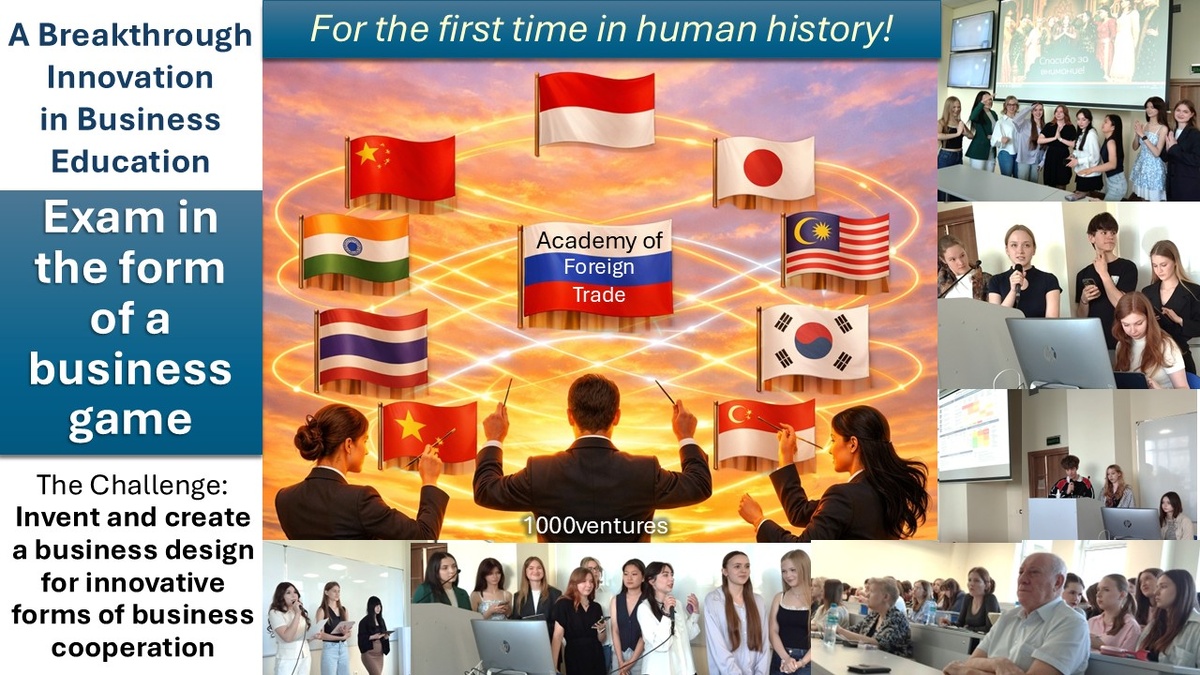
For the first time in human history, the exam was conducted in the form of a business game, during which students not only demonstrated their knowledge but also their ability to apply it innovatively in practice.
The creative challenge posed by the examiners to the Sinology students was: Invent and create a business design for innovative forms of business cooperation with seven Asian countries: Vietnam, India, Indonesia, Singapore, Thailand, South Korea, and Japan.
70 first-year students were divided into seven groups and... amazed not only the faculty but also experienced international business professionals with their brilliantly presented innovative solutions, their ability to ask challenging questions about the essence of a business problem, and their ability to answer them effectively and promptly. The simulation of real business challenges, like a magical kiss from a sleeping beauty, awakened the "sleeping geniuses" within the students and helped them unleash their full talents.
A Simple Solution to Three Big Problems of Classical University Education
The three big problems of classical global university business education have long been well-known:
- Students are given a lot of theory but very little practice, resulting in them graduating as strong theorists but weak practitioners.
- In today's rapidly changing global economy, driven by continuous innovation, theoretical business knowledge quickly becomes outdated, leaving graduates stranded in a reality for which they were not prepared.
- Students are taught to be managers operating within the existing "red ocean" of monotonous practices, not breakthrough innovators who break outdated rules, create new "blue oceans" in the global market, and move the world forward by changing the rules of the game to which everyone else has to hastily and clumsily adapt.
A simple solution to these three major problems is based on a partial paradigm shift in classical business education: we need to train not so much strong theorists for yesterday's realities, but flexible and enterprising innovative leaders capable of both quickly adapting to rapidly changing realities and proactively creating new realities, "skimming the cream" of the new market niches they create.
Simulation business games like InnoBall offer a simple solution that helps effectively and quickly address all three major problems of traditional business education.
From theory to practice – in a team and creative way!
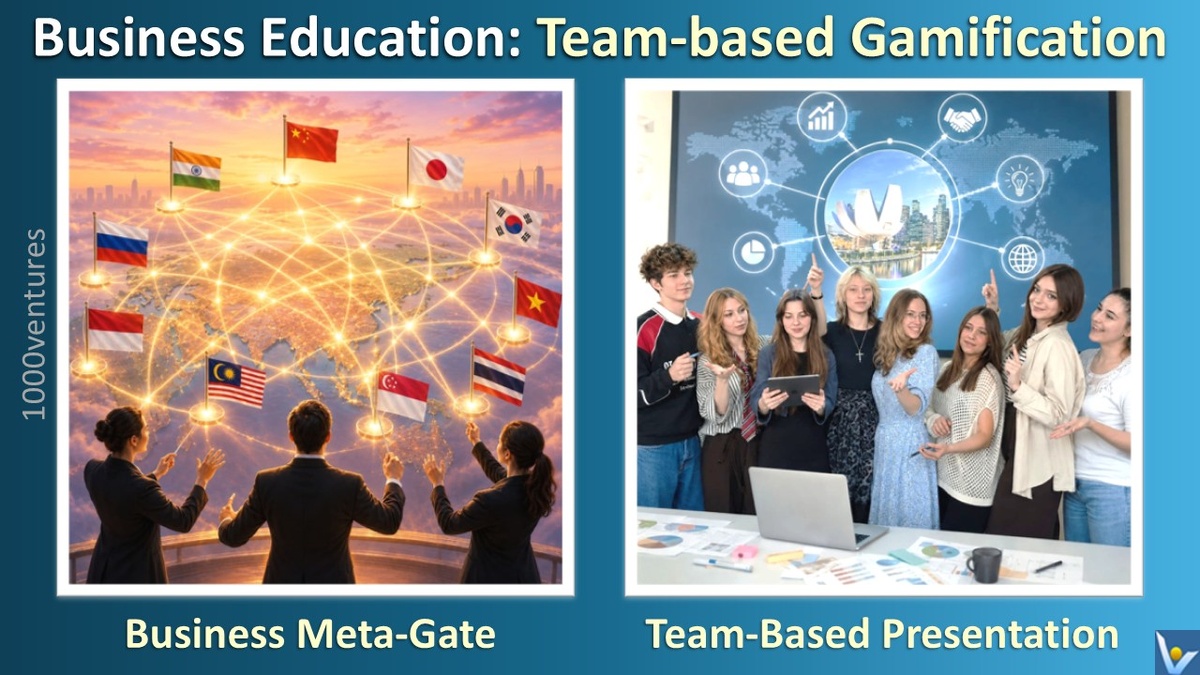
In business education, team-based gamification replaces traditional lectures and exams with engaging, competitive business games that simulate realistic situations typical of a rapidly changing, turbulent, and competitive business environment. Students work in teams, managing simulated projects or companies, addressing real-world business challenges such as new product development, rapid growth strategy design, market penetration, and customer engagement, while competing against other teams for awards for the best solutions.
Breakthrough Innovation in Business Education
The benefits of gamified learning are well known. Research shows that in corporations, gamified learning increases employee engagement by over 60% and material retention by over 40%. However, gamified learning has been relatively under-implemented in university education to date. And then...
For the first time in the history of university education, an academic exam was transformed into a real‑time business game - a dynamic challenge in which students demonstrated not only what they knew, but what they could create with it, innovatively and systematically. Knowledge alone was no longer enough. What mattered was the ability to apply theory in innovative, entrepreneurial, and culturally intelligent ways.
The examiners presented a creative challenge worthy of the moment:
Invent and design a breakthrough business model for innovative forms of cooperation with Asian countries.
This was not a test of memorization. It was a test of imagination, strategic thinking, cross‑cultural empathy, and entrepreneurial agility. Students had to think like innovators, negotiate like diplomats, and act like startup founders navigating a complex global landscape.
Instead of answering questions, students designed solutions.
Instead of repeating theories, students built business designs.
Instead of competing for grades, students competed for impact.
- Instead of answering questions, students developed solutions and presented them, while the student audience learned both innovative approaches from their fellow developers and the art of asking business questions (which is typically not taught at universities, despite being a crucial skill for innovators).
- Instead of repeating theories, they created business projects based on their acquired knowledge, expanding this knowledge through the process of innovative creation.
- Instead of striving for a desired grade, the examinees sought to create maximum value for the imaginary participants of their conceptual projects.
This exam marked the birth of a new educational format — one where learning becomes a meta‑game of innovation, and students become creators of the future, not consumers of the past.
7 Benefits of an Exam in the Form of a Business Game
Brief description of the 7 Benefits of Exams in the Form of a Business Games is provided in this article (>> русская версия)