Control is an illusion — and the leaders who chase it are holding their teams back. Workplace culture expert Jessica Kriegel explores the tactic that leaders who want to achieve extraordinary results should try instead.
https://www.ted.com/talks/jessica_kriegel_the_counterintuitive_secret_of_leadership
00:03
Every time I give one of these talks,
I have a routine.
I start by showing up early, and I do the sound check.
I get the mic,
and then I go in the halls, and I walk around,
and I look at the audience
because I want to get a sense of the vibe.
And really, where my mind starts to go is: prepare.
I get backstage, I sit down,
and I start to think about all the things
that I wish were a little bit different --
the things that would be better if they were my way.
So I wish the room was a little bit cooler.
I wish the stage was a little bit bigger.
I wish that the audience didn’t look so hungover --
no, you guys look great, not you.
Sometimes, though, they look hungover,
and I get worried,
and I start focusing on all of the things that I can't control
because ultimately, I want to do a good job.
00:50
You know, I’m a keynote speaker,
and I've been hired to show up and perform and drive results.
And I'm worried that all these things
might prevent me from doing that.
For leaders, you can probably relate
because this is actually a very natural coping mechanism
to being under pressure.
You as a leader have to drive results,
[and] it is harder than it ever has been to get results right now.
You have increasing shareholder expectations
at the same time as employee expectations are increasing,
the rapid pace of change,
the workforce generally is shifting so quickly,
and yet you as a leader, you've still got to get those results.
And so leaders tend to focus on what it is that they have to do
to make it work.
And they think about what they have to manage,
every detail that they need to adjust,
the processes and the people --
what they need to do differently.
01:39
But the reality is, control is an illusion.
You can't control anything outside of yourself.
The only thing you can control is the way that you show up.
So what if instead of trying to force the world
to fit into the way that you would like it to be,
we tried something radical and unconventional.
We tried surrender.
02:03
Now surrender can feel like a touchy-feely word,
especially when we're talking about leaders driving results.
But let me demonstrate surrender right now in this talk, OK?
I am going to surrender.
I'm going to stop talking and be quiet until someone says, "now."
02:19
Now? Oh, that was fast.
Well thank you.
It was so much easier than I thought it was going to be.
And that's kind of the point of surrender.
I was thinking you guys might take 30 seconds
and make me stand here quietly,
and it's uncomfortable to surrender.
That's part of the point.
That's part of why it's so hard to surrender.
But what happened in that moment?
I stepped back and you, sir, you stepped in
and a new dynamic was created.
And we did something different.
And we co-created this moment together.
Now the problem with the control mindset
is that it doesn't drive results
because it chokes adaptability.
And adaptive cultures win, not control cultures.
02:59
I studied this with Stanford Graduate Business School a couple years ago.
We looked at 243 companies --
... their purpose and their strategy, their culture
and obviously their results.
And we wanted to know which kinds of companies won.
And the companies that outperformed all other types
were the adaptive companies.
They outperformed control companies three times
over the course of three years.
Their revenue growth was significantly higher.
03:27
So how do you create an adaptive culture?
That is the question.
Well, it's not by telling everyone that we're going to be adaptive now
and controlling the adaptability of the room, right?
The way that you create an adaptive culture
is by understanding your role
in the co-creation of it.
So to surrender is not passive.
It is not giving up.
It is a radical acceptance
of what you need to do in that moment
that you actually have control of.
03:56
Now we know that results come from actions.
People are trying to drive results
by focusing on the actions that people are taking,
which is that control mentality.
But most leaders,
they think that if they want to change those actions,
they have to implement a bunch of processes and procedures
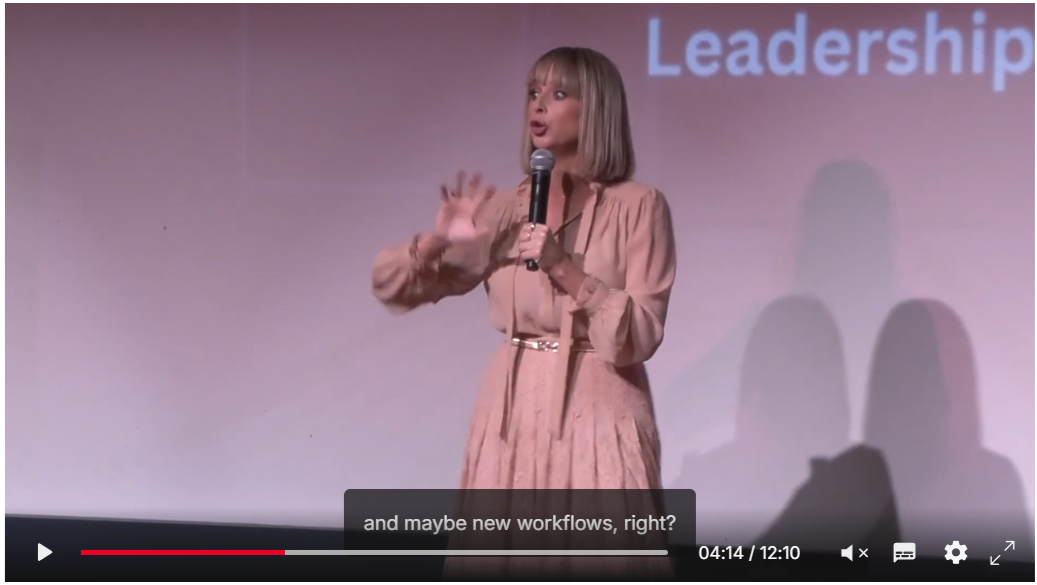
and maybe new workflows, right?
Have a bunch of meetings, do KPIs and dashboards.
And when you take that approach, you are in that control mindset.
04:22
And what I found in 20 years of consulting
is that people don't change because you implemented new processes.
People will act in alignment with what they believe.
And so if you want to change their behavior,
you have to shift what it is that they believe.
And once again, I can't control your beliefs, right?
I can’t say, OK, you’re now going to be comfortable with risk-taking, thank you.
That doesn't happen.
But what I can do is I can create an experience
which I control,
that will shift your belief.
And that belief will have you then proactively choose to take a new action
which will drive a result.
04:59
What does it look like in action?
I will give you an example from years ago.
I was hired to be the CHRO, the head of HR for a technology company.
And I had just had this personal moment of transformation
in which I was embracing surrender in life,
and I wanted to try it at work.
And so what happened was I got this new job,
I went to my first board meeting, I felt very special being there,
and the board let us know
that we had to lay off 20 percent of the workforce,
and I was in charge.
Surrender.
So I show up and I'm trying to figure out what to do.
And let me tell you how layoffs typically go in corporate America.
The executives know that it's happening months before anyone else,
and they control the process.
They control the narrative,
they get into rooms and they meet and discuss
who are we going to lay off and how many people
and how is that going to affect the budget
and how are we going to control the narrative?
And then when are we going to announce it?
And then they drop the ax and then they deal with the fallout.
05:58
But I wanted to surrender.
And so I asked myself what surrender would look like in that moment,
not controlling everyone else,
but making a choice about the experience that I could create.
And so I showed up the next day at work,
the day after the board meeting,
and I gathered everyone together and I said,
"I've just been told that we need to lay off 20 percent of the workforce.
And I don't know who yet, and I don't know when exactly,
but we're going to be figuring that out,
and I'm going to let you know every step of the way."
That was an experience that I created in that moment
that shifted the beliefs of the people that worked on that team.
Now some of the people’s beliefs that shifted were,
"I've got to go get a job."
They started applying for jobs and then they left.
Other people, though,
were really grateful for the transparency,
and it was something that they hadn't experienced before.
And so they said, "You know what?
I want to stay here and work with someone who’s going to tell me the truth
and walk through the front door.”
You can't mismanage the truth.
And you know what happened after the next couple of months
as we watched people leave the organization?
We realized we didn't even have to do layoffs
because the company had rightsized itself.
And people who left,
they left of their own accord -- on their own terms.
And the people who stayed, they were with us.
They were ready to adapt to the business circumstances
because they knew that we had them.
07:17
Here's another example.
This was from one of our clients: Ocean Spray.
This was years ago.
They had multiple plants and one plant was in Kenosha, Wisconsin,
and it was the worst-performing plant in the entire company.
So they hired a new guy named Tim to come in.
He was the plant manager,
and his job was to turn it around.
And Tim was the surrendered leader.
So he was not interested in the command-and-control approach.
And he showed up and he was looking at --
I mean, they had the highest costs in the system,
they had high injury rates,
they had hostile union relations.
And Tim came in and he said,
"What can I do to change the situation?"
A lot of plant managers would come in and start talking
about what you guys need to do differently.
"You guys have to act right,
if we don't turn this around, we're going to have to close the plant.
We're going to implement a bunch of new processes and procedures.
We're going to have meetings and make sure that you're on track."
That's the command-and-control approach.
08:14
But Tim surrendered, and he asked himself,
"What are the beliefs that people have at this plant that need to shift?"
And the belief that he identified was largely resentment.
I mean, there was distrust between the employees and the leaders.
And he could understand why.
Because when the plant workers would show up in the morning,
they would walk past all of the empty parking spaces
that were "reserved for managers" that weren't even there yet,
because they don’t show up until 9am when the office day started.
So imagine that experience
that's being created for those plant workers.
So Tim gets everyone outside and he says,
"Come on, everyone, we have a meeting outside,"
goes in the parking lot, literally brings a chainsaw
and chainsaws down every single "reserved for manager" parking sign.
And then he looked at them and he said,
"Park wherever you want.
Let's go back to work."
09:06
That was a powerful chainsaw moment of surrender, right?
And what it did was it shifted the beliefs.
There was more work to be done, obviously,
but the belief began to shift
in which people said, "OK, this is different.
These leaders, they do not --
I can trust them," right?
"I can trust this guy.
Let me see what I can do to adapt to turn this around."
They ended up reducing injuries by 75 percent,
their costs went down,
they went from the worst, almost-shutting-down plant,
to the number-one plant in the entire Ocean Spray ecosystem --
because Tim surrendered.
He didn't show up and say, "What do you guys got to do differently?
How do I wish it was different than the way that it was?"
09:47
Now think of all the energy that you spend wishing things were different,
wishing that they were your way so that you can be more comfortable.
And there are a lot of people who don't like the word surrender
because it can feel kind of weak, right?
Especially military people.
It conjures up images of waving the white flag and giving up.
But I'm not suggesting that you give up.
I'm suggesting that you give up the illusion of control
which you never really had in the first place.
And you take all of that energy that you're spending in that,
and you point it towards mastering yourself,
the way you respond, the way you show up,
especially as a leader,
when you are responsible for creating experiences
that will shape the beliefs of those around you.
10:27
Now the Navy Seals have a saying which is “control the controllables.”
But there is a corollary,
the hidden message within that is also
"and stop trying to control the uncontrollables."
So the Navy Seals know they can't control what their brother does.
They can't control what the orders are that they've been given.
They can't control if the equipment malfunctions.
They can't control what the enemy is doing.
And when the chopper is going down in enemy territory,
they're not going down thinking, "Well, I wish it was different.
Wait, hold on, we shouldn't be here."
They are focused on
"What do I need to do to adapt in this moment
and respond and show up?"
They are experts in surrender.
11:07
So my invitation to you is to experiment with surrender,
letting go [of] the illusion of control,
and focus on the experiences that you're creating
that will shift and shape the beliefs of those around you
that you're there to influence and to support.
That will ultimately allow them
to make different choices about the actions that they want to take,
because they've got free will.
You can't control them.
I understand for leaders it's hard to understand
because you’ve been given the title of manager and director,
and so it feels like it's my job to tell everyone what to do,
but ultimately, they're only going to do it if they believe in it.
And that is how you drive results within teams of organizations.
11:48
So try surrender --
it is uncomfortable sometimes and it can feel like a risk --
but every great breakthrough came when someone was willing to take a risk.
So take a risk today.
Surrender to lead.
And once more, as I finish this talk,
I'm going to hand it over to you.
What will you do with it?
12:09
Thank you.