
In your IELTS Academic Writing Task 1 preparation, you'll need to practice a total of 7 IELTS Academic Writing Task 1 data types. In this post, we'll look at the Line Graphs in IELTS Academic Writing Task 1 questions in detail and provide you with many line graphs practice questions.
Table Of Contents
How to Tackle Line Graphs in IELTS Writing Task 1 Questions
In a line graph, there are usually multiple lines that show changes over time. In your writing, you need to group information based on lines having similar trends or values, so your essay structure will be as follows:
- Introduction: Paraphrase the question
- Overview: Describe the overall trend or write a general overview of the main groupings
- Body paragraph 1: Describe the first grouping of lines having similar trends or values.
- Body paragraph 2: Describe the second grouping of lines having similar trends or values.
We will use this essay structure for all line graph questions. Now, let’s join IELTS Instructor Tina below to learn how to approach IELTS Writing Task 1 Line Graphs questions.
IELTS Academic Writing Task 1 - Line Graphs
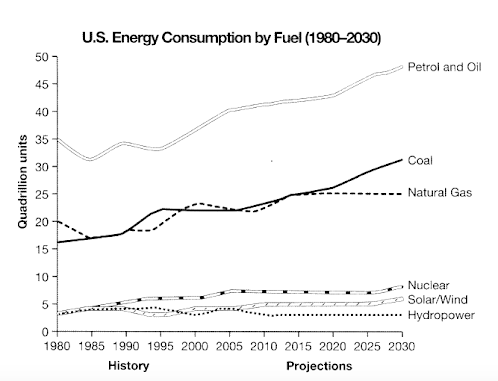
The graph below gives information from a 2008 report about consumption of energy in the USA since 1980 with projections until 2030. Summarise the information by selecting and reporting the main features and make comparisons where relevant. Write at least 150 words.
Model Essay
Important functional words are highlighted in red
Useful vocabulary and phrases are highlighted in green
Synonyms and topic vocabulary are highlighted in blue
The given line graphs illustrates data from a report in 2008 regarding energy consumption in the USA since 1980 with predictions until 2030.
Overall, fossil fuels have shown increases in consumption since the start of the period, with expectations for even more reliance on these fuel sources. Cleaner energy sources have accounted for considerably less consumption with predictions for a similar trend.
Regarding fossil fuels such as coal, natural gas, petrol and oil, they have seen steady increases in energy consumption since 1980. Petrol and oil started at 35 quadrillion units in 1980, then fluctuated until 2000, at which point they rose steadily with a prediction of over 45 quadrillion units by 2030. Additionally, coal followed a similar rising trend. It is predicted that it will have surpassed 30 quadrillion units by 2030. Natural gas usage and it is set to level off at around 24 quadrillion units from 2020 onwards.
In contrast, cleaner energy fuel sources all began the period at under 5 quadrillion units and showed declines in their use, with the exception of nuclear, which climbed slightly to 6 quadrillion units in 2005 with solar/wind expecting to see slight increases . Hydropower is projected to remain relatively unchanged until 2030.
Now that you're familiar with the IELTS Writing Task 1 Line Graphs questions, it's time to practice. Check out the practice questions below.