by Aigerim
(0:00-1:30) Introduction: The Motivation
"Good day, ladies and gentlemen.
Before I show you what is under this cover, I want you to remember your last week. For me, it was a week of exhausting exams. There were moments when I wanted to drop everything, close my eyes, and just give up. We’ve all been there, right?
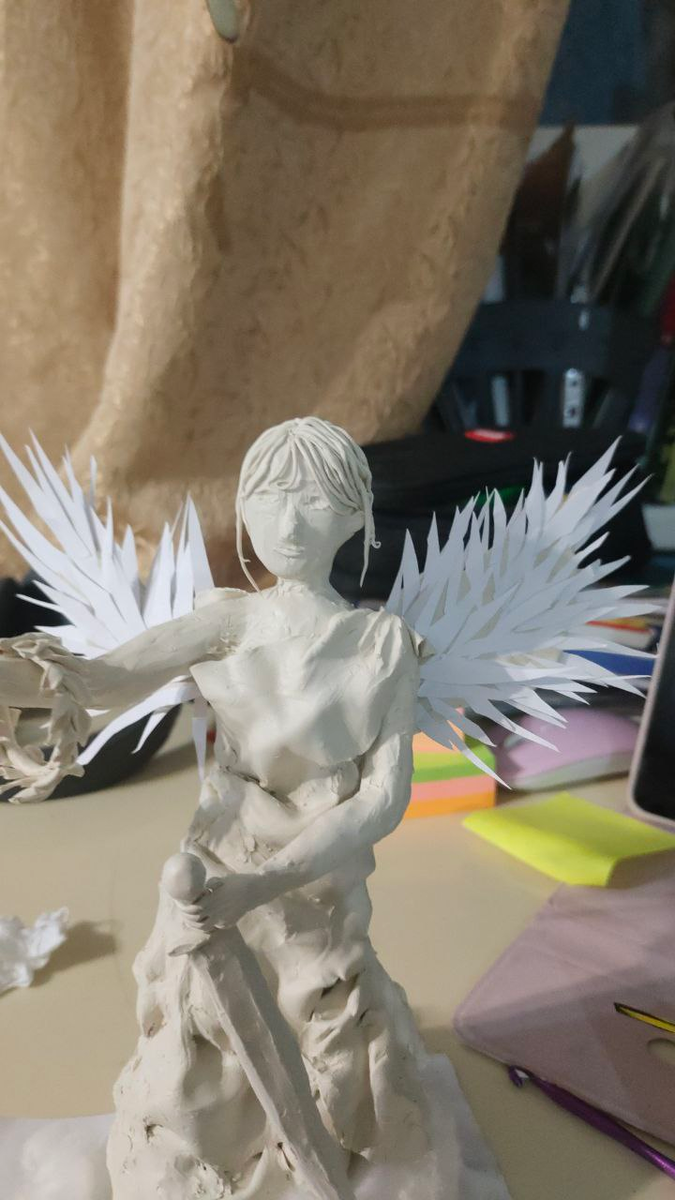
In those moments of stress, I felt a desperate need to create something that would represent the strength we all carry inside. I decided to recreate the image of Nike — the ancient Greek Goddess of Victory. But what started as a simple hobby project turned into a 6-hour battle, a lesson in anatomy, and a deep metaphor for life itself."
(1:30-3:30) Part 1: The Material and the "Warmth"
"I chose white, hard sculptural clay. When I bought it, the instructions were clear: 'To work with this material, you must heat it. Use a radiator or dip it in hot water.' It sounded rigid and stubborn.
But then, something unexpected happened. I started kneading it with my hands. And after just 10 minutes of human touch, the clay became soft. It surrendered. It became pliable. This was my first lesson: sometimes the obstacles in our lives seem stone-cold and impossible to change, but once you actually put your energy and heart into them, they soften. You don't always need external heat; sometimes, your own persistence is enough."
(3:30-5:30) Part 2: The Struggle with Perspective (The "Ugly" Phase)
"I’ll be honest with you — this was my first time ever making a real sculpture. I used to make tiny things, but never a full figure. And if you think everything went smoothly, you are mistaken.
I started with the head. I spent so much time on it! But when I moved to the body, I hit the biggest challenge of sculpting: the 3D perspective. In your head, it looks perfect. But then you rotate the statue, and suddenly... (Show the photo of the proportions fail).
As you can see on the screen, the proportions of the head and the body were living completely different lives! I had to learn how to keep the anatomy consistent from every single angle. Making the folds of the clothing look 'natural' and 'light' while working with heavy clay was like trying to catch the wind with your bare hands."
(5:30-7:30) Part 3: Innovation and the "Cloud" Wings
"Now, let’s talk about the 'engineering' side. Professional sculpting tools — the sticks we call 'stacks' — cost around 6,000. As a student, I thought: 'I can do better.' So, if you look closely at the texture of her dress, it wasn't made with expensive tools. It was shaped with a simple knitting hook.
For the wings, I wanted them to look grand. I built a clay base and then attached every single feather, one by one, using white paper. To give the statue a sense of divinity, I used cotton wool at the base and the back of the wings. I wanted her to look like she was emerging from the clouds, rising above the mundane problems of our world. I placed the whole construction on a piece of white paper so I could rotate it easily — my own DIY professional sculpting turntable."
(7:30-9:00) Part 4: The Symbolism (The Heart of the Speech)
"But why Nike? Why the sword and the laurel wreath?
This statue is about the cycle of achievement. The sword in her hand represents the struggle. It’s the hard work, the sleepless nights, and the 'fights' we have with ourselves when we want to quit.
The laurel wreath in her other hand is the result. It’s the victory that comes only after the fight. The white wings represent our ambitions — they are what keep us looking up at the bright future, even when our feet are still in the clouds of uncertainty.
I want to dedicate this work to everyone who is going through a hard time right now. Especially to my fellow students who are facing exams. This statue is proof that even if you start with a 'wrong proportion,' even if you don't have the expensive tools, if you keep going for 6 hours, or 6 days, or 6 months—you will eventually see your Victory."
(9:00-10:00) Conclusion
"Victory isn't just about the final result. It's about the 10 minutes of kneading the cold clay until it finally listens to you. It’s about fixing the mistakes and finding a way to fly.
Thank you for your attention. And now, ladies and gentlemen, I would be happy to answer any questions you may have."