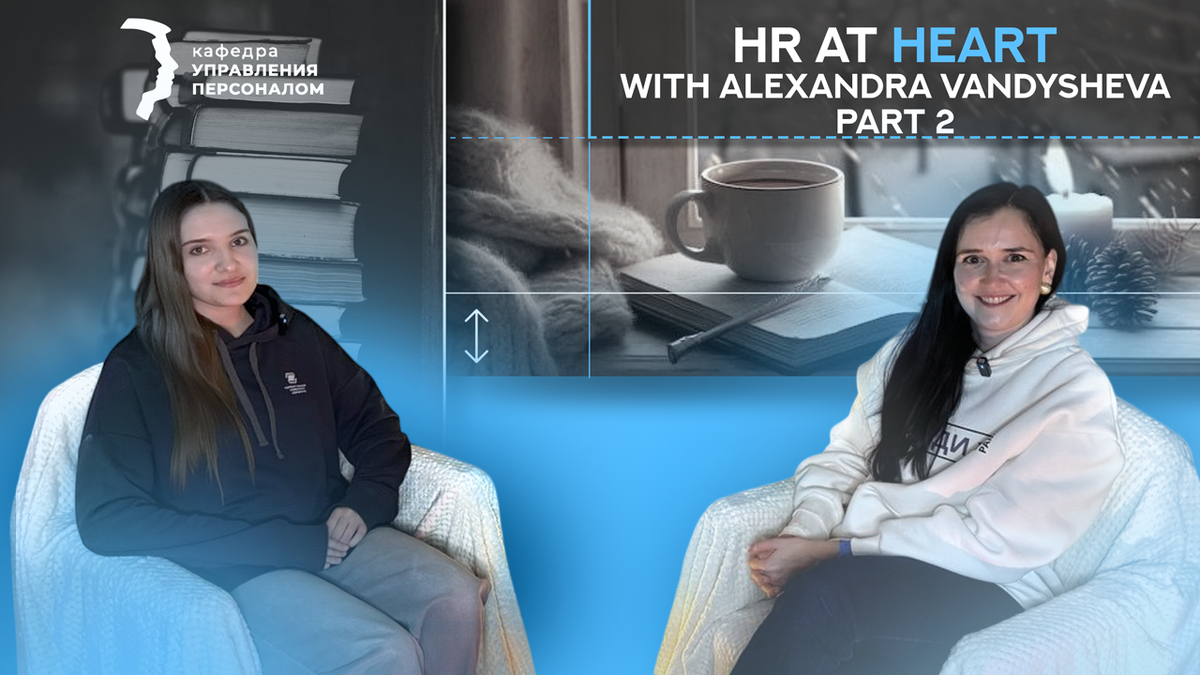
Host Polina:
You have mentioned several times your love for corporate culture. Please tell us, does corporate culture really have such a strong influence on talent, and what is the corporate culture like in your company?
Alexandra Vandyshova:
I love such questions related to corporate culture because I know better than anyone how one culture differs from another. You know, there’s a saying: "Corporate culture ate strategy for breakfast." This is indeed true because we can strive for high performance, sell a lot, and so on, but until we have a quality corporate culture, those metrics will not increase. When great work ethic, focus on results, and the desire to achieve those results from employees come together in a cool company where you feel comfortable and are not afraid to make decisions, even to make mistakes, that incredible growth will happen. Therefore, corporate culture plays a huge role in the development of any company, including, of course, in retaining talent. I have already provided several examples that confirm how important corporate culture is for retaining employees and for their development. If we talk about what our corporate culture is like, I really want our podcast readers to study the types of corporate cultures and so on.
There are different approaches to assessing corporate culture. Red corporate culture, yellow, blue, and so on. There are various definitions. For example, order-oriented corporate culture, where you are told to do something, and you go and do it, with no right to your own opinion. This happens. In fact, there are many such companies; at a certain stage of a company's development, such corporate culture is acceptable, and that’s normal.
When a company is more mature, has reached stable growth, and has gone through a phase of rapid growth, its corporate culture can and probably should be reformed. The focus shifts to people, to retaining them, precisely because in red culture there is a very high turnover. In a culture where we are strongly green, focusing on people, we are already working on this turnover, and so on.
So, I work in a wonderful company! I love it, I adore it; I have been working there for 12 years for a reason, but when I came to this company, it was viewed differently. If you had read the reviews from 2013, all former employees advised never to work in this company; it was scary. It really was, but not too much, but it was still very stressful.
In 2019, our company underwent a major transformation at a global level, and new behavioral standards were adopted across all companies. We understood that by implementing these behavioral standards, our employees would achieve better results. It was then that we focused on moving our company from red to a greener company.
Host Polina:
So, young companies tend to be more authoritarian in this aspect?
Alexandra Vandyshova:
They can be. It all depends on the specifics of the business. Let's say, companies that grow quickly need to achieve results very fast. This is possible if you adhere to the principle of "I said, you did." But you also need to understand that these are extremes; there always needs to be a mix, sometimes more, sometimes less.
Host Polina:
As far as I know, this is often applied in Japan.
Alexandra Vandyshova:
Maybe.
Host Polina:
Because there, the hierarchy is very strict.
Alexandra Vandyshova:
Maybe, but I think in Japan there is also a certain mix; it all depends on the company’s strategy. In general, some companies can thrive as red for decades; that exists, and people who work there feel comfortable.
Returning to the topic, in 2019, this change began, and we approached it very well; we listened to the behavioral standards that the company promotes, and we conducted a substantial study within the Russian branch to see how our company currently operates in Russia: how we make decisions, how we view mistakes, and so on. It was a very large study, and we understood that we had A, B, and C – our focal areas that needed work to reach certain behavioral standards.
Here, I want to emphasize an important point: any corporate culture does not change in a month, two, and so on; it takes several years. Especially when you do transition from one extreme to another, completely reforming the company. Therefore, in 2019, we began this journey, and we saw our first results, probably in 2021, after the first employee engagement survey. Employee responses highlighted moments that showed us we were on the right track. Now, in 2025, we conduct an engagement survey every year and assess the corporate culture of the company as well. For three years (2024, 2023, 2022), we have been ranked first in the country among, I believe, 30,000 companies and a huge number of branches worldwide, with the highest employee engagement rating of 87% – the highest score globally in our company. This is precisely because we do a lot to support the corporate culture that is important to us.
Host Polina:
Did you personally contribute to the improvement of the corporate culture?
Alexandra Vandyshova:
Great question, very interesting. Look, a very important and trendy word that I will mention is influencers. At that time, I was not yet working in HR; I was working in the transformation department, dealing with changing this culture. One of the tools for starting the development of a new culture was the establishment of a community of influencers within the company—those employees who believe in the new culture and demonstrate the behavioral standards that we, as a company, promote. Since I was involved in this project, I was selected as one of the influencers; there were 50 of us, and I was the advocate who went around sharing what the new culture is, what the behavioral standards are, and demonstrating what it means to take responsibility and think about the company, and so on.
So, probably, my contribution lies in being a bright representative, a bearer of our corporate culture. Now, when I give such presentations, I always say that I am a bearer of our DNA, the DNA of our corporate culture. I truly value this, but probably because I am doing it, it is very close to me, and I feel great merging with the company as one.
Host Polina:
What innovations do you plan to implement in the near future to increase employee engagement?
Alexandra Vandyshova:
Look, again, I advocate a systematic approach. In general, if we want to work with employees, their development, engagement, etc., then one-off events or actions do not work. There should be a sequence of actions so that employees see that there is continuity: today we did one thing, tomorrow another, and all of this is interconnected. This way, a complete picture is formed, which is very important.
If we talk about employee engagement, as I mentioned, one of the key tools that assess our corporate culture is the engagement index, which we calculate through employee engagement surveys. Starting in 2021, we conduct this survey every year in September, sometimes in October, in all countries of the world, and it receives a lot of attention: separate communications on this topic are released, and employees are prepared for it; it’s a serious matter. We receive the results of the engagement survey, and then—qualitative analysis; this is the key to success. You understand three areas, maybe five, but not too many, on which you want to focus.
And what does this indicate? It shows that you are listening to your employees. For example, if employees say that they are overloaded, do not feel support from managers, or something else. You see that among all the indicators, these indicators are the weakest; they are weak across all departments, and it is clear that they stand out among all other metrics. Then the management committee, HR, all sit down together and start working on our focal areas. Then, throughout the year, until the next engagement survey, the company undertakes certain activities, discusses these topics, and shows how some changes are occurring in a more positive direction that employees requested. The best part is when in the next engagement survey you see that this indicator has increased by 0.2, 0.1, or 0.3 points; this means we are really responding, and employees see this; they are very grateful.
Host Polina:
Tell us how you and your company influence the development of employees?
Alexandra Vandyshova:
We pay a lot of attention to the development of our employees. As I said, we train managers, we create development programs, and we conduct career dialogues. Throughout the year, we have at least three check-ins where we talk with employees about their development. These are mandatory events that are cyclical stages. Every employee goes through this. I truly believe that such a thorough approach positively influences employee development.
Host Polina:
What do you do for your professional development?
Alexandra Vandyshova:
I love this question; I could give a long lecture on this topic. But for young professionals and those who generally care about their careers and development, I will share a few secrets of success. First, you should be the one primarily responsible for your career and development. No one knows better than you what you want, how you want to get there, and so on. Secondly, I’ll share from my own experience. I have a clear strategy for my development; I understand what I want to achieve this year, what skills I want to develop, and I actually have a long-term plan; I know exactly who I see myself as at 50 years old. Based on this, I understand that in order to get there, I need to go through certain stages, which I also understand. Then I have my own development plan for both the short-term and long-term. Every year, I set goals for myself. They are both personal and professional. Then I clearly outline what I will do this year to be able to say at the end of the year: “Yes, I did it; I checked that off.”
Host Polina:
Do you develop your plan yourself, or have you sought help from a career consultant?
Alexandra Vandyshova:
Look, when I was very young, I had informal mentors with whom I could consult regarding my career development, “how to think about my career?” and so on. Yes, now there are many career coaches who also help with career development. But since I consider myself a great career coach for myself, I have already gone through many stages. Therefore, to clearly formulate my actions, I primarily talk to myself; a very important moment of awareness happens: “where” I am, “what” I am, what skills I need to develop, what feedback I received, what I need to work on, and so on.
I have a great story related to a career coach. Once, he helped me get out of a career deadlock. I highly recommend mentorship; it’s just amazing. It’s great when there is someone who serves as a role model for you in certain areas. For example, if you want to develop public speaking, and that person is a god in this area, you approach them with your request for mentorship, and they guide you on how they developed their public speaking skills. Therefore, I personally use all possible tools that can help me achieve the career goals that I have set for myself.
I want to emphasize again that often employees, being in a wonderful company and realizing that the company is developing, sit and wait for when they will start to be developed, when someone will come to them to have a career dialogue. Fortunately, there are wonderful companies like ours, where we truly come and talk, but that’s not the case everywhere. Therefore, I still insist that each person should understand that if they want some development, they must first take steps for it and show initiative.
Host Polina:
We know that you studied at the State University of Management. Please tell us about your experience studying there, the moments that influenced you and your career development, and how the State University of Management may have helped you.
Alexandra Vandyshova:
I hold my education at the State University of Management in great affection because I truly had a lot of freedom there. I made my own decisions about how to spend my time. I came here to gain the knowledge I wanted, and there was plenty of it. Along with that, I had the opportunity to work, and I am very grateful for that because I started working after my first year; I immediately went to a recruitment agency, and that was a very cool experience. Now I realize that I have gained immense experience, which is fantastic.
I am grateful to the university for one particular incident, and I will share it now.
I always wanted to work in international companies, especially when I was studying 15 years ago. It would have been great to get into an international company, but it was challenging. While working in a small Russian company during my fourth year, I received a call from PricewaterhouseCoopers, now known as PwC. Although it may have been renamed by now, I love this company. They called and said, “You were recommended to us by the university to work as an intern.” I came, went through the interview, and got hired. Honestly, I still don’t know who recommended me to this wonderful company as a good candidate worth hiring. If I knew who that person was, I would personally like to say a big thank you because that job at PricewaterhouseCoopers was my first incredible step that had a significant impact on my career development and on me. Therefore, I believe that the institute, perhaps not specifically through education but through external actions, greatly influenced where I am now.
Host Polina:
Maybe someone will read our podcast, and we will find out who that person is who recommended you. And the last question before our lightning round: give advice to the students of the Personnel Management Department at the State University of Management.
Alexandra Vandyshova:
What advice would I give to the students currently studying in the Personnel Management Department, and probably not only to them but to everyone studying at any university, especially, of course, at my beloved State University of Management?
First, be curious; that is the most important thing. Be interested in everything because you never know where fate will take you and where you will develop, where the knowledge you gain today here or there will be applicable.
Second, and this is really important, develop your network; communicate with a large number of different people at the university, across different departments, with various specialists, with your peers, with peers from other cohorts, with your parents’ friends, with anyone. This is important because networking, believe it or not, works wonders. At some point, someone recommended me to the wonderful PricewaterhouseCoopers because I was talking to someone here, and someone noticed me and recommended me. So, develop your network; it will help you immensely in life.
Host Polina:
It’s time for the lightning round. I will ask you a question, and you give a brief answer. All the questions are simple, so let's not keep you waiting.
So, what song is currently playing in your head?
Alexandra Vandyshova:
These are unusual questions. I am learning French, so let it be a French song by the singer Zaz, "On ira."
Host Polina:
What is your zodiac sign?
Alexandra Vandyshova:
Gemini.
Host Polina:
What was your first job?
Alexandra Vandyshova:
KPG Resources.
Host Polina:
Where would you like to spend your vacation?
Alexandra Vandyshova:
In Antarctica.
Host Polina:
Who is your idol in life?
Alexandra Vandyshova:
Socrates.
Host Polina:
Three things that inspire you?
Alexandra Vandyshova:
Nature, seeing my child grow, achieving goals.
Host Polina:
Favorite term in HR?
Alexandra Vandyshova:
I will give you a trendy term that I recommend everyone to master. Let it be “serendipity.”
Host Polina:
What does that term mean?
Alexandra Vandyshova:
I probably won’t dive into it now. I recommend everyone read the book "Serendipity." In Russian, you will find it under the title "Неслучайная случайность" (Non-Random Coincidence). It’s an incredibly cool book about how coincidences are not random and how they can greatly influence you.
Host Polina:
And your favorite department in the university?
Alexandra Vandyshova:
Of course, Personnel Management.
Host Polina:
Our interview has come to an end. Thank you for coming!
Alexandra Vandyshova:
Thank you! It was a pleasure for me too.
Host Polina:
And to you, dear readers, thank you for tuning in to our podcast "HR at Heart."