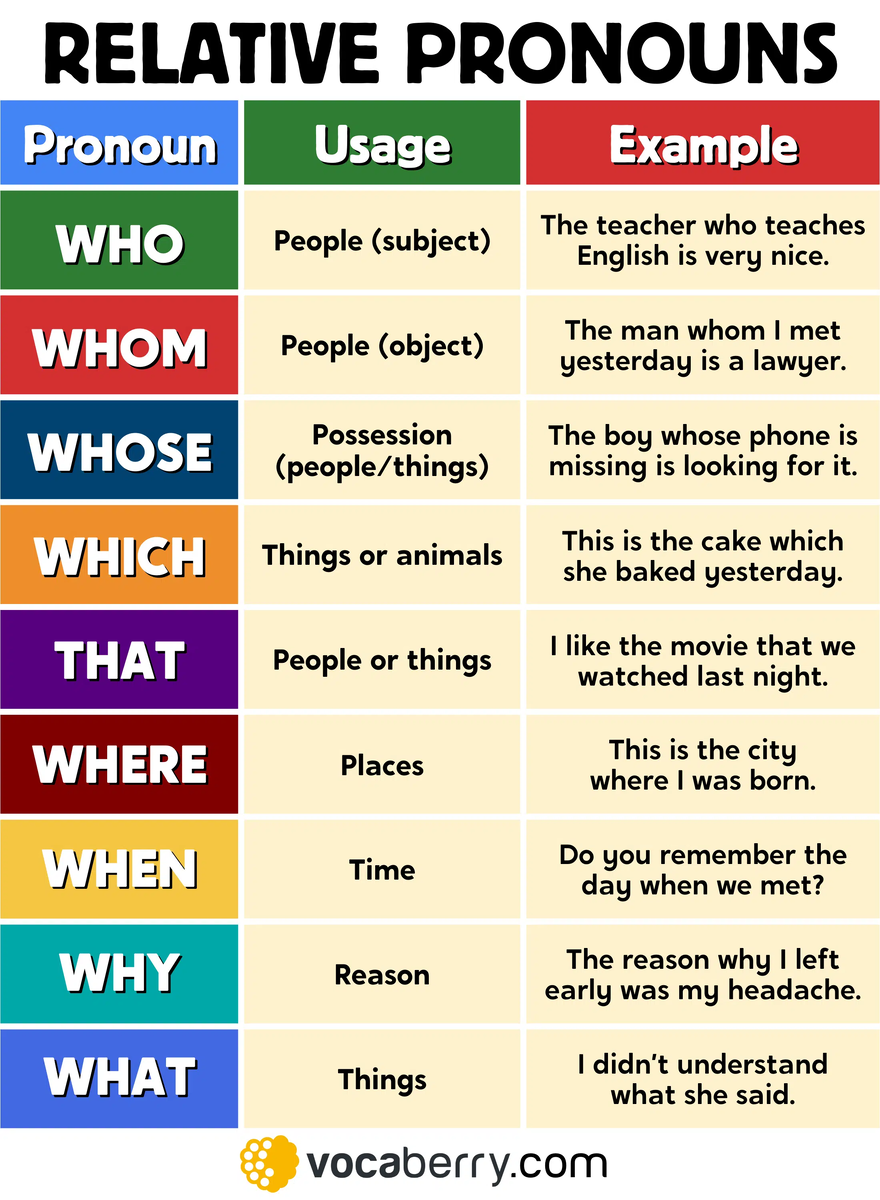
Relative clauses help us combine sentences and add more information about a person, place, or thing without starting a new sentence. They make English sound more natural and fluent in both speaking and writing.
In English, relative clauses usually start with relative pronouns like who, whom, whose, which, and that. These pronouns help connect the main sentence with extra details.
For example:
- Two separate sentences: I have a friend. She lives in Spain.
- With a relative clause: I have a friend who lives in Spain.
Understanding relative clauses and relative pronouns will help you create longer, more natural sentences and improve your English fluency. In this guide, you’ll learn the types of relative clauses, how to use relative pronouns correctly, and common mistakes to avoid.
What Are Relative Clauses?
A relative clause is a dependent clause that gives more information about a noun in a sentence. Since it is dependent, it cannot stand alone.
Example:
- This is the book that I borrowed from the library.
(The clause “that I borrowed from the library” gives more details about the book.)
Relative clauses often begin with relative pronouns like who, whom, whose, which, and that.
Types of Relative Clauses
1- Defining Relative Clauses (Restrictive Clauses)
A defining relative clause gives essential information about a noun. Without this information, the sentence would not be clear.
- No commas are used.
- The clause is necessary to identify the noun.
- Relative pronouns who, that, which, whose are commonly used.
Examples:
- The student who won the prize is my brother.
- I need the book that is on the table.
2- Non-Defining Relative Clauses (Non-Restrictive Clauses)
A non-defining relative clause gives extra information that is not essential to understand the sentence.
- Commas separate the clause from the rest of the sentence.
- The sentence still makes sense if the clause is removed.
- The pronoun that is not used in these clauses.
Examples:
- My father, who is a doctor, works at the hospital.
- This book, which I read last year, was really interesting.
Relative Pronouns and Their Uses
Relative clauses begin with relative pronouns, which refer to the noun in the main sentence.
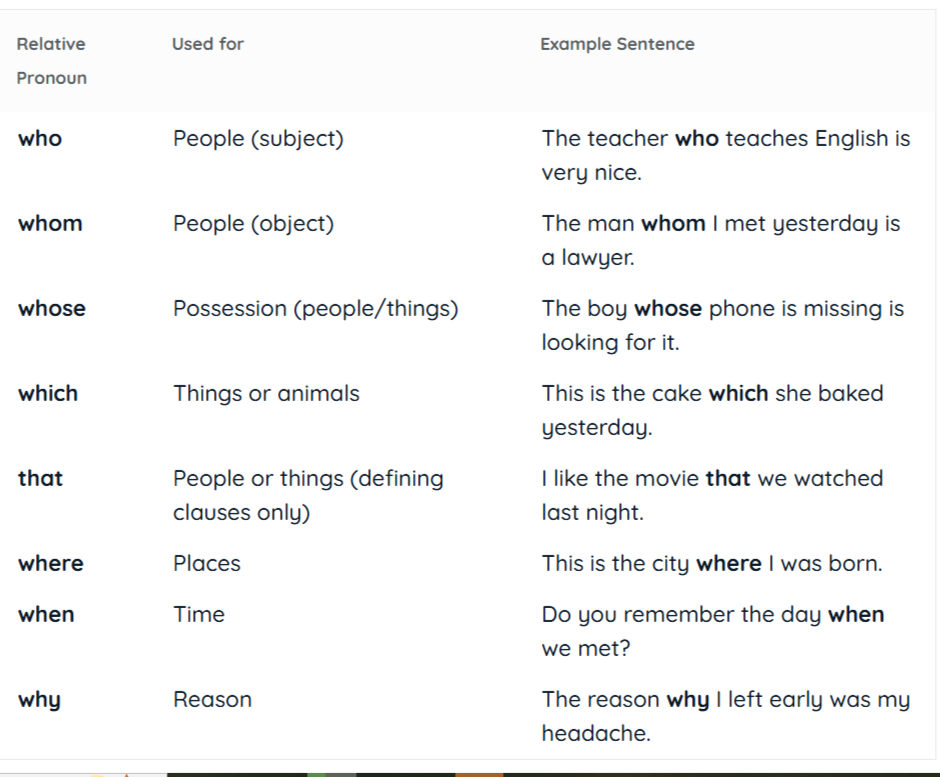
Who vs. Whom – What’s the Difference?
- Use who when referring to the subject of the clause.
- Use whom when referring to the object of the clause.
Examples:
- She is the girl who won the race.
- He is the boy whom I helped yesterday.
Tip: If you can replace the word with he/she, use who. If you can replace it with him/her, use whom.
- Who called you? (He called me.)
- Whom did you call? (I called him.)
In spoken English, most people use who instead of whom.
That vs. Which – When to Use Them
- Use that for defining (essential) clauses.
- Use which for non-defining (extra information) clauses.
Correct Usage Example Sentence
That (defining)
The book that I borrowed is on the table.
Which (non-defining)
This book, which I borrowed last year, is very interesting.
Tip: If the clause needs commas, use which. If it doesn’t need commas, use that.
Common Mistakes and How to Avoid Them
- Using “that” instead of “who” for people
Incorrect: The man that called me was very kind.
Correct: The man who called me was very kind.
- Using “which” for defining clauses
Incorrect: The car which I bought is very fast.
Correct: The car that I bought is very fast.
- Forgetting commas in non-defining clauses
Incorrect: My brother who lives in London is a doctor.
Correct: My brother, who lives in London, is a doctor.
- Confusing “whose” and “who’s”
Incorrect: The girl who’s phone is missing is upset.
Correct: The girl whose phone is missing is upset.
Quiz: Relative Clauses and Pronouns
1. He is the man ___ helped me yesterday.
a) who
b) whom
c) which
2. This is the house ___ I grew up.
a) where
b) when
c) whose
3. The cake ___ she baked was delicious.
a) which
b) who
c) when
4. My sister, ___ lives in Paris, is a lawyer.
a) that
b) who
c) whose
5. This is the reason ___ I left early.
a) which
b) why
c) when
6. Do you remember the day ___ we met?
a) where
b) when
c) that
7. The girl ___ you met at the party is my cousin.
a) which
b) whom
c) where
8. The boy ___ bicycle was stolen is very upset.
a) that
b) whose
c) which
9. She met a man ___ speaks five languages.
a) who
b) whom
c) that
10. The dog ___ was barking all night kept me awake.
a) that
b) who
c) whom
Quiz Answers
1) who
2) where
3) which
4) who
5) why
6) when
7) whom
8) whose
9) who
10) that