Passive voice is important for IELTS. Whenever you speak or write, or try to understand reading passages, you need to have the ability to use and understand a good range of grammar.
However, a way that the passive is specifically needed for IELTS is if you get a process diagram in Academic IELTS Task 1. In this case you will use it throughout your explanation of the process.
So first we'll take a look at how to use the passive voice generally, then we'll see how it is used in a Task 1.
Passive Voice Rules
What are the Active and Passive?
When we use the active voice, the subject is doing the action of the verb. When we use the passive voice, the person or thing receiving the action becomes the subject:
Active Passive
The dog bit the boy The boy was bitten by the dog
To make a sentence passive, we do three things:
- Move the object of the sentence, and make it the subject. The object thus becomes the subject (often we exclude the object because it is not important to the sentence).
- Add in "by" before the new object (if you are including it in the new sentence)
- Add the verb "to be" to the front of the verb, and change the verb to the past participle. You then have a passive voice verb. Remember to keep the tense the same.
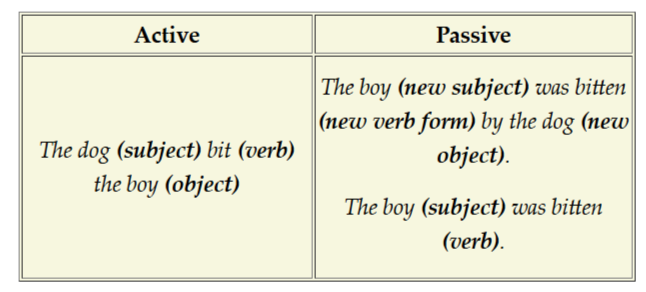
In this case the verb "bit" is in the past simple, so when it is made passive, the verb "to be" must be the past simple - "was".
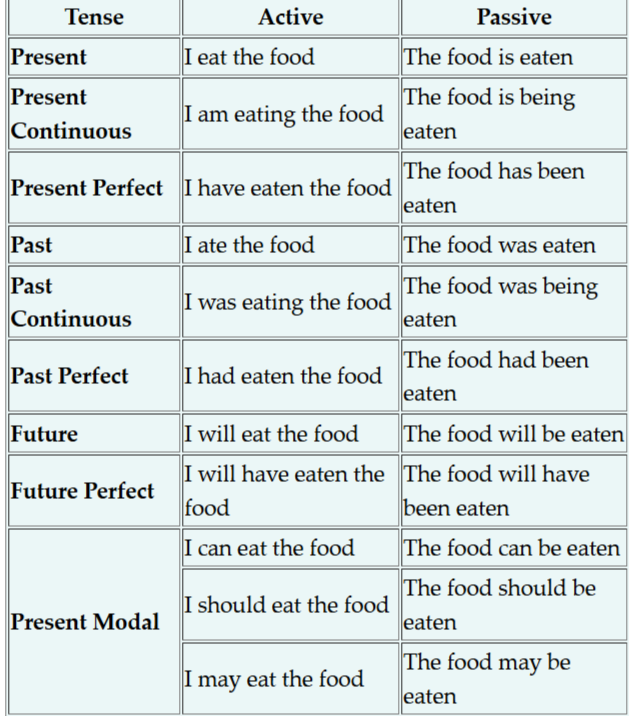
With Differing Tenses
These are examples of how we form it with different tenses (without the object in the passive):
With Gerunds and Infinitives
We can also use the passive voice for infinitive and gerund structures:
Transitive and Intransitive Verbs
However, you cannot use the passive with intransitive verbs.
Transitive verbs have to take an object. For example, you cannot say "He discovered". This is a transitive verb so it needs an object: " He discovered a cure".
So this can be made passive: "A cure was discovered".
Intransitive verbs are not followed by an object. For example, you can say "He died". Or it could be followed by an adverb: "He died yesterday".
But we cannot say: "He was died" or "Yesterday was died he".
Learn more about transitive and intransitive verbs
When do we use it?
It is much more common to use the active than the passive, so you should only use it if there is a specific reason. Below are are the reasons that we use it.
Remember that this is usually a matter of choice for you, depending on the context in which you are writing.
1. When you think the receiver of the action is more important than the doer of the action
Interested in the doer The farmer harvested the corn in September
Interested in the action The corn was harvested in September
2. When you think it is obvious who the doer is so it does not need to be mentioned
An obvious subject The police arrested the burglar
Omitting the doer The burglar was arrested
3. When the doer of the action is unknown or we don't want the doer to be known
A known doer Jonathan stole Peter's phone
An unknown doer Peter's phone was stolen
4. When you think the doer is irrelevant
You feel it is relevant The manager will close the shop at 3pm
You feel it is irrelevant The shop will be closed at 5pm
5. When you are writing for certain genres, such as science reports or for academic journals
Referring to the researcher I can draw several conclusions from the results
Anonymising the researcher Several conclusions can be drawn from the results
The passive voice for IELTS
As it is just a part of general grammar, you may use it at any point in the speaking or writing.
The time when you will really be in trouble if you don't know how to use it is if you have to write about a man-made process in Task 1 of Academic IELTS (for natural processes you use active voice).
Here is an example of a mad-made process diagram, where you have to describe the process of making chocolate:
When we describe a process such as this, we are not interested in who does the activity, the "doer", we are interested in the activity itself.
So in order to emphasize this, the activities are used as the subjects. Check out this model answer - the passive voice has been highlighted.
To begin, the cocoa comes from the cacao tree, which is grown in the South American and African continents and the country of Indonesia. Once the pods are ripe and red, they are harvested and the white cocoa beans are removed. Following a period of fermentation, they are then laid out on a large tray so they can dry under the sun. Next, they are placed into large sacks and delivered to the factory. They are then roasted at a temperature of 350 degrees, after which the beans are crushed and separated from their outer shell. In the final stage, this inner part that is left is pressed and the chocolate is produced.
You can view some more examples of process diagrams here:
Passive Voice Exercise
You can now test yourself with the passive voice.
In the quiz, the sentence given is active. Write the passive sentence below.
DO NOT include the object i.e. "by ...", unless you are asked to do so. If you do it will get marked as incorrect. Include everything else.
Don't put a space or full-stop (period) after your sentence as it will also appear as incorrect, and start the sentence with a capital letter.
Here is an example:
Active: I have read the book
Answer: The book has been read
Passive Quiz
1. John cancelled the meeting
2. The van takes the meat to the market
3. I will take the medicine
4. The police interviewed the suspect
5. The canteen was serving lunch
6. His grandfather looked after him. (use an object)
7. The boss will fire him tomorrow
8. I can still use this pen
9. My uncle raised me. (use an object)
10. I will paint the room next month
Passive Quiz answers
1. The meeting was cancelled
2. The meat is taken to the market
3. The medicine will be taken
4. The suspect was interviewed
5. Lunch was being served
6. He was looked after by his grandfather
7. He will be fired tomorrow
8. This pen can still be used
9. I was raised by my uncle
10. The room will be painted next month