Infinitives are created by to + verb.
It is important that you can use them correctly in your IELTS speaking and writing as errors will affect your band score for grammar.
We have already looked at gerunds, which are verbs ending in –ing (which makes them nouns).
Take a look at this paragraph. The infinitives are in red.
To improve my IELTS score, I joined a writing class in a college in my home town. I wanted to make sure that my grammar was as good as it could be. The teachers helped me to understand some complex grammatical points. It is impossible to know everything in a short time, but I improved lot, and I would really like to thank them for what they did. To help me like this was very kind.
All these are being used in different ways. In this lesson we'll examine them further.
The Grammar
The infinitive form of the verb means that it does not take a tense. It is the bare form of the verb, but with 'to' before it.
Here are some examples
to go
to see
to wait
to manipulate
to consider
to amend
A common mistake in writing is to think of it like a finite verb (a verb that has a subject and takes a tense). It does not change its form.
Here is an example of a common mistake with the infinitive:
It took me five hours to reached the destination.
The person has made the infinitive verb, reach, in the past tense. Only the main verb (take in this case) can be given a tense.
This is how it should be written:
It took me five hours to reach the destination.
How Infinitives Are Used
As direct objects
When an infinitive is used as a direct object, it is placed after the verb:
I wanted to make sure that my grammar was as good as it could be.I decided to study abroad, but my parents are refusing to pay.
To show purpose
They are sometimes used as a reduction of the phrase 'in order to'.
In order to improve my IELTS score, I joined a writing class in a college in my home town.To improve my IELTS score, I joined a writing class in a college in my home town.I joined the exercise class in order to lose weight.I joined the exercise class to lose weight.
As a subject
To help me like this was very kind.To get involved in charity work is a very noble cause.
However, note that the use of the gerund in these structures is much more common:
Helping me like this was very kind.Getting involved in charity work is a very noble cause.
If you do see an infinitive at the beginning of a sentence, it is much more likely to be showing purpose i.e replacing in order to.
With phrases beginning with 'it' (it + be + infinitive)
It is impossible to be perfect in a short time.(Adjective + Infinitive)It could be a mistake to leave my job.(Noun + Infinitive)
With the verb 'take' (it + take + noun + infinitive)
It took me five hours to reach the destination.It takes a lot of concentration to read this book.
After certain adjectives
My brother was surprised to see me.I was careful not to speak too loudly.
Verbs with the Infinitive
If you wish to put two verbs together, then the second verb will need to be an infinitive and / or gerund.
For example, you can't say this:
He hoped see me again.He hoped seeing me again.
If "hope" is followed by another verb, it needs to be an infinitive:
He hoped to see me again.
Remember, certain verbs should be followed by an infinitive, not a gerund, and some verbs can be followed by either. For example:
I like to swim (verb + infinitive)OrI like swimming (verb + gerund)
Follow this link to see the lesson on gerunds or learn when you can use the gerund and infinitive.
Here is a list of verbs that are very commonly followed by an infinitive (not a gerund):
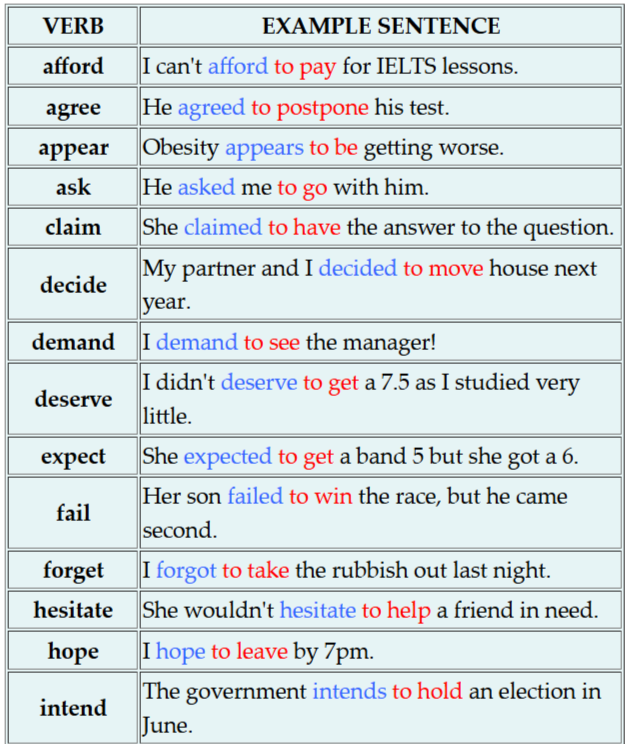
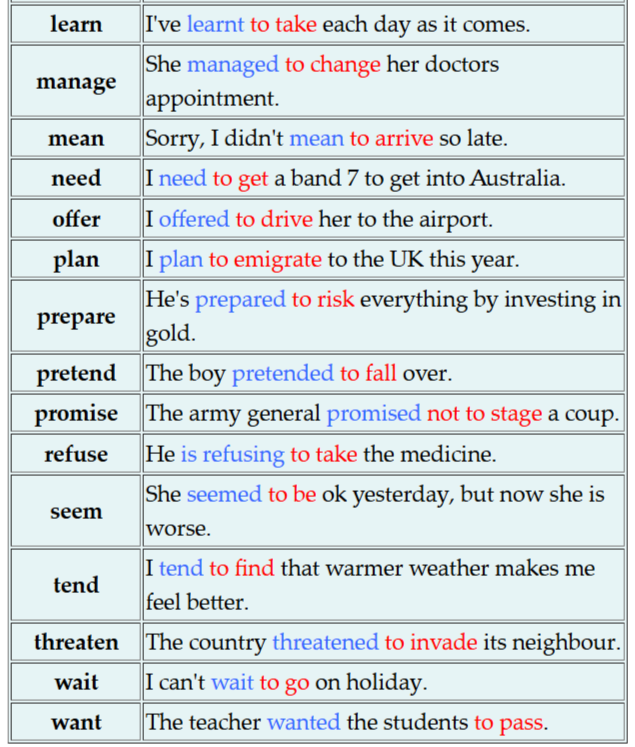
Adjectives and Nouns with the Infinitive
The next tables show you some common ways that adjectives and nouns are used with the infinitive.
Common adjectives preceded by
it + be and followed by infinitive
Test yourself in a quiz - gerund and infinitive exercises
Gerund and Infinitive Exercises
On this page you can try some gerund and infinitive exercises to test your knowledge. There are two quizzes.
You have to decide if you need the gerund:
- verb + ing e.g. swimming
or the infinitive:
- to + verb e.g. to swim
For some, either the gerund or infinitive is possible.
Quiz 1
In this Gerund and Infinitive Exercise Quiz 1, it is a story about Ali, who is taking the IELTS test in order to go and study abroad.
You have to write in either the infinitive or gerund form, or if you think it could be either, write in both. You can then check your answers at the end of each paragraph.
Ali's Story
Booking The School
Ali decided that he wanted (study) abroad. (achieve) his goal, he had many things that he had (do) . Firstly he needed (improve) his English so he could take the IELTS test. Unfortunately Ali disliked (learn) English so this would not be much fun. His friend recommended (attend) a school close to his house. Ali went to look and from what he could see it seemed (be) a good school. He didn't delay (register) for a course. He managed (get) a good price for the course because they had a special offer on. This was good because he could not afford (pay) too much.
Studying
He had never read much in his life and knew he was weak in this area, so he practiced (read) as much as he could. He hated (write) in English too as his grammar was quite weak so he also planned (practice) writing as many essays as possible. His teachers agreed (check) these for him. As it turned out, Ali actually really enjoyed (study) English. The other students on the course didn't hesitate (help) Ali and the teachers always offered (assist) him if he was stuck. He kept up his studying for a number of months because he wouldn't risk (sit) the exam until he was ready.
Taking the Test
Then came the time for Ali (take) the test. He couldn't stop (worry) before the test. His teacher had recommended (do) the Task 2 first in the writing so he followed those instructions. He finished (write) his Task 2 after exactly 40 minutes and then went on to the Task 1. The speaking test seemed (go) quite well even though he was nervous. He can recall (ask) the examiner at the end how well he had done but she refused (tell) him. Then came the time for his result. He had expected (get) a band 5.5 but he was surprised (find) out that he had been given a band 6.
The Result
So Ali could now go and study abroad. Although he was happy, unfortunately it did mean (leave) his wife and children for a year. He considered (take) them with him but it would be too expensive. He knew he would miss (see) them everyday but his parents offered (take) care of them and promised (make) sure they were safe. Ali did love (travel) though so he knew he would enjoy the trip. He began (prepare) his trip immediately.
Quiz 2
This next gerund and infinitive exercise is a multiple choice and you need to choose the correct answer.
Multiple Choice
1. He resented his father choose one leaving to leave leaving / to leave him no money in the will.
2. She intended choose one finishing to finish finishing / to finish the work by 7pm.
3. She continued choose one taking to take taking / to take the medicine for two weeks.
4. The committee forgot choose one taking to take taking / to take minutes of the meeting.
5. He quit choose one trying to try trying / to try to persuade his friends to go with him.
6. The government discussed choose one reducing to reduce reducing / to reduce the level of taxes.
7. He started choose one developing to develop developing / to develop an addiction to the drugs.
8. He claims choose one being to be being / to be the best builder in the town.
9. Developed countries tend choose one having to have having / to have the highest levels of obesity.
10. I appreciated her choose one taking to take taking / to take the time out to talk to me.
Answers
- wanted to study
- To achieve
- had to do
- needed to improve
- disliked learning
- recommended attending
- seemed to be
- delay registering
- managed to get
- afford to pay
- practiced reading
- hated writing / to write
- planned to practice
- agreed to check
- enjoyed studying
- hesitate to help
- offered to assist
- risk sitting
- to take
- stop worrying
- recommended doing
- finished writing
- seemed to go
- recall asking
- refused to tell
- expected to get
- surprised to find
- mean leaving
- considered taking
- miss seeing
- offered to take
- promised to make
- love traveling / to travel
- began preparing / to prepare
1. leaving
2. to finish
3. taking / to take
4. to take
5. trying
6. reducing
7. developing / to develop
8. to be
9. to have
10. taking