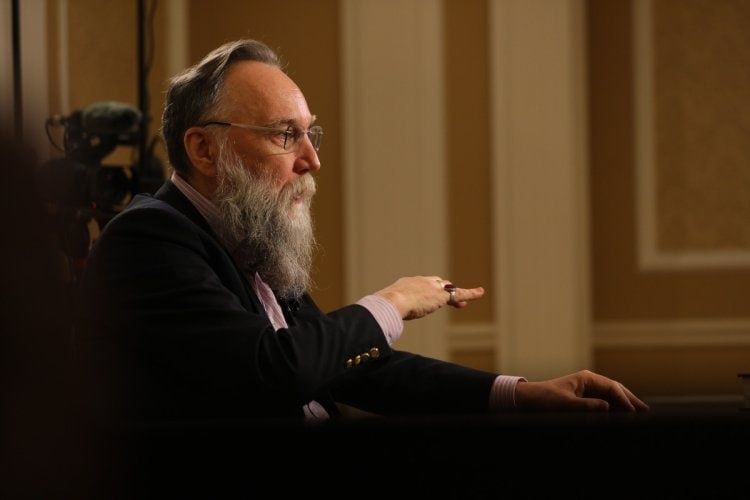
Question: So, as I understand you, we do not yet have a sovereign philosophy?
Alexander Dugin: To say that it does not exist at all would be to deny ourselves, for philosophy cannot be artificially created — it is a living tradition. We do have a sovereign philosophy, but it remains dormant and unactivated. It rests on principles already present within our society — above all, Orthodox culture and fidelity to the Orthodox faith. There can be no Russian sovereign philosophy that is not Orthodox at its core.
For several centuries, Russia has been under the determining influence of Western philosophical thought. Therefore, the affirmation of our civilizational uniqueness — as in the case of the Slavophiles, the Eurasianists, and other intellectual schools — requires a new justification, a rebirth of our independent Orthodox mode of thinking. We must restore the fullness and richness of Orthodox thought that forms our foundation. We cannot replace it with a surrogate or remain within the trajectory of Western European civilization, which has reached monstrous extremes and has now become openly hostile to us. Hence, we must affirm our distinctness — not as something invented from scratch, but as something rooted in continuity with our civilizational path and history.
For this, we must turn to the sources — to Greek and Byzantine Orthodoxy, to the treasury of Orthodox thought from Justin the Philosopher and the Cappadocian Fathers, to the Alexandrian School, John of Damascus, Symeon the New Theologian, and Gregory Palamas. All of this is the treasury of authentic Christian thought, which must not merely be studied, but reactivated: we must grasp its structure and treat it as an operating system or code underlying our historical self-consciousness.
At the beginning of the 20th century, we suffered an intellectual catastrophe: an entire millennium of philosophical history was erased and replaced with the surrogate of Marxist thought. Perhaps Marxism contained some valuable elements that indirectly reflected aspects of our identity. But it is impossible to speak of sovereignty based on a doctrine formed in entirely different conditions — one that embraced the universalism of Western civilization, in which we were relegated to the periphery. During the Soviet period, we possessed political and ideological sovereignty, yet not philosophical sovereignty.
Then, in the 1990s, we lost all forms of sovereignty altogether, which had a tragic impact on Russian philosophical thought. If we combine a century of Communist ideology with the liberal decline and crisis of the 1990s, it becomes clear how far we have drifted from the condition that Russian philosophy had begun to reach in the 19th century — and how we still remain trapped in this philosophical pause. Attempts have been made — during the Soviet era, among émigrés, and in recent decades — but the rupture persists.
Today, the movement toward sovereign philosophy faces resistance from the institutes and university departments of philosophy, which fail to meet the challenges of our time. They continue an inertial process that leads us away from the essential task — the construction of sovereign philosophy. And without it, we will have no independence — technological, economic, or political. The preconditions for its creation exist, and the need is urgent. Yet the existing institutions are utterly unfit for the task.
Of course, one might ask: can philosophy even be institutionalized? It is said, “When philosophers appear, philosophy will appear as well. When they do not, no officials can replace them.”
Read the full interview here:
https://www.multipolarpress.com/p/philosophical-sovereignty
Photo: Nikolai Malakhin / Nauchnaya Rossiya (Scientific Russia)