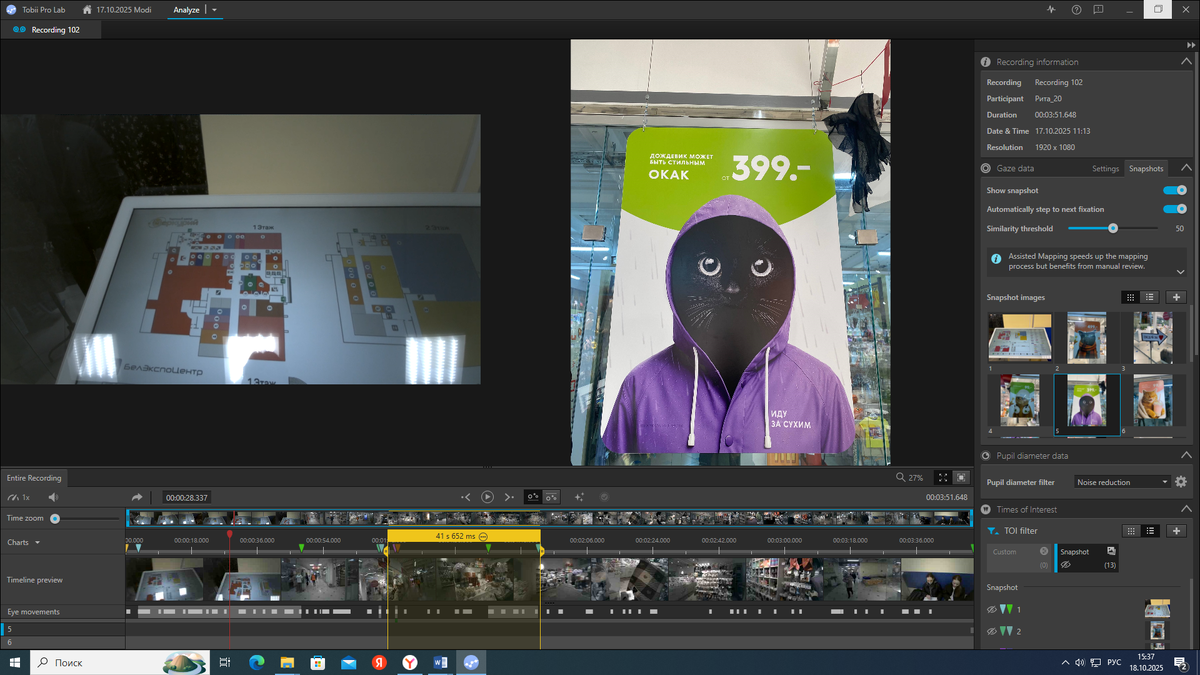
Imagine you're fishing for carp, but you bait your hook with an artificial fly for trout. You'll sit all day without a catch and conclude there are no fish in the lake. In reality, the problem isn't the lake—it's your bait.
In neuromarketing, the stimulus is your "bait for the brain." And the correctness of this bait determines all your conclusions.
1. The Ghost Stimulus: When You Test Something People Will Never See in Reality
Classic Mistake: A company tests a beautiful product banner on a white background.
Reality: This banner will be shown in an Instagram feed among cat pictures, memes, and friends' posts.
Result: Eye-tracking shows long fixations on the product. You rejoice. You launch the campaign... and it fails. Why? Because you didn't test for attention competitiveness. Your stimulus was a "ghost" in the sterile conditions of a lab.
The Takeaway: The stimulus must exist within the same visual noise as in real life.
2. The Riddle Stimulus: When the Brain Wastes Energy on Comprehension, Not Reaction
The Mistake: Giving participants the task: "Evaluate the usability of our banking app's interface."
The Problem: The participant's brain throws all its resources into understanding the term "usability." Their gaze becomes tense, they start "reading" the interface instead of using it intuitively. You get data not on unconscious behavior, but on how a person performs a complex task.
The Takeaway: The stimulus and task must be intuitive and not require deciphering.
3. The Phantom Stimulus: When You Show Something That Doesn't Exist
A Hard Example: A company wants to test reactions to a new bottle shape. But for the research, they create a 3D model on a computer.
The Revelation: Eye-tracking will capture the gaze on the screen. But it will never show how light refracts in real glass, what texture the label has to the touch, or how the bottle looks in hand. You are testing a phantom, but you will be selling a real object.
The Takeaway: The closer the stimulus is to the final medium (paper, screen, real object), the more honest the data.
4. The Self-Deception Stimulus: When You Ask the Brain to React to a Part, Ignoring the Whole
The Mistake: Testing a new "Buy" button separately from the entire webpage of the online store.
The Failure: The button might be perfect on its own. But on the actual page, it might be "killed" by a screaming banner at the top or an ugly font on the left. You are optimizing a detail without seeing the system.
The Takeaway: Context is not the background; it is part of the stimulus.
How to Choose the Right Stimulus? Ask Yourself:
- "Where will my consumer encounter this in real life?" (In a social media feed? On a shelf among competitors? In their hands?)
- "What will they be doing at that moment?" (Scrolling through a feed, rushing to work, comparing prices?)
- "Are all the details of the final product present here?" (Material, size, neighboring elements?)
The Philosophical Bottom Line:
A correctly chosen stimulus is the bridge between the artificial conditions of the lab and the chaotic real world. Break this bridge—and your impeccable eye-tracking data turns into a beautiful but useless report that will gather dust on a shelf.
A stimulus is not just a picture. It is the universe in which you ask the brain to make a decision. Create the right universe for it.
We're on RUTUBE: https://rutube.ru/channel/15929939/
Our website: https://project12488975.tilda.ws/
We're on DZEN: https://dzen.ru/id/67e3fb0af580b555b1c37fbc