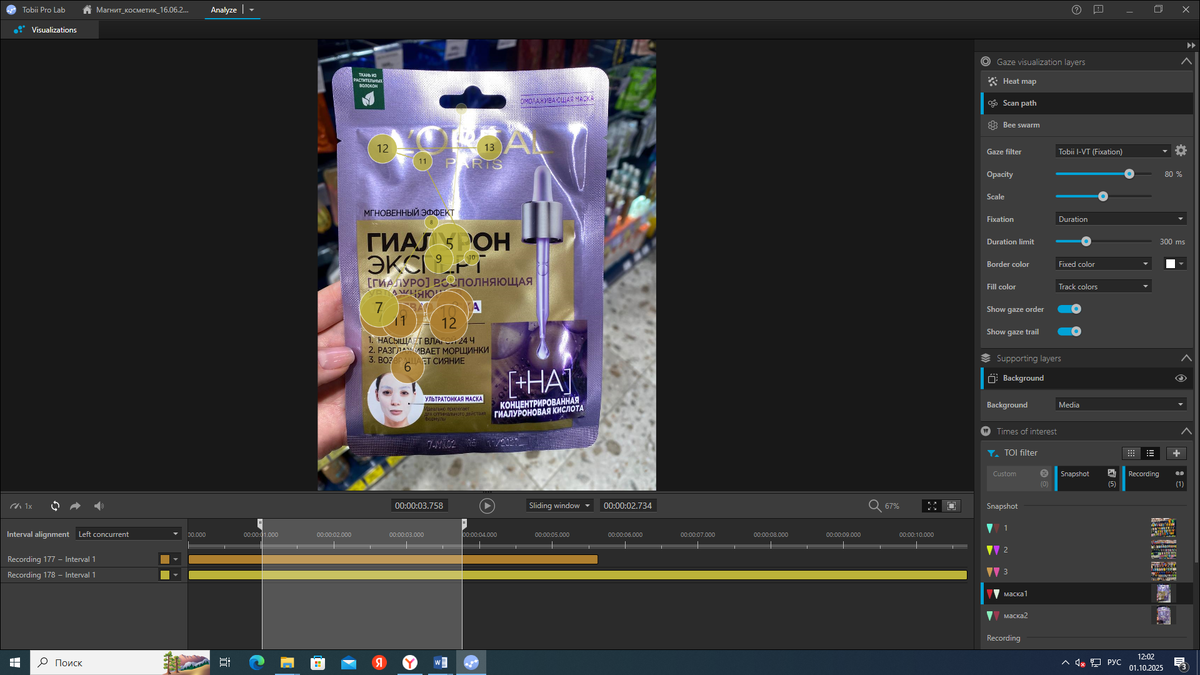
You are conducting research not just to "learn something," but to get answers to specific questions. A hypothesis is precisely your question, translated into the language of data that can be tested. Here is how we transform curiosity into scientific hypotheses for testing a face mask using eye-tracking.
Step 1. Question EVERYTHING (The Zone of Skepticism)
First, ask yourself: "What 'truths' about our product do I believe in, but lack objective proof for?"
- "Our new packaging is impossible to miss on the shelf!" — Is it, really?
- "Everyone immediately sees that it's a collagen mask—it's our key advantage!" — Are you sure?
- "The 'Revitalift' inscription instantly communicates premium quality!" — Or is it just confusing?
- "Customers read about the innovative bio-cellulose fabric!" — Or does their gaze just slide off this complex text?
Each of these beliefs is fertile ground for a hypothesis.
Step 2. Turn Guesses into Measurable Hypotheses
Now we formulate them so that Tobii Pro Glasses 3 can provide a clear, measurable answer.
Hypothesis 1: The Shelf War
- The Hunch: "The L'Oreal mask packaging gets lost among competitors."
- The Measurable Hypothesis: "During free shelf viewing, the L'Oreal Paris mask packaging attracts the first gaze of less than 30% of participants, and the time to its discovery exceeds 5 seconds."
- What We Will Measure:
Time to First Fixation on the L'Oreal packaging.
First Fixation (Percentage of participants whose first gaze landed on it).
Hypothesis 2: The Magic of Collagen
- The Hunch: "The word 'collagen' is our primary visual magnet."
- The Measurable Hypothesis: "The inscription 'Collagen' is among the TOP 3 most viewed elements of the packaging, receiving 50% more fixations than secondary details (volume, fabric type)."
- What We Will Measure:
Fixation Count on the AOI "Collagen".
Total Visit Duration in this zone.
Hypothesis 3: The Curse of Complex Text
- The Hunch: "Nobody reads about the 'bio-cellulose fabric'."
- The Measurable Hypothesis: "The technical description of the mask (material, fabric features) will receive less than 10% of the total packaging viewing time and will be ignored by more than 50% of participants."
- What We Will Measure:
Dwell Time on the AOI "Fabric Description".
Revisitors (Percentage of participants who even fixated on it).
Hypothesis 4: The Emotional Trigger
- The Hunch: "The before/after image or the mechanism of action diagram sparks interest."
- The Measurable Hypothesis: "Visual elements explaining the result (diagram, 'before/after') cause a statistically significant pupil dilation (on average by 10%) compared to viewing the logo, indicating higher emotional engagement."
- What We Will Measure:
Pupil Dilation when fixating on different visual elements.
Step 3. Build a "Basket" of Hypotheses for a Single Experiment
Good research tests not one, but a whole system of hypotheses to see the complete picture.
Participant Scenario: "In front of you is a shelf with skincare products. Please find a face mask that might interest you and examine it."
The Set of Hypotheses to Be Tested:
- About Discovery: L'Oreal packaging is not competitive enough on the shelf.
- About Messaging: The key advantage (collagen) gets through to the consumer.
- About Barriers: Technical information is either off-putting or ignored.
- About Emotions: Visualization of the result triggers a stronger response than text.
The Philosophical Takeaway: What Are We Really Testing?
We are not testing the packaging. We are testing the encounter between the product and the consumer. We are checking if the language spoken by the brand (design, text, placement) matches the language used by our customer's eyes and brain.
Tobii Pro Glasses 3 is the bridge between these two worlds. Each hypothesis is a question we ask across this bridge: "Do you see me? Do you understand me? Do you feel me?"
A well-posed question is already 80% of the answer. By forming precise, measurable hypotheses, you force the data to reveal its most valuable secrets.
We're on RUTUBE: https://rutube.ru/channel/15929939/
Our website: https://project12488975.tilda.ws/
We're on DZEN: https://dzen.ru/id/67e3fb0af580b555b1c37fbc