Armenia is a place where time seems to pause, and history unveils its secrets with every breath and every sight. Some of these secrets amaze, others bring sorrow, but always, Armenia's people inspire with their devotion to roots and their capacity for love, even amidst historic fragmentation.
Like a snowball rolling from the slopes of Mount Ararat, Armenia’s distinct identity gathers force with each passing year. It settles in the hearts of all who encounter it. Once visited, Armenia remains with you for a lifetime—a source of endless falling in love.
Armenia’s reach is global. Many Armenians can be found among friends and acquaintances, as the nine-million-strong diaspora carries messages of peace and tolerance to every corner of the world. The diaspora itself is often what leads travelers to the country—a young Portuguese couple, living in a house once owned by famed Armenian philanthropist Calouste Gulbenkian, discovered Armenia simply by researching his name, which led them to journey there.
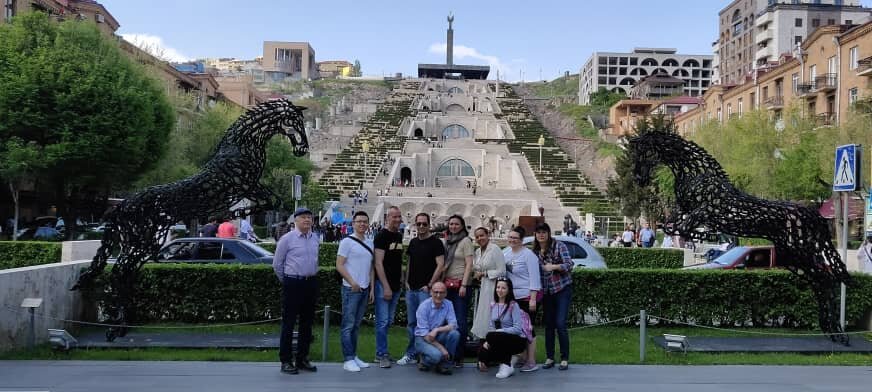
For me, it was the Oganesyan family, of Voskevas Winery near Yerevan, who invited me to taste their extraordinary wines, made from Apri, an ancient grape variety. After years of promises, I finally arrived with the help of Babushka Vartanoush—tour company and friend. My announcement in the Moscow Travel Club sparked a global gathering, and soon, ten companions shared a six-day road trip with me, each drawn by their own curiosity about Armenia.
Armenia came alive for us through emotions and stories—through the eyes of fellow travelers. As Mourad from Luxembourg described:
“I am very happy to have finally discovered this country of which I dreamed—the grandiose landscapes, and of course, the monasteries perched in breathtaking sites. This trip exceeded all my expectations. From a historical perspective, I especially appreciated the museums, in particular the moving Armenian Genocide Memorial at Tsitsernakaberd. And let’s not forget the culinary journey—delicious fruits and vegetables, always fresh, often enjoyed outdoors under perfect weather. A true delight!”
Sacred Spaces and the Armenian "Church Grotesque"
At Lake Sevan, in the remote hills, and within ancient churches and temples carved from basalt, Armenia’s Christian legacy is uniquely expressed. Christianity arrived as early as the third century AD, but what sets Armenian religious art apart is its bold rejection of convention in depicting holy figures.
Here, one can encounter the faces of God and the apostles represented in unexpected ways—sometimes with Mongolian features, braided hair, odd clothing, or humorous, even comical poses. Witnessing these is profoundly educational and surprisingly moving.
As wrote after the May 2019 trip:
"What I witnessed and came to believe is Armenia’s unique ‘church grotesque:’ a visual tradition that survived in the Christian world up to the late Middle Ages, but is almost absent from Russian churches, frescoes, and icons. Contemplating these ancient works is not only fascinating; it is powerfully educational."
— Alexander, Armenia Trip, May 2019
This “grotesque” tradition in Armenian churches mirrors broader European medieval art, where fantastic and mystical figures—sometimes humorous, sometimes satirical—appear in stone and paint. Scholars have debated their purpose. Some argue that grotesques served to teach biblical stories to the illiterate or to ward off evil; others contend they allowed for religious expression and cultural transformation, distinct from the institutional church's teachings. For Armenia, they capture the tension of survival, humor, and transcendence—a persistent testament to the nation’s capacity to endure and reinvent itself.
Legacy: Armenia’s Enduring Message
Armenia, in its land, art, and diaspora, remains a source of love and resilience, shaping those who visit and inspiring those who have never left. Its greatest gift may be its ability to teach: history is neither just tragedy nor celebration, but an ongoing story of pride, creativity, memory, and hope.