Developing Cognitive Skills Through Project-Based Learning: An Effective 10-Week Online Course To Prepare Students In Grades 9-11 For The Unified State Exam In English In The Russian Federation
Ekaterina Shchegoleva
Submitted in Partial Fulfillment of the Requirements for the
University of the People
Master of Education in Advanced Teaching, Secondary Teaching (Grades 6-12)
13.08.2025
Dr. Manisha Sharma
5th term 2025
Acknowledgments
I would like to thank the University of the People for the opportunity to gain knowledge in a format that is convenient for me and at a speed that suits me individually. I thank my instructors for their attention, care and valuable advice, and my classmates for teamwork and the opportunity to communicate without grades.
I also want to thank my students for the experience they gave me, because it was their difficulties that motivated me to create this course.
Many thanks to Galina, the director of the Galingua online school, for believing in my ideas and support.
And endless gratitude to my family, my husband, daughter and son, who patiently waited for their mother to do her job. I love you!
Table of Contents
Introduction 4
Goals 4
Objectives 5
Summary 5
1.Module/Unit 1 7
Introduction 7
Module/Unit Learning Objectives 7
Learning Materials and Resources 7
Tasks 8
2.Module/Unit 2 9
Introduction 9
Module/Unit Learning Objectives 9
Learning Materials and Resources 9
Tasks 10
3.Module/Unit 3 11
Introduction 11
Module/Unit Learning Objectives 11
Learning Materials and Resources 11
Tasks 12
4.Module/Unit 4 13
Introduction 13
Module/Unit Learning Objectives 13
Learning Materials and Resources 14
Tasks 14
Conclusion 15
Recommendations 15
References 16
Appendix 17
Introduction
Galingua Online English Language School has commissioned a 10-week Unified State Exam preparation program for 9-11th grade students in the Russian Federation. The program aims to unify teaching methods and increase students' effectiveness, interest, and motivation through global themes and interactive exercises. Collaboration with universities, foreign language courses, and the Institute for Educational Development is crucial. The program aims to overcome difficulties in exams by restructuring teaching processes, using modern technologies, and avoiding prohibited websites.
Goals
- To introduce students to the specifics of project-based learning
- To give students the opportunity to expand the application of their skills and abilities through project-based learning
- Teach students to independently analyze exam requirements and plan their preparation.
Objectives
- Students will gain experience working with authentic text and learn how to analyze it, expressing their thoughts through oral speech during a discussion, as well as through a “letter to a friend.”
- Students will study documents and research about the environment, in particular such a resource as water, assess the scale of the problem and learn how to create projects to draw attention to the problem.
- Students will understand the stages of the Unified State Exam, analyze its parts and features, evaluate their knowledge and capabilities, and create similar materials for their classmates as part of the project work.
Summary
Galingua Online English Language School has commissioned a 10-week Unified State Exam preparation program for 9-11th grade students in the Russian Federation. The program aims to unify teaching methods and approaches, increase students' effectiveness, interest, and motivation through global themes and interactive exercises. The program collaborates with universities, foreign language courses, and the Institute for Educational Development to conduct field sessions and use distance technologies. The goal is to introduce project-based learning, expand students' skills and abilities, and teach them to analyze exam requirements independently. The program also includes studying environmental resources, assessing scale, and creating projects to draw attention to problems.
1. Module 1 Multicultural learning
Introduction
Students get to know each other, the lesson plan, and the book. The book is provided to each student in pdf format. In three weeks (9 lessons), students learn how to evaluate their classmates, work in a group during and after class. Students learn to read the text to understand the meaning and convey their thoughts in a letter to a friend (classmate). The final stage of this part of the course will be a meaningful letter to a friend about the chapters of the book a student has read and their own thoughts on its content.
Module/Unit Learning Objectives
Cultural Awareness: Develop respect, empathy and understanding of diverse cultural perspectives
Critical Thinking: Analyze concepts and challenge stereotypes through
discussions
Language Proficiency: Enhance vocabulary and linguistic skills through
multicultural texts
Learning Materials and Resources
Text Selection
Things Fall Apart (Achebe, 1958) Chapters 1,7 and 23 taken from the channel Ekaterina Shchegoleva linguist, psychologist, English teacher (2025)
Reason for selection of the text
Things Fall Apart was selected for its exploration of the impact of European colonialism on Igbo society in Nigeria. The novel addresses themes of tradition, masculinity, and cultural identity, challenging students to examine the complexities of cultural change and resistance
Tasks
Tasks in this section include
- Answers to questions that will make students think about the book and its contents
- Reading text during a limited amount of time
- Analysis of the information received and answers to questions about the text
- Reading the text aloud with the intonation of the narrator
- Learning the basic criteria for writing a letter to a friend
- Writing a letter to a friend based on a book you've read
- Evaluation of letters from classmates, according to the criteria.
2. Module/Unit 2 Living and learning globally
Introduction
This is a program for globally competent learners to explore global issues and take action during 3 weeks or 9 lessons. It emphasizes collaboration with various disciplines, acknowledging diverse perspectives, and using technology to bridge language barriers. The program also covers water management policies, governance, sustainability, and sanitation. Students are able to understand the importance of clean water, biodiversity, and human rights, and it encourages students to advocate for their rights to clean water and sanitation.
Module/Unit Learning Objectives
Understanding Water and Sanitation Challenges
• Real-world implications of water and sanitation issues.
• Impact of access to clean water and sanitation on the community.
• Demonstrating ability to collect and present local water samples.
• Participation in activities to improve water quality conditions.
Learning Materials and Resources
1) Toolkit for Water Policies and Governance. (2021, March 22)
2) Water Governance | Land & Water | Food and Agriculture Organization of the United Nations | Land & Water | Food and Agriculture Organization of the United Nations. (n.d.)
3) 4 - What is water governance? (2023, August 2).
Tasks
The tasks in this section include
- Study of articles and documents
- Discussing water resources issues around the world and in your city
- Preparation for an online exhibition dedicated to water resources issues
- Studying projects by other authors and choosing their own theme, problem, and way to create an online exhibition
3. Module/Unit 3
Introduction
Students begin preparing for the Unified State Exam Appendix, determining their needs, strengths and weaknesses (3 weeks - 9 lessons). While studying this topic, students learn how to self-organize to achieve effective results, and look for strategies to overcome difficult situations and psychological discomfort during the exam. Students learn to focus on tasks and control their own emotions.
Module/Unit Learning Objectives
The academic goal is to master exam subjects, eliminate knowledge gaps, and allocate time effectively.
The psychological goal is to overcome stress, develop self-confidence, and create a comfortable environment during preparation. This includes understanding test structure, solving trial tests, and analyzing errors.
Learning Materials and Resources
- Educational portal for exam preparation English language
2) Verbitskaya, M. V., Makhmuryan, K. S., Treshchina, I. V., Federal Service for Supervision of Education and Science, & Federal Institute of Pedagogical Measurements. (2024). METHODOLOGICAL RECOMMENDATIONS for students on organizing independent preparation for the Unified State Exam in 2024. English language. Moscow.
Tasks
To successfully pass the Unified State Exam in English, student need to:
1) speak a foreign language, have strong skills in various types of speech activity (listening, reading, writing, speaking), which implies a large vocabulary, the ability to operate vocabulary in different communication situations, mastery of grammatical, phonetic, spelling skills, as well as strategies for working with in foreign language texts;
2) have a complete and accurate understanding of the exam format, the types of tasks, and the time allotted for their completion;
3) based on the demo version, familiarize yourself with the task evaluation system (with criteria, additional evaluation schemes for detailed answers);
4) practice regularly and systematically, thoughtfully and consistently, distributing the load correctly.
4. Module/Unit 4
Introduction
Students create their own version of the USE assignment for their classmates, focusing on the themes of multicultural learning and global living (1 week - 3 lessons).
In the first lesson, students develop an exam plan and decide whether to submit an oral or written part of their work.
In the second lesson, students share their work, exchange exam parts with their classmates, and conduct testing (which can be done as homework).
In the third lesson, students review the results, provide feedback, and issue certificates of completion for the course.
Module/Unit Learning Objectives
Students are able to identify the main goals and objectives of their work.
Students are able to analyze primary structures and create similar ones.
Students understand what skills are required to create exam assignments and what skills they will test.
Students know how to manage their time correctly and work quickly for results.
Learning Materials and Resources
Students themselves are looking for resources to work on their projects or use those that were in previous units.
Tasks
Students prepare their own version of the USE assignment for classmates using the topics Multicultural learning and Living and learning globally.
Conclusion
The purpose of this course is to help students who do not have access to English exam preparation resources in their area of residence. This course allows students to look at their education differently, understand their responsibility for it, and gain the necessary skills and experience to plan their studies further.
Recommendations
It is necessary to make a questionnaire on the expectations and results of this course for each student. Student data is best divided into three categories: ninth, tenth, and eleventh grade. Analyze the survey results after completing the course and review parts of the course based on student feedback and experience. It is also recommended that teachers complete this course before they teach their students.
References
4 - What is water governance? (2023, August 2). WAREG - European Water Regulators. https://www.wareg.org/articles/4-what-is-water-governance/
Educational portal for exam preparation English language https://en-ege.sdamgia.ru/test?id=3089589
Ekaterina Shchegoleva linguist, psychologist, English teacher (2025). Dzen.ru. https://dzen.ru/a/aGDVMO3b2Vz5_WTG
Toolkit for Water Policies and Governance. (2021, March 22). OECD. https://www.oecd.org/en/publications/toolkit-for-water-policies-and-governance_ed1a7936-en.html
Verbitskaya, M. V., Makhmuryan, K. S., Treshchina, I. V., Federal Service for Supervision of Education and Science, & Federal Institute of Pedagogical Measurements. (2024). METHODOLOGICAL RECOMMENDATIONS for students on organizing independent preparation for the Unified State Exam in 2024. English language. Moscow. https://doc.fipi.ru/navigator-podgotovki/navigator-ege/MR_angl_yaz_ege_2024.pdf
Water Governance | Land & Water | Food and Agriculture Organization of the United Nations | Land & Water | Food and Agriculture Organization of the United Nations. (n.d.). Www.fao.org. https://www.fao.org/land-water/water/watergovernance/en/
Choosing a Reading Strategy - TIP Sheet - Butte College. (n.d.). Www.butte.edu. https://www.butte.edu/departments/cas/tipsheets/readingstrategies/reading_strategy.html
Cambridge University Press. (2025). Cambridge free English dictionary and thesaurus. Cambridge.org. https://dictionary.cambridge.org/dictionary/
The Capstone Project
For this assignment, you will edit and finalize your Capstone Project
Assignment Instructions:
Submit a completed and polished Capstone Project that adheres to the points below:
- Both the capstone deliverable and the rationale report were copiously developed and were congruent.
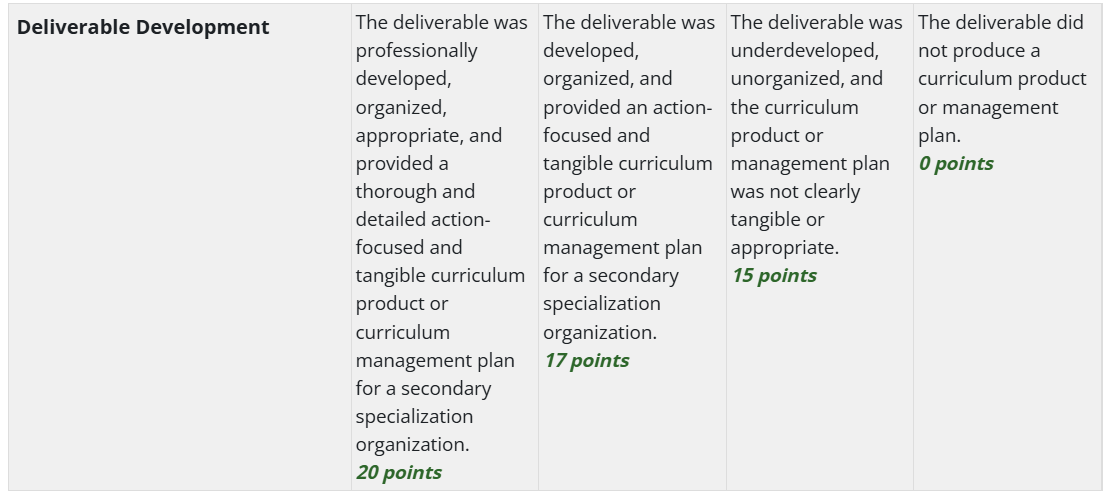
- The deliverable was professionally developed and organized and provided a thorough and detailed action-focused and tangible curriculum product or curriculum management plan.
- The rationale report explained the reason and underlying principles for the deliverable.
- The rationale distinctly answered the need for conducting the project as well as justified the significance and uniqueness of the project.
- The report thoroughly covered the background, purpose, and significance of the deliverable. It clearly included the process used, the application implications, and how the results would be communicated to the organizational stakeholders.
This capstone project will demonstrate and showcase the culmination of what you have learned and the skills you acquired throughout the program to advance your career.
This assignment will be assessed by your instructor using the rubric below.
Grading criteria
Hi Ekaterina,
Congratulations on successfully submitting your Capstone Project! Please apply all the feedback till date in your capstone project for improvement. Your project is well-organized and professionally presented, demonstrating a clear and thorough understanding of the key principles. But here are certain areas which may be improved further for future usage of your project report:
a) Header: Please do not write anything in header except page nos.
b) References: You should add references at the end of Deliverable report.
c) APA: Please follow double line margins for Deliverable report also as per APA 7. The references shared at the end of Rationale report also need improvement as per APA 7.
d) Recommendations: Recommendations can be improved further by adding future recommendations on the basis of project findings.
However, I have watched your work as a researcher grow tremendously over these eight weeks. Your ability to comprehend and analyze things into a deeper context demonstrates to me that you will be a good researcher in future. Keep improving and progressing.
Best Wishes,
Dr. Manisha Sharma