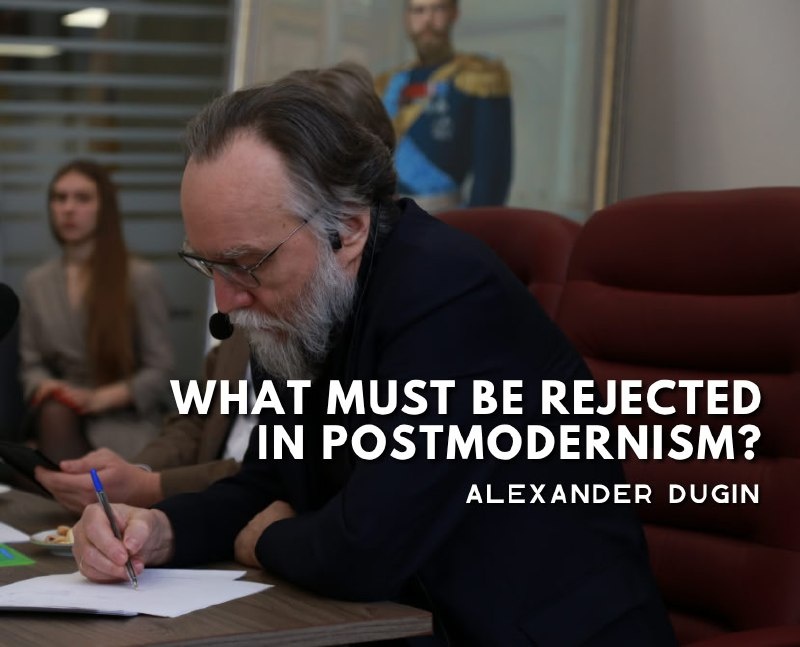
What Must Be Rejected in Postmodernism?
— Let us now identify the features of Postmodernism likely responsible for its totalitarian turn:
— Progressivism, now paradoxical: “progress” means the dismantling of belief in utopia and the future. This could be called “black progressivism” or the “Dark Enlightenment” (Nick Land)
— Materialism, redefined as the apex of postmodernist doctrine, surpassing older, more “idealistic” materialisms. A new “real” materialism must be justified (Deleuze, Kristeva)
— Relativism, in which all universals, taxonomies, and hierarchies are rejected, even as relativism itself becomes dogma (Lyotard, Negri & Hardt)
— Post-structuralism, seeking to overcome structuralism’s limitations, especially its inability to accommodate historical and social dynamism (Foucault, Deleuze, Barthes)
— Radical critique of Tradition, viewed (especially by Hobsbawm) as a bourgeois fiction, a narcotic for the people. This erases any sovereign ontology of spirit.
— New universalism, defined by ironic decomposition and distrust of all unifying claims, shifting focus to ontic fragments and heterogeneity
— The morality of total liberation, celebrating boundless transgression (Foucault, Deleuze, Guattari, Bataille)
— Anti-essentialism, a distorted inference from Heidegger’s Dasein: essence is rejected entirely; being becomes sheer becoming
— Abolition of identity, as identity becomes transient, performative, and morally suspect. Only its overcoming is virtuous.
— Gender theory, imposing radical relativization of gender, age, and species identity (Kristeva, Haraway)
— Postmodern psychoanalysis, seeking to dismantle Freud and Lacan’s structural maps (Guattari)
— Hatred of hierarchy, rejecting vertical order in favor of schizo-masses and “parliaments of organs” (Latour)
— Nihilism, no longer a diagnosis but a celebration of Nothingness — a will towards Nothing (Deleuze)
— Abolition of the Event, replaced by recycling (Baudrillard)
— Posthumanism, surpassing the human as too traditional, advocating hybrids, cyborgs, and chimeras (B.-H. Lévy, Haraway)
— Apologia for minorities, equating organic archaic cultures with artificial, mechanical subcultures; promoting networked pervert and mentally ill communities
Read the full essay here:
https://www.multipolarpress.com/p/alternative-postmodernism