American Psychological Association. (2023). Equity, diversity, and inclusion: Inclusive Language Guide (2nd ed.).
Foreword
This is the second edition of APA’s Inclusive Language Guide. By updating its 2021 edition, the American Psychological Association (APA) continues to work to dismantle the destructive hierarchies that have marginalized people from equitable representation and participation in society. APA remains committed to effecting true change toward achieving equity, diversity, and inclusion (EDI). With this guide, we acknowledge the power of language and explain why certain terms are harmful to marginalized communities. We also understand that some of the terms and concepts that are included may be offensive and painful to different groups.
This second edition of the Inclusive Language Guide incorporates the constructive input and collaborative feedback we received from individuals within and beyond the Association and the field of psychology. The changes reflect our assessment of the current research at the time of publication and include additional guidance and more comprehensive definitions concerning gender-inclusive pregnancy-related language, neurodiversity, religious discrimination, and weight stigma. We also updated our guidance around avoiding conversational language that may contribute to microaggressions. However, this guide is neither exhaustive nor definitive because language evolves over time.
As stated in the first edition, the guide is written to raise awareness, direct learning, and support the use of culturally sensitive terms and phrases that center the voices and perspectives of those who have been historically marginalized or stereotyped. The guide also explains the origins of problematic terms and phrases and offers suitable, more contemporary alternatives. Because this guide is not a legal treatise or advice, terms may differ from how they are defined, interpreted, and applied under law. Please recognize that cultural, global, and regional differences abound; in this guide, we concentrate on language used in a U.S. context.
We encourage all people to adhere to the basic principles of inclusive language, which are to choose appropriately specific terms and to show respect by calling people what they call themselves. This requires being open to continual learning and capacity building and remaining mindful that language may change. Identity is intersectional, meaning that people have multiple identities that are affected by interlocking systems of oppression and privilege. No group is a monolith. Make sure to use inclusive terms to acknowledge that intersectionality. People are different and may disagree on language. It is acceptable to recognize that there may be no perfect solution. Ensure you do your due diligence in the language you select.
This guide will continue to evolve and reflect honest and conscientious efforts by APA to encourage inclusive language that enables effective communication in a rapidly diversifying society and globe.
Maysa Akbar, PhD, ABPP
Chief Diversity Officer
Chief of Psychology in the Public Interest
Inclusive language in writing
General terms related to equity and power
access
The elimination of discrimination and other barriers that contribute to inequitable opportunities to join and be a part of a work group, organization, community, or services (APA, 2021c).
accomplice
“Encompasses allyship but goes beyond to advocacy. An accomplice uses their privilege to challenge existing conditions at the risk of their own comfort and well-being. Whereas an ally might work to make changes on an individual level, an accomplice aims to tackle injustices” such as racial injustices on an institutional level (M. Akbar, 2020; Schafranek, 2021, Definitions section). They aim to alter the structures and policies within society that place marginalized groups at a disadvantage.
ally/allies
People who recognize the unearned privilege they receive from society’s privileging of Whiteness, male gender, Christianity, heterosexuality, ableism, and other identities and take responsibility for advancing equity. It is important to be intersectional when considering how overlapping systems of oppression affect people’s lives (Adames et al., 2023). Although you may experience discrimination due to one or more identities, you may simultaneously experience privilege in others. For example, White women may experience discrimination based on their gender but may also benefit from Whiteness and have privilege as a result. Being an ally is more than just being sympathetic and feeling bad for those who experience discrimination. An ally is willing to act with and for others in pursuit of ending oppression and creating equality. Allyship is not a label you give yourself. How you can serve as an ally is defined and determined by the community you are advocating for. Authentic and transparent allies are willing to step out of their comfort zones. Those who decide to undertake the ally role must recognize and understand the power and privileges that they receive, accept, and experience, and they must use that position to act for justice by centering marginalized voices (M. Akbar, 2020).
antisemitism
Prejudice against, hostility toward, or hatred of Jews. Antisemitism has taken various forms and has been perpetrated by many groups throughout history (APA, 2007a; U.S. Holocaust Memorial Museum, n.d.). Hate crimes, including those derived from antisemitism, can have dangerous physical, psychological, and societal consequences. In 2021, according to Jennifer Kelly , former APA president, “forty percent of U.S. Jewish people experienced antisemitism this past year and 63% experienced it in the past five years” (APA, 2021a, para. 4). Psychological research shows that hate crimes including but not limited to antisemitism create fear, anxiety, and insecurity among victims and others in the community, leaving them feeling vulnerable, angry, and depressed (APA, 2021a). It is important to spell “antisemitism” without a hyphen (for more, see the explanation for the appropriate spelling of antisemitism ; Anti-Defamation League, n.d.).
bias
Partiality, or an inclination or predisposition for or against something. Motivational and cognitive biases are two main categories studied in decision-making analysis. Motivational biases are conclusions drawn due to self-interest, social pressures, or organization-based needs, whereas cognitive biases are judgments that are contrary to evidence, and some of these are attributed to implicit reasoning (APA, 2021c). See implicit bias .
climate
The degree to which community members feel included, affirmed, or excluded in the work group, organization, or community (APA, 2021c). Climates are shaped by organizational practices; interactions among members of the work group, organization, or community; and objective characteristics of the setting (Nishii & Rich, 2014). Please note that in the context of this guide, geophysical climate is not meant by this term.
cultural humility
A lifelong commitment to learning, self-reflection, and challenging your own biases about diverse cultures that are different from yours (Tervalon & Murray-García, 1998). Cultural humility acknowledges that identity is complex, and that each person’s experiences are unique, diverse, and varied. Cultural humility seeks to redress power imbalances and to develop mutually beneficial and equitable partnerships with communities on behalf of individuals and defined populations.
cultural competence
The ability to collaborate effectively with individuals from different cultures; such competence improves experiences and outcomes in health care, consulting with clients, and working with students and trainees in a variety of disciplines (Nair & Adetayo, 2019). “Cultural competence does not refer to a process that ends simply because the psychologist” or other health professional is deemed competent or because the professional is from the culture in question (APA, 2017b, p. 8). Rather, “cultural competence incorporates the role of cultural humility” and is considered a “lifelong process of reflection and commitment” (APA, 2017b, p. 8; see also Sue et al., 2022; Waters & Asbill, 2013). One can commit to the process of lifelong reflection to be aware, responsive, and accountable to the communities one is serving or working with. See cultural responsiveness .
cultural responsiveness
Understanding and responding appropriately to the different aspects of culture and diversity that an individual brings to interactions. It requires valuing diversity, desiring to increase knowledge about other cultures, and striving to create spaces where diversity is integrated (American Speech-Language-Hearing Association, n.d.; Hopf et al., 2021).
decolonization
The process of “undoing the impacts of historical domination on subordinated populations by powerful outsiders” (Gone, 2021, p. 259). Colonization requires the dehumanization of peoples who are Indigenous to an area so that their land is stolen, their culture is erased, and peoples are eliminated for the economic benefit of empire building. The practice of colonizing is “when a country or clan claims the resources of another without permission or just compensation,” in certain cases abusing treaties or disregarding initial agreements. For example, “Great Britain colonized India, stripping the land of its natural resources and depriving its people of basic needs and a right to self-govern” (Simons-Rudolph, n.d., What Is Decolonization? section). A form of colonization, specifically settler colonialism, may be used to describe the way White people “colonized” people in the United States “when they displaced and killed Indigenous populations in their search for land and resources and when eventually expanding eastern railroads” (Simons-Rudolph, n.d., What Is Decolonization? section). The legacy of settler colonialism is dislocation, dispossession, and displacement (Liu et al., 2023) as well as discrimination, oppression, and White privilege. Decolonization is a process of examining and undoing the epistemological injustice, harm, and exclusion that resulted from these historical and present-day processes (Silva & Students for Diversity Now, 2018) and a demand for “land-back” and other forms of economic and cultural justice.
discrimination
The unjust and differential treatment of members of different identities (such as age, gender, gender identity and expression, race, ethnicity, religion, national origin, immigration status, language, disability, sexual orientation, socioeconomic status) and other groups at the individual and institutional or structural level. This unjust treatment favors certain groups over others, restricting opportunities for other groups. Identities can be actual or perceived; for example, a person may be discriminated against for a perception of disability or other marginalized status. At the individual level, discrimination may manifest as prejudice involving negative, hostile, and injurious treatment of the members of marginalized groups (APA, 2021c). At the institutional or structural level, discrimination may manifest as operating procedures, laws, and policies that favor one group over another.
diverse
Involving the representation or composition of various social identity groups in a work group, organization, or community. The focus is on social identities that correspond to societal differences in power and privilege and thus to the marginalization of some groups based on specific attributes—for example, age, gender, gender identity and expression, race, ethnicity, religion, national origin, immigration status, language, disability, sexual orientation, and socioeconomic status. There is a recognition that people have multiple identities and that social identities are intersectional and have different salience and impact in different contexts (APA, 2021c).
English language learners (ELLs)
Multilingual learners in the process of learning English who need additional or modified supports, “who often come from bilingual or non-English-speaking homes and backgrounds, and who might require specialized or modified instruction in both the English language and their academic courses” (The Glossary of Education Reform, 2013, para. 1), although this may not be the case for all ELLs. In most industrialized nations, speaking two or more languages is desirable. Many ELLs encounter bias and national origin discrimination in the United States because English is not their dominant language.
equity
“An ongoing process of assessing needs, correcting historical inequalities, and creating conditions for optimal outcomes by members of all social identity groups” (APA, 2021c, p. 12). Equity also consists of providing resources according to the need to help diverse populations achieve their highest state of health and other functioning and identifying and breaking down barriers to achievement of fair outcomes.
generalization
“The process of deriving a concept, judgment, principle, or theory from a limited number of specific cases and applying it more widely, often to an entire class of objects, events, or people, which can lead to mischaracterizations and stereotypes ” (APA, n.d., Generalization Definition 1).
global citizenship
The umbrella term for “social, political, environmental, and economic actions of globally minded individuals and communities on a worldwide scale” (United Nations, n.d., para. 1). The term may also refer to “the belief that individuals are members of multiple, diverse, local and non-local networks rather than single actors affecting isolated societies” (United Nations, n.d., para. 1).
global majority
Also known as people of the global majority (PGM), a collective term that encourages those of African, Asian, Latin American, and Arab descent to recognize that together they comprise the vast majority (around 80%) of people in the world. Understanding the truth that Whiteness is not the global norm has the power to disrupt and reframe conversations on race (Maharaj & Campbell-Stephens, 2021). Countries that tend to have less economic power and wealth are also sometimes referred to as “majority world” nations instead of “third world” or “developing” countries, terms that are no longer accurate in categorizing countries (Machado, 2016).
Global South
“Refers broadly to the regions of Latin America, Asia, Africa, and Oceania that are mostly (although not all) low-income and often politically or culturally marginalized. The use of the phrase ‘Global South’ marks a shift from a central focus on development or cultural difference toward an emphasis on geopolitical relations of power” (Dados & Connell, 2012, p. 12). “It has been used to discuss systemic inequalities stemming from the ‘colonial encounter,’ the continuing reverberations of (mostly) European colonialism and imperialism, and the potential of alternative sources of power and knowledge” (Haug et al., 2021, p. 1928).
health equity
Ensuring that everyone has a fair and just opportunity to be as healthy as possible. This requires removing obstacles to health such as poverty, discrimination, and their consequences, including powerlessness and lack of access to good jobs with fair pay, quality education and housing, safe environments, and health care (Braveman et al., 2017). For example, individuals with disabilities encounter multiple obstacles to equitably access health care, including the lack of government-funded and/or insurance-covered aids, transportation, and medical equipment; the disproportionate level of poverty associated with having a disability; and the difficulty of obtaining and/or maintaining gainful employment, which could create further barriers to health care.
historical trauma
“Multigenerational trauma experienced by a specific cultural, racial, or ethnic group. It is related to major events that oppressed a specific group of people, such as slavery; the Holocaust; forced migration; and the violent colonization” of Indigenous populations, including Native Americans, Alaska Natives, and Native Hawaiians (Administration for Children and Families, n.d., para. 1). Some people with historical trauma may experience “poor overall physical and behavioral health, including low self-esteem, depression, self-destructive behavior, marked propensity for violent or aggressive behavior, substance misuse and addiction, and cardiovascular disease. Acute problems of domestic violence or alcohol misuse may be exacerbated by living in a community” with historical trauma (Administration for Children and Families, n.d., para. 1) . Multigenerational trauma has also been linked to high rates of suicide. Parents' and caregivers/caretakers’ experiences of historical “trauma may disrupt typical parenting skills and contribute to behavior problems in children. Compounding this familial or intergenerational trauma, historical trauma often involves the additional challenge of a damaged cultural identity” (Administration for Children and Families, n.d., para. 1; see also Sotero, 2006).
human rights
Rights to which all human beings are inherently entitled. The international community has established The Universal Declaration of Human Rights (United Nations, 1948/n.d.), the U.N. Declaration on the Rights of Indigenous Peoples (United Nations, 2007), and other international human rights laws that codify the obligations of governments to respect, protect, fulfill, and promote human rights (APA, 2015b). Human rights are defined by the United Nations as “universal legal rights that protect individuals and groups from those behaviors that interfere with freedom and human dignity” (as cited in APA, 2021c, p. 12). Human rights include “rights to life, freedom from torture, freedom of information and expression,” health, housing, education, and freedom to access the benefits of science and culture (APA Task Force on Human Rights, 2021, p. 3).
implicit bias
An attitude, of which one is not consciously aware, against a specific social group, also known as implicit prejudice or implicit attitude. Implicit bias is thought to be shaped by experience and based on learned associations between particular qualities and social categories, including race and/or gender. Individuals’ perceptions and behaviors may be influenced by the implicit biases they hold, even if they are unaware, they hold such biases. Implicit bias is an aspect of implicit social cognition: the phenomenon that perceptions, attitudes, and stereotypes can operate before conscious intention or endorsement (APA, 2022b).
inclusion
An environment that offers affirmation, celebration, and appreciation of different approaches, styles, perspectives, and experiences, thus allowing all individuals to express their whole selves (and all their identities) and to demonstrate their strengths and capacity (APA, 2021c).
intergenerational trauma
The transmission of trauma or its legacy, in the form of a psychological consequence of an injury, attack, or poverty, from the generation experiencing the trauma to subsequent generations. An example that researchers often cite is posttraumatic slave syndrome, first coined by Na’im Akbar in 1996. Joy DeGruy Leary (2005) further conceptualized this idea by suggesting enslavement of African Americans creates intergenerational psychological trauma. The transference of this effect is believed to be done via epigenetic inheritance—that is, the genetic inheritance remains unaltered but the gene expression (i.e., the phenotype) is altered (Harper, 2005). The trauma experienced by the older generation is translated into a genetic adaptation that may be passed to successive generations (M. Akbar, 2017; APA, 2017a; Menakem, 2017; Whitbeck et al., 2004). In sum, a generations' phenotypical responses to environmental challenges and trauma changes the expression of certain genes and that new gene expression may be transmitted to the offspring via epigenetic inheritance, even when the young generations do not experience the challenges themselves (Harper, 2005). Research suggests that biological or molecular representation of intergenerational experiences may validate the experiences of children who feel the effects of trauma exposure from previous generations (Yehuda & Lehrner, 2018). Also called historical trauma , multigenerational trauma, and secondary traumatization.
intersectionality
The complex, cumulative way in which the effects of multiple forms of discrimination combine, overlap, or intersect—especially in the experiences of marginalized individuals or groups—to produce and sustain complex inequities. The theory of intersectionality, as introduced by Kimberlé Crenshaw in an article for the University of Chicago Legal Forum (Crenshaw, 1989), is the idea that when thinking about how inequalities persist, categories like gender, race, and class are best understood as overlapping and mutually constitutive rather than isolated and distinct. At the time, Crenshaw’s work was focused on Black women’s experiences with racism and sexism. The Combahee River Collective (1977/1995), a group of Black feminists, wrote a statement that is cited as one of the earliest expressions of intersectionality.
Islamophobia
“Prejudice, negative sentiments, and hostility toward Islam and Muslims. Islamophobia may be based on ideas about Islam as a religion and on ideas about Muslims as a cultural and ethnic group. Islamophobic ideas portray Islam and Muslims as a threat to non-Muslims” (Berntzen & Rambøl, 2020, Key Definition section). Hateful rhetoric often leads to discriminatory behavior toward Muslims. In addition, Muslims with overlapping gender and other demographic characteristics may experience intersectional discrimination and stereotyping. For example, Muslim men may be stereotyped as terrorists and violent, whereas Muslim women may be stereotyped as lacking control over their own lives (Clay, 2017). People who present as being from Arab, Middle Eastern, and North African countries may experience Islamophobia regardless of whether they identify as Muslim.
marginalization
“Marginalized communities are those excluded from dominant social, economic, educational, and/or cultural life” (Sevelius et al., 2020, p. 2009). Examples of marginalized populations include, but are not limited to, groups excluded because of age, gender, gender identity and expression, race, ethnicity, religion, national origin, immigration status, language, disability, sexual orientation, and socioeconomic status. Marginalization occurs because of “unequal power relationships between social groups” that perpetuate and sustain inequities (Sevelius et al., 2020, p. 2009).
microaggressions
Commonly occurring brief, verbal or nonverbal, behavioral, and environmental indignities that communicate derogatory attitudes or notions toward a different “other” (Sue et al., 2007). Microaggressions may be intentional or unintentional (APA, 2017b). Microaggressions may accumulate over time and lead to severe harm. The prefix “micro” does not indicate that the aggression is small but rather that it occurs on a person-to-person or “micro” level. The term “microaggression” was coined by Chester Pierce of Harvard University in the 1970s (Pierce et al., 1977). Types of microaggressions include microassaults, microinsults, and microinvalidations (Sue et al., 2007).
minority
A minority group is a population subgroup (e.g., ethnic, racial, religious, or other group) with differential power than those who hold the majority power in the population. The relevance of this term with regard to race and ethnicity is outdated given the changing demographics of the U.S. population. Thus, refrain from using the term “minority.” Instead, use the specific name of the group or groups to which you refer, or use broader terms such as “people of color” or “communities of color” as opposed to “ethnic and racial minorities” (APA, 2020b, 2022a), or you may describe the population as being “minoritized.” You may also consider using the phrase “individuals from underrepresented groups,” “historically marginalized communities,” or “individuals with marginalized identities.” It is still permissible to refer to the sexual and gender populations as minority populations .
oppression
Occurs when one subgroup has more access to power and privilege than another subgroup and when that power and privilege are used to dominate the other to maintain the status quo. Thus, oppression is both a state and a process, with the state of oppression being unequal group access to power and privilege, and the process of oppression being the ways in which that inequality is maintained (APA, 2021c).
pathway programs
Programs (e.g., in secondary schools and colleges) that foster increased access or reduce barriers for marginalized groups to education, training, or a profession. Pathway is preferable to “pipeline” (see definition of pipeline for explanation; APA, 2021c).
performative allyship
Also known as optical allyship , this term refers to someone from a nonmarginalized group professing support and solidarity with a marginalized group but in a way that is not helpful. Worse yet, the allyship is done in a way that may actually harm “the cause.” In many cases, the “ally” may be motivated by some type of reward, such as praise or positive feedback on social media (Kalina, 2020).
population health
The examination of health risks of specific groups of people. It involves a multitiered approach that includes (a) universal provision of preventative tools and health promotion for all people, families, and communities; (b) monitoring, anticipatory guidance, and early intervention for those with risk factors for physical, mental health, and substance-related conditions; and (c) psychosocial, mental health, and/or substance use care for those experiencing illness and/or worsening physical health and mental distress (APA, 2022c). See health equity .
positionality
One’s social position or place in a given society in relation to race, ethnicity, and other statuses (e.g., age, gender, gender identity and expression, religion, national origin, immigration status, language, disability, sexual orientation, socioeconomic status) within systems of power and oppression. Positionality refers to individual identities and the intersection of those identities and statuses with systems of privilege and oppression. Positionality shapes a person’s psychological experiences, worldview, perceptions others have of them, social relationships, and access to resources (Muhammad et al., 2015). Positionality therefore means actively understanding and negotiating the systemic processes and hierarchy of power and the ways that statuses affect relationships because of power dynamics related to privilege and oppression (APA Task Force on Race and Ethnicity Guidelines in Psychology, 2019).
prejudice
A negative attitude toward another person or group formed in advance of any experience with that person or group. Prejudices may include an affective component (e.g., nervousness, anger, contempt, pity, hatred) and a cognitive component (assumptions and beliefs about groups, including stereotypes). Prejudice is typically manifested behaviorally through discriminatory behavior and may be conscious or unconscious. Prejudicial attitudes tend to be resistant to change because they distort perceptions of information about the marginalized person and/or group. Prejudice based on racial grouping is racism; prejudice based on perceived sexual orientation is homophobia and biphobia; prejudice based on sex or gender identity and expression (including transphobia) is sexism; prejudice against people from other countries is xenophobia; prejudice based on chronological age is ageism; and prejudice based on disability is ableism (APA, 2021c).
privilege
Power or advantages that are often inequitably distributed. Such power may come in the form of rights, benefits, social and physical comfort, opportunities, or the ability to define what is normative or valued (A. Bailey, 1998; Johnson, 2018; McIntosh, 1989). Privilege exists because of systems of oppression in the United States that have given advantage to individuals who are White, male, and wealthy, among other identities. It persists to exclude marginalized people from power and position (APA Task Force on Race and Ethnicity Guidelines in Psychology, 2019).
religious discrimination
Prejudice and biased actions against individuals and groups based on their religious, and/or spiritual beliefs, practice, adherence, identification, and/or affiliation. Such discrimination has been carried out by individuals, groups, and governments. Examples include social ostracism against individuals on the basis of their religion, desecration of religious buildings or sites, and violence or other hate crimes targeted toward adherents of particular faith traditions (APA, 2007b). See antisemitism and Islamophobia .
social justice
Commitment to creating fairness and equity in resources, rights, institutions, and systems, and the treatment of marginalized individuals and groups of people who do not share equal power in society (APA, 2021c).
stereotype
A set of cognitive generalizations (e.g., beliefs, expectations) about the qualities and characteristics of the members of a group or social category. Stereotypes, like schemas (“a cognitive structure representing a person’s knowledge about an entity or situation”; APA, n.d., Stereotype Definition 2), simplify and expedite perceptions and judgments. They are often exaggerated, negative rather than positive, and resistant to revision even when perceivers encounter individuals with qualities that are not congruent with the stereotype. See bias .
structural competency
The ability to discern how issues defined clinically as symptoms, attitudes, or diseases (e.g., depression, hypertension, obesity, smoking, medication noncompliance or nonadherence, trauma, psychosis) are influenced by upstream decisions (e.g., access to education, health care and food-delivery systems, zoning laws, and urban and rural infrastructures) or even the very definitions of illness and health (Metzl & Hansen, 2014). Downstream efforts may be conceptualized at the individual or family level of intervention, whereas upstream efforts focus more on “the distribution of power, wealth, opportunities, and decision-making at the societal level” (Lucyk & McLaren, 2017, p. 3).
xenophobia
“Hostile attitudes or aggressive behavior toward people of other nationalities, ethnic groups, regions, or neighborhoods” (APA, n.d., Xenophobia Definition 2). The growing visibility of immigrants from the Global South in the United States and across the globe has triggered a “sense of collective anxiety” (Tummala-Narra, 2020, p. 50). There is an intersection between racism and xenophobia in these cases, and many immigrants and refugees are identified as the causes of unemployment and crime or as threatening to social or cultural identity.
Person-first and identity-first language
person-first versus identity-first language
The discussion of person-first versus identity-first language was first applied to issues regarding people with disabilities (Andrews et al., 2019; Dunn & Andrews, 2015). Although this definition provides examples from the disability context, the language has been broadened to refer to other identity groups as well. Authors who write about identity are encouraged to use terms and descriptions that both honor and explain person-first and identity-first perspectives. Language should be selected with the understanding that the individual’s preference supersedes matters of style. If you are uncertain about how a person identifies, it is recommended that you ask their preference. In person-first language for disability, the person is emphasized, not the disability. “In identity-first language, the disability becomes the focus that allows the individual to claim the disability and choose their identity rather than permitting others (e.g., authors, educators, researchers) to name it or to select terms with negative implications. Identity-first language is often used as an expression of cultural pride and a reclamation of a disability that once conferred a negative identity” (APA, 2020b, p. 136). In some cases, as with the Deaf community and autistic community, it is appropriate to use the preferred identity-first language of the community until you can learn an individual’s preference (APA, 2020b, 2022a). Using the preferred approach to language when discussing people with disabilities—whether that be person-first language, identity-first language, or a mix of both—treats people with disabilities with respect and helps reduce bias in practice, research, and educational settings.
Person-first language may also be appropriate in the following scenarios (Centers for Disease Control and Prevention [CDC], 2022c; National Archives, 2023; National Center on Disability and Journalism, 2021; PFLAG, 2022):
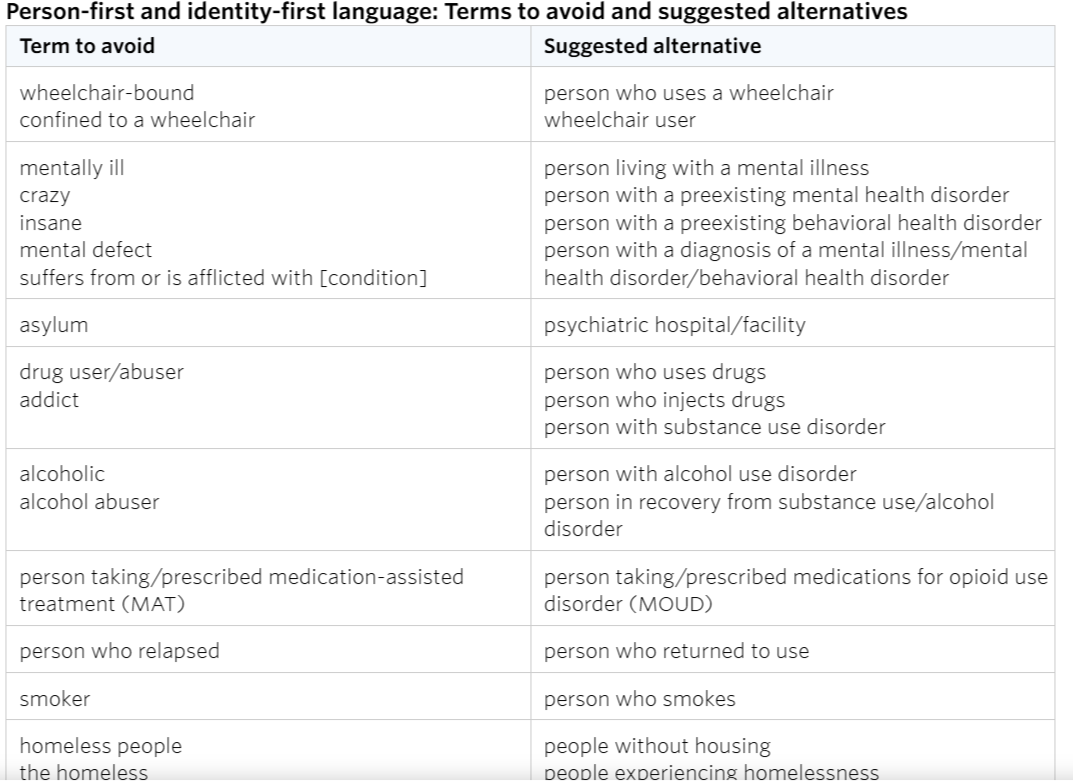
For more information on person-first and identity-first language, please refer to the APA bias-free language guidelines for writing about disability (APA, 2020b, 2022a).
Authors who write about identity are encouraged to use terms and descriptions that both honor and explain person-first and identity-first perspectives.
Identity-related terms
Age
ageism
Stereotyping and discrimination against individuals or groups based on their age, regardless of whether the targeted individual or group is younger or older. Ageism may take many forms, including prejudicial attitudes, discriminatory practices, or some institutional policies and practices that perpetuate stereotypical beliefs (APA, 2020a). Recent data reflect that age discrimination claims constituted 21% of the complaints filed with the Equal Employment Opportunity Commission (EEOC, 2021).
Identity-related terms: Terms to avoid and suggested alternatives
“Avoid using terms such as ‘seniors,’ ‘elderly,’ ‘the aged,’ ‘aging dependents,’ and similar ‘othering’ terms because they connote a stereotype and suggest that older adults are not part of society but rather a group apart” (APA, 2020b, p. 135; see also Lundebjerg et al., 2017; Sweetland et al., 2017). Ageist language may also occur if categories are defined as “adults” in comparison to “older adults.” Individuals aged 18 years and older are adults. Language to provide age comparisons should involve comparable labels for each age range: “younger, middle-aged, and older adults”; “early adulthood, midlife, and later life.” Also, avoid the term “geriatric pregnancy” because it is outdated; instead, use the term “advanced maternal age” or describe the age of the pregnant person specifically, such as “pregnancy at age 35 or older” (American College of Obstetricians and Gynecologists, 2022).
Ageist imagery and presentations are rampant and often include derogation of physical health, cognitive functioning, and psychological well-being even among the healthiest older adults (Chang et al., 2020; Levy, 2022). Take care to avoid linking older age to issues such as memory loss. The term “senior moment” is inherently biased. Likewise, indicating that a behavior or product will generate greater youth implies that youth is preferable.
For more information on problematic and preferred language use related to age, please refer to the APA bias-free language guidelines for writing about age (APA, 2020b, 2022a). See also the APA’s Psychologists Against Ageism resource page and the Reframing Aging Initiative.
Body size and weight
Weight stigma, independent of a person’s weight, is pervasive and has been linked to poorer psychological and physical health outcomes among the people who experience it (Zhu et al., 2022). To avoid perpetuating weight stigma, use neutral terms that affirm and respect the dignity of all individuals regardless of their body size, such as “weight,” “lower weight,” and “higher weight” (Meadows & Daníelsdóttir, 2016), rather than terms such as “underweight,” “fat,” “obese,” and “morbidly obese.”
Although body mass index (BMI) is often used to determine body fat content by medical standards, a growing consensus exists that the BMI is a crude measure because it fails to consider the factors of muscle mass, bone density, overall body composition, and racial and sex differences (Nordqvist, 2022). In June 2023, the American Medical Association issued guidance to physicians stating that BMI is “an imperfect way to measure body fat in multiple groups given that it does not account for differences across race/ethnic groups, sexes, genders, and age-span” (para. 1). The American Medical Association also recognized the BMI’s history of racist exclusion as it is “based primarily on data collected from previous generations of non-Hispanic White populations” (American Medical Association, 2023, para. 2).
When working directly with people, it is best to ask them what terms they prefer and to use those terms, as this is consistent with person-first and identity-first language. Individuals who identify as part of the fat-acceptance community prefer to be called “fat” or “plus sized” as a way to reclaim the word “fat” as a neutral descriptor and normalize the existence of fat bodies (Saguy & Ward, 2011 ).
Many individuals with higher weight internalize negative societal attitudes toward being obese or overweight “and devalue themselves because of their weight, a phenomenon variously labeled as ‘internalized weight stigma,’ ‘weight bias internalization,’ or ‘weight-related self-stigma’” (Meadows & Higgs, 2022, p. 237). Some measures consider self-devaluation because of internalized weight stigma to be distinct from fear of being stigmatized by others (Lillis et al., 2010; Meadows & Higgs, 2020), whereas others view them as interconnected (Durso & Latner, 2008; Meadows & Higgs, 2022).
weight stigma or sizeism
Bias against individuals because of their body size. Like other forms of bias and discrimination, weight stigma, also called sizeism , leads to emotional suffering and psychological distress. Sizeism and stereotypes of individuals of higher weight may have a negative impact on their physical health and well-being. Health professionals who treat people disrespectfully or shame them to motivate changes in behavior create stress and may cause them to delay seeking health care or avoid interacting with providers. Intersectionality may result in a greater cumulative burden for people who experience sizeism as well as other forms of oppression (e.g., sexism, ageism, racism, classism, transphobia, and/or xenophobia), and the stress that such oppression causes may damage people’s health (Abrams, 2022; Chrisler & Barney, 2017).
Body size and weight: Terms to avoid and suggested alternatives
Disability
ableism
Stereotyping, prejudicial attitudes, discriminatory behavior, and social oppression toward people with disabilities to inhibit their rights and well-being (APA, 2021c; Bogart & Dunn, 2019). Multiple attitudinal and cultural factors across global societies lead to various forms of microaggressions and discrimination toward people with disabilities. It is important to counter the deficit orientation that is often implicit in language used to refer to disability. For example, there is often a tendency to infantilize people with physical disabilities or to assume a cognitive deficit if someone has a visible disability. Everyday language and practices implicitly determine the worth of a person depending on whether they are “functional” by medical standards. They rely on the false assumption that if someone does not have full use of their body; cognitive, sensory, or neurological functions; or emotional health they are somehow less valuable or less capable than someone who does. More recently, there has been a shift away from the medical, deficit-based model of disability to the social model of disability. As described by Dunn and Andrews (2015), the social model presents disability as a neutral characteristic borne out of external, social barriers preventing accessibility and participation. More recently, disability has been advanced as an important and valued aspect of diversity (Andrews et al., 2019).
accessibility
“A process shaped by what one needs to do, one’s interactions with the environment, and one’s personal preferences. Accessibility is achieved when people with disabilities can ‘acquire the same information, engage in the same interactions, and enjoy the same services’ as people who do not have disabilities” in “an equally effective and equally integrated manner with substantially equivalent ease of use” (Office of Civil Rights, 2013, para. 3). For further guidance on writing for accessibility, consult PsycLearn’s Cultivating an Accessibility Mindset resource.
disability
A broad concept that describes the interaction of physical, psychological, intellectual, and socioemotional differences with the social environment (World Health Organization, 2001). The members of some groups of people with disabilities—effectively subcultures within the larger culture of disability—have ways of referring to themselves that they would prefer others to adopt. The overall principle for using disability language is to maintain the integrity (worth and dignity) of all individuals as human beings (APA, 2020b, 2022a).
universal design
The process of creating products and built environments to be usable by all people, to the greatest extent possible, without the need for adaptation (APA, 2019).
Disability status: Terms to avoid and suggested alternatives
For more information on problematic and preferred language use related to disability, please refer to the APA bias-free language guidelines for writing about disability (APA, 2020b, 2022a). Other resources include the style guide from the National Center on Disability and Journalism (2021) and the Glossary of Ableist Terms and Phrases (Brown, 2022).
Neurodiversity
The CDC estimates that 15% to 20% of the world population exhibits some form of neurodivergence based on both genetic and environmental factors (CDC, 2021, 2022a; Doyle, 2020). Conceptualizations of neurodiversity continue to evolve since the introduction of the term by Judy Singer in 1998. Neurodiversity refers to the diversity of minds and brains that exist among all people, just as biodiversity refers to biological diversity. Because no two individuals have identical minds or brains, even people who would be categorized as “neurotypical” are considered neurodiverse (Dwyer, 2022). The concept “describes the idea that people experience and interact with the world around them in many ways; there is no one ‘right’ way of thinking, learning, and behaving, and differences are not viewed as deficits” (Baumer & Frueh, 2021, para. 1). Although the word “neurodiversity” refers to the diversity of all people, it is often used in the context of neurological and developmental conditions including autism, attention-deficit/hyperactivity disorder/condition (ADHD/ADHC), and learning disabilities (Baumer & Frueh, 2021). It is the nonpathological “variation in the human brain regarding movement, sociability, learning, attention, mood, and other mental functions at a group level” (Elsherif et al., 2022, p. 9; see also Singer, 2017). Neurodiversity is broad in its definition because it is not limited to disabilities or neurodivergence only; it includes neurotypicality. Experts recommend an “inclusive approach to neurodivergence and propose that it is not solely dependent on a diagnosis and should consider the variable nature of neurobiology” (Elsherif et al., 2022, p. 9). Neurodiversity-related discrimination is a specific type of ableism that can occur in the form of biases and expectations around cognitive functioning, neurodivergence, or mental health.
neurodivergent
When a person’s neurology differs from the neurological “majority”; these differences include autism, attention-deficit/hyperactivity disorder/condition, dyslexia, and dyspraxia (Azevedo et al., 2022). Neurodivergent conditions are frequently centered around diagnoses fitting a narrow set of presentations or behaviors, but they are not solely dependent on the presence of a diagnosis (Elsherif et al., 2022). Neurodivergent individuals are often stigmatized, devalued, and objectified. No universal agreement on the classification of neurodivergence currently exists (Ne’eman & Pellicano, 2022). A person can be described as multiply neurodivergent when their neurocognitive functioning differs from dominant societal norms in multiple ways—for instance, an autistic person who has dyslexia and epilepsy (Walker, 2021). The terms “neurodivergent” and “neurodivergence” were coined by Kassiane Asasumasu, a multiply-neurodivergent neurodiversity activist (Boston University, n.d.).
neurotypical
Being “within parameters of neurocognitive style that have not been either medically defined as ‘disorders’ or culturally defined as ‘neurodivergent’” (Boston University, n.d., Neurotypical Definition 1). It is important to remember there is no such thing as a “normal” brain; rather, “human neurodiversity is a highly complex spectrum, in which everyone sits” (Boston University, n.d., Neurotypical Definition 2).
Race, ethnicity, and culture
acculturation
“The processes by which groups or individuals adjust the social and cultural values, ideas, beliefs, and behavioral patterns of their culture of origin to those of a different culture. Psychological acculturation is an individual’s attitudinal and behavioral adjustment to another dominant culture, which typically varies with regard to degree and type” (APA, n.d., Acculturation definition). Acculturation for marginalized people is often traumatic, not simply a choice but a matter of survival. Forced acculturation experiences are violent, with the intent of reinforcing the primacy of a dominant culture and its people (e.g., White) and substantiating the societal racial hierarchy (Liu et al., 2019).
African American/Black
African American refers to American people of African ancestry. African American and Black are not always interchangeable; African American refers to the ethnicity, whereas Black is a racial group/category. “African American” should not be used as an umbrella term for people of African ancestry worldwide because it obscures other ethnicities or national origins, such as Nigerian, Kenyan, Jamaican, Bahamian, Puerto Rican, or Panamanian; in these cases, use “Black.” The term Afro-Latine (and related terms ending in -Latino, -Latina, or -Latinx) refers to individuals in Latin America or of Latin American descent who are also of African ancestry. The terms “Negro,” “colored,” and “Afro-American” are outdated, and their use is generally inappropriate (APA, 2020b, 2022a).
antiracism
A system of equity based on race that is created and maintained by a dynamic interplay between psychological factors (i.e., equitable thoughts, feelings, and actions) and sociopolitical factors (i.e., equitable laws, policies, and institutions; Roberts & Rizzo, 2021).
Arab, Middle Eastern, and North African (Arab/MENA)
This category “includes all individuals who identify with one or more nationalities or ethnic groups with origins in Arabia, the Middle East, and North Africa. Examples include, but are not limited to, Lebanese, Iranian, Egyptian, Syrian, Moroccan, and Israeli” (Initial Proposals, 2023, p. 5379). When writing about people of MENA descent, state the nation of origin (e.g., Iran, Iraq, Egypt, Lebanon, Israel) when possible. “In some cases, people of MENA descent who claim Arab ancestry and reside in the United States may be referred to as ‘Arab Americans’” (APA, 2020b, p. 144). In all cases, it is best to allow individuals to self-identify (APA, 2022a).
Asian/Asian American
When writing about people of Asian ancestry from Asia, the term “Asian” is appropriate; for people of Asian descent from the United States or Canada, the appropriate terms are “Asian American” and “Asian Canadian,” respectively. It is problematic to group “Asian” and “Asian American” as if they are synonymous. This usage reinforces the idea that Asian Americans are perpetual foreigners. “Asian” refers to Asians in Asia, not in the United States, and should not be used to refer to Asian Americans who are citizens of the United States. Similarly, Asian international students, scholars, visitors, migrants, or immigrants who reside in the United States, but have not become U.S. citizens, should not be referred to as “Asian Americans” because not every Asian who lives in the United States has the rights of citizenship and is protected by the U.S. Constitution. The outdated term “Oriental” is primarily used to refer to cultural objects such as carpets and is pejorative when used to refer to people. Refer to the specific nation or region of origin when possible, for example, “Asian origin” may be divided regionally into South Asian, East Asian, and Southeast Asian (APA, 2020b, 2022a).
BIPOC (Black, Indigenous, and people of color)
People use the term “BIPOC” to acknowledge that not all people of color face equal levels of injustice. The construction of the term recognizes that Black and Indigenous people are severely impacted by systemic racial injustices (Garcia, 2020; Merriam-Webster, n.d.-a). The term “BIPOC” is still considered by many to indicate a hierarchy among communities of color. Scholars argue that the limitation of BIPOC is that it homogenizes communities of color together and a need exists to account for people’s unique racial, cultural, and intersectional identities (Cisneros et al., 2023). Experts suggest that when “BIPOC” is used, people fail to recognize how different groups are racialized and further engage in othering, particularly for racial groups that are not part of Black and Indigenous communities. It is important to recognize that some terms or phrases that were initially created to encourage solidarity among different racial movements may over time become descriptors that erase distinctions (Grady, 2020). Therefore, use specific terms when referring to different racial and ethnic groups. When such a level of specificity is not possible, instead of “BIPOC” use alternative terms, such as “people/persons of color” and “communities of color.”
The term BIPOC is considered by many to indicate a hierarchy among communities of color. Therefore, use specific terms when referring to different racial and ethnic groups. When such a level of specificity is not possible, instead of “BIPOC” use alternative terms, such as “people/persons of color” and “communities of color.”
color-blind beliefs
The denial or minimization of race or racism in society (i.e., “not see [skin] color”; Neville et al., 2013, p. 456; see also Bonilla-Silva, 2021). Color-blind beliefs in a racial sense purportedly are based on the assumption that acknowledgment of race reifies racial divisions in society. People who endorse color-blind beliefs believe that individual effort is sufficient for achievement in a meritocracy predicated on the idea that everyone has equal opportunities for life success. People who hold color-blind attitudes believe that doing so reduces racial and ethnic prejudice and that acknowledging racial and ethnic differences promotes racial division. However, research shows that holding color-blind beliefs allows racial and ethnic prejudice to fester (Pahlke et al., 2012; Richeson & Nussbaum, 2004). Likewise, scholars are beginning to acknowledge the inherent ableism in the term “color-blind” to describe beliefs and policies that promote a deficit orientation toward disability. The use of the term “color-evasiveness” is suggested as an alternative because it is an “expansive racial ideology” that “resists positioning people with disabilities as problematic” (Annamma et al., 2017, p. 153).
color-blind policies
Institutional policies that are race-neutral in language and tone but have a disproportionately harmful impact on people of color (Apfelbaum et al., 2012; Block, 2016; Castro-Atwater, 2016; Penner & Dovidio, 2016). Color-blind beliefs undergird color-blind policies. Research indicates that the United States is not a meritocracy (Farkas, 2003; Gale et al., 2017; Pearson et al., 2009). Moreover, color-blind policies that have a disparate negative impact on people of color do not lead to equitable treatment across groups (APA Task Force on Race and Ethnicity Guidelines in Psychology, 2019; Helms, 2008; Neville et al., 2000, 2016). Please see the discussion in “ color-blind beliefs ” regarding the use of the term “color-evasiveness” as an alternative to “color-blind.”
colorism
“A form of discrimination based on skin color, usually, though not always, favoring lighter skin color over darker skin color within a racial or ethnic group” (Noe-Bustamante et al., 2021, para. 3).
culture
The values, beliefs, language, rituals, traditions, and other behaviors that are passed from one generation to another within any socially definable group. Accordingly, cultural groups could include groups based on shared identities such as ethnicity (e.g., German American, Blackfoot, Algerian American), gender and gender identity (e.g., woman, man, transgender, gender nonconforming), sexual orientation (e.g., gay, lesbian, bisexual), and socioeconomic status (e.g., poor, working class, middle class, wealthy; APA Task Force on Race and Ethnicity Guidelines in Psychology, 2019).
cultural appropriation
“An action whereby an individual makes use of, imitates, or takes possession of cultural products of an outgroup or source community” (A. J. Mosley et al., 2023, p. 1). Perceptions of cultural appropriation vary and are influenced by multiple factors, including the degree to which people hold color-evasive or color-blind beliefs , racial power differentials, and knowledge of racial history.
enculturation
First introduced by anthropologist Melville Herskovits (1948), enculturation is defined as “the process by which individuals learn and adopt the ways and manners of their culture” (Matsumoto, 2004, p. 156). Enculturation emphasizes socialization to, or maintenance of, one’s culture of ethnic or familial ethnic origin (APA Presidential Task Force on Educational Disparities, 2012; Kim & Abreu, 2001; Zhang & Moradi, 2013). This process considers how, for example, U.S.-born or highly U.S.-acculturated individuals may be more actively learning their ethnic origin culture, rather than maintaining it (APA Task Force on Race and Ethnicity Guidelines in Psychology, 2019).
ethnic bias
“Differential treatment toward individuals based on their ethnic group, often resulting in inequities in such areas as education, employment, health care, and housing. [With regard to testing and measurement, ethnic bias refers to] deficiency or tainting in an instrument that differentially affects the scores of those from different ethnic groups. Ideally, researchers strive to create culture-fair tests” (APA, n.d., Ethnic bias definition; see also Phinney, 1992; Rivas-Drake & Umaña-Taylor, 2019). See also definition of bias .
ethnic identity
“An individual’s psychological sense of being a person who is defined, in part, by membership in a specific ethnic group. This sense is usually considered to be a complex construct involving shared social, cultural, linguistic, religious, and often racial factors but identical with none of them” (APA, n.d., Ethnic identity definition).
ethnicity
A characterization of people based on having a shared culture (e.g., language, food, music, dress, values, and beliefs) related to common ancestry and shared history (APA, 2021c).
Hispanic, Latino, Latina, Latino/a, Latin@, Latine, Latinx, or Chicano
When writing about people who identify as Hispanic, Latino, Latina, Latin@, Latine, Latinx, Chicano, or another related designation, you should consult with the individuals with whom you are working to determine the appropriate terminology.
- Note that “Hispanic” is not necessarily an all-encompassing term, and the labels “Hispanic” and “Latine” have different connotations.
- The term “Latine” (and its related forms) might be preferred by those originating from Latin America, including Brazil. “Latine” is a gender-inclusive alternative that is far more adaptable to the Spanish language than “Latinx” (Ochoa, 2022).
- Some use the word “Hispanic” to refer to those who speak Spanish; however, not every group in Latin America speaks Spanish (e.g., the official language of Brazil is Portuguese).
- The word “Latino” is gendered (i.e., “Latino” is masculine, and “Latina” is feminine), whereas the term “Latine” is gender inclusive.
The term “Latinx” may be used for people who identify as Latinx but may not broadly resonate as an inclusive term given that the “x” signifier does not conform with Spanish or Portuguese syntax ( de Onís, 2017). Typically, the most marginalized communities do not use “Latinx” (Ochoa, 2022). Individuals who tend to self-identify as Latinx are likely to be U.S.-born young adults who are predominantly English speakers. Whenever possible, use terms that people use to describe themselves.
In general, naming a nation or region of origin is preferred (e.g., Bolivian, Dominican, Salvadoran, or Costa Rican is more specific than Latino, Latine, Latinx, Latin American, or Hispanic; APA, 2020b, 2022a).
Indigenous
The Native American Journalists Association (n.d.) states that although no official definition of “Indigenous” exists, “the United Nations has developed an understanding of the term based on self-identification; historical continuity to pre-colonial and/or pre-settler societies; links to territories and resources, distinct social, economic and political systems and possession of distinct languages, cultures and beliefs” (Indigenous or Aboriginal section). Capitalize “Indigenous People” when referring to a specific group; when describing specific persons who are Indigenous, capitalize “Indigenous” but not “people” (APA, 2020b, 2022a; for more information, see APA’s bias-free language guidelines on racial and ethnic identity ). Avoid using possessive language in reference to Indigenous groups, such as “of” or “our.” For example, First Nations, Inuit, and Métis peoples in Canada prefer that any possessive language be avoided because they do not “belong” to Canada but are sovereign nations in their own right (Queens University, 2019).
Indigenous Peoples around the world
When writing about Indigenous Peoples, use the names that they call themselves. In general, refer to an Indigenous group as a “people” or “nation” rather than as a “ tribe .” The bias-free language guidelines of the Publication Manual (APA, 2020b, p. 144) make the following distinctions:
- In North America, the collective terms “Native American” and “Native North American” are acceptable (and may be preferred to “American Indian”). “Indian” usually refers to people from India. Specify the nation or people if possible (e.g., Cherokee, Navajo, Sioux).
- Hawaiian Natives may identify as “Native American,” “Hawaiian Native,” “Indigenous Peoples of the Hawaiian Islands,” and/or “Pacific Islander.”
- In Canada, refer to the Indigenous Peoples collectively as “Indigenous Peoples” or “Aboriginal Peoples” (National Aboriginal Health Organization, n.d.); specify the nation or people if possible (e.g., People of the First Nations of Canada, People of the First Nations, or First Nations People; Métis; Inuit).
- In Alaska, the Indigenous People may identify as “Alaska Natives.” The Indigenous Peoples in Alaska, Canada, Siberia, and Greenland may identify as a specific nation (e.g., Inuit, Iñupiat). Avoid the term “Eskimo” because it may be considered pejorative.
- In Latin America and the Caribbean, refer to the Indigenous Peoples collectively as “Indigenous Peoples” and by name if possible (e.g., Quechua, Aymara, Taíno, Nahuatl).
- In Australia, the Indigenous Peoples may identify as “Aboriginal People” or “Aboriginal Australians” and “Torres Strait Islander People” or “Torres Strait Island Australians.” Refer to specific groups when people use these terms to refer to themselves (e.g., Anangu Pitjantjatjara, Arrernte).
- In New Zealand, the Indigenous People may identify as “Māori” or the “Māori people” (the proper spelling includes the diacritical macron over the “a”).
For information on citing the Traditional Knowledge or Oral Traditions of Indigenous Peoples as well as capitalizing terms related to Indigenous Peoples, see Sections 5.7 and 8.9, respectively, of the Publication Manual (APA, 2020b).
Indigenous land acknowledgment
“An effort to recognize the Indigenous past, present, and future of a particular location and to understand [one’s] place within that relationship. Land acknowledgments usually take the form of written and/ or verbal statements” and are becoming more common at conferences (including the APA convention), community gatherings, places of worship, concerts, and festivals (Native Governance Center, 2021, What Is Indigenous Land Acknowledgment? section). Such land acknowledgments are a first step only. Without substantive action to accompany acknowledgment, it would be performative allyship . Substantive action can include concrete steps about how you intend to support Indigenous communities. To view an example, visit APA's land acknowledgment .
Jews/Jewish Americans
According to a 2020 Pew survey on Jewish Americans, the U.S. Jewish population consists of the following two groups:
- About three quarters (73%) of U.S. Jewish adults identified their religion as Jewish and do not profess any other religion.
- About a quarter (27%) of U.S. Jewish adults described themselves (religiously) as atheist, agnostic, or nothing in particular but considered themselves to be Jewish ethnically, culturally, or by family background (e.g., they have a Jewish parent or were raised Jewish).
- The majority of U.S. Jews identify as White (Pew Research Center, 2021).
people of color
This term represents a shift from the term “ minority ” to refer to individuals from diverse racial and ethnic backgrounds. Although it is acceptable for communities to be described as “minoritized,” it is not recommended to refer to people or a population as minority . Instead, use “people of color” or “communities of color” when referring to groups from diverse backgrounds who are non-White. When appropriate, you may use the terms underserved, underrepresented , or marginalized to describe populations of color; however, use the specific group title whenever possible, such as Asian American women, Black students, or Indigenous communities (APA, 2020b, 2022a).
people of European origin
When writing about people of European ancestry, the terms “White” and “European American” are acceptable. Adjust the latter term as needed for location (e.g., “European,” “European American,” and “European Australian” for people of European descent living in Europe, the United States, and Australia, respectively). Using the term “Caucasian” instead of “White” or “European” is discouraged because it originated as a way of classifying White people as a race to be favorably compared with other races. As with all discussions of race and ethnicity, be more specific about regional (e.g., Southern European, Scandinavian) and national (e.g., Italian, Irish, Swedish, French, Polish) origin when possible (APA, 2020b, 2022a).
race
The social construction and categorization of people on the basis of perceived shared physical traits that result in the maintenance of a sociopolitical hierarchy (APA, 2021c).
racial identity
“An individual’s psychological sense of being defined, in part, by membership in a particular racial group. The strength of this sense depends on the extent to which an individual has processed and internalized the psychological, sociopolitical, cultural, and other contextual factors related to membership in the group. Given the socially constructed nature of racial categories, racial identifications may change over time in different contexts” (APA, n.d., Racial identity definition; see also Rivas-Drake & Umaña-Taylor, 2019).
racial and ethnocultural justice
Applies social justice meanings specifically to inequities affecting people of color (Prilleltensky, 2012). Thus, it explicitly attends to the ways that race and ethnicity have affected the inequitable distribution of resources and opportunities for equitable participation, power, and influence (e.g., distributive, procedural, retributive, relational, and cultural justice; Prilleltensky, 2012). Racial and ethnocultural justice within psychology also speaks to how oppression and marginalization have shaped the psychological, relational, and practical experiences of people of color. Psychologists aspiring for racial and ethnocultural justice strive to apply this understanding to develop their professional activities in ways that address the negative effects of injustice and challenge the existence and maintenance of racial and ethnic oppression (APA Task Force on Race and Ethnicity Guidelines in Psychology, 2019).
racial socialization
Refers to the developmental process by which race-related messages about the meaning of race and racism are transmitted by parents and caregivers, peers, and extended families intergenerationally. It consists of various kinds of parental messages, activities, and behaviors; teaching children about their racial–ethnic heritage and history and promoting racial pride ( racial pride / cultural socialization ); highlighting the existence of inequities between groups and preparing youths to cope with discrimination ( racial barriers / preparation for bias ); emphasizing individual character traits such as hard work over racial or ethnic group membership ( egalitarianism ); focusing on the necessity of individual excellence and the development of positive character traits ( self - development ); promoting feelings of individual worth within the broader context of the child’s race or ethnicity ( self - worth messages ); emphasizing negative characteristics associated with their racial identity ( negative messages ); conveying distrust in interracial communications ( promotion of mistrust ); engaging in race-related activities and behaviors ( socialization behaviors ); and avoiding mention of issues pertaining to race or ethnicity ( silence about race ; Hughes et al., 2006; Neblett et al., 2012; Scottham et al., 2006). Together, these multiple aspects of racial socialization are thought to combine to provide youths of color with a view of both the significance and the meaning of race (and ethnicity) in U.S. society (Neblett et al., 2016).
racial/racialized/race-based trauma
A form of race-based stress, referring to people of color and Indigenous individuals’ reactions to dangerous events and experiences of racial discrimination. Such experiences may include threats of harm and injury, humiliating and shaming events, and witnessing racial discrimination toward other people of color. Although similar to posttraumatic stress disorder, racial trauma is unique in that it involves ongoing individual and collective injuries due to exposure and reexposure to race-based stress. Brave Heart (2000), a Hunkpapa/Oglala Lakota social worker, “conceptualized historical trauma and documented how the trauma of racism and colonization showed ‘cumulative wounding across generations’” (French et al., 2020, p. 18). Later literature argued “that the systematic effects of intentional or unintentional racism across individual, institutional, and cultural levels can have significant psychological impacts similar to other forms of trauma” (French et al., 2020, p. 18; see also Bryant-Davis & Ocampo, 2005; Carter, 2007; Comas-Díaz et al., 2019; Kniffley, 2018; D.V. Mosley et al., 2020).
racism
A system of power that structures opportunity and assigns value to people based on their ancestry and phenotypic properties (e.g., skin color and hair texture associated with “race” in the United States). Racism is expressed at multiple levels in a given society. It encompasses interpersonal interactions involving racial discrimination, cultural imagery, and harmful stereotypes of people of color and macrolevel policies and practices that systematically disadvantage people of color for quality education, housing, health care, employment, and so forth. These disadvantages result in racial disparities favoring White people in earnings and wealth, mental and physical health, political access and influence, and treatment under the law (APA, 2021b; Jones, 2002). The following more specific forms of racism also exist:
- cultural racism
The “institutional domination and sense of racial–ethnic superiority of one social group over others,” justified by culturally constructed markers like language use, religious practice, immigrant status, social welfare dependency, and the profiling of criminal and terrorist behavior (Chua, 2017, para. 1). - institutional racism
The collection of policies, practices, and procedures of societal institutions—such as educational institutions, government, health care, employers, housing, financial institutions, the arts, entertainment and media, and knowledge—that marginalizes and subjugates nondominant racial groups in a given society (Harrell, 2000; Jones, 2000). Also institutionalized racism, systemic racism. Various disciplines (e.g., psychology, sociology, and public health) are beginning to delineate between institutional and structural racism . Until recently, these terms were often used interchangeably (Gee & Hicken, 2021). - structural racism
Results from interconnected and synergistic effects of institutional racism. That is the laws, policies, and practices across institutions that maintain White supremacy, thereby producing harmful cumulative, durable, race-based disparities. It includes the failure to correct previous laws and practices that were explicitly or effectively racist (Anderson et al., 2022; Z. D. Bailey et al., 2017; Gee & Hicken, 2021). Also systemic racism. - interpersonal racism
Occurs when individuals from socially and politically dominant racial groups behave in ways that diminish and harm people who belong to other racial groups. Interpersonal racism is therefore a form of bigotry (negative attitudes about groups different from one’s own, not necessarily tied to race) or prejudice (a preconceived opinion that is not based on reason or actual experience; APA, 2021b; Jones, 2000). - internalized racism
A notion of interpersonal impact experienced by people of color, in which people hold negative societal beliefs and stereotypes about themselves—for example, about complexion and color (i.e., colorism) that reinforce the superiority of White people and may lead to the self-perception of being devalued, worthless, and powerless (APA, 2021b; Jones, 2000).
Roma, Romany, Romani, or Traveler communities
Roma (singular: Rom), also called Romany, are “an ethnic group of traditionally itinerant people who originated in northern India” but now live worldwide, mostly in Europe (Britannica, 2017, para. 1). They have long experienced marginalization and discrimination from society. Using the term “Gypsy” to refer to these communities is now considered outdated and pejorative. The European Commission Against Racism and Intolerance describes anti-Gypsyism as “a specific form of racism, an ideology founded on racial superiority, a form of dehumanization and institutional racism nurtured by historical discrimination, which is expressed, among others, by violence, hate speech, exploitation, stigmatization, and the most blatant kind of discrimination” (as cited in O’Brien et al., 2022, para. 2).
texturism
Discrimination based on hair texture often directed at people of African descent. Curls that are smaller, coarser, or kinkier in texture are often less prized, whereas looser curls and straight hair that adheres to Eurocentric beauty standards are considered more ideal (Awad et al., 2015).
tokenism
“The making of a perfunctory or symbolic gesture that suggests commitment to a practice or standard, particularly by hiring or promoting a single member of a previously excluded group to demonstrate one’s benevolent intentions. For example, an all-White company may hire a token Black employee to give the appearance of organizational parity as opposed to actually eliminating racial inequality in the workplace. Tokenism depends on the prevailing norms, structures, and conceptualizations (e.g., of ideal ingroup and outgroup members) of the cultural context in which it is embedded” (APA, n.d., Tokenism definition).
White privilege
Unearned power that is afforded to White people on the basis of race, rather than earned merit, that protects White people from the consequences of being racist and benefitting from systemic racism (Liu, 2017). Such power may come in the form of rights, benefits (e.g., health care), social comforts, opportunities (e.g., access to education), or the ability to define what is normative or valued. This does not mean that White people seek to be privileged, only that they inherently benefit from being members of a dominant group in a biased system (APA Task Force on Race and Ethnicity Guidelines in Psychology, 2019; Goodman, 2011).
White supremacy
The ideological belief that biological and cultural Whiteness is superior to all other races and ethnicities, as well as normal and healthy. This pervasive ideology continues to polarize the United States and undergird racism (APA, 2021c). For more information, see also White privilege .
For more information on problematic and preferred language use related to race and ethnicity, please refer to the APA bias-free language guidelines for writing about racial and ethnic identity (APA, 2020b, 2022a).
Institutional racism results from policies, practices, and procedures of societal institutions—such as educational institutions, government, health care, employers, housing, financial institutions, the arts, entertainment and media, and knowledge—that marginalize and subjugate nondominant racial groups in a given society.
Sexual orientation and gender diversity
Inclusive language allows us to respect the vast spectrum of ways in which people express their gender identity and sexual orientation. As always, we recommend listening to and affirming the ways in which different communities refer to themselves. Make room for nuance and flexibility when considering how sociocultural contexts and demographic factors affect sexual orientation and gender diversity. Although no acronym or term is all encompassing, depending on generation, age, geographic region, and other facts and circumstances, some people may use terms to describe themselves and others that may be perceived as pejorative but are empowering for those individuals and their communities. Take a global perspective when considering how gender identity and sexual orientation are conceptualized outside of Western, educated, industrialized, rich, and democratic (WEIRD) societies.
cissexism
“Prejudice, stereotyping, or discrimination on the basis of sex, specifically toward transgender and gender-expansive people” (PFLAG, 2022, Cissexism definition).
gender
The spectrum of masculinity, femininity, gender expansive, and nonbinary status that includes expression, identity, behavior, and sociocultural constructions. “In a human context, the distinction between gender and sex reflects the usage of these terms” (APA, n.d., Gender Definition 1): Sex usually refers to biological features that have been associated with being male, female, or intersex such as genitalia, hormones, and chromosomes, whereas gender is “a set of socially constructed roles, behaviors, activities, and attributes that a given society considers appropriate” for a specific gender identity (PFLAG, 2022, Gender definition). Here is an example of when it is appropriate to use gender versus sex: “I am a cisgender woman” versus “I was born a female.”
gender and pronoun usage
Do not use the term “preferred pronouns” because this implies a choice about one’s gender. Use the term “pronouns” or “identified pronouns” instead. When writing about a known individual, use that person’s identified pronouns. When referring to individuals whose identified pronouns are unknown or when the gender of a generic or hypothetical person is irrelevant within the context, use the singular “they” to avoid making assumptions about an individual’s gender. Use the forms “they,” “them,” and “theirs,” (APA, 2020b, 2022a). Although pronoun usage is often unique and personal to the individual, some people who transition may view themselves as always being their affirmed gender, even before they were able to socially or medically transition. Use the pronoun that is aligned with a person's identified gender even when referring to a person's lived experiences from before their transition.
gender/sex binary
The belief that sex is binary and that sex determines gender (Hyde et al., 2019). Instead, use “sex” to refer to biological factors such as chromosomes and anatomy and “gender” to refer to the roles and self-identity associated with sex (i.e., what it means to be/identify as a woman, man, or nonbinary in a specific culture; Morgenroth et al., 2021; see also APA, 2018; Wood & Eagly, 2015). Empirical evidence affirms that gender is a nonbinary spectrum (Hyde et al., 2019). Inclusive language should reflect and respect gender diversity. It is important to note that holding beliefs in the gender binary fails to represent science’s understanding of gender and can result in avoidable harm (Cameron & Stinson, 2019).
gender creative
A term coined by clinical and developmental psychologist Diane Ehrensaft to describe a child or adolescent who rejects expected gender roles and stereotypes. The gender creative child or adolescent “transcends the culture’s normative definitions of gender to creatively interweave a sense of gender that comes neither totally from the inside (the body, the psyche), nor totally from the outside (the culture, others’ perceptions of the child or adolescent’s gender), but resides somewhere in between” (Ehrensaft, 2011, p. 5).
gender-exclusive versus gender-inclusive language
Gender-exclusive language consists of terms that categorize all people under masculine language or within the gender binary (i.e., man or woman), thereby failing to include everyone. Conversely, gender-inclusive language uses terms that are more gender equitable. When describing a generic or hypothetical person whose gender is irrelevant to the context of the usage, do not use gendered pronouns such as “he” and “she” or gendered pronoun combinations such as “he or she” or “s/he” because these pronouns and pronoun combinations assume gender and a gender binary. Instead, use the singular “they” because it is gender inclusive. When describing a specific person, use that person’s pronouns (e.g., “he,” “she,” “they,” “ze,” “xe” ; Conover et al., 2021). Ask the person for their pronouns rather than making assumptions because there may be cultural and linguistic nuances (e.g., in the Latine community, pronouns such as “ella” and “el” may be used).
Avoid gendered nouns when generally describing people who may be of any gender. For example, instead of “ladies and gentlemen” or “you guys,” use gender-inclusive nouns such as “everyone,” “distinguished guests,” “folks” or “folx,” “friends,” or “y’all.” Likewise, avoid gendered occupational nouns such as “chairman.” Instead, use gender-inclusive occupational nouns such as “chair” or “chairperson” (National Institutes of Health, 2023).
gender-fluid
“Describes a person who does not consistently adhere to one fixed gender and who may move among genders” (PFLAG, 2022, Genderfluid definition).
gender identity
A person’s psychological sense of their gender. Many people describe gender identity as a deeply felt, inherent sense of being nonbinary, a woman/girl, or a man/boy, although these gender identities are not mutually exclusive—you may be a boy and nonbinary at the same time. These gender identities may or may not correspond to a person’s sex assigned at birth, presumed gender based on sex assignment, or primary or secondary sex characteristics (APA, 2015a). Gender identity applies to all individuals and is not a characteristic of only transgender or nonbinary individuals. Gender identity is distinct from sexual orientation ; thus, the two must not be conflated (e.g., a gay transgender man has a masculine gender identity and a gay sexual orientation, a heterosexual cisgender woman has a feminine gender identity and a heterosexual orientation). Gender identity is also distinct from gender expression, which refers to one’s outward appearance, including “the presentation of an individual including physical appearance, clothing choice and accessories, and behaviors that express aspects of gender identity” (APA, 2015a, p. 861).
- affirmed gender
The gender by which one wishes to be known. This term is often used to replace terms like “new gender” or “chosen gender,” which imply that an individual’s gender was not always their gender or that the gender did not always exist (PFLAG, 2022). - agender
“Refers to a person who does not identify with or experience any gender. Agender is different from nonbinary [see nonbinary ] because many nonbinary people do experience gender” (PFLAG, 2022, Agender definition). - cisgender/nontransgender
Refers to “a person whose gender identity aligns with sex assigned at birth” (APA, 2015a, p. 833). - gender socialization
“A process that influences and teaches an individual how to behave as a man or a woman, based on culturally defined gender roles. Parents [and caregivers], teachers, peers, media, and faith traditions are some of the many agents of gender socialization. Gender socialization looks very different across cultures, both inside and outside of the [United States], and is heavily impacted by other intersecting identities” (PFLAG, 2022, Gender socialization definition). - nonbinary
“Refers to people who do not subscribe to the gender binary. They might exist between or beyond the man–woman binary. Some use the term exclusively, while others may use it interchangeably with terms like genderqueer, gender-fluid, gender nonconforming, gender diverse, or gender expansive” (PFLAG, 2022, Nonbinary definition). - transgender
An umbrella term used to describe “the full range of people whose gender identity and/or gender role do not conform to what is typically associated with their sex assigned at birth” (APA, 2015a, p. 863). Many transgender people engage in a process of affirming their transgender identity through social, legal, and/or medical transition .
gender-inclusive language related to pregnancy
Recommended language regarding pregnancy is evolving, and appropriate wording depends on the audience and context. The most inclusive language recognizes that not only cisgender women but also transgender people who were assigned female at birth (AFAB) may become pregnant or desire to become pregnant. Thus, terms such as “pregnant person,” “pregnant parent,” and “birthing parent” may be preferred over “pregnant woman,” which is grounded in cisnormativity (MacKinnon et al., 2021). The “use of gendered terminology (e.g., ‘she,’ ‘mom,’ ‘breasts’) intensifies gender-related psychological distress” for transgender pregnant people (MacKinnon et al., 2021, p. 201). The term “chestfeeding” may be used as an inclusive term for gender nonconforming, transgender, or queer gestational parents.
Consider the audience before using medicalized terminology (e.g., “person with a cervix,” “menstruators”) as opposed to more plain language that may be more appropriate with young people, those with low literacy or education, those with intellectual disabilities, and English language learners who may not have a strong understanding of anatomical and physiological terms and may not recognize themselves as being referred to by these terms (Gribble et al., 2022). Terms such as “birther” and terminology that prioritizes referring to body parts over the whole person (e.g., “uterus owners”) may be perceived as dehumanizing and othering. An entirely gender-neutral approach to pregnancy-related terminology risks erasing the lived authentic experiences of women who are pregnant (Dahlen, 2021; Gribble et al., 2022; Hall Smith & Bamberger, 2021).
Rather, strive to be gender-inclusive by intentionally portraying how individuals’ behaviors and experiences are shaped by living in a gendered world (Hall Smith & Bamberger, 2021). Choose terms carefully and provide definitions, especially when comparing groups and distinguishing between sex and gender. For example, define whether “nonpregnant people” refers to women and AFAB trans people who could become pregnant or to all people who are not pregnant, including cisgender men (Gribble et al., 2022). When working directly with pregnant people or those who could become pregnant, use the terms used by those individuals. When working with diverse audiences, it may be helpful to develop targeted materials using the preferred language.
gender nonconforming (GNC)/gender expansive
Umbrella term for individuals with gender identities outside the man–woman binary (e.g., nonbinary, genderqueer, and agender individuals; Westafer et al., 2022) or who do not follow gender stereotypes. Use the terms people use to call themselves regardless of any prior associations or ideas about those terms. Although some parents and allies use the term “gender expansive,” the preferred term in the LGBTQ+ community is usually “gender nonconforming” (but check with the individuals with whom you are working; PFLAG, 2022).
heterosexism
“Prejudice against any nonheterosexual form of behavior, relationship, or community, particularly the denigration of lesbians, gay men, and those who are bisexual or transgender. Whereas homophobia generally refers to an individual’s fear or dread of gay men or lesbians, heterosexism denotes a wider system of beliefs, attitudes, and institutional structures that attach value to heterosexuality and disparage alternative sexual behavior and orientation” (APA, n.d., Heterosexism definition). See also heteronormativity (APA, n.d.).
sexual and gender minorities (SGM)
The term “minority” may be considered pejorative in the context of race and ethnicity; however, it is seen as acceptable in the context of sex and gender. The umbrella term “sexual and gender minorities” refers to multiple sexual and/or gender minority groups. Other umbrella terms include “sexual orientation and gender diversity” or “minoritized sexual and gender identities/communities.” Abbreviations such as LGBTQ, LGBTQ+, LGBTQIA, and LGBTQIA+ may also be used to refer to multiple groups. If you use the abbreviation LGBTQ (or a related one), define it and ensure that the term represents the groups about which you are writing. Be specific about the groups to which you refer: For example, do not use LGBTQ and related abbreviations to write about legislation that primarily affects transgender people; instead, specify the affected group. When in doubt, however, use an umbrella term rather than a potentially inaccurate abbreviation (APA, 2020b, 2022a). SGM populations include, but are not limited to, individuals who identify as lesbian, gay, bisexual, asexual, transgender, Two-Spirit , queer, and/or intersex. Individuals with same-sex or same-gender attractions or behaviors and those with a difference in sex development are also included. These populations also encompass those who do not self-identify with one of these terms but whose sexual orientation, gender identity or expression, or reproductive development is characterized by nonbinary constructs of sexual orientation, gender, and/or sex (Sexual & Gender Minority Research Office, 2023).
sexual orientation and identity
Refer “to an enduring disposition to experience sexual, affectional, or romantic attractions to nonbinary people, women, or men. The term also encompasses an individual’s sense of personal and social identity based on those attractions, behaviors expressing them, and membership in a community of others who share them” (Brief for American Psychological Association et al., as Amici Curiae supporting petitioners, Obergefell v. Hodges , 2015, p. 7). The term “homosexual” is outdated and should not be used to describe a person’s sexual orientation.
For more information on problematic and preferred language use related to sexual orientation and gender diversity, please refer to the APA bias-free language guidelines for writing about sexual orientation and gender (APA, 2020b, 2022a). For additional definitions, please refer to the list of definitions from the Trans Student Educational Resources website.
transition
Refers to “the process—social, legal, and/or medical—one goes through to affirm one’s gender identity” (PFLAG, 2022, Transition definition). This can include changing hairstyle or clothing, pronouns, naming, identification documents, and other forms of gender expression. It may also “include gender-affirming medical care such as puberty blockers, hormones, or gender-affirming surgeries. There is no one way to transition; the word means something unique to each individual” (PFLAG, 2022, Transition definition).
Socioeconomic status
classism
The assignment of characteristics of worth and ability on the basis of actual or perceived social class and the attitudes, policies, and practices that maintain inequality on the basis of class (Collins & Yeskel, 2005). Classism serves to define and reinforce social class groups. Classism may be expressed via prejudiced or discriminatory attitudes, language, or behaviors directed toward individuals on the basis of perceived or actual social class (Liu, 2011, 2013; Noonan & Liu, 2022). This may occur in interpersonal interactions, education, housing, health care, legal assistance, politics, public policy, and elsewhere (APA Task Force on Developing Guidelines for Psychological Practice with Low-Income and Economically Marginalized Clients, 2019; Lott & Bullock, 2007).
class privilege
Encompasses the unearned advantages, protections, immunities, and access experienced by a small class of people who typically carry special status or power within a society or culture (Class Action, n.d.). This status and privilege are typically conferred on the basis of wealth and financial status, occupational prestige (e.g., the perceived societal valuation of an occupational class or job title), title or leadership within a culture, or fame and recognition. These advantages are typically granted to the disadvantage of others and contribute to the establishment of perceived and concrete hierarchies within a community, culture, and/or society (APA Task Force on Developing Guidelines for Psychological Practice with Low-Income and Economically Marginalized Clients, 2019).
socioeconomic status (SES)/social class
The social standing or class of a group or individual, often measured as a combination of education, income, and occupation. It is “commonly conceptualized in terms of access to resources (e.g., income, education, neighborhood). Although some define SES using single indicators, others use a combination of these factors or complex formulas to calculate an individual’s level of material resources. Another complementary approach is to measure an individual’s cultural capital as an indicator of socioeconomic status. This approach defines SES as access to resources through one’s social networks. What these definitions have in common is a focus on the attainment of goods, services, or information to define one’s SES” (APA Task Force on Developing Guidelines for Psychological Practice with Low-Income and Economically Marginalized Clients, 2019, p. 35).
Socioeconomic status: Terms to avoid and suggested alternatives
For additional terms related to socioeconomic status, please refer to the APA Guidelines for Psychological Practice for People with Low-Income and Economic Marginalization and the APA bias-free language guidelines for writing about socioeconomic status (APA, 2020b).
Socioeconomic status (SES) is conceptualized in terms of access to resources and is often measured as a combination of education, income, and occupation.
Avoiding microaggressions in conversation
Culturally appropriative and pejorative language
cabal
This term is antisemitic. “Jews have long been accused of being part of a secret group that controls the economic and political world order. The term cabal originates from the word ‘kabbalah,’ the Jewish mystical interpretation of the Hebrew Bible. Its sinister use was popularized in A Child’s History of England by Charles Dickens when it was used as an acronym for five English government ministers during the reign of King Charles II. Today, often denoted as ‘Jewish cabal’ on social media, it is a dog whistle for Jewish control” (American Jewish Committee, n.d., Cabal definition). (For more information on this term, please consult the American Jewish Committee’s Translate Hate glossary .)
Eskimo
This term is generally considered offensive. The etymology is somewhat unclear, with different groups ascribing possibly French, Spanish, Montagnais, and Cree origins for the term (Alaskan-Natives.com, n.d.; Hersher, 2016). Instead, please use the terms “Inuit” and “Inuk” to describe the Indigenous circumpolar maritime people found in Canada, Greenland, Alaska, and Russia. Inuit means “people” in the Inuktitut language and should be used as an adjective (e.g., “Inuit drum”) and to describe multiple Inuit people (e.g., “three Inuit doctors”). Inuk means “person” and should be used to describe a single person (e.g., “an Inuk doctor”). “Inuit people” is redundant and should be avoided. Note that “many Inuit prefer to be called Inuit instead of Indigenous” (Journalists for Human Rights, 2017, p. 5).
Indian-giver
The term “Indian-giver” is offensive and is based on the racist assertion that Indigenous people could not be trusted to keep their word, which is ironic given the betrayal of multiple treaties by settler colonial powers (Stevens, 2013). Suggested alternatives: “take something back” or “rescind a gift.”
“no can do”
“Originally emerged in the 19th century to mock Chinese immigrants’ speech patterns in English” (Office of Human Rights & Mayor’s Office of Racial Equity, 2022, p. 2). Suggested alternative: “Sorry, I can’t.”
pipeline
A term that is considered offensive to Indigenous communities as a result of oil companies transporting crude oil through the sacred lands of Native Americans or Alaska Natives and contaminating their water supply. The National Congress of American Indians (2019) recommends that allies for Indian country should avoid careless use of words that refer to historical trauma or socioeconomic conditions. A possible alternative term is pathway .
powwow
A celebration and display of Indigenous food, music, dance, and traditional clothing. During a powwow, families and friends eat and share their culture. It is incorrect to use “powwow” to refer to a quick or impromptu meeting because real powwows are carefully planned events. Instead of “powwow,” use “huddle” or “quick meeting” (Kojo Institute, 2020).
spirit animal
Considered culturally appropriative and disrespectful when used outside of Indigenous communities (Office of Human Rights & Mayor’s Office of Racial Equity, 2022). A possible alternative term is “kindred spirit.”
totem pole
Phrases like “low man on the totem pole” perpetuate stereotypes and imply a monolithic culture (National Museum of the American Indian, n.d.). They also misinterpret totem poles because “totem poles are not designed to reflect social ranking. In fact, in some cases, the figure at the bottom of the totem pole is the most important” (Kojo Institute, 2020, “Instead of ‘bottom of the totem pole’” section, para. 3). As an alternative, use terms like “least significant.”
tribe/tribal
As stated in the definition of “ Indigenous people ,” the term “tribe” has a pejorative meaning for many groups. Outside of being used to describe racial, ethnic, and/or cultural groups, the word “tribe” was historically used in a dehumanizing way to equate Indigenous people with being “savage” or “primitive.” Modern misuse of the term perpetuates stereotypes about African and Indigenous peoples (Kojo Institute, 2020). Whenever possible, identify Indigenous people by their specific nations or communities. Do not use a general term such as “Oklahoma Native American Tribe” or “Native American group” when a specific term exists. Although Indigenous groups may share a common history of oppression and colonialism, every Indigenous group is diverse and different. Not using the name of the group to which you are referring is inaccurate and unfair, undermines diversity, and erases identity (Native American Journalists Association, n.d.). If you cannot be specific, use “people” or “community.”
“sold down the river”
This expression belittles the painful history of millions of enslaved people sold and literally transported via the Mississippi or Ohio rivers to perform brutal manual labor on cotton plantations further south during the 19th century. Historians now refer to this journey as the “second middle passage” and it represented the “nadir of American slavery” (Zeisler-Vralsted, 2019, p. 92). An alternative to “sold down the river” could be “betrayed” (Gandhi, 2014).
“to get gypped”
An offensive derivative of “Gypsy” that was once used to stereotype Romani people as thieves. Romani people were discriminated against because of their darker skin and were enslaved in parts of Europe (Office of Human Rights & Mayor’s Office of Racial Equity, 2022). As an alternative, use “to get ripped off.”
Violent language
Violent language: Terms to avoid and suggested alternatives
Language that doesn’t say what we mean
Language that doesn’t say what we mean: Terms to avoid and suggested alternatives