Discussion Assignment
Innovation in education may mean new and unique ideas and practices that expand students’ imaginations and pushes frontiers of their knowledge and understanding. It means being willing and flexible enough to find ways to adjust what you teach and how you teach to keep your students engaged and excited to learn. It is also creating a safe place for them to make mistakes, take risks, and ask questions.
What does innovation look, sound, and feel like in your situation? Investigate the types of changes that must be supported by educational leaders in order to satisfy the demands of global citizenship by examining in-depth the Innovation in education emphasizing your perception of it creatively described as, innovation:
Looks like…
Feels like…
Sounds like…
Discussion Requirements
Your Discussion should be at least 300 words in length. Use APA citations and references for the textbook and any other sources used; you should use at least 1 APA citation and reference, but you can use more if needed. Refer to the UoPeople APA Tutorials in the LRC for help with APA citations.
Discussion Responses
It is your responsibility to respond to three classmates by providing comments, asking questions, or having a conversation about their main post. Feedback should be appropriate, meaningful, and helpful. For instance refer to how your own experience supports/contradicts the opinions developed by your peers. If you think they are too general or not rooted enough in personal experience, you may also ask for more detailed examples supporting these opinions. In particular make sure that the examples provided are properly referenced and that you are able to access them. Overall, your comments should contribute positively to the conversation by broadening or clarifying it. Feedback should be at least 3-4 complete sentences.
Discussion Rating
After posting an appropriate, meaningful, and helpful response to your three classmates, you must rate their posts on a scale of 0 (unsatisfactory) to 10 (Excellent). The rating scores are anonymous; therefore, do NOT mention in your remarks the separate rating score you will give the peer. The instructor is the only person who knows which score matches the comment given to a peer. Some classmates may worry that some peers will not provide a fair rating, or be unable to provide accurate corrections for grammar or other errors. It is the instructor’s responsibility to ensure fairness and accuracy.
Please review and follow the guidelines on the discussion forum rubric for assessing your peer's responses to the Discussion Assignment.
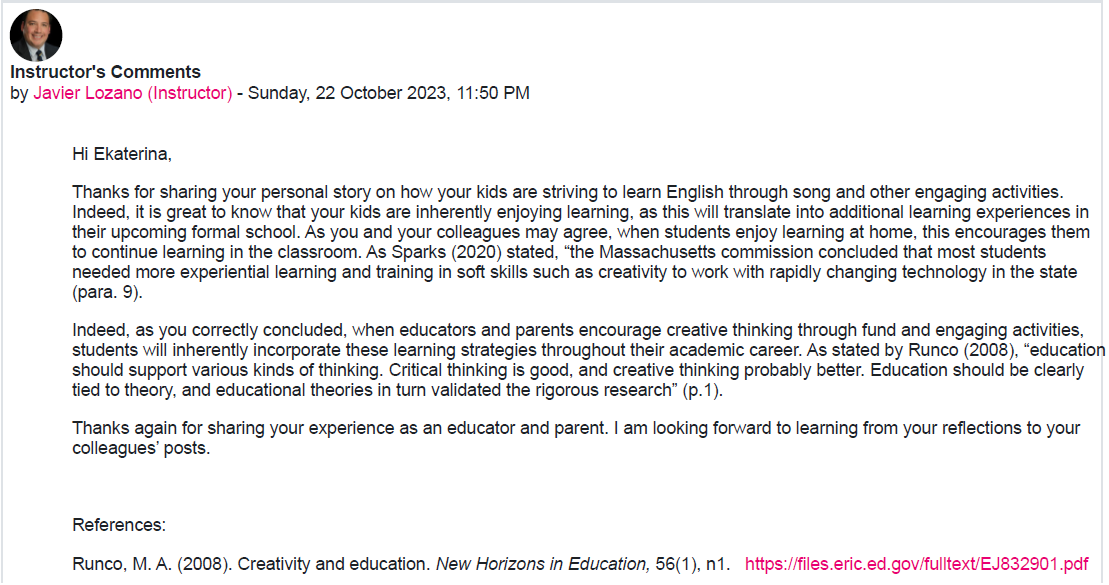
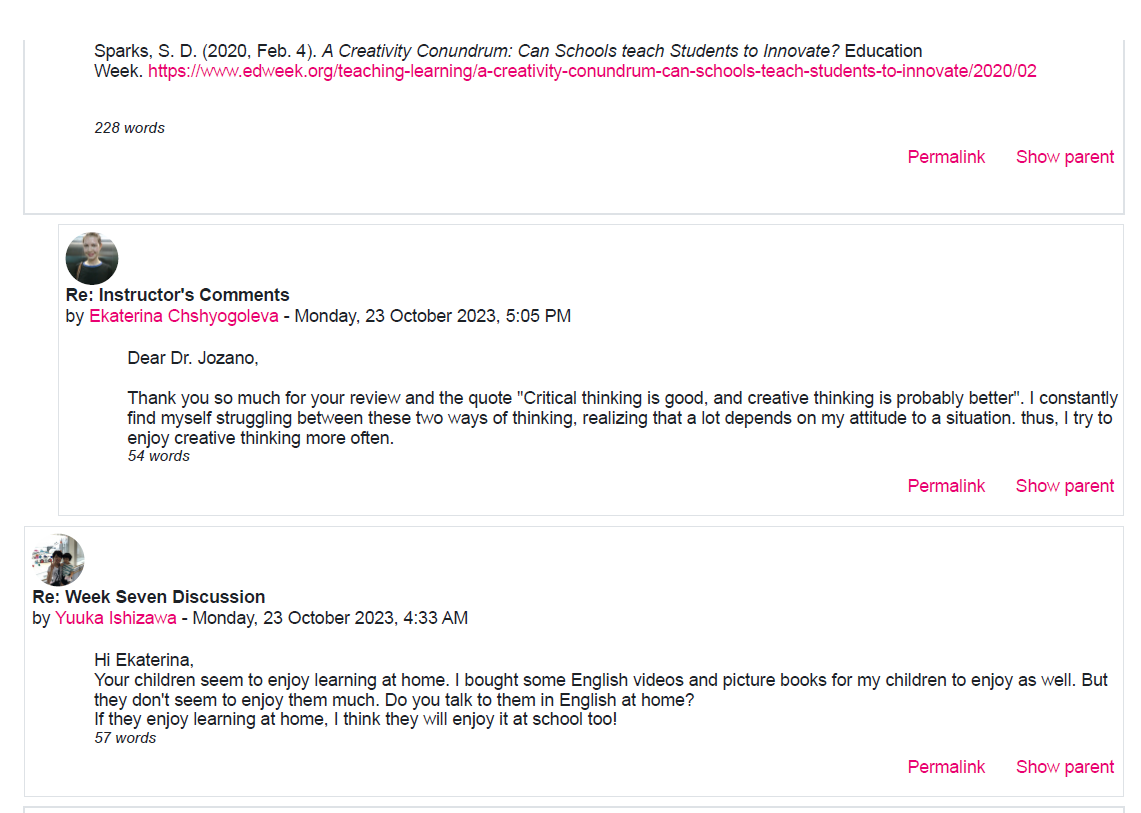
The article Why Do Parents Become Involved? (Hoover-Dempsey et al., 2005) gave me an opportunity to look at my teaching situation with my five-year-old daughter and three-year-old son.
To begin with a short story. My son is 2 1/2 years younger than his sister and tries to imitate her in everything. When he fails to do something like his sister, he starts fighting her. My husband often demands him to stop fighting because "you can't hurt your sister, you have to love your sister". After that, my daughter started coming up to me saying "Mommy, I want to love you!".
Since I am an English teacher, my children often encounter English-language books, captioned pictures, cartoons, hear my lessons, and so on. My daughter has her own laptop and chooses her own cartoons for self-education. Lately, I only hear English-language cartoons and songs. What gets lost most from our daughter's speech is her dad. One day dad made soup for the kids and asked how much they liked it. The daughter replied that "it's so delicious!" with intonations from the cartoon. The husband now tells everyone that his daughter speaks English. Consequently, the father's encouragement, the mother's enthusiasm, and the admiration of her brother, who cheerfully sings along about Old Man McDonald's, create an incredibly powerful motivation to continue learning the language, searching for more information, and memorizing the names of dinosaurs to tell others about.
By the time my children enter first grade, they will need to hold writing utensils correctly, recognize words and sounds, learn to interact with teachers and peers, and adapt. Learning conditions refer to factors that may increase or decrease a student's ability to learn is discussed in Focus on the Wonder Years: Challenges Facing the American Middle School (Juvonen et al., 2004).
In researching the factors that influence my daughter's desire to use English in everyday speech, I can say that the creative innovation looks like a process of engaging in a situation with a necessary flow of information. What is being learned must be constantly present and tangible.
This is how we get to the point where all five senses are involved in perceiving, living and reflecting on the world around us, on the surrounding reality.
If we talk about sound, I would like to recall the influence of music and musical culture on the formation of human personality. Now my children love children's songs, but then their tastes will change. It is quite possible that we, with our habits, our talents or hobbies, can significantly influence what our children will choose for themselves as a model in the future.
And at the very beginning, every teacher needs to express themselves, to realize their preferences and their sound in order to sound confident and clear.
Juvonen, J., Le, V., Kaganoff, T., Augustine, C., & Constant, L. (2004). Whole-School Reform Models. In Focus on the Wonder Years: Challenges Facing the American Middle School (pp. 98-111). Santa Monica, CA; Arlington, VA; Pittsburgh, PA: RAND Corporation. Retrieved from
https://www.rand.org/content/dam/rand/pubs/monographs/2004/RAND_MG139.sum.pdf
Hoover‐Dempsey, K., Walker, J., Sandler, H., Whetsel, D., Green, C., Wilkins, A., & Closson, K. (2005). Why Do Parents Become Involved? Research
FIndings and Implications. The Elementary School Journal, 106(2), 105-130. doi:10.1086/499194. JSTOR,JSTOR www.jstor.org/stable/10.1086/499194