Imsa-ard, P. (2022). Reading better? Enhancing Thai EFL secondary school students' reading comprehension abilities with the use of graphic organizers. English Language Teaching, 15(5), 1–13. https://files.eric.ed.gov/fulltext/EJ1344375.pdf
- This study explores the impact of graphic organizers on the reading comprehension of Thai EFL students. Using reading passages and self-designed graphic organizers, the experimental group demonstrated a significantly higher post-test score compared to the control group. Students expressed a positive opinion about this instructional approach, indicating potential benefits for improving reading comprehension, especially for students with lower abilities.
Abstract
The purpose of this study is to examine the effectiveness of utilizing graphic organizers to enhance Thai EFL students' reading comprehension abilities and their opinions regarding using graphic organizers for reading comprehension. To gather information from sixty-four upper secondary school students at a public school in Bangkok, this research study used 1) instructional instruments: ten reading passages from a coursebook and ten graphic organizers designed by the researcher; and 2) research instruments: two English reading comprehension tests with multiple-choice, true/false, and short-answer questions, and focus-group interviews about students' opinions toward English reading instruction using graphic organizers. The data were analyzed using descriptive statistics, including mean scores, normalized gains, standard deviations, and inferential statistics, namely the dependent t-test and Cohen’s d. The results indicated that the mean score on the reading comprehension post-test was significantly higher than the mean score on the pre-test at the 0.05 level of significance, and the experimental group acquired a higher score (M=87.00, SD=10.55) than the control group (M=51.18, SD=12.127) with the effect size of .846. Students exhibited a favorable opinion toward English reading instruction employing graphic organizers; and the average normalized gain was in the high gain range, g> = 0.78. Additionally, this research established that English reading instruction employing graphic organizers benefited students with low reading abilities and improved their abilities to comprehend what they read. The findings of this study provide potential avenues for improving students' reading comprehension.
Keywords: reading comprehension, reading technique, graphic organizer, Thai EFL students
1. Introduction
English has developed into a global language as a result of international communication in a variety of fields, including business, tourism, and education (Crystal, 2003; Estaji & Savarabadi, 2020; Korpela, 1995). English has been designated as the official language of communication between ASEAN member nations since the Association of Southeast Asian Nations (ASEAN) was established in 2015. Additionally, English is becoming more frequently utilized in everyday life and educational contexts in Thailand (Trakulkasemsuk, 2018). English is a required subject at all grade levels in today's society, due to its widespread relevance in academic areas, the most notable of which being higher education (Sripanngen, 2008; Woodrow, 2017). Additionally, Thai students could not overlook the necessity of reading English texts, since the English language is extensively utilized in academia, particularly higher education, and therefore could not overlook the value of reading English materials. As a result, there is an overwhelming need for individuals to acquire and enhance their English language proficiency. According to Sitthitikul (2020), morever, for Thai EFL students, reading was the lowest ability they could perform, with one probable cause being that teachers failed to give appropriate practice for students to become strategic readers.
When it comes to studying English, one of the most critical and challenging components of the four language skills is reading, which most students find to be a complex and boring process. Indeed, reading is a critical component of language learning. For instance, reading may help students improve their spelling and grammar and serve as excellent examples for their own writing (Harmer, 2007). Grabe (2004) indicates that reading in English is more difficult owing to three major impediments: specific reading skills, one's own background knowledge, a different context and culture, and challenges with grammar and vocabulary. Chawwang (2008) asserts that the majority of students in a Thai EFL context have a limited vocabulary. Not unexpectedly, numerous reading studies conducted with Thai high school students found that they had poor English competence and had difficulty reading English (Chawwang, 2008; Chomchaiya & Dunworth, 2008; Oranpattanachai, 2010). Additionally, those studies imply that English language teachers do not explicitly discuss reading processes or methods, but rather concentrate on translation and factual information included in the text. Indeed, class time should be dedicated to the development of reading methods appropriate for reading activities that require understanding (Chinokul, 1999).
Kurniaman et al. (2019), McKnight (2010) and Willis (2008) demonstrate that utilizing graphic organizers to teach reading was appropriate for young students since graphic organizers were brain compatible. Additionally, graphic organizers may enable the brain to better comprehend meaning from visuals than from words. Additionally, McKnight (2010) demonstrates that graphic organizers convey the visual stimulation preferences of general young learners. According to the National Reading Panel (2000), as stated in Grabe (2004), adding graphic organizers into reading instruction is an extremely successful method of increasing students' reading comprehension. However, graphic organizers should be used in conjunction with other instructional tools to aid students with varying learning styles and levels of language competence (Kaur & Kamini, 2018). As a result, the researcher included additional procedures – skimming and scanning – into each treatment. Moreover, the researcher chose to utilize a reading strategy, specifically graphic organizers, to help students enhance their reading comprehension.
Additionally, readers face several obstacles when they attempt to grasp what they are reading (Behroozi & Amoozegar, 2014; Nanda & Azmy, 2020). This diminishes their drive and enables them to stop reading. Without comprehension abilities, students are thought to be reading a blank piece of paper. More specifically, the researcher’s students encountered reading difficulties in their English lessons, which could lessen their motivation in learning English. Much literature (e.g., Casteleyn, Mottart, & Valcke, 2013; Qi & Jiang, 2021) demonstrates that teachers may use graphic organizers to assist students improve their reading comprehension abilities during reading classes. Enhancing students' reading abilities has been investigated and examined in a variety of circumstances, according to the pertinent literature. In lights of its significance, further research on Thai EFL secondary school students' reading abilities should be undertaken in order to develop a successful technique for students' reading ability improvement. Additionally, the findings of this research may assist EFL teachers in comparable circumstances in designing English lessons that help students improve their reading skills in order to meet the learning goals. The outcomes of this research are believed to benefit English language teachers in Thailand and other similar contexts in terms of providing the greatest appropriate help to their EFL students as they learn English.
2. Literature Review
2.1 Reading Comprehension
According to Anderson (2012) and Li et al. (2016), reading comprehension is crucial for academic and occupational achievement. Reading comprehension is a cognitively complex process that requires collaboration and engagement. It demonstrates the critical need of an engaged student who devotes cognitive resources to text comprehension. The most basic purpose for reading is to gain understanding (Grabe & Stoller, 2002). According to Rumelhart (1976) and Floyd and Carrel (1987), reading comprehension is a collaborative process including the reader, the text, and the context. Comprehension requires that the reader make connections between the text's contents and his or her own knowledge (Samiei & Ebadi, 2021). As a consequence, the reader is an active participant in constructing meaning, which is contingent on the reader's motivation for reading, prior knowledge, and the overall context.
According to the aforementioned definitions, reading comprehension is a two-way relationship between the reader's interpretation and the text. Throughout the reading process, the reader will interact with the texts. Additionally, the amount of information that the reader may glean from the text is dependant upon the reader's prior knowledge and ability to infer from context. The reader's understanding of the text may differ from the author's intention. Similarly, the meaning derived by one reader from a book may differ from the meaning derived by another reader from the same text. Readers make use of a range of resources while they read. As a result, reading comprehension differs per reader. Day and Park (2005) distinguish six types of reading comprehension abilities: literal comprehension, reorganization, inference, prediction, evaluation, and personal response. To begin, literal comprehension refers to the ability to comprehend the plain meaning of texts. Students at this level are able to extract and synthesize information from the books they have read, offering specifics and primary concepts. Second, reorganization comprehension refers to the ability to incorporate information from many parts of a text, restructuring the text in order to increase understanding. At this level, students are expected to verify material from texts to see if they comprehend them from a broader perspective. Thirdly, inferential comprehension occurs when individuals can infer the content of a text based on their prior knowledge or intuition. Students at this level are able to form inferences about the questions they are given. To elaborate, the solutions may not be explicit in the text but may be implied by certain clues. Fourth, predicting comprehension occurs when individuals may utilize their comprehension of texts and prior information to speculate on the story's repercussions. Fifth, evaluation comprehension occurs when individuals can exhibit their ability to make judgments about texts by applying their prior knowledge or values to the material. Finally, a personal response occurs when one may express emotion in response to messages. Students' replies must be rationalized. Because each level emphasizes the significance of reading comprehension for all readers, it is critical for readers to improve reading comprehension in order to successfully complete the comprehension levels.
Watanapokakul (2006), on the other hand, demonstrates that Thai students struggle with reading comprehension tests and general reading abilities due to a lack of vocabulary and understanding on how to derive the meaning of unfamiliar words. Kruekeaw and Tongkumchum (2008), as well as Wan-a-rom (2012), emphasize the importance of reading ability for Thai students studying English and the importance of vocabulary knowledge in addition to the ability to read words; this can aid students in developing reading speed, comprehension, a positive attitude, and motivation. Numerous elements contribute to the development of comprehension ability. It is critical to collect a variety of reading materials that are appropriate for the learners' level. Additionally, reading resources, appropriate vocabulary, and challenging questions all contribute to the development of reading ability. Additionally, Nuttall (2005) asserts that students must read more widely in order to improve their reading. As a result, students should be given more opportunities to read and practice. Additionally, Farrell and Farrell (2009) advocate for the usage of reading techniques and practical reading tools to aid in the development of reading comprehension ability. To summarize, effective reading skills is required, and texts need various degrees of understanding to be interpreted. To help students improve their reading comprehension abilities, it is critical to provide them with practical and understandable teaching and tools. Reading assessment has undergone significant changes to mirror changes in reading instruction. Teachers examine the results of their students' learning concurrently throughout class time. Aebersold and Field (1997) indicated that evaluations in an ESL/EFL reading class include the following: multiple-choice questions, vocabulary tests, cloze tests, completion tasks, short answer and open-ended questions, and contextualized or authentic assignments.
2.2 Graphic Organisers and Reading Instruction
Over the last several decades, graphic organizers have been widely advocated as an educational tool in language classrooms. A graphic organizer is a diagram that depicts a connection that is triggered by a thinking verb. The word "sequence" requires a diagram of a succession of boxes linked by arrows that depicts one box's "event" leading to another box's "event" (Hibbard & Wagner, 2003). McTighe (1992) identified three primary methods in which teachers may include graphic organizers into their instruction and a variety of ways in which students can utilize them to help their learning process in his 1992 book, Graphic Organisers: Collaborative Links to Better Thinking. Graphic organizers may be employed at three stages of the reading process: before instructions, during instructions, and after instructions. Prior to instruction, graphic organizers are used to determine the students' material proficiency. During education, graphic organizers aid students in approaching the topic cognitively. Additionally, it enables students to create maps that are tailored to their own learning methods. Following teaching, they assist students by serving as a summarisation tool or approach and by assisting students in recognizing their progress in terms of passage comprehension. If a student can connect prior knowledge to what they have learned and identify relationships between those ideas, graphic organizers have aided them in their learning process successfully.
When confronted with a great amount of information to process in a short period of time, graphic organizers aid with comprehension (Praveen & Rajan, 2013). Graphic organizers serve a variety of purposes. In reading comprehension, they assist students to:
(1) Clarify and organise information into categories (Main idea, Supporting details, Topic sentence, Fact, Opinion, etc)
(2) Organise information in a paragraph for better understanding
(3) Construct meaning of difficult words and sentence dividing into lexias
(4) Understand the context by associating with prior knowledge
(5) Identify conceptual and perceptual errors that may occur in the course of reading a passage
Additionally, Russell (2010) illustrates how graphic organizers might assist young learners in reading texts with better clarity. To demonstrate, graphic organizers may assist learners in focusing on the interconnections between the texts. Additionally, graphic organizers provide teachers with tools to assist students in attaining better levels of categorize it into little, easily-understandable parts. Marzano, Pickering, and Pollock's (2010) investigation demonstrates the effectiveness of graphic organizers. The use of graphic organizers is an excellent strategy for increasing reading comprehension. The National Reading Panel (2000) identified graphic organizers as an effective instructional method for enhancing reading teaching. Additionally, graphic organizers may be used efficiently to monitor continuing comprehension while reading. Similarly, they may be used as a summative task to determine students' understanding after they have finished reading the book. Additionally, it may be used to review vocabulary in a variety of subject areas.
In this study, students in the researcher’s classes struggled with reading comprehension. Reading comprehension, in general, occurs when the reader actively seeks meaning from the written material (Bursuck & Damer, 2011). Additionally, Trabasso and Bouchard (2002) indicate that an understanding of text organization is a critical component of total comprehension ability. The low-ability students' difficulties in this research might be explained by the fact that they struggle with reading comprehension because they are unable to absorb the meaning of the text and are unaware of how the text is organized. Thus, using graphic organizers into reading teaching aims to aid low-ability children in developing their reading comprehension abilities.
The primary premise behind the use of graphic organizers in the classroom is the activation of the student-centered approach, which empowers students to develop and utilize their own language when confronted with any kind of graphic organizer in their work (Gallavan & Kottler, 2007). Additionally, graphic organizers assist students in organizing their thoughts and gaining a better knowledge of the concepts around the original subject. As a result, using graphic organizers in the classroom is one strategy to help students enhance their learning and performance. According to Fisher and Frey (2008), these visual tools provide visual representations for complicated concepts. Indeed, graphic organizers can assist learners in visualizing how complex ideas are organized within a text. They will then apply this framework to their own thoughts as the next phase in their education. Additionally, graphic organizers provide concrete representations for abstract concepts and assist learners in recognizing the hierarchy or sequence of ideas (Fountas & Pinnell, 2001). By prioritizing, sequencing, analyzing, and building on new knowledge, graphic organizers assist learners in 'chunking' material. Indeed, learners can clarify concepts, organize ideas and information, and demonstrate intricate links between pieces using just a few words. Additionally, graphic organizers provide instructors with a clear picture of how their students think.
Barron (1979) and Singleton and Filce (2015) assert that graphic organizers aid in reading comprehension and that they might be further modified to meet the needs of various texts. Additionally, McKnight (2010) illustrates that graphic organizers are critical and useful tools for organizing facts and ideas and assisting students in comprehending new information. Moreover, Sidik et al. (2019) demonstrates further that graphic organizers may be employed at all grade levels due to the visually stimulating nature of graphic organizers. Graphic organizers or visual displays combine text with visual information, allowing students to engage their whole brains, since the brain is better equipped to handle visuals than words. Additionally, Willis (2008) illustrates that when young children are attempting to build prediction or previewing skills via the examination of sections of a book, graphic organizers might assist them in connecting the link between chapter headings and subheadings. Furthermore, graphic organizers may be used to visually separate the core concept from supporting notions. As a result, graphic organizers assist in recognizing the pattern and information contained in text relationships as they translate information into visual representations. Additionally, visual displays may help young kids improve their understanding, organization, summarizing, prioritizing, memorizing, and analyzing skills by assisting them in constructing and visualizing relationships. Because graphic organizers emphasize the order of text material and increase readers' awareness of the text's rhetorical organization (Grabe & Stoller, 2002), the use in reading instruction may have at least four obvious benefits:
(a) The teacher can illustrate through graphic organisers how complicated ideas in a text are structured to make a single meaning to help students form a holistic view of a reading text and therefore strengthen students’ understanding.
(b) The teacher can use graphic organisers to inform students of different text structures in different text types of different cultures and add to their knowledge of text- structures, through introduction, comparison, and contrast.
(c) With constant exposures to text-structures through graphic organisers, students can recognize the important role text-structures play in reading comprehension. They can make use of their increased background knowledge of top-level structures (formal schema) to make predictions about the meaning of a text (clearly organised according to familiar structures) in a top-down manner.
(d) Through teachers’ demonstrations and their own practices, students can gradually develop their metacognitive knowledge of reading and transfer their knowledge across texts and content areas, using this knowledge flexibly to make meaning and strengthen their understanding and learning.
2.3 Related Studies
There have been various research studies investigating the effects of graphic organizers on reading comprehension skills. To begin with, Kurniaman and Zufriady (2019) discussed the effectiveness of designing graphic organizer teaching resources for reading in primary school's fourth grade, and discovered that teaching materials using graphic organizers in reading are quite successful when used properly. Furthermore, Bethune and Wood (2013) conducted a research study about the effects of Wh-Question graphic organisers on reading comprehension skills of students with Autism Spectrum Disorders. Their study employed delayed multiple baselines across participants designed to evaluate the effects of graphic organisers on the accuracy of Wh-Questions answered following short passage reading. Participants were three elementary-age students with autism spectrum disorder. Results indicated improved accuracy of responses to Wh-questions, generalisation, and maintenance of gains following intervention. Additionally, Bethune and Wood (2013) conducted research on the benefits of Wh-Question graphic organizers on students with Autism Spectrum Disorders' reading comprehension abilities. Their research used delayed multiple baselines among individuals to assess the influence of graphic organizers on the accuracy with which Wh-Questions were answered after brief passage reading. Three elementary-aged kids with autism spectrum disorder participated in the study. The results demonstrated an increase in the accuracy of Wh-question responses, generalization, and maintenance of gains after intervention.
Moreover, Hernández-Chérrez, Hidalgo-Camacho, and Carrera-Martínez (2020) determined the extent to which it effects the reading comprehension development of students at Unidad Educativa Joaquin Lalama in Ambato, Ecuador. The sample consisted of 40 students in the control group and 35 students in the experimental group. The data were gathered by observation and the comparison of pre- and post-test results for reading comprehension. This study discovered that using graphic organizers effectively improves reading comprehension. Similarly, Albufalasa (2019) examined the usefulness of graphic organizers (GOs) in boosting EFL students' reading comprehension and motivation, using a mixed-method approach that included quantitative data collected via reading tests and questionnaires and qualitative data collected through class observation. Their findings suggested that when EFL students utilized graphic organizers to grasp the story, their performance was greatly improved.
In Thailand, a few studies have been conducted in many institutions. Firstly, Bangsri and Phusawisot (2020) examined the impact of employing a story map on the reading comprehension abilities of Thai EFL sixth graders, as well as the students' attitudes toward the story map's effect on their reading comprehension skills. Reading comprehension pre- and post-tests, as well as a student attitude questionnaire, were used to gather data. The findings of this study indicated that, at the 0.01 level, there was a statistically significant difference in students' reading comprehension abilities for narrative texts after the use of the story map. Students' attitudes regarding the story map also suggested that they had a favorable attitude toward the story map's implementation. Moreover, Sathongeay and Prasansaph (2019) examined the English critical reading abilities of 36 Thai undergraduate students before and after they used the graphic organizers technique. The findings indicated that after utilizing the graphic organizers, students' English critical reading abilities improved dramatically at the .05 level.
Numerous studies have shown the effectiveness of graphic organizers in L1 reading environments. Surprisingly, the L2 context has received less consideration (Wong, 2019). Along with a dearth of research on the L2 context, there is also a dearth of research on the effectiveness of graphic organizers in low-ability students in the L2 context, particularly in a secondary school level in Thailand. Given the tremendous potential and usefulness of graphic organizers for the development of L2 reading, there is a compelling need for studies on this topic.
2.4 Research Questions
As noted in the literature review, several studies have been undertaken to investigate the use of graphic organizers in reading instruction instruction in general, but very little attention has been paid to their utility in reading instruction for low-ability students in Thailand. Given the limitations of graphic organizers' usefulness in certain circumstances, the following research questions are intended to assist in the completion of this study.
1) To what extent do graphic organizer-based reading instructions improve students' reading comprehension?
2) What are students’ declared opinions towards reading instructions using graphic organizers?
3. Methods
3.1 Participants
The population of the study was Thai EFL students at an upper secondary school level at a public school in Bangkok, Thailand. The participants in this research study comprised sixty-four students studying in a tenth-grade English Reading course, selected through purposive sampling. Purposive sampling is the purposeful selection of a participant based on the individual's characteristics (Etikan, Musa, & Alkassim, 2016) which were the focus of this study. Participants were chosen using a purposive sampling procedure based on specific criteria. The participants in this research were chosen to reflect the characteristics of the issues being addressed. The majority of the sixty-four students had considerable difficulty with English reading, as shown by their failure to pass three consecutive quizzes. All of sixty-four students were from two different rooms: one with 30 students, and the other with 34 students. Thus, in this study, one classroom was designated as a control group and taught using the traditional reading technique, while the other classroom was assigned as an experimental group and taught how to decode information from reading passages using graphic organizers.
3.2 Instruments
In this study, there were two kinds of instruments used: Instructional instruments and research instruments.
3.2.1 Instructional Instruments
The 10-week reading instruction using graphic organisers was used to improve the reading comprehension abilities of an experimental group. The instruction was developed in accordance with the school curriculum with the goal of determining the reading comprehension level of tenth grade students. The researcher himself taught the lessons. In each reading lesson, graphic organizers were the primary reading tool. To ensure that participants could recognize and effectively utilize each graphic organizer on their own, students were taught and trained to use graphic organizers in the first two sessions.
• Lesson plans
(1) Ten reading passages from the textbook used: Mega Goal 4 or related texts
(2) Ten Graphic organizers with Wh-questions in the boxes designed by a teacher
Lesson plans were developed for this study using the curriculum and reading passages. The graphic organizers were created using 'Wh-' guided questions to assist students in comprehending the text, including 'What did the man do?' and 'Where did the man go?' Graphic organizers in each week were unique, meaning that they were created in response to the text. According to Praveen and Rajan (2013), many types of graphic organizer questions may assist students in improving their comprehension of texts. As a result, it is critical that the teacher properly reads the materials and develops guided questions for the graphic organizers. The rationale for including graphic organizers into the lesson rather than only traditional instruction is because the visual processes associated with reading comprehension enable more intricate mental models of narrative texts (Woolley, 2010). At the beginning of each lesson, the teacher should elicit students' knowledge via the use of illustrations or questions. If students are unfamiliar with new vocabulary or grammatical rules, it is necessary to teach them prior to assigning them to read the passage. When students are assigned to read, they will do it using the visual organizers given. As a result, students may get a holistic view of the passages they read by completing graphic organizers.
3.2.2 Research Instruments
This section explains the processes of constructing two research instruments including the English reading comprehension tests as well as focus-group interviews.
(1) Two English reading comprehension tests with multiple choice and true/false and short-answer questions (10 items, 5 items, and 2 items respectively)
(2) Interview schedules about students’ opinions towards English reading instruction using graphic organisers.
3.3 Data Collection
Between June 24 and September 10, 2017, data were collected at a public school in Bangkok. Prior to giving treatments, the study evidenced and recognized students' reading comprehension difficulties through pre-test sessions and quizzes. The researcher then prepared and arranged the lesson plans for the treatments. The researcher then recorded and gathered data from the post-test session. Following the post-test session, focus groups of six students through random assignment were held to get detailed information regarding participants' attitudes on the use of graphic organizers for reading comprehension. Additionally, the researcher explained the aim of the focus groups to the participants and then solicited their involvement.
3.4 Data Analysis
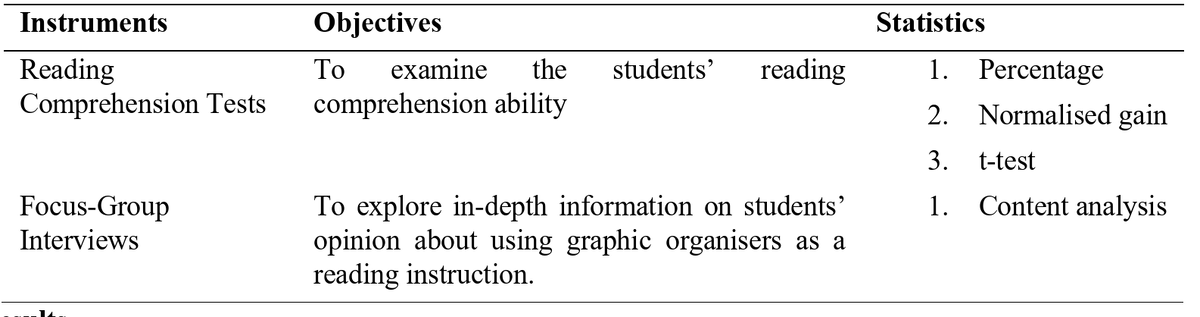
The data were analyzed using descriptive statistics–mean and percentage–and normalized gain before and after participants received treatments, as well as inferential statistics–dependent t-test and Cohen's d–to establish the treatment's effectiveness on students' reading comprehension. More specifically, the pre- and post-test scores within an experimental group were analyzed using a paired samples t-test, and the scores between the control and experimental groups were analyzed using an independent samples t-test.
Table 1. Data Analysis in this Study
4. Results
To examine the effects of graphic organisers as a reading instruction, the pre-test and post-test scores, and normalised gain were analysed. Table 2. Overall information from the experiment
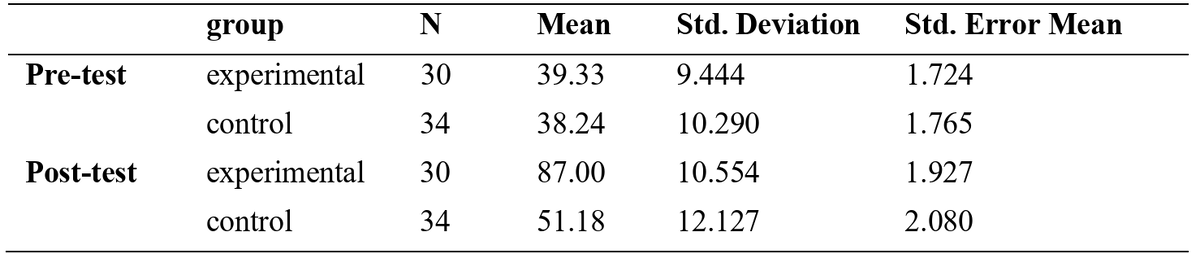
According to Table 2, the mean score of the pre-test in an experimental group is 39.33 while the one in a control group is 38.24. In addition, the mean score of the post-test in an experimental group is 87.00 while the one in a control group is 51.18. Table 3. Test Results of Reading Comprehension in an experimental group
According to Table 3, the mean score of pre-test scores in an experimental group is 39.33%. After giving treatments to participants, the mean score of post-test scores is 87.00%. Therefore, the mean score of post-test scores is higher than of pre-test scores. Also, it can be seen that there is development of every participant. The average normalised gain was in the high gain <g> = 0.78. Table 4. The paired samples t-test of the pre-and-post-test mean scores
Paired-Sample Test
According to Table 4, the paired samples t-test was used to determine if there was a difference in the mean scores of students in the experimental group between pre- and post-test. The findings indicated a statistically significant difference in students' test scores, t(29) = 22.408, p<.05 (Table 4). In the Reading Comprehension test, the students' average post-test score (M=87.00, SD=10.55) was statistically substantially higher than their pre-test score (M=39.33, SD=9.44). This suggests that after participating in reading instruction utilizing graphic organizers, students increased their English reading abilities. Table 5. The independent samples t-test of the pre-and-post-test mean scores
Additionally, according to Table 5, the independent samples t-test was performed to determine whether or not there was a statistically significant difference in the mean scores of the students in the experimental and control groups. R was also computed to ascertain the magnitude of the effect of the difference in means. The findings indicated a significant difference in post-test mean scores between the control and experimental groups (t(62)=12.525, p<.05). Additionally, the findings indicated that both groups' post-test mean scores were greater than their pre-test mean scores (Table 4). Additionally, the experimental group acquired a higher score (M=87.00, SD=10.55) than the control group (M=51.18, SD=12.127). Additionally, the effect size r of .846 indicates a substantial effect size, demonstrating the intervention's magnitude on the independent variable. This indicates that the students' reading comprehension improved as a result of the intervention. The classroom reflections indicated that a significant number of students struggled with reading comprehension at the beginning of the semester. Typically, prior to implementing reading instruction using graphic organizers, children had low reading comprehension scores due to a lack of reading methods and a limited vocabulary. These difficulties diminished as a result of the researcher's use of graphic organizers for reading teaching. Students may complete the assignment without a dictionary, since they first preferred to use their mobile phones to look up each word in the paragraph. After offering certain remedies on a case-by-case basis, none of the students used a dictionary at all. They exhibited a proclivity for organization when reading. According to Willis (2008), graphic organizers aid in recognizing the pattern and information associated with text relationships since they translate information into visual representations. Additionally, visual displays may help young students improve their understanding, organization, summarizing, prioritizing, memorizing, and analyzing skills by assisting them in constructing and visualizing relationships.
In focus-group interviews, most students revealed the positive attitudes towards the graphic organiser as a reading instruction, as Student A and C stated:
I think graphic organisers helped me organise the ideas while reading. The more I used graphic organisers, the better-organised I become. At first, it could be difficult to do the graphic organisers, but things got much better when we got used to doing it. (Student A)
I agree with [Student A]. I had problems with reading texts, especially long texts. When the teacher introduced the graphic organisers to the class, I found it quite interesting because I had never done such things before. The graphic organisers surely taught me how to organise the ideas while reading, but it really helped me. I could see my progress in terms of reading comprehension. (Student C)
However, some students reported that the class time is too short for the whole activity, as Student B stated. The reason for short class time is because this is something about the school policy that the class allotment is only 50 minutes per each period.
Graphic organisers are really great tools to help us organise ideas during reading. Well, however, I think the class time is too short. We have only 50 minutes per period, and in fact, we have only 10-15 minutes to do the task. I think it would be more fun and suitable if class time should be longer. (Student B)
Focus group interviews demonstrated that Graphic Organizers aided students in learning to read English. Additionally, the participants said that the graphic organizer aided them in organizing the information and concepts for their reading. To indicate the effectiveness of using graphic organisers to improve reading comprehension ability, the researcher had collected all of the data from the participants as follows:
(1) The mean of post-test scores is more than pre-test scores. Also, there is development of every participant. The average normalised gain was in the high gain <g> =0.78.
(2) The findings indicated a statistically significant difference in students' test scores, t(29) = 22.408, p<.05 (Table 4.2). In the Reading Comprehension test, the students' average post-test score (M=87.00, SD=10.55) was statistically substantially higher than their pre-test score (M=39.33, SD=9.44). The findings indicated a significant difference in post-test mean scores between the control and experimental groups (t(62)=12.525, p<.05). Additionally, the findings indicated that both groups' post-test mean scores were greater than their pre-test mean scores. Additionally, the experimental group acquired a higher score (M=87.00, SD=10.55) than the control group (M=51.18, SD=12.127). Additionally, the effect size r of .846 indicates a substantial effect size, demonstrating the intervention's magnitude on the independent variable.
(3) Focus-group interviews with participants demonstrated a favourable response to employing graphic organizers to assist students in improving their reading comprehension skills. The majority of participants expressed satisfaction with their use of graphic organizers while reading the materials. Additionally, they expressed a need for additional activities using graphic organizers. However, a few students stated that the class period's time limit is insufficient to execute the graphic organizer exercises fully, since more time is required.
5. Discussion
The purpose of this section is to interpret, explain, and discuss the key findings of this research study using prior literature in order to answer two primary research questions. The discussion is particularly focused on two issues: the effects of graphic organizers on reading comprehension ability and students' opinions. However, it is worth noting that all qualitative data were self-reported by students. The findings should be interpreted and extrapolated to a broader context with cautions.
To begin, the mean score on the post-test was significantly higher in the experimental group than in the control group (87.00 and 51.18 respectively). This might imply that graphic organizers had a beneficial effect on students' reading comprehension abilities. This finding is corroborated by Marzano, Pickering, and Pollock (2010), Hernández-Chérrez et al. (2020), and Albufalasa (2019), who identified graphic organizers as an effective strategy for increasing reading comprehension. Moreover, the results from this study are also in line with Kurniaman and Zufriady’s (2019) findings which discussed that teaching materials using graphic organizers in reading are quite successful when used properly. Additionally, the researcher's use of graphic organizers for reading instruction alleviated the difficulties faced by students who had poor reading comprehension scores owing to a lack of reading skills and a limited vocabulary. When they read, they displayed a predisposition for organizing. The results are also similar with Praveen and Rajan (2013), who claimed that the usage of visual organizers might help students enhance their reading abilities. It allows students to develop a strong textual connection by identifying the text's essential concept and content.
In terms of students’ opinions, the interviews revealed that graphic organizers assisted students in their efforts to learn to read English. This conclusion is consistent with McKnight's (2010) concept that graphic organizers are crucial and effective reading teaching aids for organizing students' knowledge and ideas and supporting them in grasping new material. Additionally, this is consistent with the results of Praveen and Rajan (2013), Sari, Drajati, and Rochsantiningsih (2019), and Wong (2019), all of whom suggest that gaphic organizers may assist students in improving their reading comprehension. Additionally, the finding is also in line with Bangsri and Phusawisot (2020) who students had a favorable attitude towards the implementation of graphic organizers. However, several students noted that the class time allotted for the activity was insufficient. This is corroborated by Wong (2019), who proved the need of allotting a significant amount of time for students to be trained on how to use graphic organizers.
Clearly, it appears as if utilizing graphic organizers may help students improve their reading comprehension abilities. This assertion is backed by a substantial effect size of .846, which indicates the impact of the intervention on the independent variable. This finding is consistent with Yussof et al. (2012), who concluded that the intervention is very effective at improving reading comprehension performance due to its large effect size. According to Kanszolu (2017), moreover, graphic organizers have a greater effect size on academic achievement than traditional teaching approaches. Thus, this shows that the graphic organizers enhanced the students' reading comprehension.
6. Conclusion and Recommendation
The study concluded that utilizing graphic organizers to teach English reading was successful and might help students enhance their reading comprehension skills. The results indicated that once students learned the reading technique of employing graphic organizers, their reading comprehension ability increased. Each student achieves a positive normalised gain, and the average normalised gain was 0.78, which is considered to be a high degree of gain. The results revealed that there was a significant difference in the mean post-test scores between the control and experimental groups (t(62)=12.525, p.05). Additionally, the results suggested that the post-test mean scores for both groups were higher than the pre-test mean scores. Furthermore, the experimental group scored higher (M=87.00, SD=10.55) than the control group (M=51.18, SD=12.127). Additionally, the effect size r =.846 suggests a sizable effect, indicating the magnitude of utilizing graphic organizers on students’ reading comprehension abilities. Additionally, results from the focus group interview demonstrated that students liked using graphic organizers and that graphic organizers aided students in learning to read English. Understanding how each graphic organizer aids students who struggle with reading comprehension enables teachers to plan lessons more effectively and to encourage learning. The suggestion for future researchers is about research instruments and time used for implementing treatments. Further studies should be conducted with more times and take longer period of lessons because providing more time to learn would lead students to be more familiar with using graphic organizers.
References
Aebersold, J., & Field, M. L. (1997). From reader to reading teacher. Cambridge University Press. Albufalasa, M. (2019). The impact of implementing graphic organizers on improving EFL students’ reading comprehension of narrative texts and motivation. International Journal of Applied Linguistics and English Literature, 8(4), 120-129. http://doi.org/10.7575/aiac.ijalel.v.8n.4p.120 Anderson, N. J. (2012). Reading instruction. In A. Burns & J. C. Richards (Eds.), The Cambridge guide to pedagogy and practice in second language teaching (pp. 218-225). Cambridge University Press. https://doi.org/10.1017/9781009024778.028 Bangsri, K., & Phusawisot, P. (2020). The effect of using a story map to improve reading comprehension skill of Thai EFL sixth graders (Doctoral dissertation, Mahasarakham University). Barron, R. F. (1979). The effect of graphic organizers on learning of social studies content and attitude towards reading. In H. L. Herber & J. D. Riley (Eds.), Research in reading in the content areas: The fourth report (pp. 42-51). Syracuse University Press. Behroozi, M., & Amoozegar, A. (2014). Challenges to English language teachers of secondary schools in Iran. Procedia-Social and Behavioral Sciences, 136, 203-207. https://doi.org/10.1016/j.sbspro.2014.05.314 Bethune, K. S., & Wood, C. L. (2013). Effects of Wh-question graphic organizers on reading comprehension skills of students with Autism Spectrum Disorders. Education and Training in Autism and Developmental Disabilities, 48(2), 236-244. Bursuck, W. D., & Damer, M. (2011). Teaching reading to students who are at risk or have disabilities: A multi-tier approach. Pearson. Carrell, P. L. (1985). Facilitating ESL reading by teaching text- structure. TESOL Quarterly, 19(4), 727-752. https://doi.org/10.2307/3586673 Casteleyn, J., Mottart, A., & Valcke, M. (2013). The impact of graphic organisers on learning from presentations. Technology, Pedagogy and Education, 22(3), 283-301. https://doi.org/10.1080/1475939X.2013.784621
Chawwang, N. (2008). An investigation of English reading problems of Thai 12th grade students in Nakhonratchasima educational regions 1, 2, 3, and 7 (Master’s dissertation). Srinakharinwirot University, Bangkok. Chinokul, S. (1999). Development of English reading skills. Department of Foundation of Education: Chulalongkorn University. D. Chomchaiya, C., & Dunworth, K. (2008). Identification of learning barriers affecting English reading comprehension instruction, as perceived by ESL undergraduate in Thailand. Edith Cowan University. Crystal, (2003). English as a global language (2nd ed.). Cambridge University. https://doi.org/10.1017/CBO9780511486999 Day, R. R., & Park, J. S. (2005). Developing reading comprehension questions. Reading in a foreign language, 17(1), 60-73. Estaji, M., & Savarabadi, M. F. (2020). English as an International Language: Reconstructing EFL teachers' cultural awareness and perception of teaching culture. Journal of English as an International Language, 15(1), 82-99. Etikan, I., Musa, S. A., & Alkassim, R. S. (2016). Comparison of convenience sampling and purposive sampling. American Journal of Theoretical https://doi.org/10.11648/j.ajtas.20160501.11 and Applied Statistics, 5(1), 1-4. Farrell, T. S. C., & Farrell, T. S. (2009). Teaching reading to English language learners: A reflective guide. Corwin press. Fitzpatrick, H. C., & Ruscica, B. M. (1997). Reading Passages. Houghton Mifflin Company. Floyd, P., & Carrell, P. L. (1987). Effects on ESL reading of teaching cultural content schemata. Language learning, 37(1), 89-108. https://doi.org/10.1111/j.1467-1770.1968.tb01313.x Fountas, I. C., & Pinnell, G. S. (2001). Guiding readers and writers, grades 3-6: Teaching comprehension, genre, and content literacy. Heinemann. Frey, N., & Fisher, D. (2008). Teaching visual literacy: Using comic books, graphic novels, anime, cartoons, and more to develop comprehension and thinking skills. Corwin Press. Gallavan, N. P., & Kottler, E. (2007). Eight types of graphic organizers for empowering social studies students and teachers. The Social Studies, 98(3), 117-128. https://doi.org/10.3200/TSSS.98.3.117-128 Grabe, W. (2004). Research on teaching reading. Annual review of applied linguistics, 24, 44-69. Cambridge University Press. https://doi.org/10.1017/S0267190504000030 Grabe, W., & Stoller, F. L. (2002). Teaching and Researching Reading. Pearson Education. Griffin, C., Malone, L., & Kameenui, E. (1995). Effects of graphic organizer instruction on fifth-grade students. Journal of Educational Research, 89(2), 98-107. https://doi.org/10.1080/00220671.1995.9941200 Hake, R. R. (1998). Interactive-engagement vs traditional methods: A six-thousand-students survey of mechanics test data for introductory physics courses. American Journal of Physics, 66(1), 64-74. https://doi.org/10.1119/1.18809 Hall, T., & Strangman, N. (2002). Graphic organizers. National Center on Accessing the General Curriculum. Retrieved from https://www.cast.org/publications/ncac/ncac_go.html Harmer, J. (2007). How to teach English. Pearson Education. https://doi.org/10.1093/elt/ccn029 Hernández-Chérrez, E., Hidalgo-Camacho, C. S., & Carrera-Martínez, V. (2020). Graphic organizers for the enhancement of EFL reading comprehension. Revista Chakiñan de Ciencias Sociales y Humanidades, (12), 106-117. https://doi.org/10.37135/chk.002.12.07 Hibbard, K. M., & Wagner, E. A. (2003). Assessing and teaching reading comprehension and pre-writing, 3-5 (Vol. 3). Eye On Education. Hudson, T. (2007). Teaching second language reading. Oxford University Press. Study. Kansızoğlu, H. B. (2017). The Effect of Graphic Organizers on Language Teaching and Learning Areas: A Meta-Analysis Education & Science/Egitim https://doi.org10.15390/EB.2017.6777
Kaur, S., & Kamini, M. (2018). Effect of teaching through graphic organizers on academic achievement in science of VII graders. International Journal of Innovative Research Explorer, 5(4), 400-404. Korpela, J. (1995). English: The universal language on the internet. Kruekaew, T., Tongkumchum, P., & Choonpradub, C. (2008). Factors affecting English vocabulary skill of undergraduates at Prince of Songkla university, Pattani campus. Asian Social Science, 4(9), 12-17. https://doi.org/10.5539/ass.v4n9p12 Kurniaman, O., Oktari, C., & Pahrurazi, P. (2019). The implementation of teaching materials reading graphic organizers in Elementary Schools. Lensa: Kajian Kebahasaan, Kesusastraan, dan Budaya, 9(2), 105-119. https://doi.org/10.26714/lensa.9.2.2019.105-119 Li, M., Murphy, P. K., Wang, J., Mason, L. H., Firetto, C. M., Wei, L., & Chung, K. S. (2016). Promoting reading comprehension and critical–analytic thinking: A comparison of three approaches with fourth and fifth graders. Contemporary Educational Psychology, 46, 101-115. https://doi.org/10.1016/j.cedpsych.2016.05.002 Marzano, R. J. (2002). Designing a new taxonomy of educational objectives. Corwin Press. Marzano, R. J., Pickering, D., & Pollock, J. E. (2001). Classroom instruction that works: Research-based strategies for increasing student achievement. Ascd. McKnight, K. S. (2010). The teacher’s big book of graphic organizers. Jossey-Bass A Wiley Imprint. McTighe, J. (1992). Graphic organizers: Collaborative links to better thinking. Teachers College Press. Merkley, D. M., & Jefferies, D. (2001). Guidelines for implementing a graphic organizer. The Reading Teacher, 54(4), 350-357. Nanda, D. W., & Azmy, K. (2020). Poor reading comprehension issue in EFL classroom among Indonesian secondary school students: Scrutinizing the causes, impacts and possible solutions. Englisia: Journal of Language, Education, and Humanities, 8(1), 12-24. https://doi.org/10.22373/ej.v8i1.6771 Nation, P. (2004). Vocabulary learning and extensive reading. EA Journal, 21(2), 20-29. Nuttall, C. (2005). Teaching reading skills in a foreign language. Macmillan Education. Oranpattanachai, P. (2010). Perceived reading strategies used by Thai pre-engineering students. ABAC Journal, 30(2), 26-42. Paulston, C., & Bruder, M. (1976). Teaching English as a second language: Techniques and procedures. Winthrop Publishers. Praveen, S. D., & Rajan, P. (2013). Using graphic organizers to improve reading comprehension skills for the middle school ESL students. English language teaching, 6(2), 155-170. https://doi.org/10.5539/elt.v6n2p155 Qi, W., & Jiang, Y. (2021). Use of a graphic organiser as a pedagogical instrument for the sustainable development of EFL learners’ English reading comprehension. Sustainability, 13(24), https://doi.org/10.3390/su132413748 Richards, J. (2015). Key issues in language teaching. Cambridge University Press. 13748. Rumelhart, D. E. (1976). Toward an interactive model of reading. Center for Human Information Processing, University of California. Russell, L. (2010). The impact of thinking maps on the reading comprehension of elementary school students (Doctoral dissertation). Texas A&M University. Samiei, F., & Ebadi, S. (2021). Exploring EFL learners’ inferential reading comprehension skills through a flipped classroom. Research and Practice in Technology Enhanced Learning, 16(1), 1-18. https://doi.org/10.1186/s41039-021-00157-9 Sari, N. K., Drajati, N. A., & Rochsantiningsih, D. (2019). Promoting students’ reading comprehension using graphic organizer: A classroom action research. International Journal of Language Teaching and Education, 3(2), 118-129. https://doi.org/10.22437/ijolte.v3i2.7394 Sathongeay, S., & Prasansaph, S. (2019). Effects of using graphic organizers technique to enhance undergraduate students’ English critical reading skills. Rajapark Journal, 13(31), 209-220. Sidik, A. S., Keguruan, F., & Huda, U. Q. (2019). Improving Reading Comprehension of the Second Grade Students by Using Graphic Organizer. JPE (Jurnal Pendidikan Edutama), 6(2), 47-52. https://doi.org/10.30734/jpe.v6i2.523
Singleton, S. M., & Filce, H. G. (2015). Graphic organizers for secondary students with learning disabilities. Teaching Exceptional Children, 48(2), 110-117. https://doi.org/10.1177/0040059915605799 Sitthitikul, P. (2020). Proposed directions for the meaningful learning in the Thai EFL context. Journal of English Language and Linguistics, 1(1), 1-8. Sripanngen, A. (2008). Effects of a reading instruction program using team-based learning approach on english reading comprehension ability of upper secondary school students (Doctoral dissertation). Chulalongkorn University. Sumniengsanoh, R. (2013). The effects of using graphic organizers on English reading ability of elementary school students (Doctoral dissertation). Chulalongkorn University. Trabasso, T., & Bouchard, E. (2002). Teaching readers how to comprehend text strategically. In C. C. Block & M. Pressley (Eds.), Comprehension instruction: Research-based best practices (pp. 176-200). The Guilford Press. Trakulkasemsuk, W. (2018). English in Thailand: Looking back to the past, at the present and towards the future. Asian Englishes, 20(2), 96-105. https://doi.org/10.1080/13488678.2017.1421602 Wan-a-rom, U. (2012). The effects of control for ability level on EFL reading of graded readers. English Language Teaching, 5(1), 49-60. https://doi.org/10.5539/elt.v5n1p49 Watanapokakul, S. (2006). The effects of learning prefixes and roots to improve the ability to derive the meaning of unfamiliar words. Language Institute Journal, 3, 96-109. Willis, J. (2008). Teaching the brain to read. Association for Supervision and Curriculum Development (ASCD). Wong, S. (2019). The effectiveness of graphic organizers on the reading comprehension of EFL students: A proposed syllabus. Studies in Applied Linguistics, 122, 73-79. Woodrow, L. (2017). English in academic settings. In Introducing Course Design in English for Specific Purposes (pp. 220-227). Routledge. https://doi.org/10.4324/9781315143279-22 Woolley, G. (2010). Developing reading comprehension: Combining visual and verbal cognitive processes. Australian Journal of Language and Literacy, 33(2), 108-125. Yussof, Y. M., Jamian, A. R., Roslan, S., Hamzah, Z. A. Z., & Kabilan, M. K. (2012). Enhancing reading comprehension through cognitive and graphic strategies: A constructivism approach. Procedia-Social and Behavioral Sciences, 64, 151-160. https://doi.org/10.1016/j.sbspro.2012.11.018
Ссылка для донов