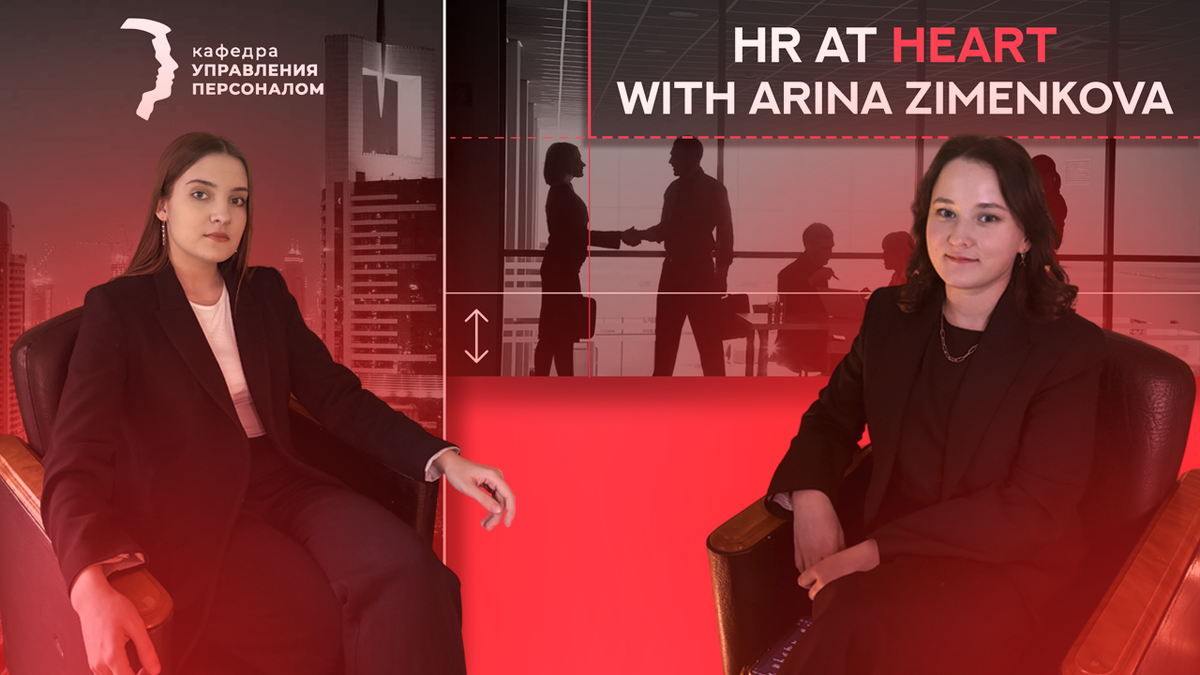
Host Polina: Hello, dear listeners and viewers. My name is Polina, and we continue our podcast series "HR at Heart." Today, we have a guest, а recruiting partner at DataRu, Arina Zimenkova. Hello, Arina!
Arina Zimenkova: Hi!
Host Polina: How was your trip? Did everything go well?
Arina Zimenkova: Yes, everything is great! I haven't been to the university for a long time. Glad to be here again.
Host Polina: Please tell us about yourself and the company you work for.
Arina Zimenkova: I have been in HR for five years, and I absolutely love this field. I enjoy developing in this area and helping companies grow their HR functions. Currently, I work at an IT company, which is small, with about 200 employees. At the same time, DataRu is a group of companies. Our main business is large-scale assembly of IT equipment. We assemble networks, servers, and sell them as vendors.
Since 2023, we have opened new businesses, including cloud services, consulting, and support services. We now provide technical support for vendors that have left Russia. We also implement information systems for client companies, as well as offer cloud solutions. We are continuously striving to develop our new businesses alongside our core business.
Regarding my current tasks, I am a recruiting partner and focus on personnel selection. In addition to that, I lead HR projects, which include onboarding, training (various workshops), and developing the HR brand. Occasionally, I also participate in small corporate events.
Host Polina: Oh, HR brand. How does the development and formation of the HR brand happen in your company? I’m very interested.
Arina Zimenkova: We actively started developing our HR brand back in 2023. In principle, the whole story comes from top management. Employees from international vendors and big international companies joined us, which led to a more Western corporate culture characterized by transparency, structure, and openness. Yes, we don’t have all processes established yet because we have new businesses and a more or less established core business focused on large-scale equipment assembly, but a lot had to be built almost from scratch. Our top managers played a significant role in this by communicating everything to the employees.
As a result, we have developed a culture of growth. Even our CEO says that we need to become 1% better every day. We all follow this, and it’s truly great. The company gives us opportunities for training and various workshops, which we also communicate externally.
In addition to development, we actively promoted our corporate life. Overall, the company has created very good working conditions for us. Basic things: a good office, a social package, and the stability that the company can offer in the current situation. Moreover, we made significant efforts to unite the team. This included corporate events, various activities, outings—basically everything that can engage and retain employees.
Our company is fundamentally about a human-centered approach. We pay a lot of attention to employee care; for example, we have a comprehensive health insurance plan, which is a standard offer from any company, but ours is extended. It includes dental care and specialized professionals, such as veterinarians, psychologists, and doctors who may not be needed by everyone but can be necessary. We also promote a healthy lifestyle and sports, and the company supports this in various ways. We have football teams, and we reimburse sports expenses after a year of employment.
These small details contribute to the positioning that we communicate externally and shape our values. Speaking of our company values, they revolve around development, expertise, and opportunities. The company provides opportunities for growth, interesting projects, and participation in them. Asfor expertise, we hire truly expert employees and evaluate them as thoroughly and accurately as possible upon entry to understand how they can realize themselves in our company. And regarding growth: we are small, flexible, and again, we offer many opportunities for employees. How did we additionally form the HR brand? Our recruitment team, hiring managers, and company employees communicate everything happening in the company externally.
We used social media. LinkedIn is our professional social network, along with TenChat, pages on Habr, and HeadHunter. We tried to immerse our audience in the information about what is happening with us.
Host Polina: So that everyone can see the values within the company.
Arina Zimenkova: Yes. The main thing is that we genuinely published what was happening and how we felt about it—our events, our teams, and various activities and challenges we conducted for ourselves. Last year, we had many challenges when we hired a large number of people in one direction, and we held a large-scale competition, which we communicated about. Not everything went smoothly, and we openly discussed it. Our target audience, our candidates, saw that not everything worked out for us, but we kept moving forward and learned from our mistakes.
Host Polina: Honesty is key, in fact.
Arina Zimenkova: Yes, yes, that’s what attracted candidates’ interest. And gradually, we have formed the brand that we have now, our HR brand. We have established a good reputation in the market, and many candidates started coming to us; people know and remember us. This is a significant effort made by our large team.
Host Polina: There must be something to pay attention to when forming an HR brand. What specifically does your company focus on, or what do you personally pay attention to?
Arina Zimenkova: When you are forming an HR brand in the market, it is very important to maintain an honest dialogue and an open approach to your target audience. No matter how well you describe how good, interesting, and convenient it is to work in the company, if an employee comes in and sees a completely different picture, your HR brand will be simply destroyed.
Host Polina: They will just leave immediately.
Arina Zimenkova: Yes, they will leave, information will spread in the market, and everything you built will become meaningless. Therefore, it's very important to communicate what you truly have. Not all companies may come to this realization, but it's crucial to be able to talk honestly about your shortcomings and mistakes. It is indeed important how we handle these issues, rather than just what exists. So, honesty is 100% essential.
When you are forming an HR brand, it is very important to highlight key points that will distinguish you from competitors. This is about NPS*, your values, and your approaches. It’s crucial to communicate this to the market.
And perhaps the third point I would like to emphasize is people. Our target audience consists of candidates, and people connect with people. If a company simply describes its hybrid work format and beautiful office in a dry manner, that doesn’t engage anyone. Everyone has a beautiful office. What attracts people now are the individuals, the approaches, the values, and the human-centered approach that shows care for employees. These are the aspects that make you think, "I would definitely work in this team; I would want to grow there; it aligns with my future plans." That’s the main thing.
*NPS (Net Promoter Score) is a customer loyalty index that shows how willing customers are to recommend a company, product, or service to others.
Host Polina: Yes, the team, the people you are around, motivate you more to work. You can understand a company's attitude toward people by looking at the team.
Arina Zimenkova: Yes, indeed, people connect with people. We had a very good case. When we were developing our social media, we decided to conduct a mini-experiment. We started publishing posts from our hiring manager, who was looking for people for the team. He posted about the team, his approaches, rules, and the clients he worked with. After some time, we noticed that candidates were coming through him. A candidate visits the page of their potential manager, sees their rules, approaches, values, and team, and naturally understands whether they are ready to work with them or not, and they reach out directly. When a recruiter publishes a vacancy or some information, it’s not so clear. For example, I, as a recruiter, have 10 open positions, and the connection between the manager and the employee gets lost. I can talk about the manager, the tasks, and some approaches, but it still won’t be the same match that occurs in a conversation between the manager and the candidate. So, we decided to conduct this experiment, and for several months we published posts from the hiring manager, and indeed, candidates were drawn in; it was a very good result. We still do this and continue to develop it. I would say the groundwork has already been laid.
Host Polina: Please tell us about your student years at SUM. How did you study, and what memorable experiences did you have during those years?
Arina Zimenkova: I always remember those four years at SUM with warmth. We had a wonderful department; I studied human resource management, and we were given very interesting material during our practices. In seminars, we worked on cases and projects, which was very engaging. I can say that we received practical knowledge that later proved useful in my job. It’s worth noting that there wasn’t an overwhelming workload. We were consistently engaged in interesting projects, which allowed us to participate in extracurricular activities. I’m talking about student groups, clubs, and the young scientists’ council. We constantly participated in Olympiads, forums, and competitions, which provided a broader understanding of our field and human resource management. This also helped me later in my work.
If we talk about the creative side, I was part of Studeos, a vocal and dance group, where we frequently traveled to competitions. I also participated in student council events, such as "Voice of GUU" and various mentoring activities. It was very interesting.
Host Polina: We just had "Voice of GUU." I also wanted to participate but forgot to submit my application. I just missed the deadline. Well, it happens.
Arina Zimenkova: No worries, there will be more opportunities.
Host Polina: Overall, the impressions left are only positive. And now we are also forming only good impressions. What steps is your company and you personally taking to stand out among competitors?
Arina Zimenkova: That's a very good question. As I mentioned earlier, it's about our values, our approaches, and a human-centered approach. This is what distinguishes us in the market right now; we really care about our employees and our candidates with whom we communicate and build relationships. Speaking of standard basic conditions, this is also important, despite many companies offering interesting bonuses, perks, and development opportunities. The basics that everyone has are also important. The stability of companies in the market, such as official employment, health insurance, social bonuses, and opportunities for training and development. As I said, we strive to be 1% better every day. Regarding our training: our employees take external courses once or twice a year. If someone wants to take courses more frequently, we also provide that opportunity.
Additionally, we have internal training sessions. Besides that, we often participate in conferences, webinars, and events. Even if they are paid, such opportunities are available. This is very valuable because when you participate in relevant conferences, you hear about what’s happening in the market, and you continue to develop in your field.
One more important point I would like to highlight is that we are a rapidly growing company with several businesses, and we have a well-developed open-door policy. Our management is very flexible in terms of implementing new projects or ideas. It’s great that in our company you can come up with any project that interests you, present it to management, take it under your wing, and then lead, develop, and assemble a team to accomplish it.
Host Polina: So, there is a freedom of creativity in your company.
Arina Zimenkova: Yes, indeed, to some extent. Naturally, you need to justify your project, demonstrating its relevance and feasibility, but I have had an example where I looked at the adaptation system, realized that a certain stage was missing, pointed it out, and expressed my desire to implement new points. I discussed it with management, developed a new system, and we are currently using it. What I wanted to add is that since not all processes are established in the company, you can actually create something yourself. This will be a plus for you as an interesting project, your development, and of course, a benefit for the company. This is what currently distinguishes us in the market. Not all large or small companies can offer such opportunities, but because we have a pro-Western approach and an open-door policy, we can allow such a system, which is very valuable.
Host Polina: In this era of a vast information landscape that is actively used, how does your company and you personally believe what content is best to use for promoting the HR brand?
Arina Zimenkova: It’s 100% about people. As I mentioned, people connect with people. Posts with photos and information about the team always get more likes and views. No matter how much a company writes about how great it is and what achievements it has made, people are still more interested in reading about individuals. This is exactly the example I mentioned when the hiring manager started posting information on social media about his team; candidates began coming through him. This applies to absolutely any other direction as well. Corporate events, the team, and again, the conditions we provide for our employees. For example, our company has many corporate events beyond public holidays and the New Year's party. We go as a whole company to a city in Russia once or twice a year for two to three days, where we have business sessions and excursions, a gala evening for employees. Colleagues who work remotely can interact and listen to the top team presenting our successes and future plans. The marketing department conducts a lot of activities: quizzes, various competitions, smart Fridays, and weekend events. We try to share all of this information.
Host Polina: When people read and see some interesting news or event, they think, "I want to be part of that! I want to connect with this company." I follow many companies because they publish important content. They show how people work in the companies, their teams, and how they spend their time. This creates a desire to join them.
Arina Zimenkova: Yes, absolutely. It’s also great when companies publish information about the internal life of their employees on their pages. Simply photographing the office, the workspace, and the relaxation areas can attract people. There will be fewer questions for the recruiter and manager during interviews. It's very important, by the way, to develop your career page. We are also moving in that direction. This year, we are creating a separate career page for DataRu, where we will have all the information about conditions, events, corporate culture, and our values, so that our target audience, the candidates, can have a complete understanding of our company. Therefore, this is also very important. But again, I would place more emphasis on corporate events and people.
Host Polina: How do you collect and analyze feedback from your employees to shape or improve the HR brand?
Arina Zimenkova: We work with DreamJob. It’s a service where current and former employees can leave reviews about the company. We, of course, monitor everything and do not ask employees to write positive reviews. We ask them to share their feedback as it is, and we respond to them.
Host Polina: Again, it’s about honesty.
Arina Zimenkova: Yes, it’s about honesty because, again, it’s important for candidates to see how things really are in the company, and they need to know where they are going. So, we monitor this service. We also conduct surveys every six months or annually among employees to share their opinions about the company and the challenges they face. Since we are not very many—about 200 people—it’s not possible to talk to everyone in detail. That’s why we launch surveys so that our colleagues can share their impressions of the company and suggest ideas.
In addition, we have wonderful HR business partners who closely monitor new employees during their probation period. They hold three meetings to gather feedback from the new employee, find out how to make their work better and more comfortable. They then meet with all employees every six months to discuss goal setting, collect feedback on work, and suggestions for improving certain processes.
Host Polina: In the spring, our university hosts the A.Ya. Kibanov HR Forum at SUM from our department. I wanted to ask about your participation in SUM as a project participant. Do you plan to attend our forum this year?
Arina Zimenkova: I have participated in the forum almost every year while studying. I started in my second year, and I had the chance to be a volunteer, a participant, and a partner. That’s why I absolutely love this forum. I was there with several projects, including the Olympiad, so I really hope to participate again this year. Last year, I was actually on the jury. We became partners of the forum, so I would be very happy to participate again this year.
Host Polina: We will definitely be waiting for you.
Arina Zimenkova: Thank you.
Host Polina: What inspires you to come up with new solutions, and what do you enjoy doing in your free time?
Arina Zimenkova: I am very inspired by performances; I love to sing and dance, and recently I returned to the stage, performing various vocal and dance numbers. Regarding work, I recently discovered the opportunity to give lectures and webinars. My colleague and I are trying to develop relationships with more specialized universities, and we recently went to give a lecture to students about starting their careers. Last year, I even managed to conduct a training session for IT college students about careers, CVs, and starting their way.This inspires and fills me up. I return to work with renewed energy and ready to break all the molds.
Host Polina: Going into battle.
Arina Zimenkova: Yes, going into battle.
Host Polina: Can you please share with us an experience when something at work didn’t go as planned? How did you handle it?
Arina Zimenkova: Yes, things at work generally don’t go as planned. Especially when it’s a format of work where many events happen, and you have a lot of tasks to complete in a short time. One interesting situation that didn’t go as planned was when I was working on a top position. We found a great candidate; she was a 10 out of 10. The candidate perfectly matched our corporate culture and our tasks, and she could bring a lot to our company while also gaining valuable experience for her development. We made her an offer, but unfortunately, or perhaps fortunately, she declined because she received an offer from another company where the tasks were a bit more interesting. In our company, she would have had to prove herself to the market and break all the molds, whereas there she would be improving upon existing processes. So, she chose the other company. It was indeed a blow for us; it was very sad, but we quickly regrouped, adjusted our requirements and tasks, and launched the search again. Within just two weeks, we found another very good candidate and made her an offer. I consider this a mini-victory because after the first candidate's rejection, it was difficult to look at other candidates since it’s rare to find someone who fits all the tasks perfectly and is exactly what you need. But the key is to quickly regroup and continue the search.
Host Polina: The main thing is to remember that after every dark stripe, a light stripe always follows, and that you can always learn something from such problems and troubles.
Arina Zimenkova: Yes, yes, but I want to say that we remained on good terms with the first candidate. I really hope that in the future we will cross paths again at work. This work, where you meet interesting people, is inspiring. You learn from their experiences and get to know their cases, which is very interesting.
Host Polina: Speaking of cases, were there any interesting or creative cases in the company?
Arina Zimenkova: I mentioned that we are very people-centered and that we care a lot about our employees, but this also extends to candidates. Again, this is part of forming the HR brand, and it starts with the little things. It’s elementary how we communicate with candidates and how we provide feedback. Many people say that recruiters and HR don’t get back to candidates with answers. We strive to respond with any answer, whether it’s a "yes" or a "no." One of the most unusual things we experienced was when we made an offer to a candidate, and she declined—not because she didn’t like us. She liked us very much, but she was going through a very difficult situation in her life, which caused her to stop her job search and leave her current position. It was very sad. She is a very good specialist, and we had an interesting project for her, but she had to decline. We didn’t abandon her; we didn’t withdraw the offer; we put it on hold for an indefinite period so that when she resolved her issues, she could come back to us. As a gesture of support, we sent her a small sweet gift to cheer her up and show our support. This was very valuable for her; she didn’t expect such a gesture, such a present, such attention from us. This approach, the care and support, truly distinguishes our company from all others. Because we are about people, it’s important to remember that there’s a person on the other end too, and they may have their own difficulties; it’s important to approach this with understanding.
Host Polina: What advice would you give to students from the Human Resourse department at the State University of Management?
Arina Zimenkova: Besides the importance of studying, I would advise doing what interests you. I am sure that education nowadays allows you to engage in various hobbies, so find a hobby, discover your interests—things that will fill you with joy: drawing, dancing, singing, absolutely anything. It can even relate to your professional journey: you can attend conferences, meet people, and develop your networking skills, but it’s essential to do what you love so that you come to work energized, with new ideas. So, I wish you inspiration.
Host Polina: So, let's move on to our blitz survey. First question: What superpower would you like to have?
Arina Zimenkova: To do several tasks simultaneously and quickly.
Host Polina: Like Julius Caesar. Your credo in one word?
Arina Zimenkova: My credo is nothing is impossible. Everything can be done, the important thing is to figure it out.
Host Polina: What is your zodiac sign?
Arina Zimenkova: Gemini.
Host Polina: Favorite season?
Arina Zimenkova: It’s probably spring.
Host Polina: Favorite city?
Arina Zimenkova: Moscow.
Host Polina: Favorite project at SUM?
Arina Zimenkova: It was a project we did at the HR forum where we analyzed generations. It was the theory of generations Y, Z, and so on. We surveyed a large number of respondents and created a very good sample. We found clear differences between the generations, which was very interesting.
Host Polina: And the last question. Complete the phrase: "The smartest word that came to my mind."
Arina Zimenkova: Human-centeredness.
Host Polina: That will be the word of this podcast! The word of the podcast is "Human-centeredness."
Arina Zimenkova: Yes!
Host Polina: Thank you for visiting us and answering our questions!
Arina Zimenkova: Thank you very much for inviting me!
Host Polina: And thank you for following our podcast interview "HR at Heart"!