Alina Reznitskaya is an associate professor in the Educational
Foundations department at Montclair State University, New Jersey, USA;
e-mail reznitskayaa@mail.montclair.edu.
Reznitskaya, A. (2012). Dialogic Teaching: Rethinking Language Use During Literature Discussions. The Reading Teacher, 65(7), 446–456. https://doi.org/10.1002/trtr.01066
Rethinking Language Use During Literature Discussions
By making their classroom interactions more dialogic, teachers can engage
students in a collaborative deliberation of complex questions and support
the development of students’ thinking.
For many years, educational researchers have criticized recitation as a prevalent
instructional approach used to conduct group discussions of assigned readings (e.g.,
Alexander, 2008; Cazden, 2001; Mehan, 1998; Tharp & Gallimore, 1991). Recitation, during which teachers ask “known information questions” (Mehan, 1998)
and control key aspects of communication, has been shown to impede student engagement and learning, especially at higher levels of cognitive complexity
(Alexander, 2008; Galton, 2007; Nystrand, 1997).
Stressing the important role of language in the development of higher order thinking, contemporary theory and research suggest that classroom
communication needs to become more dialogic (Alexander, 2008; Paul, 1986; Vygotsky, 1968).
In dialogic classrooms, teachers and students act as coinquirers, collaboratively engaging in a generation and evaluation of new interpretations of texts in order to “gain a fuller appreciation of the world, [them]selves, and one another” (Burbules,
1993, p. 8). As opposed to monologic approaches, such as recitation, during which only the teacher “knows and possesses the truth” (Bakhtin, 1984, p. 81), truth
in a dialogic discussion “is born between people collectively searching for truth” (Bakhtin, 1984, p. 110).
Today, there are many convincing theoretical accounts of dialogic teaching (Burbules, 1993; Mercer & Littleton, 2007; Wells, 1999), as well as empirical evidence linking it to important learning outcomes (Mercer & Littleton, 2007; Reznitskaya et al., 2009;
Soter et al., 2008). Recent professional standards in the United States describe accomplished teachers as knowing how to “engage students in a dialogue” and
to ask questions that “provoke the most thoughtful conversation” (National Board for Professional Teacher Standards, 2002).
Yet, despite its recognized pedagogical potential, dialogic teaching is rare, sporadic, and difficult to achieve in today’s schools (Alexander, 2008; Nystrand, Wu, Gamoran, Zeiser, & Long, 2003; Smith, Hardman, Wall, & Mroz, 2004). In a recent carefully executed study of more than 200 American classrooms, the authors concluded that there was “little discussion in any classes in the sense of an open and in-depth exchange…. What most teachers in our study called ‘discussion,’ was, in the words of
one teacher, ‘question-answer discussion’—that is, some version of recitation” (Nystrand et al., 2003, p. 178).
Thus the reality of typical classroom practices today does not correspond to the highly advocated educational ideal of dialogic teaching. A variety of reasons have been offered to explain “the failure of dialogue” (Burbules, 1993, p. 144), ranging from the power of tradition (Tyack & Tobin, 1993) to crowded public classrooms (Burbules, 1993). Although changing the patterns of classroom discourse requires
efforts from a variety of actors in an educational system, this article aims to help practicing teachers engage in a critical reflection on the quality of their classroom communication. I start by reviewing empirically supported features of dialogic talk and relating them to relevant theoretical models. I then describe the Dialogic Inquiry Tool (DIT), an observational scale designed to analyze teacher–student interactions in elementary language arts classrooms. Finally, I use excerpts from classroom discussions to demonstrate the use of the DIT and its potential to inform teacher practice.
“The reality of typical classroom practices today
does not correspond to the highly advocated
educational ideal of dialogic teaching.”
Teaching and Learning in a Dialogic Classroom
In order to be able to facilitate a dialogic discussion, teachers first need to recognize whether it is occurring in a classroom (Sandora, Beck, & McKeown, 1999). Fortunately, research studies have identified the following key verbal behaviors and practices that characterize dialogic teaching (Alexander, 2008; Billings & Fitzgerald,
2002; Mercer & Littleton, 2007; Nystrand et al., 2003; Soter et al., 2008):
1. In a dialogic classroom, power relations are flexible, and authority over the content and form of discourse is shared among group members.
Students take on key responsibilities for the flow of the discussion. They participate in managing turns, asking questions, judging each other’s answers, introducing new topics, and suggesting procedural changes.
2. Dialogic teaching relies on questions that are “fundamentally open or divergent…in terms of allowing a broader degree of uncertainty in what would constitute an adequate answer” (Burbules, 1993, p. 97). The purpose of divergent questions is
neither to test students nor to lead them to a narrow range of answers deemed acceptable by the teacher. Rather, these questions serve to inspire a meaningful inquiry toward new understandings.
3. To advance the group’s inquiry further, teachers in dialogic classrooms provide students with meaningful and specific feedback. They work strategically with student
answers, asking for justification, challenging, or prompting for evidence. Students use teachers’ feedback to negotiate and construct new meanings.
4. Participants in dialogic discussions consistently engage in meta-level reflection. They scrutinize both the products and the processes of the discussion, thus creating
opportunities for the group to self correct (Burbules, 1993; Splitter & Sharp, 1996). The primary role of a teacher is to help students pay attention to the process and
quality of their reasoning—from questions toward judgments— rather than to tell students what the answers should be (Gregory, 2007). Examples of meta-level
moves include seeking clarification, connecting ideas across contexts and
participants, and reflecting on levels of understanding.
5. Students in a dialogic classroom present lengthy, elaborate explanations of their ways of thinking. They take public positions on complex issues and support them with reasons, examples, and other evidence. They continually address the questions of “Why?” and “How?”
6. During dialogic discussions, students engage in the collaborative coconstruction of knowledge. They listen to and react to each other’s positions and justifications and “take up” the preceding contribution to further develop the group’s reasoning.
“Dialogic teaching reflects social-constructivist theories of learning.”
The aforementioned verbal behaviors and practices suggest that dialogic teaching departs significantly from more traditional, monologic, approaches to instruction. The differences stem from core underlying assumptions that represent alternative
theories of teaching and learning.
Traditional Western schooling is largely based on behaviorist views (Windschitl, 2002), which suggest that teachers transmit knowledge to be remembered by students through the unambiguous use of language.
Students are expected to passively and unselectively copy and reproduce the
transmitted knowledge in its original, objective form. Recitation, during
which students report fixed answers to a teacher who then evaluates their
responses as either right or wrong, exemplifies behaviorist perspectives.
In contrast, dialogic teaching reflects social-constructivist theories of learning (e.g., Piaget & Inhelder, 1969; Vygotsky, 1968). These theories view students as active meaning makers, who can progress to higher levels of cognitive development through their interaction with the environment.
Language is seen not just as a medium for communicating ideas, but also as
a primary tool for forming new ways of thinking and knowing (Vygotsky, 1968).
Participants in a dialogic discussion collectively formulate, defend, and
scrutinize each other’s viewpoints, negotiating and constructing new
meanings. As a result, they observe, try out, and eventually appropriate general
intellectual dispositions and specific linguistic skills, which they can use
whenever they need to resolve complex issues.
In this view, the purpose of schooling shifts from the acquisition of established
facts to the internalization of intellectual competencies that underlie the
development of disciplinary knowledge.
Several studies documenting gains in students’ skills and knowledge following
their engagement in dialogic discussions provide support for the proposed
learning processes. Participation in dialogic discussions has been linked to a variety of important learning outcomes, including improved reasoning in new contexts, deeper conceptual understanding, increased inferential comprehension of text, and enhanced quality of argumentative writing (e.g., Asterhan & Schwarz, 2007; Kuhn &
Udell, 2001; Mercer & Littleton, 2007; Murphy, Soter, Wilkinson, Hennessey, & Alexander, 2009; Reznitskaya et al., 2009).
It is important to note that the use of dialogic teaching is not advocated for all
purposes and at all times (Alexander, 2008). As with any other pedagogical
approach, dialogic teaching should not become dogmatic. There are contexts
in which other methods may be more appropriate. However, a common concern consistently supported by research studies (e.g., Alexander, 2008; Galton, 2007; Mehan, 1998; Nystrand et al., 2003), is that students rarely experience dialogic teaching throughout their schooling.
This educational reality stands in sharp contrast to the rhetoric focused
on student-centered teaching aimed at developing independent thinkers, as
well as with the theory and research linking inquiry dialogue, rather than other approaches, to student development of higher order thinking (Murphy et al., 2009; Nystrand et al., 2003; Webb et al., 2007; Wegerif, Mercer, & Dawes, 1999). Thus it is
important that teachers examine and expand the repertoire of their language practices, flexibly and strategically choosing discourse tools suitable for different pedagogical goals.
Studying Classroom Interactions
With the Dialogic Inquiry Tool Although data-analytic schemes used by the researches of classroom discourse are often too intricate and time consuming to be used by practicing teachers (e.g., Chinn, O’Donnell, & Jinks, 2000), several recently developed measurement instruments not only allow teachers to gather rich data about their communications, but also are efficient and suitable for school settings (e.g., Junker et al., 2006; Pianta, La Paro, & Hamre, 2008; Reznitskaya, Glina, &
Oyler, 2011; Wilkinson, Reninger, & Soter, 2010). Consider, for example,
the DIT (Reznitskaya et al., 2011), an anchored classroom observation scale
that is specifically designed to help elementary school teachers examine
and rethink the quality of talk during literature discussions.
Using the DIT, teachers observe short (20 minutes) segments of video recorded or real-time discussions and apply multiple evaluation criteria, or indicators, to systematically study their discourse patterns. Before using the DIT to evaluate their interactions, teachers are asked to state their pedagogical goals for the lesson. This
allows teachers to later reflect on their language practices, their goals, and
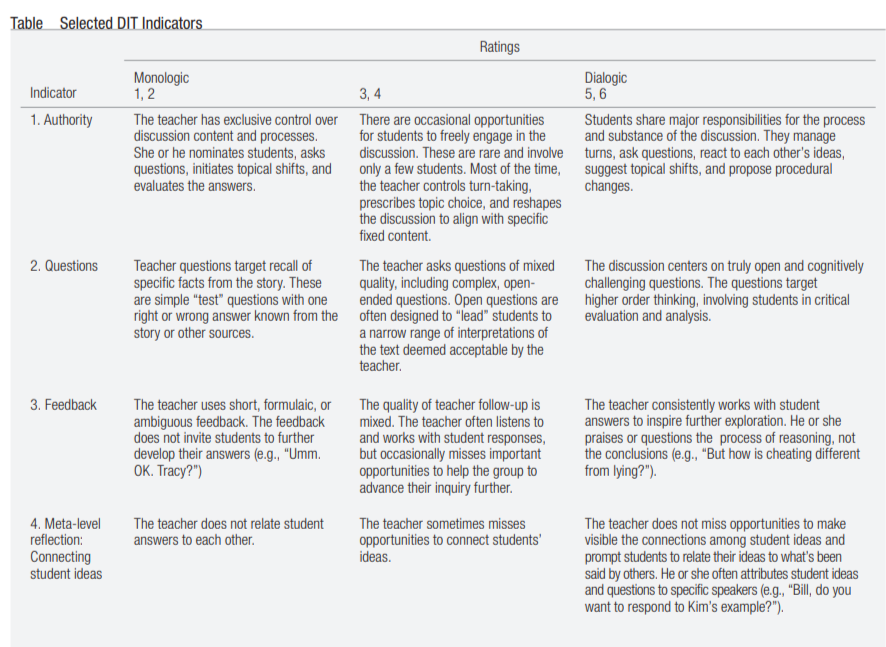
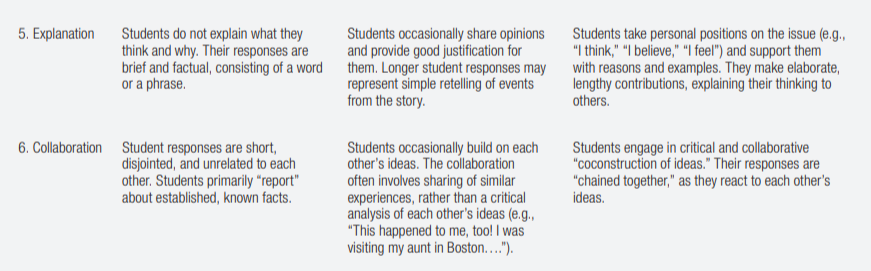
the alignment between the two. The Table illustrates six DIT indicators
that represent the key features of the dialogic approach to teaching discussed
earlier.
To enhance the quality of information generated with the DIT, teachers take notes in relation to each indicator as they observe real-time or videotaped discussions. The notes should represent low-inference descriptions of behaviors (e.g., “All nominations are done by the teacher.”) and direct quotes from discussion participants (e.g., “Let’s now turn to page 23.”).
To illustrate how the DIT can help teachers analyze their practice, I discuss
three excerpts from whole-group discussions of literature conducted in
fifth-grade classrooms. The excerpts came from a recent study that examined
discourse practices of elementary school teachers (Reznitskaya et al., in press).
I chose these experts because they effectively represent existing variations
in group communication in relation to six DIT indicators shown in the Table.
All student names used in these excerpts are pseudonyms.
Although the discussion in each excerpt was based on a different story,
all three stories were comparable in terms of their focus on complex,
thought-provoking issues that are central to human experience and
relevant to students’ lives. The first story was a Native American tale
about a young man who showed kindness to two eagles (Rosebud
Yellow Robe, 2001). In return, the eagles saved the man’s life by carrying
him to safety. This story raised important questions about loyalty,
courage, and friendship.
“It is important that teachers examine and expand the repertoire of their language practices, flexibly and strategically choosing discourse tools suitable for different pedagogical goals.”
The second excerpt was based on the story about an unusual giraffe that
learns to communicate with humans (Lipman, 1996). This story addressed
such topics as intelligence, schooling, and community, as well as personal
rights and responsibilities. In the last excerpt, students read the story that
depicted historical events related to the revolt of enslaved Africans (Chambers,
2001). The story touched on essential topics, such as courage, friendship,
power, and human rights.
A Monologic Classroom
When facilitating a story discussion, each teacher created a unique learning
experience for the students, evidently addressing different pedagogical goals.
Let’s consider the first excerpt.
Teacher: OK. So now he got stuck on the cliff. So now what? That’s
a big problem.... But, first of all, why did he want to reach the eagles? Gabriel?
Gabriel: Because he wanted to bring them back to his tribe so that
everyone would have, like, a feather for everybody.
Teacher: OK. He didn’t want to bring the eagles back. He wanted to
bring what back, Trisha?
Trisha: The feathers.
Teacher: The feathers. For what? What’s it called? For what headgear? Who’s that person? What are they called? Andrew?
Andrew: The chief.
Teacher: The chief. The…starts with a w?
Jack: Warriors.
Teacher: Warriors. For the warriors’ headgear. And what problem
did he reach, um, when he was trying to reach the eagles again? He got what, Marla?
Marla: The rope, it was broke.
Teacher: It broke.
Marla: And he fell down.
Teacher: OK. And he, he got stuck. So he wants to reach the eaglets. The nest is very high up on top of the mountain top. And what does he use to lower himself? What was the resource that he used?
Jeff: A ladder.
Teacher: Made out of what? Dalia?
Dalia: Buffalo skin.
If we envision monologic versus dialogic instruction as two ends of a continuum, the preceding discussion is close to the monologic extreme.
Although this excerpt is too short to make a reliable assessment, this
discussion is likely to get low scores (1 or 2) on all 6 DIT indicators presented
in the Table.
Considering the first indicator, the teacher is clearly the only authority in the
classroom. She controls both the content and the form of the discussion, calling
on students to respond, evaluating their answers (e.g., “OK; He didn’t want to
bring the eagles back. He wanted to bring what back, Trisha?”) and initiating
topical shifts with new questions.
Her questions (indicator no. 2) target recall and basic interpretation of story
facts (“What was the resource that he used?” “Starts with a w?”). The teacher already knows the correct answers and is the ultimate source of expertise when evaluating students’ responses.
Her feedback to students (indicator no. 3) is rather mechanical and represents
simple positive reinforcement and the repetition of correct responses (e.g.,
“OK”; “The chief”; “The warrior”).
The teacher does not prompt students to support their positions with reasons,
to consider alternatives, or to question assumptions or implications. Instead,
she moves rapidly from student to student, sacrificing deep intellectual engagement for broad but superficial participation. The teacher does not make meta-level comments about the functioning of the group. For example, she misses opportunities to make connections among students’ answers (indicator no. 4).
Students in this classroom do not explain their thinking
in depth: their answers are brief, often consisting of only one or two words:
“the chief”; “warriors”; “buffalo skin”; “a ladder” (indicator no. 5).
They do not collaborate with each other; instead, they direct all their answers to the teacher, rather than peers (indicator no. 6).
A Dialogic Classroom
A very different communication pattern can be seen in the second excerpt
that follows. Students are discussing the question “Do we need to go to school in
order to learn?” prompted by their reading about a giraffe who was taught by a
friend, a boy, to speak human language:
Molly: Well, if you’re learning social studies, colonial times. And then you go to… you work at a computer, like you work with computers, how is the social studies going to
help you with computers? You would just need to use something else. Like something else would need to help you.
Teacher: Now, you should be looking at Sam, not at me, all right? Because you’re responding to…
Molly: I am agreeing with him.
Teacher: You’re agreeing with him?
Molly: Yeah.
Teacher: And how are you agreeing with Sam?
Molly: Wait, I’m confused.
Teacher: Well, maybe…maybe somebody can help. How, how is she agreeing with
Sam?
Sally: I’m not really sure.
Teacher: Well let’s, let’s retrace. Lenny?
Lenny: I think I know why she’s agreeing with him. Because I think you’re saying that if you want to go for one goal, like being a computer… become a computer whiz
or something like that, you won’t have to go to school and learn everything else. You just want to be a computer…you can just learn from somebody that already knows it, and then you won’t have to go to school.
Teacher: OK, and this is Sam’s point. That school is not necessary for picking…for things getting passed on to you. You can go find somebody else who can
pass it on to you. And you’re agreeing? [pointing at Molly]
Molly: Yes, that’s what I meant. It just came out…[makes circular hand motion]
Teacher: OK. Thank you.
Sally: I think I have a question. Well, you guys were saying that we need to go to school to learn things, to know how to do things. But how about… who was the first person who learned how to do things? Like there was no school before, and then they started to go to school because people started to learn how to do things. But, if there weren’t no school before, and people survived, and keep learning how to do many things, I don’t understand why we need it.
Teacher: Let, let’s stick with the medical example too, OK? The doctor example.
Sally: Yeah, and they didn’t go to school when they first found how to make a medicine. They just found it, like Kathy said.
Kathy: I am so confused by what you just said. I have, like, no clue.
Teacher: You need a clarification?
Kathy: Yeah.
Teacher: Could somebody clarify what Sally said?
Mick: I think what Sally was saying and asking was how, how the
cavemen learned, they weren’t in school.
[7 minutes later]
Teacher: If somehow you can…what, where have we arrived as a result of this conversation about school and learning?
Anna: As a result, we probably…
Teacher: Do we need it?
Anna: Probably, like, half and half, ’cause everyone has an opinion. So…
Teacher: Well no, not just everyone has an opinion. I think that we’re working with each other’s opinions.
Anna: Yes, so I would say that more people think that we don’t need it than we do need it. ‘Cause people were talking about cavemen didn’t have it and they were fine, and other people, and some people were talking about medical things where they have to go to school and stuff…
This classroom discussion approaches the dialogic end of the continuum, with possible scores of 5 or 6 on all DIT indicators. The teacher does not have exclusive authority over the flow of the discussion, as students share responsibilities for managing the turntaking and advancing their inquiry (indicator no. 1). For example, Sam nominates Molly to speak next, and Sally introduces a new topic by asking, “But
how about…who was the first person who learned how to do things?”
As the group engages in a collaborative search for a better understanding of a contestable question about the need for formal schooling, the teacher refrains from expressing his own position; instead, he prompts students to develop a reasonable
solution for themselves (indicator no. 2). Note how the teacher comments
on Anna’s response, when, trying to summarize the progress made by the
group, she concludes that “everyone has an opinion.” The teacher’s feedback
directs Anna to “[work] with each other’s opinions,” pressing students to engage
in a critical coconstruction of meanings (indicators no. 3 and 6). The teacher
regularly prompts students to listen to each other and make connections among
related ideas: “And how are you agreeing with Sam?”; “Could somebody clarify
what Sally said?” (indicator no. 4). During the discussion, students
provide elaborate explanations of their thinking (indicator no. 5). They
state their positions (e.g., “You won’t have to go to school”), support them
with reasons (e.g., “You could always learn from somebody else who already
knows about it”), give examples (e.g., “They didn’t go to school when they
first found how to make a medicine”), and propose alternative viewpoints
(e.g., “But, if there weren’t no school before, and people survived, and keep
learning how to do many things, I don’t understand why we need it”).
Their contributions are marked by high levels of collaboration, as indicated
by statements such as “I think I know why she’s agreeing with him...”; “I
think what Sam was saying and asking was...”; “Well, you guys were saying
that…” (indictor no. 5).
These interrelated attempts by the discussion participants to develop
a more complete understanding of relevant viewpoints serve to improve
the quality of the group’s reasoning and, as the result, its substantive
conclusions. Note that the teacher’s comments relate exclusively to the
procedural aspects of discussion, as in a dialogic classroom, teachers are
“substantively weak,” but “procedurally strong” (Splitter & Sharp, 1996). The
pedagogical goal is to focus on the processes of thinking, to engage students
in practicing and forming new “habits of mind,” which, in turn, help to create
better judgments.
The Challenges of Transitioning
Although the previous two excerpts illustrate the differences between the
two ends of the monologic versus dialogic continuum, many teachers may
find themselves somewhere in between recitation and dialogue. The DIT can
assist teachers with locating themselves on the continuum and revealing
important diagnostic information, so that teachers can adjust their current
positions. It can also encourage teachers to experiment with their discourse
practices and to formulate alternative pedagogical goals for their students. In
the following excerpt, consider the discourse patterns used by a teacher who is
trying to move away from a monologic extreme.
Teacher: Who are slaves? When you think of slaves, what kind of people are really slaves, in your mind? Ah, Ellen?
Ellen: Like, they are, like um, in my mind, kind of, like, someone who really doesn’t
have the benefits of making their own choices, figuring out what they want to do,
what their destiny should be. It’s kind of somebody who really doesn’t have any kind
of freedom.
Teacher: Excellent. What do you think, Tim?
Tim: Um, people who work for others.
Teacher: OK. Doug?
Doug: People who are forced against their will.
Teacher: People who are forced against their will. Excellent, guys. Cane?
Cane: People who are forced against their will to work for somebody even somebody
that they really don’t want to.
Teacher: Victoria?
[5 minutes later]
Jim: Well, there isn’t any reason why they [slaveholders] should be able to have slaves because everyone is equal, so it doesn’t really make sense that someone just like... Like, they are all different, and one has to do everything what the other person says. It’s just not fair.
Teacher: All right…Kelly?
Kelly: Might be that the slave masters, probably, might have thought that they were not as good as them. Maybe, the slaves were better than them.
Teacher: OK, that’s an interesting point. Let’s see...Tim?
The teacher in this excerpt starts by asking students a truly divergent question (i.e., “Who are slaves?”) and does not seem to have a specific answer in mind. Some of her students, such as Ellen and Jim, provide rather elaborate explanations of their views.
Thus this teacher may get higher scores on indicators no. 2 and 5.
Unfortunately, as the discussion develops, it becomes clear that although the teacher has abandoned the traditional recitation script with its factual, test-type questions, she has not yet acquired an appropriate alternative.
As a result, the teacher is left with very limited functions as a discussion
facilitator: providing superficial feedback (“Excellent,” “OK,” “All right”) and nominating students to speak (indicator no. 3). The teacher largely remains the only authority in this classroom, as she briefly evaluates each answer and then selects the next student (indicator no. 1). Neither the teacher nor her students reflect on
group processes. For example, the teacher does not help her students identify important connections between their own ideas and those of their peers (indicator no. 4). As a result, the discussion time is dedicated entirely to the sharing of opinions,
which remain unexamined and disjointed. There is no collaboration: Students simply state what they think in a sequential fashion, essentially disregarding the input of others (indicator no. 6).
The low scores on several DIT indicators in the previous discussion can help to make the unproductive discourse patterns visible to the teacher. She can then deliberately
focus on particular language moves, such as providing more strategic feedback and relating student ideas to each other. In a similar way, the teacher from the first excerpt can use the information revealed by the low scores on the DIT indicators not only to analyze specific language patterns in her classroom, but also to re-think
her pedagogical goals, as well as her implicit theories of teaching and learning: What kind of knowledge and skills are being acquired by students who consistently engage in the simple retelling of basic facts from a story?
Are there important student outcomes that are being overlooked through
the use of recitation? What kind of new learning opportunities can exist in a classroom where students share control over the key aspects of communication?
Toward Dialogic Teaching
To conclude, one of the reasons for the well-documented prevalence of monologic instruction in today’s classrooms is the lack of opportunities for teachers to study their own practice in a systematic and deliberate manner (Adler, Rougle, Kaiser, &
Caughlan, 2003; Smith et al., 2004). Furthermore, in a comprehensive review of professional development practices, Elmore (2002) argued convincingly that “few people willfully engage in practices that they know to be ineffective; most educators
have good reasons to think that they are doing the best work they can” (p. 19). Thus, in order to bring about nonsuperficial changes in classroom discourse, teachers need to reexamine their own interactions with students, try out and evaluate new behaviors, discover discrepancies between their intended instructional goals and actual practices, and continually question their conceptions of effective pedagogy
(Garet, Porter, Desimone, Birman, & Yoon, 2001; Walsh, 2002).
Using measurement tools such as the DIT, teachers are able to collect rich information about their practice that can encourage further reflection about
knowledge, authority, language, and learning, and, eventually, facilitate the
transition to more dialogic instruction.
As a society facing serious political, economic, and scientific challenges,
we cannot afford to have “orderly but lifeless classrooms” where teachers
continue to “avoid controversial topics, simplifying complex issues into bitesized pieces of information,” and where students routinely “recall what someone
else thought, rather than articulate, examine, elaborate, or revise what they
themselves thought” (Nystrand, 1997, p. 3).
REFERENCES
Adler, M., Rougle, E., Kaiser, E., & Caughlan, S. (2003). Closing the gap between concept and practice: Toward more dialogic discussion in the language arts classroom. Journal of Adolescent & Adult Literacy, 47(4), 312–322.
Alexander, R. (2008). Essays on pedagogy. New York: Routledge. Asterhan, C.S.C., & Schwarz, B.B. (2007). The effects of monological and dialogical argumentation on concept learning in evolutionary theory. Journal of Educational Psychology, 99(3), 626–639. doi:10.1037/0022-0663.99.3.626
Bakhtin, M.M. (1984). Problems of Dostoevsky’s poetics (Vol. 8). Minneapolis, MN: University of Minnesota.
Billings, L., & Fitzgerald, J. (2002). Dialogic discussion and the Paideia seminar.
American Educational Research Journal, 39(4), 907–941. doi:10.3102/00028312039004905
Burbules, N. (1993). Dialogue in teaching: Theory and practice. New York: Teachers College Press.
Cazden, C.B. (2001). Classroom discourse: The language of teaching and learning. Portsmouth, NH: Heinemann.
Chambers, V. (2001). Amistad rising: The story of freedom. In J. Flood, J.E. Hasbrouck, J.V. Hoffman, D. Lapp, A.S. Medearis, S. Paris, et al. (Eds.), McGraw-Hill Reading (pp. 619–645). New York: McGraw-Hill School Division.
Chinn, C.A., O’Donnell, A.M., & Jinks, T.S. (2000). The structure of discourse
in collaborative learning. Journal of Experimental Education, 69(1), 77–97.
doi:10.1080/00220970009600650
Elmore, R.F. (2002). Bridging the gap between standards and achievement: The imperative for professional development in education. Washington, DC: Albert Shanker Institute.
Galton, M.J. (2007). Learning and teaching in the primary classroom. London: Sage.
Garet, M.S., Porter, A.C., Desimone, L., Birman, B.F., & Yoon, K.S. (2001). What makes professional development effective? Results from a national sample of teachers. American Educational Research Journal, 38(4), 915–945. doi:10.3102/00028312038004915
Gregory, M. (2007). A framework for facilitating classroom dialogue. Teaching Philosophy, 30(1), 59–84.
Junker, B.W., Matsumura, L.C., Crosson, A.,
Wolf, M.K., Levison, A., Wiesberg, J., et al. (2006). Overview of the Instructional Quality Assessment. Los Angeles: University of California, National Center for Research on Evaluation, Standards, and Student Testing.
Kuhn, D., & Udell, W. (2001). The path to wisdom. Educational Psychologist, 36(4),
261–264. doi:10.1207/S15326985EP3604_6
Lipman, M. (1996). Nous. Montclair, NJ: The Institute for Advancement of Philosophy for Children.
Mehan, H. (1998). The study of social interaction in educational settings: Accomplishments and unresolved issues. Human Development, 41(4), 245–269. doi:10.1159/000022586
Mercer, N., & Littleton, K. (2007). Dialogue and the development of children’s thinking: A socio-cultural approach. London: Routledge.
Murphy, P.K., Soter, A.O., Wilkinson, I.A., Hennessey, M.N., & Alexander, J.F. (2009). Examining the effects of classroom discussion on students’ comprehension of text: A meta-analysis. Journal of Educational Psychology, 101(3), 740–764. doi:10.1037/a0015576
National Board for Professional Teacher Standards. (2002). What teachers should
know and be able to do. Arlington, VA: Author.
Nystrand, M. (1997). Opening dialogue: Understanding dynamics of language and
learning in the English classroom. New York: Teacher College Press.
Nystrand, M., Wu, L., Gamoran, A., Zeiser, S., & Long, D.A. (2003). Questions in time: Investigating the structure and dynamics of unfolding classroom discourse. Discourse Processes, 35(2), 135–198. doi:10.1207/S15326950DP3502_3
Paul, R.W. (1986). Dialogical thinking: Critical thought essential to the acquisition of
rational knowledge and passions. In J.B. Baron & R.J. Sternberg (Eds.), Teaching
thinking skills: Theory and practice (pp. 127–148). New York: Freeman.
Piaget, J., & Inhelder, B. (1969). The psychology of the child. New York: Basic.
Pianta, R.C., La Paro, K.M., & Hamre, B.K. (2008). Classroom Assessment Scoring System (CLASS). Baltimore: Brookes.
Reznitskaya, A., Glina, M., Carolan, B., Michaud, O., Rogers, J., & Sequeira, L. (in press). Examining transfer effects from dialogic discussions to new tasks and contexts. Contemporary Educational Psychology.
Reznitskaya, A., Glina, M., & Oyler, J. (2011). Dialogic Inquiry Tool. Montclair, NJ: The Institute for the Advancement of Philosophy
for Children.
Reznitskaya, A., Kuo, L., Clark, A., Miller, B., Jadallah, M., Anderson, R.C., et al.
(2009). Collaborative Reasoning: A dialogic approach to group discussions.
Cambridge Journal of Education, 39(1), 29–48. doi:10.1080/03057640802701952
Rosebud Yellow Robe. (2001). Tonweya and the eagles. In J. Flood, J.E. Hasbrouck, J.V. Hoffman, D. Lapp, A.S. Medearis, S. Paris, et al. (Eds.), McGraw-Hill Reading (pp.
557–577). New York: McGraw-Hill School Division.
Sandora, C., Beck, I., & McKeown, M. (1999). A comparison of two discussion
strategies on students’ comprehension and interpretation of complex literature.
Journal of Reading Psychology, 20(3), 177–212. doi:10.1080/027027199278394
Smith, F., Hardman, F., Wall, K., & Mroz, M. (2004). Interactive whole class teaching in the National Literacy and Numeracy Strategies. British Educational Research Journal, 30(3), 395–411. doi:10.1080/01411920 410001689706
Soter, A., Wilkinson, I.A., Murphy, P.K., Rudge, L., Reninger, K., & Edwards,
M. (2008). What the discourse tells us: Talk and indicators of high-level
comprehension. International Journal of Educational Research, 47(6), 372–391.
doi:10.1016/j.ijer.2009.01.001
Splitter, L.J., & Sharp, A.M. (1996). The practice of philosophy in the classroom. In R.F. Reed & A.M. Sharp (Eds.), Studies in philosophy for children: Pixie (pp. 285–314). Madrid, Spain: Ediciones De La Torre.
Tharp, R., & Gallimore, R. (1991). The instructional conversation: Teaching and learning in social activity. Santa Cruz, CA: The National Center for Research on
Cultural Diversity and Second Language Learning.
Tyack, D., & Tobin, W. (1993). The “grammar” of schooling”: Why has it been so hard to change. American Educational Research Journal, 31(3), 453–479.
Vygotsky, L.S. (1968). Thought and language (newly revised, translated, and edited by Alex Kozulin). Cambridge, MA: MIT Press.
Walsh, S. (2002). Construction or obstruction: teacher talk and learner involvement in the EFL classroom. Language Teaching Research, 6(1), 3–23. doi:10.1191/1362168802lr095oa
Webb, N. M., Franke, M. L., Ing, M., Chan, A., Battey, D., Freund, D., et al. (2007). The role of teacher discourse in effective Groupwork. Paper presented at the American Educational Research Association, Chicago.
Wegerif, R., Mercer, N., & Dawes, L. (1999). From social interaction to individual
reasoning: An empirical investigation of a possible sociocultural model of cognitive development. Learning and Instruction, 9(6), 493–516. doi:10.1016/S0959-4752(99)00013-4
Wells, G. (1999). Dialogic inquiry: Toward a sociocultural practice and theory of
education. Cambridge, UK: Cambridge University Press. doi:10.1017/CBO9780511605895
Wilkinson, I.A.G., Reninger, K.B., & Soter, A.O. (2010). Developing a professional development tool for assessing quality talk about text. Yearbook of the National Reading Conference, 59. Oak Creek, WI: National Reading Conference.
Windschitl, M. (2002). Framing constructivism in practice as the negotiation of dilemmas: An analysis of the conceptual, pedagogical, cultural, and political challenges facing teachers. Review of Educational Research, 72(2), 131–175.
doi:10.3102/00346543072002131
MORE TO EXPLORE
ReadWriteThink.org Lesson Plans
■ “Developing Students’ Critical Thinking Skills Through Whole-Class Dialogue” by Kate Chiliberti
■ “Talking About Books to Improve Comprehension” by Erika Griffin
IRA Journal Articles
■ “Promoting Emergent Literacy and Social–Emotional Learning Through Dialogic Reading” by Brooke Graham Doyle and Wendie Bramwell, The Reading Teacher, March 2006
■ “Story Discussion in the Primary Grades: Balancing Authenticity and Explicit Teaching” by Ellen McIntyre, The Reading Teacher, April 2007