Miller, Jeanetta Jones. Student-Centered Classroom : Transforming Your Teaching and Grading Practices (a Guide for Student-Centered Learning Through Interactive Teaching Practices And, Solution Tree, 2020. ProQuest Ebook Central, http://ebookcentral.proquest.com/lib/univ-people-ebooks/detail.action?docID=6273054.
Created from univ-people-ebooks on 2025-04-22 15:43:16.
In his last book, Th e Universal Schoolhouse, Moffett (1994) laments the lack of forward movement in public schools as “a discouraging twenty-five years trying to reform just their teaching of literacy and language” (p. 59). All the same, Moff ett’s (1994) vision of public education continues to expand, and schools must remain at the center of that vision:
Public education reaches everybody and for a long time during the
formative years What it does or does not do is extremely important
Its influence is second only to the home, and in the most important
cases—where home hardly exists—some schools already provide a safer,
warmer, and more stable environment, the prerequisite for learning
These havens point the way to broader, curative education (pp 59–60)
I heard Moffett speak at a conference in 1991 and pounced on a copy of the fourth edition of Student-Centered Language Arts, K–12, the big why-to and how-to book he wrote with Betty Jane Wagner (1992). What I learned from their passionate ideas and practical suggestions helped me get serious about taking a student-centered approach.
Gradually, I realized that within an institution designed for efficiency, there could be places designed for humanity, places where students would know one another and their teachers well, places where students would feel safe to take risks, to think and write, and to speak and listen about issues of real concern. In such a classroom, students would be free to flex their growing capacity for independent thought, exercise their imaginations, and develop the personal integrity that ultimately provides ethical grounding for society as a whole. These havens could have an immediate, beneficial impact on the students and, over time, might become the source of bottom-up reform.
As public school advocates Emily Gasoi and Deborah Meier (2018) remind us:
Ultimately, the purpose of public education in a democracy is to get
more Americans, starting in early childhood, to internalize the idea that
they are part of the deciding class, as entitled as anyone else to voice
an opinion and to make a mark on the world That, of course, is the
ideal—one worth striving for.
These considerations make up the second student-centered teaching practice: support personal growth. Personal growth requires making the classroom a safe place for students to explore and develop qualities that make us human and keep us whole. Instead of directing student learning, the teacher serves as a guide and mentor, supporting each student’s growth as a unique individual and nurturing his or her developing independence, imagination, and integrity. The following sections cover each of these three topics in turn.
Independent Thinking
It’s a natural element of a student-centered teaching approach to offer students a voice in project design and choices in their topics. In a student-centered classroom, the teacher chooses to share authority with students and to expect at least glimpses of students’ full potential. In an article about strategies teachers can use to teach independent thinking, Margaret Regan (2013), teacher and founder of Martha’s Vineyard Master Teachering Institute, focuses on a study of people who find satisfaction with their lives conducted by psychologist Mihaly Csikszentmihalyi. He defines those who are happiest when they are absorbed in complex activities as autotelic. Regan (2013) points out:
The most significant factor for autotelic development is what
Csikszentmihalyi terms attentional capacity. Consequently, if his research
into self-motivated learning is correct, then the classroom should
become an incubator for growing students’ attentional capacity. . . .
By testing and analyzing unique ideas, the classroom can grow students’
attentional capacity and show them the value of and methods for thinking
independently. . . . This is what we must do if we want schools to fulfill
their purpose: developing young minds that have been assured new ideas
are exciting and worth pursuing.
To convince your students you truly welcome independent thought, you must provide opportunities for them to think and write in ways that lesson plans do not predetermine. Teachers should let go of some of their authority as the subject-area expert. The work you ask students to engage in can’t confine them to the content and skills you already know well. When students have genuine opportunities to voice their opinions and make choices, the potential for their perceptions and insights to take you by surprise increases. It feels a little awkward to respond to a student’s idea by admitting, “I never thought of that,” or “That’s not the way I see it,” instead of saying, “That’s incorrect,” but it’s thrilling to see students think for themselves. Of course, teenagers are capable of wild ideas that do need a different kind of feedback, but they are also capable of broadening their teachers’ horizons as well as their own. I was recently in contact with a student who was in a section of American literature that I taught early in my career. One of the books we read as a class was Tim O’Brien’s (1990) The Things They Carried. As a war story, I thought the book would be especially engaging to male readers, and I knew there were some reluctant readers among the male students in the class. What I learned from my former student was that he loved O’Brien’s book, not because it was about war, but because it was about being an adult in a complex, often ambiguous world (M. Henss, personal communication, April 27, 2020).
It’s not easy to give students the kind of space—literal and metaphoric—they need to develop as independent thinkers. There are times when the idea of rows of dutiful, obedient students working away at their desks without making a peep sounds just wonderful. There are many benefits to gathering students in rooms with knowledgeable, caring adults, but managing the pragmatic needs of large numbers can be challenging. Typical approaches to crowd control tend to provoke instinctive, unreasoned resistance (that is, us or them). A student-centered approach always seeks all of us. Recognizing what students may have been dealing with before they enter your student-centered classroom will help you find the courage and patience to continue. Before long, students will come to view your classroom as a haven, a place where there’s nothing to resist except the habit of resistance.
To foster independent thought, I make a point of calling the information I give students about assignments guidelines rather than directions. Figure 2.1, for example, shows a long list of steps students could take to develop an essay.
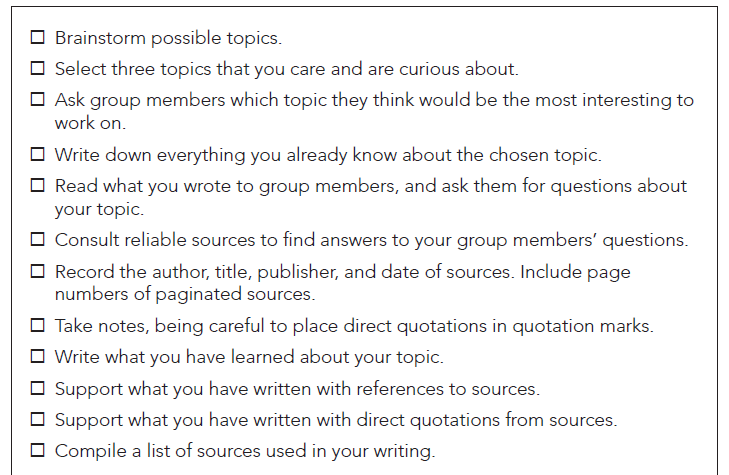
Figure 2.1: Guidelines for an essay assignment.
Visit go.SolutionTree.com/instruction for a free reproducible version of this figure.
You could insist students provide evidence they have completed every step, or you could let students select the steps helpful to them as individuals, with different ways of generating ideas and different approaches to research and writing. Even if you don’t feel comfortable inviting students to pick and choose from your list, you can accept deviations when students produce the results you have in mind. It’s tempting to feel peeved when students diverge from guidelines you worked hard to develop, but it’s important to send the clear message: you want students to be free to think about how to tackle the assignment, rather than just checking boxes.
Independence in the animal world means being able to fend for yourself in very basic terms of food and shelter and, with any luck, finding a mate and some territory that isn’t already occupied. Going off on your own is a given. Animals learn how to do this from observation, instruction, and instinct. In the human world, independence is not a given. We have to want independence and earn it on multiple levels—emotional, economic, intellectual. This is a process that begins as we learn to reflect on our own actions, temper independence with compassion, and, eventually, become the wise elders on whom others can rely for seasoned perspectives and sound advice (Korkki, 2014). The definition of wisdom that was developed by Vivian Clayton when she was a neuropsychology graduate student in the 1970s continues to serve as the foundation of research in this field. Based on her own research with ancient texts and recognized decision makers such as lawyers and judges, Clayton defined wisdom as the combination of cognition, reflection, and compassion (Korkki, 2014). Like other aspects of maturing, there are no guarantees. It’s possible to be old and foolish, just as it’s possible to be wise beyond one’s years. Laura L. Carstensen, psychology professor and founding director of the Stanford Center on Longevity, says that if you are wise, “you’re not only regulating your emotional state, you’re also attending to another person’s emotional state” (as cited in Korkki, 2014). She adds, “You’re not focusing so much on what you need and deserve, but on what you can contribute” (as cited in Korkki, 2014).
Secondary students are deep in the process of coming to grips with the idea that human beings can simultaneously be autonomous and interdependent. The struggle to find equilibrium between the two can be painful for teenagers and the relationships with family and friends that they simultaneously want to embrace and leave behind. Yet as part of this process, students are developing the capacity to care not only about their own needs but about how they can contribute to the greater good. In an article for Educational Leadership, “Assessing What Matters,” psychologist and psychometrician Robert J. Sternberg (2008) argues, “Wisdom is the most important and yet most neglected aspect of education today” (p. 25). Sternberg (2008) explains there’s nothing wrong with the traditional focus on analytical skills, but teachers shouldn’t stop there. For example, a science teacher might ask students to analyze evidence of climate change and then call on students to come up with ways to address climate change in their daily lives. The former requires close examination of the facts while the latter requires independent thought. Sternberg (n.d.) concludes a summary of his work on wisdom called “Balance Theory of Wisdom,” by asserting that though many see analytical intelligence as most important, wisdom may be even more valuable. He states:
When citizens and leaders fail in the pursuit of their duties, it is more
likely to be for lack of wisdom than for lack of analytical intelligence. . . .
In other words, they fail not for a lack of conventional intelligence, but
rather for a lack of wisdom. (Sternberg, n.d.)
If Sternberg’s observation is correct, wisdom should be at the top of the list of 21st century skills. The findings of researchers such as Csikszentmihalyi, Clayton, Carstensen, and Sternberg (n.d., 2008) demonstrate that educators can assess wisdom, and the information from such assessments is a more accurate predictor of student success in college than conventional measures such as the Scholastic Assessment Test (SAT). Sternberg’s (2008) research suggests students are ready to engage deeply across content areas on the issues and ideas of the day. Teachers just have to ask! However, this shift from a teacher-directed to a student-centered approach can be especially challenging for teachers. It takes a double helping of humility to accept responsibility as the adult in charge, and yet remain open to the possibility that the oldest person in the room might not always be the wisest. Sometimes, but not always. Even elementary students have the capacity to come up with a solution to a problem that never occurred to an older person. Encouraging independent thought in students helps them develop wisdom and sends an important message: we want our students to be successful in school because we hope what they learn will help them become the individuals they want to be.
Imaginative Freedom
As editor of English Journal, Ken Lindblom poses a particularly interesting question to readers and contributors in the November 2009 issue: Have we killed imagination? Imagination is right up there with creativity, originality, innovation, and invention. These are all qualities that generate a certain awe, qualities great artists and technological entrepreneurs possess, qualities we often think you must be born with because they can’t be taught. As someone who has never been able to sing on key, I would have to agree there are some things some people just aren’t going to get good at. But I don’t believe that should stop teachers, especially teachers who have chosen a student-centered setting, from providing opportunities for students to find out how it feels to take an imaginative leap.
In The Myth of the Muse, coauthors Douglas Reeves and Brooks Reeves (2017) take issue with the idea that creativity is innate—you either have it or you don’t. They dismantle the widely held misconception that logical and creative functions are assigned to separate hemispheres in our brains and that only individuals whose right brain is dominant are creative. The workings of the brain are much more elaborate than that:
While it is true that some control of speech is localized in the right hemisphere,
the brain is a much more complicated machine than the hemispheric
theory suggests. The left and right portions of our brains don’t
operate in isolation, but instead work together to form our thoughts and
ideas. (Reeves & Reeves, 2017, p. 15)
Rather than a flash of inspiration, the Reeves team defines creativity as a “process of experimentation, evaluation, and follow-through that leads to a significant discovery, insight, or contribution” (Reeves & Reeves, 2017, p. 17), and this process, they argue, is one in which everyone can engage. It’s not only something that great thinkers throughout history have used to contribute to society; it’s a way for all people to connect with themselves and with their communities (Reeves & Reeves, 2017).
The truth is that teachers aren’t sure imagination should be welcome in school. And neither are students. Compliance takes a lot less time and energy than a cognitive leap, and a five-paragraph essay is a lot easier to write than a passionate argument. Imagination can be unruly and, worst of all, difficult to assess. The move toward rubrics for assignments grew, at least in part, out of a genuine desire to help students succeed in school by sharing information with them. But it’s hard to write a rubric that doesn’t descend into meaningless increments of few, some, and many, and a good rubric takes hours of committee work. If teachers acknowledge imagination as something they value in school, will they have to assign and assess it? I think we should be wary of the monster we might create in writing rubrics that make the importance of imagination explicit; we owe it to our students to find a better way than adding an Imagination row to a rubric. For imagination to be welcome in the classroom, teachers need to convince students they have the time and energy to engage imaginatively in schoolwork. My experience suggests this will not happen unless there is some convincing give-and-take on the part of teachers about the nature of that work. As Reeves and Reeves (2017) put it:
Schools rarely undermine creativity intentionally. After all, vision and
mission statements extolling the virtues of creativity are ubiquitous. But
when we compared the good intentions of schools as they aspired to
enhance creativity with their actual behavior (Reeves, 2015), we found
an enormous gap between rhetoric and reality. (p. 2)
In order to convince students you mean it when you say you’re open to them using their imaginations, try giving them some latitude with their assignments. Let students know what you’re looking for and how the assignment contributes to their progress toward achieving learning goals, but then let them come up with the details. Reeves and Reeves (2017) agree: “Because students are often more interested in one subject than another, it makes sense to try to use their individual aptitudes across the spectrum” (p. 52).
Let’s say you’re a social studies teacher and you want your ninth graders to grapple with the idea that history is subject to interpretation, both by those who were present and shared their perceptions of what happened and by those who came later and realize the accounts vary or even conflict with one another. You could assign a single important event, give students a list of events to choose from, or invite students to brainstorm moments in history they’d like to know more about and, with some guidance from you, pick their topic. The form their findings take could range from a traditional report to a mock newspaper to a play in which they reenact events. You can suggest possibilities and be open to additional ideas from students. The point is that if your goal is understanding of an essential concept rather than memorization of dates and names, students can get where you want them to go by more than one route. Reeves and Reeves (2017) point out that giving students some control over the design of their work is highly motivating. And even if you’re not comfortable inviting students to take a divergent path, you can still refrain from penalizing them for doing so if the other path gets them where they need to go.
Collaboration is central to a student-centered classroom, especially when you’re hoping to give students opportunities to exercise their imaginations. We have collective images in our minds of what creativity looks like, such as “the rogue painter slaving away in her studio, brandishing a brush, and the gaunt writer hunched like a gargoyle over his laptop” (Reeves & Reeves, 2017, p. 67), but the creative history of humankind has a vast number of examples of collaborative creation as well. Working in a collaborative group gives students access to the power inherent in broaching an idea, listening to what others have to say, and building on one another’s experience and suggestions to create something that might not have been possible for a student working alone. Reeves and Reeves (2017) even suggest that the common good depends on creative minds working together to solve the multitude of problems the world faces.
While there are many amazing works of fiction in which writers have imagined entire worlds, leaps of imagination are also responsible for many things we’ve learned to take for granted in the world we actually inhabit: antibiotics, the telephone, and batteries, for example. These inventions occurred because people wondered about things, grappled with possibilities, and came up with something new. A simple exercise can help students exercise their imaginations as they tap into the evidence of imagination that is all around them. Ask students to close their eyes and imagine that all the objects in the classroom are gone and only the people remain. Are the people floating in midair? When the chairs go away, do people plop to the floor? Do people sit, stand, swim through the air? Then invite students to bring the objects that were in the room back, one by one. Where did the pencil sharpener come from? Who came up with the idea of connecting a desk with a chair? What sequence of thought resulted in motion sensors that turn lights on and off? And so on.
The ability to look beyond what is to what might be is one of the distinguishing characteristics of humankind. There are classic examples, such as Leonardo da Vinci imagining people could fly and drawing studies of the wing structures of birds to figure out how this could happen. And there are examples close to home, such as an elementary school student imagining what it’s like to be a butterfly emerging from its chrysalis and pumping up its wings. Encourage students to ask, “What if? What if butterflies could talk? What if people bounced like balls? What if a clock could soften and droop over the edge of a table? What if a person could wear a computer on her wrist? What if there was a smart vaccine that protected us from everything?” Lindblom’s (2009) question, Have we killed imagination?, suggests that encouraging independent thought might not be enough. It might also be important to welcome evidence of imagination in students’ work. Writing and sharing what we imagine carries a high degree of risk, yet sharing exactly what makes us each most unique can be immensely moving and satisfying. As students become accustomed to working in a student-centered environment, they learn to count on their peers and teacher to listen intently, respond respectfully, and celebrate their courage as well as their imaginative leaps.
Integrity
It would be hard to find anyone—student, parent, teacher, administrator, or community member—who would not agree that teachers want students to grow up to be good and do good. Yet, there is little agreement about the role teachers should play in helping students understand the importance of integrity. Certainly, students must honestly acknowledge the infinitude of sources they can access with contemporary technology. Students need to use these sources to guide and support their thinking rather than replacing their own processes with the works of others. Yet there is so much more to integrity than honest technology use.
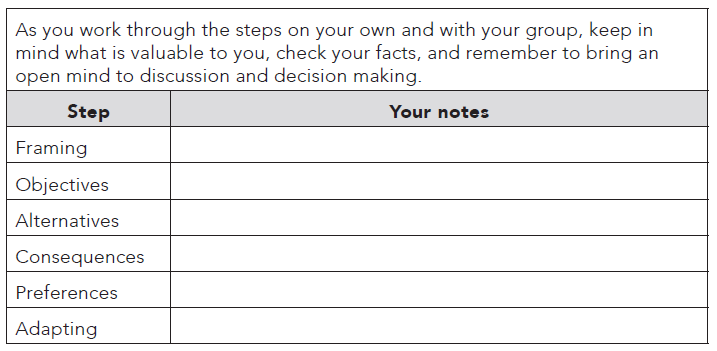
Human beings learn how to make good decisions in much the same way we acquire language—through imitation, experimentation, and instruction. Both elementary and secondary students can benefit from low-risk opportunities to practice making decisions. Andrew Quist and decision scientist Robin Gregory (2019) argue, “Decision making itself needs to be viewed as a skill, one that can be learned through a sequence of guided steps much as driving a car or speaking a new language can be learned” and that schools need to play an active role in teaching this essential skill. Gregory’s team identifies three characteristics that are fundamental to effective decision making: (1) a focus on values, (2) awareness that facts need to be accurate, and (3) a mindset open to alternatives (Quist & Gregory, 2019). In collaboration with the Delta School District in British Columbia, Gregory and his colleagues have worked with students in grades 1 through 12 to introduce six steps to the practice of thoughtful decision making (Quist & Gregory, 2019).
1. Framing: What is the problem, and how can we frame it as a choice?
2. Objectives: What things do we care about could this decision affect?
3. Alternatives: What alternatives can we consider?
4. Consequences: What are the likely consequences of different courses of action?
5. Preferences: How do we feel about the trade-offs? What do we like best, all things considered?
6. Adapting: What could trigger us to reconsider, reassess, or adapt our behaviors?
Figure 2.2 contains a tool you can use to introduce these steps to students in your
classroom.
Source: Quist & Gregory, 2019.
Figure 2.2: Six steps to the practice of thoughtful decision making.
Visit go.SolutionTree.com/instruction for a free reproducible version of this figure.
According to University of California, Berkeley, psychology professor Alison Gopnik, secondary students, especially, need opportunities to practice making decisions in order to find a balance between their emotions and motivations and their ability to exercise self-control (Levinson, 2012). As secondary students develop into adults, what motivates them evolves. As teenagers, their primary motivation is their desire for the respect of their peers. As adults, they will need the self-control to think through emotions and make independent decisions. In order to make this transition, Gopnik (2012) writes in the Wall Street Journal: “You come to make better decisions by making not-so-good decisions and then correcting them. You get to be a good planner by making plans, implementing them and seeing the results again and again. Expertise comes with experience.”
It’s difficult to discuss what it means to be a good person without some discussion of personal beliefs. For secondary students who are grappling with developing an identity that allows them to remain part of a family and simultaneously achieve independence as an individual, support for addressing such important issues in discussion and in writing helps give them and their school experience a sense of wholeness. In my subject area, the poetry of Emily Dickinson is a useful case in point. It’s possible to cherry-pick poems that comment on everyday life or the natural world, but any honest look at Dickinson’s work must include her personal beliefs. Every biography of more than a few paragraphs includes the fact that she experienced doubts about organized religion fairly early in her life (Emily Dickinson Museum, n.d.). To gloss over such matters is to waste an opportunity for students to connect with a unique American poet and feel the enduring resonance of the questions that troubled her. If students can connect with the inner world of a figure like Emily Dickinson, it can help them understand their own inner worlds. In a student-centered setting, mutual trust and respect provide some latitude for students to invite not just the outer world but also their inner worlds into the classroom.
A specific ethical challenge too many students are likely to experience is how to respond to bullying, whether it happens in a school hallway or restroom or arrives over the internet in the form of social media posts. One of the many benefits of shifting from a teacher-directed to a student-centered approach is the opportunity it provides for students to spend significant time working in collaborative groups. In my own experience, even students who are already friends get to know one another from a new perspective when they work together over the course of a year. And the opportunity for the teacher to get to know students as individuals is heightened by moving away from the front of the room to observe and drop in for visits with collaborative groups. Members of a student’s collaboration group might be the first to hear of a troubling incident, and they might serve as the first line of defense against the fear and self-doubt bullies often provoke in victims. Making sure each student belongs to an encouraging, supportive group means no student is alone when problems arise. It may also increase the likelihood that students will seek adult help when those problems are as serious as bullying. I found that students rarely came to me for advice without having first shared concerns with group members who, in turn, encouraged and supported sharing their troubling situations with me. In an atmosphere of trust and respect, students can tackle the related problem of what to do when they are not the victim but the witness of bullying. Like so many ethical questions, there is no rote right answer, but students who’ve had the opportunity to think, speak, write, and listen to one another on such issues are better prepared to do what makes sense when such a difficult and potentially dangerous situation arises.
Making the shift from a traditional to a student-centered classroom doesn’t happen overnight, but each step has its rewards. As your focus as a teacher shifts from lessons to learning, from classroom management to making connections, you’ll sense changes in the way your students respond to you, their classmates, and the partnerships you are building with them. Taking a student-centered approach is not about giving up control of your classroom, but about giving students the opportunity to have some say over what and how they learn. When students know you are willing to share authority with them, they will consent to your reasonable exercise of authority in the classroom. This consent quietly shifts the classroom dynamic from coercion and resistance to collaboration and shared responsibility. What you will not find in this book is a chapter on classroom management. As your classroom becomes student centered, I predict that if management is currently an issue for you, it won’t be any longer. Each student has a unique history, perspective, strengths, and needs. When you take the time to learn their stories, students feel known and trusted and want to learn. They will show you in so many ways they are ready to move forward with their learning and their lives.
In the next chapter, we’ll move on to the third student-centered teaching practice: make space for speaking and listening. I discuss how to give your students opportunities to develop their communication skills, as well as the confidence to put those skills to work.
REPRODUCIBLE
Next Steps for Supporting Personal Growth
The following tool details some steps you can take to foster independence, imagination, and integrity in your classroom. For each step, note the date you tried it and reflect on how it went: What d id you do? How d id it go? What would you change? What’s next? Spaces are available at the end for you to plan additional steps you can take toward a student-centered approach to teaching.
The Student-Centered Classroom © 2021 Solution Tree Press • SolutionTree.com
Visit go.SolutionTree.com/instruction to download this free reproducible.