IJRAR2001541 International Journal of Research and Analytical Reviews (IJRAR) www.ijrar.org 852
© 2020 IJRAR March 2020, Volume 7, Issue 1 www.ijrar.org (E-ISSN 2348-1269, P- ISSN 2349-5138)
Mohammad Hassan Rasuli
Head of English Department and English Lecturer of Sar – e – pul Higher Education Institute
Abstract
The goal of this article is to discuss the important considered point for planning a lesson in teaching and learning process which is crucial for both teaching and learning because a lesson plan is a rout map, a guide and detailed description of a teacher for a lesson. Moreover, it is a rout map for an effective teaching and why it is so important to plan a lesson. Indeed, this research explores important ideas about planning lessons, lessons shapes, and questions before planning such as. Who exactly are the students for this activity? What do we want to do and why? What will be needed? How long does it take? How will it fit in with what comes before and after it? Furthermore, it explores the magic moments of a lesson and lesson plan format including the most important elements of a lesson plan. At the end I hope the readers specially teachers who teaches English to find this article useful and get benefit for meeting their needs to plan effectively their lessons and achieve their teaching and learning goals.
Key words: Rout map, Effective, Planning, Guide, Activity, Crucial
Introduction
Allen (2003) explained that a lesson plan is rout map or mind map of teachers designed for a specific topic of a specific day. Great important for teachers to think about their teaching before going to the class. Therefore, the aim of this article is to describe the important considerations of a lesson plan which is the most significant part of teachers before teaching in the class. It describes the important titles such as; the definition of a lesson plan, that a lesson plan is a detailed description of a teacher for a specific lesson in a day. Some expert teachers with experience seem to have an ability to think on their feet, and this allows them to believe that lesson planning is unnecessary a lesson plan is a proposal for action, planning lessons which talks about, after panning a lesson what happens when we try to put them in to action? Suppose, for example, that the teacher has planned that the students should prepare a dialogue and then act it out, after which there is a reading text and some exercises for them to get through. Shape of the lesson plan, a good lesson needs to contain a judicious blend of coherence and variety. Coherence means that students can see a logical order to the lesson. Even if there are three separate activities questions for planning, elements of a lesson plan and a format of a lesson plan for teachers.
The Important Consideration for Planning a Lesson
A lesson plan is a detailed description of a teacher for a specific lesson having goal and objectives for predetermined students, class and time. John (2000) claimed that some expert teachers with experience seem to have an ability to think on their feet, and this allows them to believe that lesson planning is unnecessary. However, most teachers think without preparing a lesson plan and thinking about all aspect of teaching in the lesson it is impossible to teach effectively. For students, evidence of a plan shows that the teacher has devoted time and thought about the class. It is strongly considered as a level of professionalism and a commitment of teachers to all kinds of effective teaching. Lack of a plan may suggest the opposite of these teacher attributes, even if such a perception is unjustified. For teachers, a plan gives the lesson a framework, an overall shape. It is true that they may end up departing from it at some stage of the lesson, but at the very least it will be something to fall back on. Of course, good teachers are flexible and respond creatively to what happens in the classroom, but they also need to have thought ahead, to have a destination which they want their students to reach, and some idea of how they are going to get there. In the classroom, a plan helps to remind teachers what they are intended to do especially if they get distracted or quickly forget what they had proposed.
It is essential to write down it in advance what you plan to do in the class. This is not just because you might want to refer to the plan during the lesson. In practice, I usually look through my plan before the lesson, and then rarely need to glance at it while teaching, expect to check specific information like page or exercise number. A more important reason is that writing make you think ‘concretely’ and practically. It ensures that you haven’t forgotten anything and that you have planned and ordered all the components and material appropriately (Ur, 2012).
Consequently, whatever lesson plans look like, they should never be thought of as instructions to be followed, but rather as proposals for action (in the same way as course book lessons). We may have an idea of what the learning outcomes for the lesson should be (that is, what the students will have learnt by the end), but we will only really know, planning a sequence of lessons.
Planning Lessons
After panning a lesson, what happens when we try to put them in to action? Suppose, for example, that the teacher has planned that the students should prepare a dialogue and then act it out, after which there is a reading text and some exercises for them to get through. The teacher has allowed twenty minutes for dialogue preparation and acting out. But when the students start working on this activity, it is obvious that they need more time. Clearly the plan will have to be modified. A similar decision will have to be made if the class suddenly encounters an unexpected language problem in the middle of some planned sequence of activities. The teacher can bypass the problem and keep going, or they can realize that now is an ideal time to deal with the issue, and amend or revise the plan accordingly.
Another situation is also possible: all the students are working on preparing a dialogue except for two pairs who have already finished. The teacher then has to decide whether to tell them to wait for the others to catch up (which might make them bored and resentful) or whether to stop the rest of the class to prevent this (which could frustrate all those who didn’t get a chance to finish).
There are other unforeseen problems too: the tape/CD player or computer program suddenly doesn’t work; we forget to bring the material we were relying on; the students look at the planned reading text and say ‘We’ve done that before’. Good teachers need to be flexible enough to cope with unforeseen events, and it is because they know that they may have to adapt to changing circumstances that they understand that a lesson plan is not fixed in stone. So far we have suggested that teachers need to be flexible when confronted with unexpected problems. But a happier situation is also possible. Imagine that during a discussion phase a student suddenly says something really interesting, something which could provoke fascinating conversation or suggest a completely unplanned (but appropriate and enjoyable) activity. In such a situation - when this kind of magic moment suddenly presents itself - we would be not a good teacher to work on with our plan regardless. On the contrary, a good teacher will recognize the magic moment for what it is and adapt what they had planned to do accordingly. Magic moments are precious, in other words, and should not be wasted just because we didn’t know they were going to happen. There will always be a tension between what we had planned to do and what we actually do when magic moments or unforeseen problems present themselves. It is the mark of a good teacher to know when and how to deal with unplanned events, and how to balance a proposal for action with appropriate flexibility.
Lesson Shapes
According to Allen (2003) a good lesson needs to contain a judicious blend of coherence and variety. Coherence means that students can see a logical order to the lesson. Even if there are three separate activities, for example, in my lessons there has to be some connection between them - or at the very least a perceptible reason for changing direction. In this context, it would not make sense to have students listen to an audio track, ask a few comprehension questions and then change the activity completely to something totally unrelated to the listening. And if the following activity only lasted for five minutes before, again, something completely different was tried, we might well want to call the lesson incoherent. Nevertheless, the effect of having a class do a 45-minute drill would be equally damaging. The lack of variety, coupled with the endlessness of such a procedure, would work against the possibility of real student engagement. However, present it might be at the beginning of the session, it would be unlikely to be sustained. There has to be some variety in a lesson period. There are other methodological reasons why a 45-minute drill is inappropriate, too. Exercising concentrates only on the study aspect of our three important learning elements (engagement, study and activation). In effective lessons, the teacher has thought (and is thinking) carefully about the balance of engagement, study and activation, and how one can lead to the others in a variety of different sequences such as the straight arrows, boomerang and patchwork sequences. The moment we think of lessons in this way, both variety and coherence are almost guaranteed. The ideal compromise, then, is to plan a lesson that has an internal coherence but which never allows students to do different things as it progresses.
Planning Questions
One of the most important for designing a lesson it is for teachers to ask some question from him/her, what is going to happen when they get there, they will have thought about what they are going to do. These thoughts may be extremely detailed and formalized, or they may be vaguer and more informal. John (2000) stated that when we discuss plan formats we will see differences between more and less formal thinking of this kind, but in every case teacher will be answering seven fundamental questions when they decide what activities to take to a lesson. Who exactly are the students for this activity? The make-up of the class will influence the way we plan. The students’ age, level, cultural background and individual characteristics have to be taken into account when deciding what activities, texts or methodologies to use in the classroom. This includes an understanding of the kinds of individual differences in learning style, for example, that we discussed in What do we want to do and why? We have to decide what we want to do in the lesson in terms of activities, skills and language. We also need to know why we want to do it. It might be because we ourselves like the activity, or because we think it will be appropriate for a particular day or a particular group. There is nothing wrong with deciding to do an activity simply because we think it will make students feel good. However, before deciding to use an activity just because we or the students might like it, we need to try to predict what it will achieve. What will students know, be able to do, understand or feel after the activity that they did not know, were not able to do, did not understand or feel before? What, in other words, is the learning outcome of the activity? Examples of what an activity might achieve include giving students a greater understanding of an area of vocabulary, providing them with better listening strategies, teaching them how to construct conditional sentences, improving their oral fluency or raising the morale of the group through appropriate cooperative interaction.
How long will it take? Short time. Fiona (2002) discussed considerable setting-up time, discussion time, student planning time, etc. The students’ confidence in the teacher can be undermined if they never finish what they set out to do; students are frequently irritated when teachers run on after the bell has gone because they haven’t finished an activity. Teachers, for their part, are made uncomfortable if they have overestimated the amount of time something might take and are thus left with time on their hands and no clear idea what to do. There is no absolute way of preventing such problems from occurring, of course, but we should at least try to estimate how long each activity will take (based on our experience and knowledge of the class) so that we can measure our progress as the lesson continues against our proposed ‘timetable’. We can also plan for our material taking too little time by having some spare activities with us (see page 160). If we have built-in lesson stages in our plan, we can decide, as the lesson progresses, where we might want to veer away from the plan if we see that we have taken too much time over one particular element of it.
What will be needed? Teachers have to decide whether they are going to use the board, a CD or tape player, an overhead projector, a data projector, some role-cards or a computer (or computers). It is important to think about the best way of doing something (in other words, the most effective piece of classroom equipment - see Appendix A on page 252), rather than automatically choosing the most technologically exciting option. It is also important to consider the physical environment of the classroom itself and how that might affect whatever teaching equipment we wish to use.
What might go wrong? If teachers try to identify problems that might arise in the lesson, they are in a much better position to deal with them if and when they occur. This will also give the teacher insight into the language and/or the activity which is to be used. This isn’t to say that we can predict everything that might happen. Nevertheless, thinking around our activities – trying to put ourselves in the students’ minds, and gauging how they might react - will make us much more aware of potential pitfalls than we might otherwise be.
How will it fit in with what comes before and after it? An activity on its own may be useful and engaging and may generate plenty of good language. But what connection, if any, does it have with the activities which come before and after it? How does it fit into our need? Is there a language tie-in to previous or future activities? Perhaps two or three activities are linked by topics (Ward, 2000).
Planning Formats
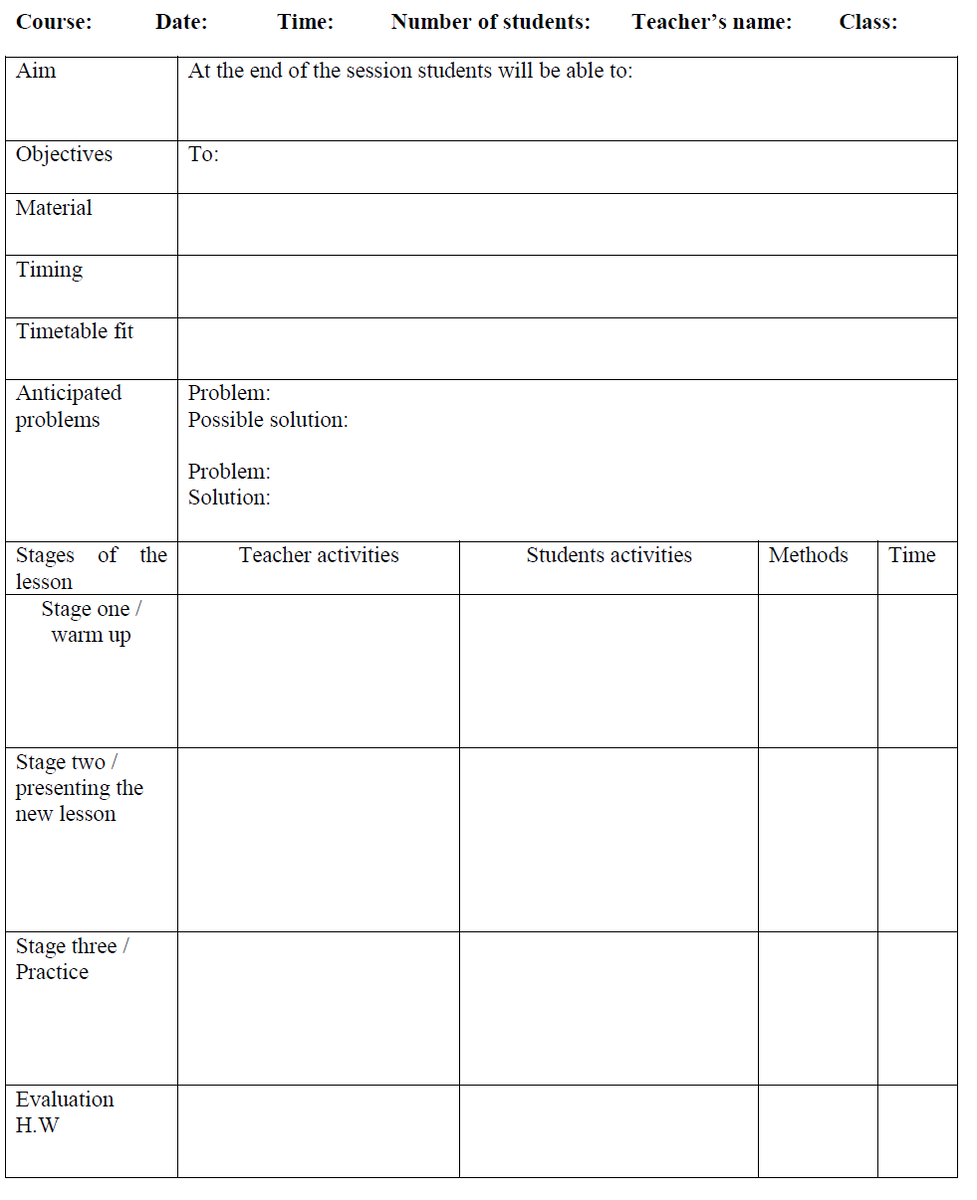
Ur, (2002) described when making plans, some teachers write down exactly what they are going to do and note down each sentence that the students are going to say. Others use note-form hints to themselves (e.g. ‘T checks comprehension’) or just write ‘pair work’ or ‘solo work ’or ‘whole classes, for example, to describe how they are going to do something. Some teachers write down notes with ordered paragraph headings, whereas others produce flow diagrams or random notes. Some just write short headings like ‘going to’ or ‘photograph activity’ or ‘Little Rock reading’ to remind them what to do. And of course there are teachers who keep the whole plan in their heads. This may be completely appropriate for them, of course, but won’t help anyone else (observers, possible substitute teachers, etc.) to know what they had in mind. When teachers are observed - or when an institution asks for formal plans - the exact format of the plan may depend on the personal preferences of trainers, exam schemes or institutions (schools, colleges, etc.). However, in some form or other, the following elements (which match the kinds of questions we asked in the previous section) are usually included:
Procedures: the meat of the plan is in the description of how it will be executed. The section on procedures can include patterns of interaction. We might write T - SS (for times when the teacher talks to the whole class), S - S (for pair work) or SSS - > SSS (for group work); or we could write ‘groups’, ‘pairs’, etc., or record these patterns in some other way. Frequently we will include timings as well, so that we have some idea of how long we expect things to take. We will also include the actual procedures, such as ‘students look through the pictures and match them with the phrases.
Anticipated problems: teachers frequently make some kind of a list of potential difficulties and suggestions about what to do if they arise. They might consider what they would do if a computer or other piece of equipment failed them - or if some other student based eventuality occurred (such as the activity being a lot more difficult for the class than expected). Extra activities/material (just in case): many teachers make a note of extra activities they could include if things go quicker than anticipated. Material to be used in the lesson: especially when they are to be observed, teachers attach examples of the material they are to use with the students to their plan (Cunningham, 1999).
Conclusion
In conclusion, this article describes the following important considerations of a lesson plan for an effective teaching in the class for all teachers. Reasons for planning, showing its advantages for students’ as well as teachers’ confidence. Also it is a framework for teachers to work from or apply their lessons in a systematic and academic ways. Plans are proposals for action rather than the action itself. Teachers need to be receptive and flexible when unforeseen problems and magic moments turn up in a lesson. It discussed about the need for a blend of both coherence and variety in a lesson plan. Moreover, whatever the format the plan takes, it should be based on who the students are, what we want them to do, how long each activity will take, how the activity actually works, what equipment will be needed, what might go wrong and how what we are planning will fit into what comes before and after it. Besides, different plan formats, saying that there are many different ways of laying out the information. It has suggested that most formal plans should include a description of the students, a statement of aims and objectives, a description of procedures (including who will be interacting with whom, and how long each activity will take), anticipated problems, extra materials and the material to be used in the lesson. Planning a sequence of lessons where topic-linking is important, but there are dangers of predictability and sameness. It is important to plan future lessons on the basis of what has gone before, and using student feedback and our own observation to inform our future decisions. Finally changing plan was another important considered point for teachers. If they couldn’t implement their plan on the due date or time they should postpone the same lesson for the next time.
A provisional sample format of a lesson Plan
Reference
Allen, G.T. (2003). Important points about planning lessons. California: Philadelphia. Teachers’ Handout University Press.
Cunningham, G.K. (1999). Planning and teaching. Bristol, PA: United States of America. Flamer Press.
Fiona, M. B. (2002). Magic’s moments of the lessons for better teaching: A systematic approach (7th Ed.). New York. ESL Printing Press.
John, H. (2000). Standards for teaching lesson plans. Virginia Town International Center for Alcohol. Central Press
Kim, D. (1999). "How planning and Justified are important in a Program? New York City. Retrieved: 4 March 2020 from http://www.languegeschools.org
Ur, P. (2012). A course in English language teaching. Cambridge: Cambridge University Press.
Ur, P. (2002). “Understanding the utility and limitations of a lesson plan as a tool for organizational learning". Oxford: Oxford University Press.
Ward, A.W. (2000). Implementing the lesson plans in the Classroom. Belmont, CA: Wadsworth Publishing Co.