This assignment assesses your skills and knowledge on:
Examining strategies for addressing diversity in the classroom
Examining the study of religions and worldviews in schools and its impact on educators
Assignment
Imagine you are a teacher in a classroom filled with students from different backgrounds, abilities, and interests. Your goal is to create a learning environment where every student feels valued and can succeed. Before you begin to write this week’s reflection, ask yourself how you will create this environment. Write your reflection paper on the following:
1. Understanding of the diverse needs of your students and the utilization of the resources at your disposal, such as books, technology, and community partnerships.
2. Creating an effective learning environment in your classroom. Give clear information on 5 to 6 practices that you will implement to accommodate diverse learners, foster inclusivity, and maximize the use of available resources.
3. Finally, refer to the article by Robert Jackson in your reading list and reflect on whether the study of religions and worldviews in schools is an aspect that you need to address or not in your practice?
October 29, 2024
I am now permitting my imagination to flourish.
I am a high school English teacher, standing in front of an English classroom with 15 students awaiting my arrival. I listen to my heartbeat, regulate my breathing, and, overcome with excitement, I enter the classroom.
Firstly, I take up a position at the front of the class and conduct a detailed observation of my students. It is essential to take note of and assess a range of factors, including attire, emotional state, physical wellbeing and capabilities.
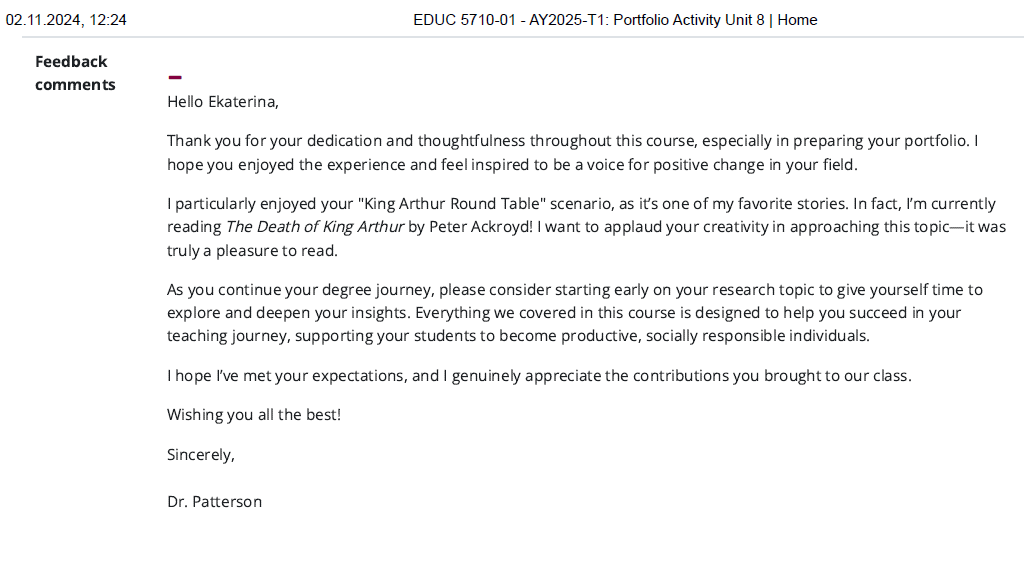
The first action to be taken is to distribute nametags, which should be completed with the students' names written on them and then pinned in a visible location. Secondly, the male students and I will establish a metaphorical "King Arthur's Round Table" (Baird, 2020) and engage in a symbolic oath of knighthood (Arthur and His Knights of the Round Table, 2024), albeit within the context of our classroom. Prior to administering the oath, it is imperative to establish a set of regulations governing conduct within the classroom. Potential topics for discussion with students should encompass five fundamental areas:
1. General Rules of Behaviour
2. Rules of behaviour before class
3. Rules of behaviour at the beginning of the lesson
4. Rules of behaviour during the lesson
5. Rules of behaviour after the lesson is over
The discussion may encompass a range of topics, including race, gender, interpersonal and other differences. It is essential to emphasise that, within this context, all knights are equal and possess the same rights, responsibilities and voting rights.
The subsequent activity will entail the division of the class into groups comprising three to four individuals, with each group tasked with formulating a distinct set of behavioural guidelines. Students may draw upon the collective knowledge of their peers, online resources, and educational materials to develop these rules. To facilitate the students' ability to work effectively, it is recommended that they be provided with pre-made worksheets containing a table for the purpose of recording the rules. An alternative approach would be to provide each student with an A4 sheet and coloured markers, which could be used to record all the rules in any form and the main points on the board.
The subsequent phase of the project is the simplification of the rules. Consequently, four worksheets comprising the students' rules of behaviour will be produced. The four lists were then merged into two groups, which were tasked with comparing the two lists and creating a single list of rules. In the final stage of the process, the entire group is once again convened. The last two lists are then subjected to a process of approval, resulting in the formation of a single, definitive list of classroom behavioural rules. The instructor's role is to listen attentively to the entire group during this activity, facilitating the process by intervening respectfully when necessary to redirect overly active students and encourage quieter and more reserved individuals to contribute.
This is followed by the Knights of the Round Table taking an oath to adhere to the established behavioural norms, which have been collectively endorsed. This can be a moment of solemnity, with the oath being read one at a time, or the individuals who read the oath first can take the oath from the others in parallel. The instructor extends congratulations to all students on their attainment of the status of Knights of the Round Table.
At the conclusion of the lesson, the instructor and students approve the topic of the subsequent lesson (the instructor presents two potential topics for consideration) and proceed to the most crucial aspect of the lesson: feedback (Feedback for Learning, n.d.). However, in this instance, the students will conduct the feedback, evaluating their individual and group work. The feedback may be provided in the form of homework assignments or verbal feedback. It is recommended that students be asked to describe their experiences in class in any form (with consideration for the capabilities of students with disabilities) as homework. It is essential for the instructor to obtain feedback in order to gain insight into the students' abilities, their willingness to engage with one another, and to develop new activities that accommodate the diverse learning styles of the class. Furthermore, it is essential to ascertain which students require additional support in English.
Prior to conducting the King Arthur Round Table activity, it is essential to ascertain the acoustic properties of the room and to ensure the availability of appropriate equipment for hearing-impaired students (Supporting Success for Children with Hearing Loss, 2017). Additionally, it is vital to evaluate the accessibility of the table for a student with dysphagia in order to guarantee their active and inclusive participation in the group (Burke, 2017). Furthermore, it is crucial to provide a designated area in the classroom for a student with autism to wait out an attack of aggression (For, n.d.) if it occurs.
It is recommended that students be grouped in a manner that avoids the formation of groups based on any significant attributes. The optimal methodology is to utilise a random selection process, whereby balls of four colours are drawn from a receptacle and distributed to the students in accordance with the number of participants in the group. This process is conducted in a manner that does not permit the students to view the balls prior to selection. It is often the case that participants exhibit greater optimism in response to situations that are perceived as being "fated" than they do in response to decisions made by the teacher.
In reading the article by Robert Jackson (Introducing Religious Education: An Interpretive Approach, n.d.), I was prompted to reflect on my own academic pursuits, despite my personal identification as an Orthodox Christian. From one perspective, Orthodox Christianity is perceived as a native and familiar aspect of my cultural milieu, given its close alignment with my lived experience and cultural identity. Conversely, I have a keen interest in Japanese and Chinese anime, and to gain insight into the fundamental principles of this artistic genre, I undertook a comprehensive study of Buddhism and Buddhist practices. Additionally, in my place of origin, Kazakhstan, there is a considerable presence of mosques and Muslims. Consequently, I have gained insight into the Muslim religion through interactions with friends, acquaintances, colleagues, and students. All world religions have a common core and espouse the view that humans are spiritual beings with souls and a responsibility to the Supreme Being, God. The opportunity to engage with a range of world religions and draw upon them in one's spiritual practice is of significant value. In my personal practice, I have found that reciting Orthodox prayers has helped me to achieve a state of mental tranquility and to discern the appropriate course of action in situations that may be considered controversial. It is beneficial for individuals to possess meditative techniques or prayers that facilitate concentration, relaxation, and introspection. These practices can assist in understanding oneself, others, and the surrounding environment. It is therefore incumbent upon educators to be able to inform their students about the various religions and the advantages that can be gained from religious observance.
References
Arthur and his Knights of the Round Table. (2024, October 29). Blogspot.com. https://maryanneyarde.blogspot.com/2015/11/arthur-and-his-knights-of-round-table.html
Baird, L. (2020). Knights of Arthur’s Round Table: Legend & Overview - Video & Lesson Transcript | Study.com. Study.com. https://study.com/academy/lesson/knights-of-arthurs-round-table-legend-quiz.html
Burke, S. (2017). Why design should include everyone. [online] Ted.com. Available at: https://www.ted.com/talks/sinead_burke_why_design_should_include_everyone/transcript?subtitle=ru
Feedback for Learning. (n.d.). Ctl.columbia.edu. https://ctl.columbia.edu/resources-and-technology/resources/feedback-for-learning/
For, O. (n.d.). A Supplemental Resource for the Understanding Autism: A Guide for Secondary School Teachers DVD UNDERSTANDING AUTISM: A GUIDE FOR SECONDARY SCHOOL TEACHERS Produced in collaboration with The Center on Secondary Education for Students with Autism Spectrum Disorders. https://csesa.fpg.unc.edu/sites/csesa.fpg.unc.edu/files/UnderstandingAutismSecondaryTeachersGuide.pdf
Introducing Religious Education: an Interpretive Approach. (n.d.). The European Wergeland Centre. https://theewc.org/resources/introducing-religious-education-an-interpretive-approach/
Supporting Success For Children With Hearing Loss | School Supports, Modifications and Accommodations for Students. (2017, June 2). https://successforkidswithhearingloss.com/supports-modifications-accommodations-for-students/