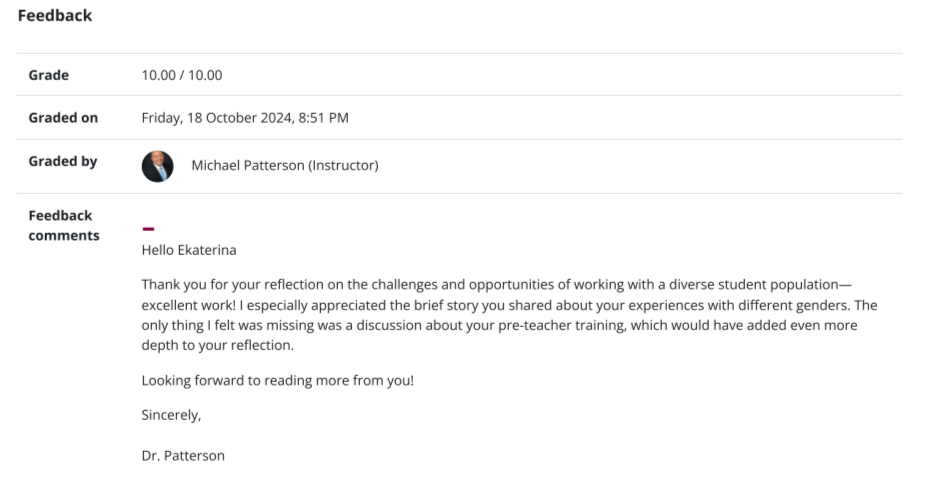
Considering the information you received in this unit examine and reect on your emotional reaction to teaching students with racial/ethnic or gender or socio-economic or cultural/linguistic variability. Out of the following, racial/ethnic or gender or socioeconomic or cultural/linguistic variability, which would you nd to be more challenging to deal with in the classroom? Do you think your pre-service Teacher Training Program has adequately prepared you to acknowledge and address with empathy: racial/ethnic or gender or socio-economic or cultural/linguistic diversity in the classroom?
I got my bachelor's degree in linguistics in 2005 and immediately went to work on English language courses, in 2006 I was hired in linguistic gymnasium No. 18, where the main language was German and English was optional. I was born in Kazakhstan, my mum is Russian and my dad is German, so when choosing my nationality I chose to be German. Kazakhstan is a multicultural, multinational country with people from different socio-economic communities. I got married at the age of 33 and gave birth to a daughter at 34 and a son at 36. In 2021 on 24 October my husband and I moved to Russia because my husband is from Krasnodar and he has relatives all over Russia.
I now live in Krasnodar, which looks like a full European city. There are many African medical students who come here to study on exchange and stay after graduation. The city is rich in different nationalities, here you can see, hear and meet almost everyone from Russia, people from Europe and Asia, as well as from other countries and continents.
Based on the environment in which I was born, raised and live, I have developed a certain habit of accepting the diversity of people, their customs, traditions, languages and other characteristics (Schwarzer et all, 2003). It is hard for me to imagine how anyone can be singled out or considered better or worse than others. Everyone is unique, everyone is worthy of admiration and respect, everyone needs love, support, understanding and patience. Everyone can be in a good mood one day and a bad mood the next.
And most importantly, children are a reflection of their parents. Every child is an integral part of their family. If with calm joy you perceive people in general, then children are also little people. You even love them a little more, because they are more open usually, more tender, more fragile and beautiful.
I find the most difficult students to work with are the ‘tough’ students. Those who want to stand out in some way, show their exclusivity, put the teacher ‘on the spot’ or humiliate their classmates. There is no more difficult job than the process of educating a brilliant, bright and beautiful egoist who does not want to reckon with anyone but himself. It is with representatives of the ‘golden youth’ that it is most difficult to negotiate. And, despite the fact that they are often healthy, full, rich and strong children, they demand attention to themselves not less, but even more than those who really need it, and are very offended by any incorrect attitude to themselves or invented nonsense. With such a child in the class is really very difficult, and if there are more than two of them, it turns into torture and the search for creative solutions.
Otherwise, there are no such peculiarities in children that can cause me difficulties in working with them.
Coniglio (n.d.) states that American boys and girls are different in following discipline, creating dramatic events and learning. I want to tell a story about my students. There was a couple I knew. A ninth grader and an eleventh grader. For a relationship is too early, because to cope with problems and their own cockroaches adequately not able to, but only add oil to the fire.
And you can't intervene because it's pointless. So, a ninth-grader, let it be Samantha, came and shared her worries. One day she came and told how her ex-boyfriend came to her, and her current boyfriend, let it be Sam, is so good and wonderful, but there are some ‘buts’. And emotions and so on. In general, struggling with her own feelings left the current for the ex, who as a result again on the same rake and to infinity.
And Sam was a very resentful young man, he began to defiantly pay attention to me when Samantha was around. But very intelligently, within the bounds of decency and reason. On the one hand a brilliant young man with a brilliant future, but on the other hand it was too early for him to choose a mate for life. Everyone realised that, except Samantha. Who thought I'd taken Sam away from her. So she started being mean. Feminine, stupid, jealous, and inept. Once she dressed provocatively and when I remarked on her behaviour, said she was like me. Well, I somehow did not aspire to be a girl with a low bar of social responsibility, and also a doctor does not take offence at the sick, so I decided to wait to see what would happen as a result.
And as a result, Samantha had a problem with the party she'd organised. It wasn't going well. And here I had a choice. To gloat and watch from the sidelines to see how she would cope. I had the choice of gloating and seeing how she did it. But that goes against my understanding of parenting and teaching.
I took her, shook her, and demanded that she pull herself together and finish what she had started. And I saw that important for me light up in her, the light of realisation of my power, responsibility and wisdom. You can do a lot for the sake of this light. And it was at that moment that I forgave her for everything she had done. She did her best and she got results.
Sam remained unaffected, continuing to behave gallantly and sweetly. However, I had to gently explain to him, too, not to get carried away until he was one hundred per cent sure of his seriousness. How I like clever fellows! He understood perfectly.
What I learnt from this story is that girls need to be taught wisdom and patience. And boys past adolescence become smart enough to play interesting games (Hackman et all, 2010). The higher the status, the higher the stakes and the finer the game.
References
Hackman, D. A., Farah, M. J., & Meaney, M. J. (2010). Socioeconomic status and the brain: mechanistic insights from human and animal research. Nature Reviews: Neuroscience, Vol 11, 651 - 659. https://neuroethics.upenn.edu/wp-content/uploads/2015/06/HackmanFarahMeaney2010NRN.pdf
Coniglio, R. (n.d.) Why gender matters in the classroom: The differences between boys and girls.TeachHub.com. https://web.archive.org/web/20190720151553/http:/www.teachhub.com/why-gender-matters-classroomYou can also access it from here.
Schwarzer, D., Haywood, A., & Lorenzen, C. (2003). Fostering multiliteracy in a linguistically diverse classroom. National Council of Teachers of English. Language Arts, 80(6), 453- 460.