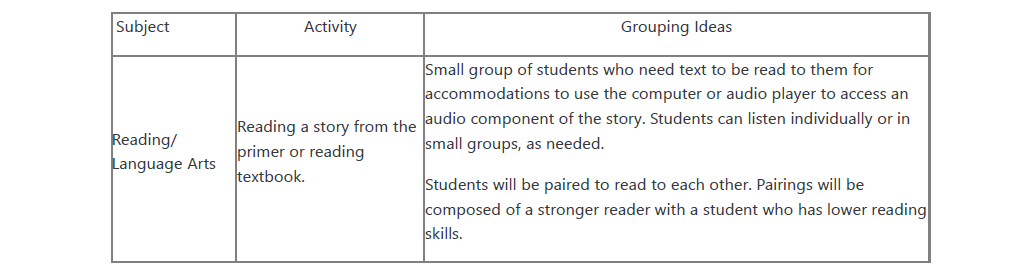
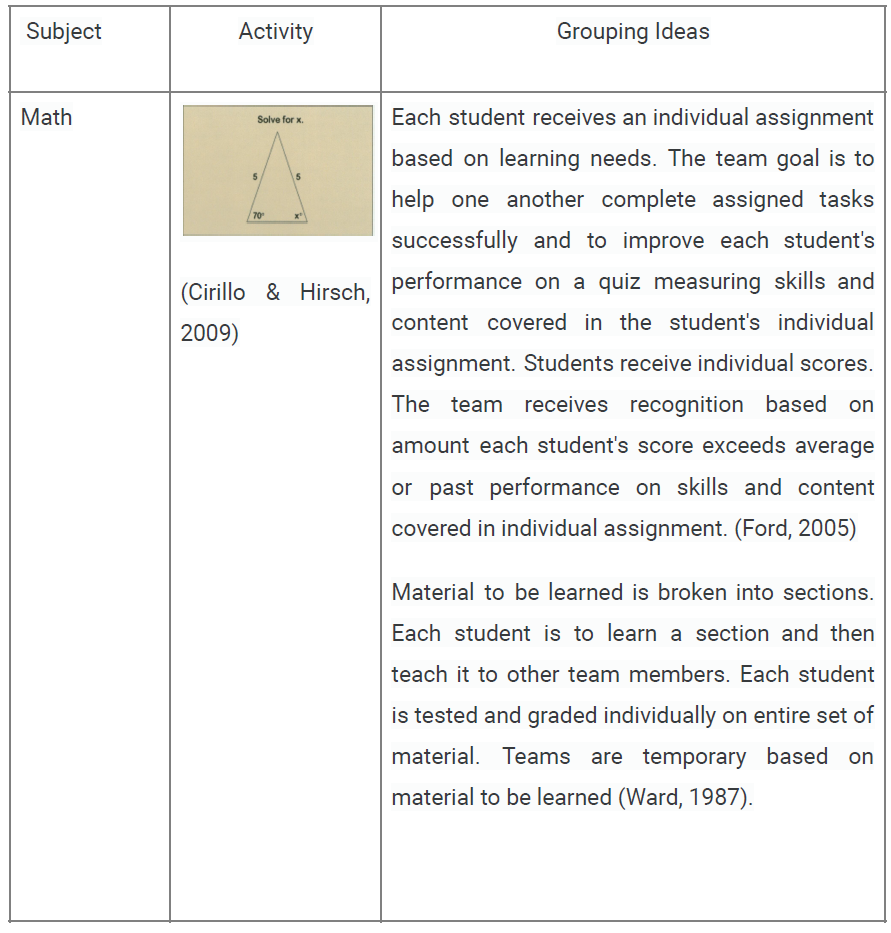
For your writing assignment for unit 6, use the readings from the unit and outside sources to think about the inclusive classroom and grouping arrangements for students. Adapt the chart below to relate grouping techniques to classroom subject domains and learning activities. Ideal groups can change for each subject domain. Reflect upon what an educator anticipates an inclusive class to need. Follow the format provided below and note the grade or age range level, subject, activity, and grouping ideas, (see the example provided). Focus on a grade level or age range (early childhood, elementary, high school, etc.) of instructional choice. Select three subjects. For each subject list and briefly describe a learning activity related to that subject. Describe two grouping arrangements for each activity listed. When the chart is completed, it will contain a total of three subjects listed, three activities listed (one per subject), and six grouping arrangements listed (2 per activity).
Your written assignment should include a brief introduction and a brief conclusion. Submit a paper which is 2-3 pages in length, exclusive of the reference and title page, double-spaced using 12 point and Times New Roman font. Cite at least 2 of the unit readings in APA format. Check all content for grammar, spelling, and be sure you have properly cited all resources used in APA format.
Example
Age-Range/Grade: Elementary
One of the main reasons for using group study is that it allows students to support each other in the learning process. Motives to satisfy curiosity, to create something to produce and offer to others come into play. As a result, students acquire personally significant, meaningful knowledge. Group learning work has great potential.
Age-Range/Grade: 10 - 12 according to K-12 (teenagers between 15 - 18 years old)
Conclusion
At the end of the group activity, the most important thing is a discussion of the results of the work, or a reflection on the result. Each group nominates a speaker who talks about the results of the group work. The results of all groups are recorded on the board and then discussed. Depending on the goals of the group work, further discussion can proceed in different ways: either choosing the only correct (or the best) result, or solutions can be different. Further it is necessary to discuss the process of work, or reflection on the process. In the process of using group work techniques, students' experiences can be discussed, for example, by asking groups that have been particularly effective in their work how they achieved it. This kind of discussion, however, is not often encountered in real practice, because in most cases for the teacher group work is a means of solving a particular lesson problem. The discussion makes it possible to make the participants aware of the ways of group work and, thus, naturally develop the ability to work in a group. The teacher hopes that the next time the discussion will be more successful because some students have realized the "laws of discussion" and have seen the possibilities for self-improvement (Gomez & Jimenez-Silva,2011). All the dynamic processes that take place in a small learning group ensure in a certain way the effectiveness of group learning work. On the one hand, an indicator of efficiency is the productivity of group activity, on the other hand, no less important indicator is the satisfaction of group members with the joint activity.
Systematic work in small study groups provides an opportunity for all students to participate in the learning process, to practice cooperation skills, interpersonal communication (in particular, the ability to listen actively, to develop a common opinion, to resolve disagreements that arise). This form of work stimulates students to study any subject and promotes their awareness of both subject matter and social interaction.
References
1. Cirillo, M., Drake, C., Herbel-Eisenmann, B., & Hirsch, C. (2009, August). Curriculum
vision and coherence: Adapting curriculum to focus on authentic mathematics. The
Mathematics Teacher, 103(1), 70-75. http://www.jstor.org/stable/20876521
2. Ford, M.P. (2005, December). Differentiation through flexible grouping: Successfully
reaching all readers. Learning Point Associates.
https://files.eric.ed.gov/fulltext/ED489510.pdf
3. Gomez, C. L., Kurz, T.L., & Jimenez-Silva, M. (2011, November). Your inner English
teacher. Mathematics Teaching in the Middle School, 17(4), 238-243.
https://www.jstor.org/stable/pdf/10.5951/mathteacmiddscho.17.4.0238.pdf?refreqid
=excelsior%3A908affbf76b2b38cf80ba3c835076dc7
4. Ward, B.A. (1987). Instructional grouping in the classroom. School Improvement
Research Series.
https://educationnorthwest.org/sites/default/files/InstructionalGrouping.pdf