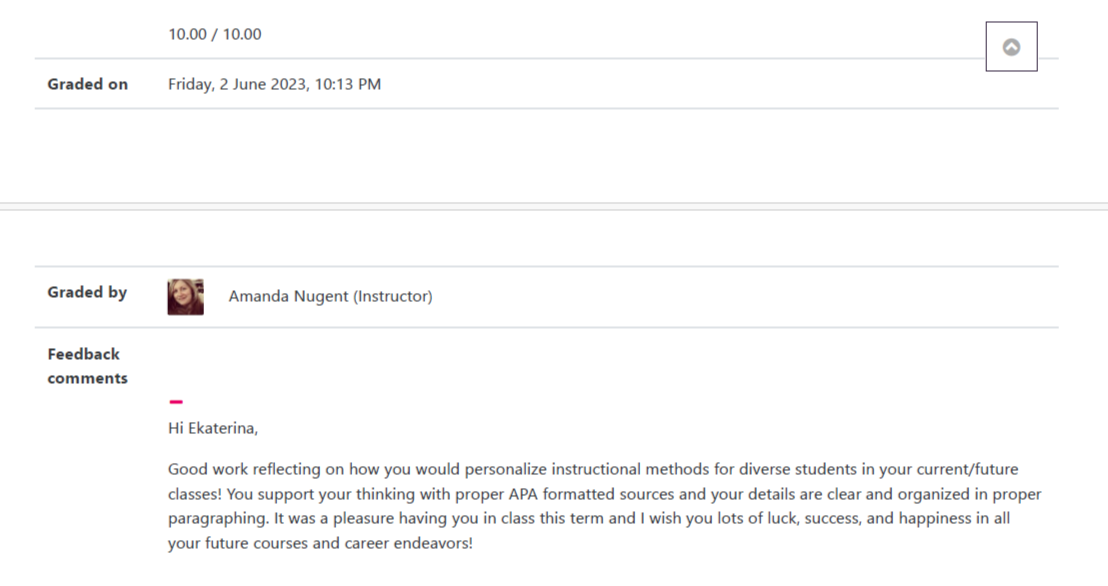
Reflect upon the topics covered in this course and unit. Explain how you would personalize instructional methods or learning materials fordiverse students in your inclusive K-12 class.
Every teacher has his or her own fears and phobias. Especially when they were not experienced and competent enough to deal with any issues or difficulties and were forced to act intuitively. It's often playing blind when you're scared, when you make mistakes and need to correct them, when you really need help from more experienced colleagues, but they have different experience and different ways of helping.
My personal experience of teaching in a classroom with different students occurred during my first year of teachingin an advanced German language gymnasium. At the time, I was working as an elective lesson teacher. I had thirty-three lessons per week. I taught five fifth grades, five sixth grades, five seventh grades, and two first grades. I had noteaching experience, nor did I have any special education, because I was a bachelor of linguistics with a specialty intranslating and interpreting. So everything I did was like jumping off a steep cliff.
While working on this course, I found answers to many questions. In Russia, education for people with disabilitieshas existed (continues to exist today) as special education for many decades. There are special scientific schools ofremedial pedagogy in pedagogical universities in Russia. At a time when, firstly, negative environmental and social conditions of life lead to an increase in the number of children requiring special conditions and technologies ofeducation, and secondly, domestic education is steadily commercialized, turning into a sphere of educational services and becoming accessible to not all segments of the population, it is necessary to think about how this democratic principle of equality of citizens in education can be implemented.
In modern processes of modernization, which have unfolded in the domestic school, the ideas of informatization,standardization and, in particular, the introduction of a fairly formalized Uniform State Examination are emphasized.It should be recognized that they are oriented to the task of ensuring equality in education for all, especially for graduates of peripheral, rural schools. However, the negative side of these measures is obvious: the averaging of the quality of education by reducing the traditionally high standard set by secondary and higher schools in Russia. The meaning of the modern concept of "inclusive education", as it is known, consists in the idea of joint education of healthy children and people with disabilities (Adams & Jones, 2016). Its implementation requires a special kind of tolerance, which can only be achieved by a systematic system of moral education of the younger generation. Such a system can be implemented by a professional, educated modern teacher who has not only medical and pedagogical tools, but also has a wide range of humanities education. It is necessary to consider the development of integrated education as one of the most important and promising directions for improving the educational system for children with disabilities. The organization of the education of such children in general educational institutions, located, as arule, at the place of residence of the child and his parents, makes it possible to avoid placing children in an institution for a long period (although their number is growing), to create conditions for their residence and education in a family, to ensure their constant communication with normally developing children and, thus, to effectively solve problems of their social adaptation and integration into society.
A person can become mobile, learning, adapting to the changing conditions of the global world, able to interact with others, understanding and tolerant, independently thinking and acting in new conditions for him only in the world integrated system of education (Scanlon & Baker, 2012).
Requirements for the mode of organizing a lesson in an inclusive classroom
The course of the lesson depends on the degree of contact of students with different educational needs (Olinghouse, 2008), how they mastered the previous topic, what stage of learning is taken as a basis (presentation of new material, repetition of the passed topic, control of knowledge, abilities and skills). If all students in the classhave a common topic, then the study of the material is conducted in a frontal manner, and children get the knowledge of the level determined by their program. The consolidation and refinement of acquired knowledge, skills and abilities is based on different didactic material individually selected for each student (cards, exercises fromthe textbook, texts on the board, etc.). If different program material is studied and joint work is impossible, then the lesson is built according to the following structure: - the teacher first explains the new material according to the standard state programs, and the students with disabilities at this time perform independent work aimed at consolidating the previously studied. Then to reinforce the newly learned material the teacher gives the classindependent work, and with a group of students (Ford, 2005) with developmental disabilities organizes work that includes an analysis of the completed task, individual assistance , additional explanation and clarification,explanation of the new material. Such an alternation of the teacher's activities continues throughout the lesson. If necessary the teacher can additionally use instruction cards which reflect the algorithm of actions of the pupil,various tasks and exercises are given. Such pedagogical method is used both with children with preserved psychophysical abilities and with children who have limited opportunities of health. Depending on the number of those and other children in the class. If the teacher is not able to give much time in the lesson to the student with an intellectual disability, he or she can use a card with an algorithm of tasks for him or her. Or, conversely, if the teacherhas to be distracted to explain a difficult topic to children with disabilities, then the strong children do some of the tasks on the cards.
One of the main requirements for the lesson is to take into account the weak attention span of children with disabilities, their exhaustion and boredom with monotonous activity. Therefore, the teacher should change different types of activity at the lesson:
a) it is better to start the lesson with tasks that train memory and attention;
b) usecomplex intellectual tasks only in the middle of the lesson;
c) alternate tasks related to learning and tasks with onlycorrective orientation (visual gymnastics, use of tasks for development of fine motor skills, development ofperception and thinking);
d) use surprise, game moments, competitive moments, intrigue, role plays, mini-scenarios (that is, all those activities that are not only for the teacher, but also for the teacher).
Students with disabilities learntopics in special (remedial) educational programs. Depending on the complexity of the topic studied, theexplanation of homework has an individual or frontal nature. It is checked one by one or jointly, depending on thecomplexity of the homework assignment, and performance is evaluated taking into account the individual capabilities of each student.
References
Adams, D., Harris, A., & Jones, M.S. (2016). Teacher-parent collaboration for an inclusive classroom: Success for everychild. Malaysian Online Journal of Educational Sciences, 4 (3), 58-71.
https://www.researchgate.net/publication/304659451_Teacher-Parent_Collaboration_For_An_Inclusive_Classroom_Success_For_Every_Child
Ford, M.P. (2005, December). Differentiation through flexible grouping: Successfully reaching all readers.LearningPoint Associates.
https://files.eric.ed.gov/fulltext/ED489510.pdf
Olinghouse, N. (2008). Designing lessons for diverse learners.
https://edwp.educ.msu.edu/te/wp-content/uploads/sites/49/2020/06/Designing-Lessons-for-Diverse-Learners.pdf
Scanlon, D., & Baker, D. (2012, November). An accommodations model for the secondary inclusive classroom.Learning DisabilityQuarterly, 35 (4), 212-224.
http://www.jstor.org/stable/41702375