Kolb's Model of Reflection (McLeod, 2013) on this course by justifying the use of technology when teaching reading and writing.
Concrete Experience
Literature and writing have been my favorite subjects since I started school. This course has become my favorite because of the many new techniques, strategies, and theoretical knowledge I learned through assignments and properly selected literature. For example, from Nikolaeva (2014) I learned to analyze the relationship between Cognitive Criticism and the research in children's literature, to compare and find differences in the knowledge of the world, other people, and self in relation to each other, and to apply this knowledge in practice.
Reflective Observations
I had the awareness and experience that boys and girls learn differently (Gurian & Carter, 2000), but I lacked the evidence base and the ability to back up my practical findings with theory, so I was able to do so. In analyzing changes in Information and Communication Technology (ICT) (Richards & McKenna, 2003) I found many benefits of literacies of the Internet for me and my classroom practice. And the topic of teaching reading struck me with its new approach to students.
First, the cases of library organization (DeCandido & Office, 2001) made me think about the need for such organizations around the world, and second, to analyze how personal, environmental background contributes to reading insights of books (Trim, 2004) and components of literacy-technology integration pertain to classroom practice (Watts-Taffe & Gwinn, 2007). Special attention should be paid to Selecting Children's Literature: grades K-8th, as this section was very helpful in getting the group work done correctly.
Abstract Conceptualization
My favorite units are sixth and seventh, as I use the story strategy most often in my classes, and I have been writing poetry since I was a teenager. Bowkett (2010) tells how to make a plan to improve strategies for writing activities in the classroom, and Carter (2004) helps you create a poetry writing workshop for use in the classroom.
Application
I have a student whom I am preparing for the IELTS exam. She never liked English before studying with me and didn't see much point in it. At first, she learned the language only because she needs a certificate to get into a European university to study design. So on Monday, I suggested she write a poem called “I Am.” It was the first practical work we did when her eyes lit up and her mood lifted. The girl is 25 years old and very good at drawing, she doesn't like many things and lives with her boyfriend in the Netherlands. This poem, or rather this technique did the almost impossible. My student fell in love with the English language.
The second poem was Alliteration ('Angry Arthur always ate ...'). My student listened to the assignment and sent me her version in 10 minutes:
amanda archer already asks amount alive aligators about anxious asters
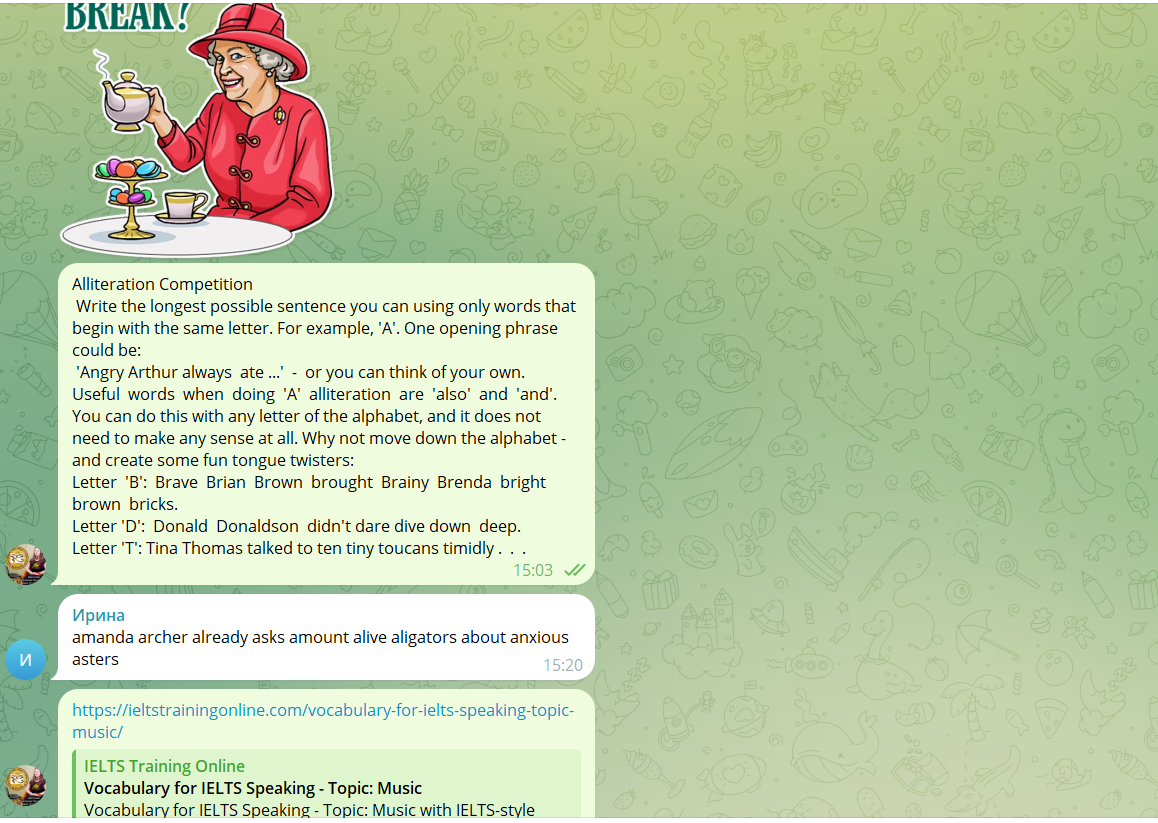
This is the first time I have received so much enthusiasm from her and now we will try a new technique every lesson.
In conclusion, I would like to thank the creators of this course and everyone who helped me to study its sections. I would like to keep a lot of my techniques and I want to buy almost all the books in this course, especially Page to stage: developing writing, speaking and listening skills in primary schools and Teaching language and literature in elementary classrooms: a resource book for professional development. With these techniques, I can not only diversify my lessons, but also stimulate my students' love for English.
References
Bowkett, S. (2010). Developing literacy and creative writing through storymaking: story strands for 7-12-year-olds. Retrieved from eBook Central .
Carter, J. (2004). Page to stage: developing writing, speaking and listening skills in primary schools. David Fulton Publishers. Retrieved from eBook Central
DeCandido, G. A., & Office, F. L. A. O. S. (2001). Literacy and libraries: learning from case studies. Retrieved from eBook Central
Gurian, P., M., & Carter, P. (2000). Boys and girls learn differently! : a guide for teachers and parents. John Wiley & Sons, Incorporated. Retrieved from eBook Central.
McLeod, S. (2013). Kolb- learning styles.Simplypsychology.org. http://cei.hkust.edu.hk/files/public/simplypsychology_kolb_learning_styles.pdf
Nikolajeva, M. (2014). Reading for learning: cognitive approaches to children's literature. Retrieved from eBook Central
Popp, M. S. (2006). Teaching language and literature in elementary classrooms: a resource book for professional development. Routledge. Retrieved from eBook Central.
Richards, J. C., & McKenna, M. C. (2003). Integrating multiple literacies in k-8 classrooms: cases, commentaries, and practical applications. Retrieved from eBook Central
Trim, M. (2004). Growing and knowing: a selection guide for children's literature. Retrieved from eBook Central
Watts-Taffe, S. M., & Gwinn, C. B. (2007). Integrating literacy and technology: effective practice for grades k-6. The Guilford press.