This week’s resource (Bowkett, 2010), on writing in the classroom, is divided into four sections: Getting Started, Building Narrative, Enriching the Story, and Story Grids. Each of these sections discusses different writing strategies to use in the classroom to help your students become successful writers. For each individual section, select one writing activity (a total of four when completed) that sounds like something you might use in your classroom. Your paper must:
Describe the activity in step by step detail so another person would be able to follow along and use it.
Evaluate the learning benefits for this activity
create some practical tips for use in the classroom you could give to other teachers using this activity
draft a plan on taking this activity a step further in the classroom.
Make sure everything is in step-by-step detail so another teacher could use the activity without question.
Getting Started
Activity
Take a single picture.
Explain the class the word: exactly, precisely, in more detail, tell me more, and also.
Remind children of the Big Six question words: what, where, when, who, why, how.
Next start framing questions with these key words and the “precision questioning terms.”. For example (Bowkett, 2010),
- What did the book look like in more detail?
- How exactly did the pages sound as the boy found the book.
- Tell me more about the room where the boy found the book.
- What else could the boy see from the road apart from the house?
- What precisely was the weather like?
Learning benefits
Activity develops skills for internalising attention. This is called metacognition, i.e. a person's knowledge of their own cognitive process, aswell as the ability to analyse their thinking strategies and manage their cognitive activities. It also strengthens multisensory thinking skillsand gives children the skill of forming precise questions (Bowkett, 2010).
Use these questions as a critical thinking tool when students are confronted by generalizations or engaged in constructive argument anddebate (Bowkett, 2010).
In the next step, students should be divided into groups and given the task of answering the generated questions. The next step is toselect the most interesting answers to create a future story plot (Planning a Writing Lesson, n.d.).
Building Narrative
Activity
And so the beginning of the story is there; however, every story has a beginning (setting the scene, introducing the protagonist and thefirst actions), a middle (understanding the difficulties, progressing the actions) and an end (solving the hero or narrative problem).Thisneeds to be told to the children (Bowkett, 2010). You can also use Story Maker 1 (2024) for a warm-up activity.
The story should have mandatory elements such as hero, villain, problem, journey, partner, help, knowledge applied as power andimportant object. The Yin-Yang symbol is suitable for demonstrating the inter-relationship between the hero and the villain (Bowkett,2010).
Working with this symbol will help students understand that every hero has weaknesses and every villain hides a grain of goodness. Youcan spend a few minutes on this and ask students to give examples from books or familiar stories (Bowkett, 2010).
Next, distribute the pre-prepared worksheets with a grid.
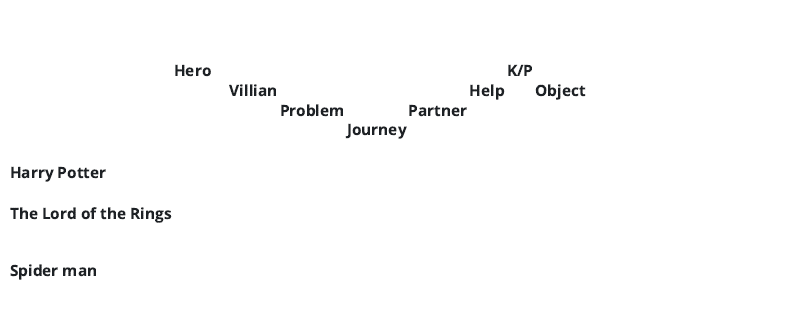
And discuss each element of the story. To maximise the involvement of each student in the discussion, it is a good idea to first ask thegroups to define each element, e.g. ‘The hero is Harry Potter. He is kind, friendly, etc.’. Working through the definitions will help to focuson the difference between hero and villain, problem and journey.
Learning benefits
- Provides a solid template for creating a structurally sound story in any genre
- Gives children a tool to analyse and explore other stories they read
- Offers a planning strategy instead of coming up with a specific story idea student can build a narrative from the end by firstconsidering the elements of the story.
The next step would be to fill a table with their values with the names of future characters in their story. And then allow students tocreate their own stories that they can read in pairs or small groups.
Enriching the Story
When stories are finished and read, it's a shame to part with beloved characters. It's time for a sequel.
Activity
For the continuation of any story you can find a correspondingly intriguing ending, when all the problems are solved, but again the phonerings, or a letter arrives at the post office, or someone in a hood knocked on the door ....
To begin work on the continuation is suitable for the following exercise (Bowkett, 2010):
Choose several cards with different stories or pictures, turn them face down and ask the student to turn over the first one with thewords: ‘If the story had a continuation, what happened next?’. Since there are more cards than one, there can be many continuationoptions. And all ideas can be suggested by students one at a time, or better yet, in the group in which they wrote their story. Each groupcan be given four cards and asked to come up with a continuation, putting all the pictures in a random sequence. This activity will teachstudents co-operation and understanding.
Learning Benefits
This activity will teach you how to ask questions and plan an investigation
It helps to develop an understanding that every action has a cause, to help reason about cause and effect, and to enable a narrative to beorganised into a logical chain.
It is not necessary to prompt what the student can see in the picture, as this prevents them from focusing on their own perceptions andfeelings.
Story Grids
Activity
The aim of this activity is to get students to orally create a short story in small groups or pairs (Story Telling Grid, 2024).
Procedure
- First of all draw a grid on the board and then put one word in each box. You can make your story grid any size you want but thebigger the grid is the more complicated the activity will become.
- You can recycle vocabulary that students are currently working on in class in the story grid, but to ensure that students can create agood story you should include a mixture of words, such as people and place names, verbs, nouns, adjectives etc., and it is usuallygood to throw in words that might give the story a bit more spice, such as crime, love, hate, murder, theft, robbery, broken-hearted,treasure, accident, etc.
- Explain to the students that the aim of the activity is to create a story using all the words in the story grid. Students can use anyvocabulary or grammar they want to but they have to include all the words in the story grid.
- The first time you do this activity you can use the example story grid below and model the story telling part of the activity for thestudents and then give the students another example story grid from the worksheet to use, or you can easily create your own storygrid.
- Another variation is to get students to create story grids for each other to use. Next get the students to create their own stories inpairs or small groups and once the students have created their stories, they can retell their story to you, the rest of the class or toother groups.
- or it can be used the activity from GridClub webpage (Tell a Story in 60 Seconds - Fun English Game for Kids by GridClub, 2024).Storyline offers a character, a location and a subject as basis for a story to narrate in 60 seconds. Develops speaking and dramaskills; encourages use of structure within a story. Best done in pairs.
Learning benefits
Elicit current vocabulary from your students for a whole class activity or let individual imaginations run wild. Story grids are great forrecalling and classifying vocabulary into word groups (e.g. write three nouns, two adverbs, a collocation and an idiom from the currentset). Once inputted into the grid the options are varied: you can ask students to swap grids for an extra challenge, create stories in groupsor set the story writing for homework after eliciting possibilities and combinations in class.
At the end of the activity the class could vote on the best stories in different categories, for example the most creative story, the mostinteresting story, the funniest story, the best told story etc. This activity can also be easily developed into a creative writing activity, eitherindividually as homework or as pair or group writing practice.
Another interesting spin-off is to get students to rewrite their stories as a radio drama. If you have recording facilities the students canperform and record their radio drama to listen to in class. If you do not have recording facilities you can get students to write their storyas a short play and try to find them an audience who they can perform to such as another teacher or another class.
References
Bowkett, S. (2010). Developing literacy and creative writing through storymaking: story strands for 7-12-year-olds. Retrievedfrom eBookCentral (accessed through LIRN).
Planning aStory telling grid. (2024). TeachingEnglish.
https://www.teachingenglish.org.uk/teaching-resources/teaching-secondary/activities/intermediate-b1/story-telling-grid
Story Maker 1 | LearnEnglish Kids. (2024). Britishcouncil.org.
https://learnenglishkids.britishcouncil.org/fun-games/games/story-maker-1
Tell a Story in 60 Seconds - fun english game for kids by GridClub. (2024). GridClub.
https://gridclub.com/activities/tell-a-story-in-60-seconds