University of the People
Dr. Angela Andrews
02 06, 2022
Education in Germany
Schooling
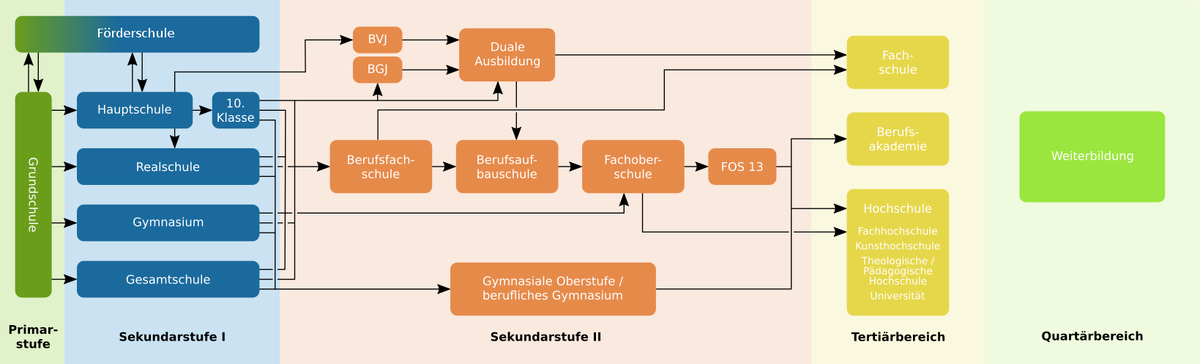
Compulsory schooling applies to children between the ages of six and nineteen, with a total of 13 years of schooling. At the end of this period, subject to successful examination, the student receives a matriculation certificate, giving him the right to enter a higher educational institution. Each school in Germany is subordinate to the government of its own land. Therefore, the programs, rules and even the duration of training in different areas of the country differ.
The German school system is a two-stage system, which includes primary education (Primastufe) and secondary education (Sekundastufe).(German Education System)
Elementary school. Grundschule.
The first stage of schooling is the primary school (Grundschule), which begins at the age of six and continues for four to six years.
In the first two classes, there is no subject structuring, that is, general, basic knowledge in mathematics, the German language, local history, music and religion is taught comprehensively, within the framework of one educational course.
After graduating from primary school, students continue their education in secondary schools. Unlike the Russian education system, secondary schools in Germany are very multivariate. There are noticeable differences between them. Each type of general education school provides students with a certain range of opportunities for further study in the chosen profession. The choice of school depends on the specialist of which direction and what level the child or his parents see themselves in the future. In addition, in order to enter a higher level educational institution, the student needs the advice of primary school teachers. In Germany, the principle is that the more capable the child is, the more opportunities he has to receive a high-quality education. Thus, the choice of the future profession or at least the level of education is carried out after primary school. Secondary schools in Germany are divided into four types: gymnasium, real school, main school, combined school.(Education in Germany)
Four types of secondary schools: 1. Gymnasium.
The most prestigious type of secondary school is a gymnasium, the diploma of which allows you to enter all higher educational institutions in Germany without entrance exams. As a rule, gymnasiums specialize in humanitarian education. The last 2 years of the gymnasium are vocational-oriented, that is, along with general education subjects, students choose several specialized disciplines to study. The duration of study at the gymnasium is 9 years, from 5th to 13th grade. After grade 12, students receive a Fachhochschulreife diploma, giving the right to enter the technical institute (Fachhochschule), and after grade 13 - Hochschulreife, a matriculation certificate for university admission.
2. Real school. Realschule.
Education in a real school lasts 6 years, from 5th to 10th grade.
Unlike the gymnasium, the real school is more focused on specialized disciplines, the main subjects are taught here with a mandatory profile bias. Real school is the most common type, most students get here (about 40%). Upon graduation from a real school, a certificate (Fachoberschulreife) is issued, allowing you to enter a technical school or special vocational school.
3. Basic school. Hauptschule.
In the main school, where about a quarter of the children get, they study up to the 10th grade. The basic school provides a fundamental general education, which, as in a real school, is focused on choosing a future profession. After studying at the main school, students usually enter a vocational school.
4. United School. Gesamtschule.
The combined school includes the main features of all the above general education institutions. The duration of study at the combined school is 6 years, from 5th to 10th grade.
Some combined schools also have upper classes (11th to 13th grade), organized on the principle of upper grades of gymnasiums, however, unlike a gymnasium, children come here without recommendations from primary school. In addition, not all lands have schools of this type. If the student successfully completes the upper grades of the combined school, he is awarded a Hochschulreife matriculation certificate, certifying the level of education sufficient to enter the university.(German Education System)
In addition to all the above types of schools, Germany also has special schools for children with mental or physical disabilities, at different levels and profiles, the so-called Sonderschule.
Certificates. After graduation, the graduate has various ways to continue his education, in a technical school, vocational school, special vocational school or university.
Not all schools provide a level of education sufficient for admission to a higher educational institution such a certificate of maturity is issued only after successful completion of a gymnasium or a combined school. At the end of a general education institution, a graduate has one of the following documents (matriculation certificates):
Hauptschulabschluss - issued after graduating from the 10th grade of the main school, sufficient for admission to vocational school.
Fachoberschulreife - issued after graduating from the 10th grade of a real school, sufficient for admission to a technical school or special vocational school.
Fachhochschulreife - issued after graduating from 12 grades of a gymnasium or a combined school and after graduating from a technical school or special vocational school, sufficient for admission to a technical institute.
Hochschulreife - issued after graduating from 13 grades of a gymnasium or a combined school, sufficient for admission to the university.
Higher education in Germany.
The higher education system of Germany represents different types of higher educational institutions that are able to meet the needs of each student. Hochschule is a university, usually of a humanitarian nature.
Another type of higher education institution - Fachhochschule - can be transmitted to Russian as a university of applied sciences or a higher special school. A feature of Fachhochschule is the close connection between theory and practice. All Fachhochschule programs involve two mandatory practical semesters. In addition, the term of study at such a university is shorter (usually 8 semesters). Fachhochschule trains high-quality specialists for individual industries, as a rule, it is engineering, business management, design and social specialties. At the end of the course, students receive a diploma Diplom. Thus, Fachhochschule attracts students in a faster way to their future professional activities and careers. According to statistics, a quarter of students enter the Fachhochschule.
Universität is larger than Hochschule and Fachhochschule. The number of faculties and subjects studied can be very large (up to 400). Here students are engaged in purely scientific activities, basic and applied research is carried out here. The university presents such fields of knowledge as medicine, natural, technical and humanities sciences, law, theology, economics, sociology and agrarian sciences. A wide selection of subjects within the same faculty allows you to obtain interdisciplinary education and specialize in various aspects of study. Academic degrees awarded by universities are Diploma Diplom, Master of Magister, Doctorate Doktor, title of assistant professor/professor Habilitationrecht, certificate giving the right to teach at the university.
Technische Universität is a university of technical education.
Here, from a purely theoretical point of view, individual areas of science are studied in detail: chemistry, physics, mechanical engineering, electronics, electrical engineering, materials science, etc. Academic degrees are similar to those issued after graduation from Universität.
There are also a number of specialized higher education institutions. For example, normal schools, theological schools, art and art music schools, schools of cinematography, etc. (Education of Germany)
Education system in Russia.
An educational institution is an institution that carries out an educational process, that is, implements one or more educational programs and (or) provides the maintenance and education of students and pupils. Educational institutions in their organizational and legal forms can be state, municipal, non-state. The Civil Code of the Russian Federation classifies educational institutions as non-profit organizations. (The Russian education system: An overview)
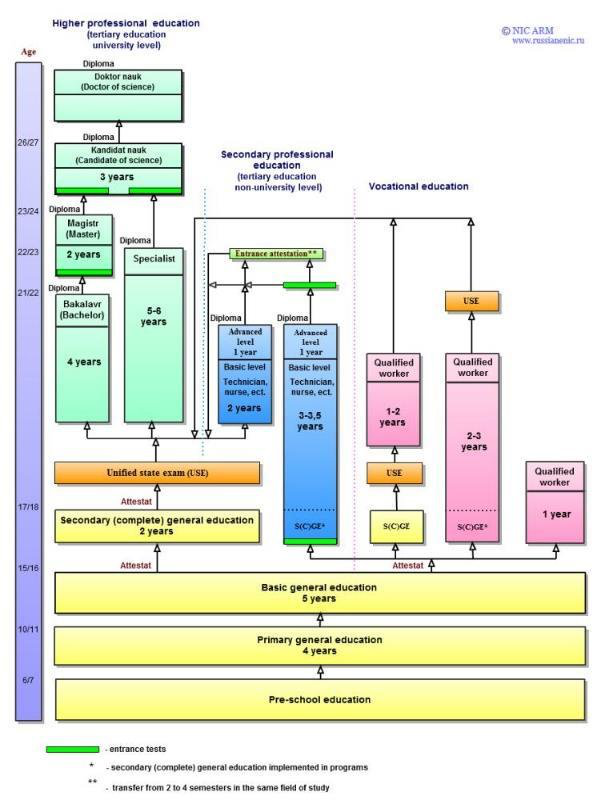
Depending on the educational program being implemented, the following types of educational institutions are created:
- secondary;
- which includes three stages: primary general, basic general, secondary (complete) general education;
- Primary, secondary, higher and postgraduate vocational education;
- additional adult education;
- additional education of children;
- special (corrective) for students with developmental disabilities;
- orphans left without parental care (legal representatives)
- other institutions carrying out the educational process.
Preschool education
It is represented by a system of preschool institutions - a kindergarten, which is designed to help the family in education.
School
The next stage is the school, the initial - 3-4 years of study, the main - 5 years of study, the secondary school - two more years of study. The school is the main basic institution in the modern education system, the greatest achievement of civilization.
Extracurricular education
In parallel, the system of extracurricular education is developing. We include all kinds of extracurricular institutions: music, sports schools, stations for young tourists, naturalists, centers of technical and artistic creativity. Their activities ensure the comprehensive development of the personality of the child and teenager.
Vocational education
The next stage is a professional school, represented by technical schools, vocational schools, now also colleges, universities of various types. The main problem is professional choice when moving from a general education to a professional school.
Currently, the postgraduate education system is increasingly developing - graduate school, doctoral studies, obtaining a second specialty, institutes and faculties of advanced training, internships, etc.
Fundamentally new for domestic higher professional education is the forming multi-stage system: bachelor, specialist, master. It attracts flexibility, the opportunity for young people to be involved in professional activities at different levels of education, integration of secondary and higher professional educational institutions.
Having considered the education systems of the two States, I came to the conclusion that they are noticeably different from each other (TOP 5 Differences between education system in Russia and Germany).
1. Already in elementary school in Germany, students choose their future profession and school in the direction.
In Germany, the principle is that the more capable the child is, the more opportunities he has to receive a high-quality education, so for admission to a higher level educational institution, the student needs the advice of primary school teachers
2. The secondary level of education in Germany is divided into four types of schools of various orientations. And in Russia, pre-professional training begins only in the 9th grade of the middle level.
3. In German schools there is a thirteen-year training.
4. After graduating from the 10th grade (real school, basic school) in Germany, in Russia this is 9th grade, students can only enter vocational schools, technical schools.
5. Higher education in Germany is also different from Russian. Germany does not have a rigid learning system. A student of a German university does not attend classes with his fellow students. According to the chosen specialty, he draws up his curriculum and attends the subjects that he needs.
In Russia higher education is multidisciplinary. The Russian level of education is recognized in Germany as not corresponding to their level. So if in Russia a schoolboy has finished 4th grade, then in Germany he will be admitted again to 4th grade. In addition, a graduate of a Russian secondary school with a matriculation certificate of completed secondary education is recognized only as a student of grade 10, and before receiving the German Hochschulreife certificate he will have to complete another 3 years, in grades 11, 12, 13 of a gymnasium or a combined school.
References
TOP 5 Differences between education system in Russia and Germany
https://www.youtube.com/watch?v=T8xVi-2QpmE
Education in Germany
https://en.wikipedia.org/wiki/Education_in_Germany
German Education System
https://www.studying-in-germany.org/german-education-system/
Education of Germany
https://www.britannica.com/place/Germany/Education
The Russian education system: An overview