Найти в Дзене
СфераЖизни

3. Case problems with pictures in topic "Physiology of the central nervous system"

Good afternoon, dear students! Posted here case problems with pictures in topic "Physiology of the central nervous system Case problem 3.1. Describe how the central and peripheral nervous systems illustrate the general principle of physiology that information flow between cells, tissues, and organs is an essential feature of homeostasis and allows for integration of physiological processes. Hint for answer 3.1. Information in the form of electrical signals moves in both directions between the CNS and PNS. In this way, the CNS can be informed of changes in the periphery, such as sensory inputs. In turn, information flow from the CNS to the periphery can direct motor functions that provide an appropriate response to sensory inputs from the PNS. The coordination of sensory and motor inputs and outputs is a key way in which homeostasis is achieved and maintained in the body. Case problem 3.2. How would the effects differ between a medication that blocks muscarinic acetylcholine receptors a

Good afternoon, dear students! Posted here case problems with pictures in topic "Physiology of the central nervous system

Case problem 3.1. Describe how the central and peripheral nervous systems illustrate the general principle of physiology that information flow between cells, tissues, and organs is an essential feature of homeostasis and allows for integration of physiological processes.
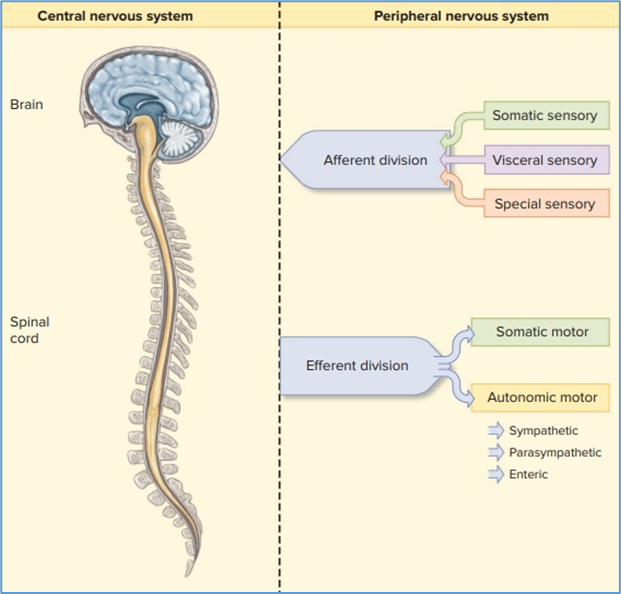
Figure 3.1. Overview of the structural and functional   organization of the nervous system. Eric P. Widmaier Human Physiology. The   Mechanisms of Body Function, New NY: McGraw-Hill Education. 2019.   https://lccn.loc.gov/2017048599
Figure 3.1. Overview of the structural and functional organization of the nervous system. Eric P. Widmaier Human Physiology. The Mechanisms of Body Function, New NY: McGraw-Hill Education. 2019. https://lccn.loc.gov/2017048599

Hint for answer 3.1. Information in the form of electrical signals moves in both directions between the CNS and PNS. In this way, the CNS can be informed of changes in the periphery, such as sensory inputs. In turn, information flow from the CNS to the periphery can direct motor functions that provide an appropriate response to sensory inputs from the PNS. The coordination of sensory and motor inputs and outputs is a key way in which homeostasis is achieved and maintained in the body.

Case problem 3.2. How would the effects differ between a medication that blocks muscarinic acetylcholine receptors and one that blocks nicotinic acetylcholine receptors?
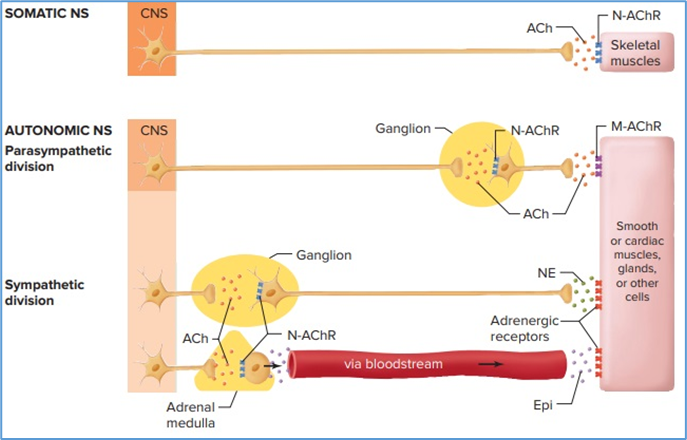
Figure 3.2. Transmitters used in the various components of the peripheral efferent nervous system. Notice that the first neuron exiting the CNS - whether in the somatic or the autonomic nervous system - releases acetylcholine. In a very few cases, postganglionic sympathetic neurons may release a transmitter other than norepinephrine. (ACh, acetylcholine; NE, norepinephrine; Epi, epinephrine; N-AChR, nicotinic acetylcholine receptor; M-AChR, muscarinic acetylcholine receptor). Eric P. Widmaier Human Physiology. The Mechanisms of Body Function, New NY: McGraw-Hill Education. 2019. https://lccn.loc.gov/2017048599

Hint for answer 3.2. The muscarinic receptor blocker would only inhibit parasympathetic pathways, where acetylcholine released from postganglionic neurons binds to muscarinic receptors on target organs. This would reduce the ability to stimulate “rest-or-digest” processes and leave the sympathetic “fight-or-flight” response intact. On the other hand, a nicotinic acetylcholine receptor blocker would inhibit all autonomic control of target organs because those receptors are found at the ganglion in both parasympathetic and sympathetic pathways

Case problem 3.3. Many spinal cord interneurons release the neurotransmitter glycine, which opens chloride ion channels on postsynaptic cell membranes. Given that the plant-derived chemical strychnine blocks glycine receptors, predict the symptoms of strychnine poisoning.

Figure 3.3. Converging inputs to local   interneurons that control motor neuron activity. Plus, signs indicate   excitatory synapses and minus sign an inhibitory synapse. Neurons in addition   to those shown may synapse directly onto motor neurons. Eric P. Widmaier Human Physiology. The   Mechanisms of Body Function, New NY: McGraw-Hill Education. 2019.   https://lccn.loc.gov/2017048599
Figure 3.3. Converging inputs to local interneurons that control motor neuron activity. Plus, signs indicate excitatory synapses and minus sign an inhibitory synapse. Neurons in addition to those shown may synapse directly onto motor neurons. Eric P. Widmaier Human Physiology. The Mechanisms of Body Function, New NY: McGraw-Hill Education. 2019. https://lccn.loc.gov/2017048599

Hint for answer 3.3. Recall that when chloride ion channels are opened, a neuron is inhibited from depolarizing to threshold. Thus, the neurons of the spinal cord that release glycine are inhibitory interneurons. By specifically blocking glycine receptors, strychnine shifts the balance of inputs to motor neurons in favor of excitatory interneurons, resulting in excessive excitation. Poisoning victims experience excessive and uncontrollable muscle contractions body-wide; when the respiratory muscles are affected, asphyxiation can occur. These symptoms are similar to those observed in the disease state tetanus, which is described in the Clinical Case Study at the end of this chapter.

Case problem 3.4. Based on this figure, hypothesize what might happen if you could suddenly stimulate gamma motor neurons to leg flexor muscles in a resting subject.

Figure 3.4. Neural pathways involved in the   kneejerk reflex. Tapping the patellar tendon stretches the extensor muscle,   causing (paths A and C) compensatory contraction of this and other extensor   muscles, (path B) relaxation of flexor muscles, and (path D) information   about muscle length to go to the brain. Arrows indicate direction of action   potential propagation. Eric P. Widmaier Human Physiology. The Mechanisms of   Body Function, New NY: McGraw-Hill Education. 2019.   https://lccn.loc.gov/2017048599
Figure 3.4. Neural pathways involved in the kneejerk reflex. Tapping the patellar tendon stretches the extensor muscle, causing (paths A and C) compensatory contraction of this and other extensor muscles, (path B) relaxation of flexor muscles, and (path D) information about muscle length to go to the brain. Arrows indicate direction of action potential propagation. Eric P. Widmaier Human Physiology. The Mechanisms of Body Function, New NY: McGraw-Hill Education. 2019. https://lccn.loc.gov/2017048599

Hint for answer 3.4. Stimulation of gamma motor neurons to leg flexor muscles would stretch muscle-spindle receptors in those muscles. That would trigger a monosynaptic reflex that would cause contraction of the flexor muscles and, through an interneuron, the extensor muscles would be inhibited. As a result, there would be a reflexive bending of the leg - the opposite of what occurs in the typical knee-jerk reflex.

Case problem 3.5. Which of these conditions would result in the greatest action potential frequency in afferent neurons from muscle-spindle receptors?

Figure 3.5. Activation of Golgi tendon   organs. Compared to when a muscle is contracting, passive stretch of the   relaxed muscle produces less stretch of the tendon and fewer action   potentials from the Golgi tendon organ. Eric P. Widmaier Human Physiology.   The Mechanisms of Body Function, New NY: McGraw-Hill Education. 2019.   https://lccn.loc.gov/2017048599
Figure 3.5. Activation of Golgi tendon organs. Compared to when a muscle is contracting, passive stretch of the relaxed muscle produces less stretch of the tendon and fewer action potentials from the Golgi tendon organ. Eric P. Widmaier Human Physiology. The Mechanisms of Body Function, New NY: McGraw-Hill Education. 2019. https://lccn.loc.gov/2017048599

Hint for answer 3.5. Although the contracting muscle results in the greatest stretch of the tendon, the muscle itself (and consequently the intrafusal fibers) are stretched the most under passive stretch conditions. Action potentials from muscle-spindle receptors would therefore have the greatest frequency during passive stretch.

Case problem 3.6. While crawling across a floor, a child accidentally places her right hand onto a piece of broken glass. How will the flexor muscles of her left arm respond?

Figure 3.6. In response to pain detected by   nociceptors, the ipsilateral flexor muscle’s motor neuron is stimulated   (withdrawal reflex). In the case illustrated, the opposite limb is extended   (crossed-extensor reflex) to support the body’s weight. Arrows indicate direction   of action potential propagation. Eric P. Widmaier Human Physiology. The   Mechanisms of Body Function, New NY: McGraw-Hill Education. 2019.   https://lccn.loc.gov/2017048599
Figure 3.6. In response to pain detected by nociceptors, the ipsilateral flexor muscle’s motor neuron is stimulated (withdrawal reflex). In the case illustrated, the opposite limb is extended (crossed-extensor reflex) to support the body’s weight. Arrows indicate direction of action potential propagation. Eric P. Widmaier Human Physiology. The Mechanisms of Body Function, New NY: McGraw-Hill Education. 2019. https://lccn.loc.gov/2017048599

Hint for answer 3.6. When crawling, the crossed-extensor reflex will occur for the arms just like it does in the legs during walking. Afferent pain pathways will stimulate flexor muscles and inhibit extensor muscles in the right arm, while stimulating extensor muscles and inhibiting flexor muscles in the left arm. This withdraws the right hand from the painful stimulus while the left arm straightens to bear the child’s weight.

Case problem 3.7. What structural features of the primary motor cortex somatotopic map reflect the general principle of physiology that structure is a determinant of - and has coevolved with - function?

Figure 3.7. Somatotopic map of major body areas in the primary motor cortex. Within the broad areas, no one area exclusively controls the movement of a single body region and there is much overlap and duplication of cortical representation. Relative sizes of body structures are proportional to the number of neurons dedicated to their motor control. Only the right motor cortex, which principally controls muscles on the left side of the body, is shown. Eric P. Widmaier Human Physiology. The Mechanisms of Body Function, New NY: McGraw-Hill Education. 2019. https://lccn.loc.gov/2017048599

Hint for answer 3.7. Different regions of the primary motor cortex have evolved different numbers of neurons associated with the specific features of the movements of particular body parts. In this way, the structural organisation of the primary motor cortex is correlated with the functional ability of different body parts. An example is the fine motor control necessary for the movement of fingers while playing a piano; such movements require many more motor neurons than does the ability to move one’s toes.

Case problem 3.8. If a blood clot blocked a cerebral blood vessel supplying a small region of the right cerebral cortex just in front of the central sulcus in the deep groove between the hemispheres, what symptoms might result?

Figure 3.8. The corticospinal and brainstem   pathways. Most of the corticospinal fibers cross in the brainstem to descend   in the opposite side of the spinal cord, but the brainstem pathways are   mostly uncrossed. For simplicity, the descending neurons are shown synapsing   directly onto motor neurons in the spinal cord, but they commonly synapse   onto local interneurons. Eric P. Widmaier Human Physiology. The Mechanisms of   Body Function, New NY: McGraw-Hill Education. 2019.   https://lccn.loc.gov/2017048599
Figure 3.8. The corticospinal and brainstem pathways. Most of the corticospinal fibers cross in the brainstem to descend in the opposite side of the spinal cord, but the brainstem pathways are mostly uncrossed. For simplicity, the descending neurons are shown synapsing directly onto motor neurons in the spinal cord, but they commonly synapse onto local interneurons. Eric P. Widmaier Human Physiology. The Mechanisms of Body Function, New NY: McGraw-Hill Education. 2019. https://lccn.loc.gov/2017048599

Hint for answer 3.8. When a region of the brain is deprived of oxygen and nutrients for even a short time, it often results in a stroke - neuronal cell death Because the right primary motor cortex was damaged in this case, the patient would have impaired motor function on the left side of the body. Given the midline location of the lesion, the leg would be most affected.

Case problem 3.9. The effect of gravity on stable posture reflects the general principle of physiology that physiological processes are dictated by the laws of chemistry and physics. List other ways you can imagine in which gravity influences physiological functions, including but not limited to motor function.

Figure 3.9. The center of gravity is the point in an object at which, if a string were attached and pulled up, all the downward force due to gravity would be exactly balanced. (a) The center of gravity must remain within the upward vertical projections of the object’s base (the tall box outlined in the drawing) if stability is to be maintained. (b) Stable conditions. The box tilts a bit, but the center of gravity remains within the base area - the dashed rectangle on the floor - so the box returns to its upright position. (c) Unstable conditions. The box tilts so far that its center of gravity is not above any part of the object’s base and the object will fall. Eric P. Widmaier Human Physiology. The Mechanisms of Body Function, New NY: McGraw-Hill Education. 2019. https://lccn.loc.gov/2017048599

Hint for answer 3.9. Gravity not only influences posture and balance but also places constraints on many types of motor behaviors, such as jumping or even walking. Simply lifting one’s leg up to take a step requires energy to overcome gravity and to maintain a stable posture and gait. In addition, gravity influences the movement of fluids in the body, such as the flow of blood up to one’s head while standing.

Case problem 3.10. How might the posture shown in part (b) influence contractions of this individual’s shoulder muscles?

Figure 3.10. Postural changes with stepping.   (a) Normal standing posture. The center of gravity falls directly between the   two feet. (b) As the left foot is raised, the whole-body leans to the   right so that the center of gravity shifts over the right foot. The dashed   line in part (b) indicates the location of the center of gravity when the   subject was standing on both feet. Eric P. Widmaier Human Physiology. The   Mechanisms of Body Function, New NY: McGraw-Hill Education. 2019.   https://lccn.loc.gov/2017048599
Figure 3.10. Postural changes with stepping. (a) Normal standing posture. The center of gravity falls directly between the two feet. (b) As the left foot is raised, the whole-body leans to the right so that the center of gravity shifts over the right foot. The dashed line in part (b) indicates the location of the center of gravity when the subject was standing on both feet. Eric P. Widmaier Human Physiology. The Mechanisms of Body Function, New NY: McGraw-Hill Education. 2019. https://lccn.loc.gov/2017048599

Hint for answer 3.10. To stand on the right foot, the hip extensors on the right side are activated while the hip flexors on the left side are activated. This is similar to what occurs when a walking person lifts the left leg and pushes forward with the right foot. In adults, spinal cord interneurons form locomotor pattern generators that connect the arms and legs, typically activating them in reciprocal fashion. Therefore, while standing on the right foot, the right shoulder flexor muscles and the left shoulder extensor muscles will tend to be activated.

Good luck in your studies!