Доброго дня.
Название материала вы видели, так что – если не готовы к восприятию информации, не читайте. Берегите себя.
Важнейшей частью психологического просвещения, которым я занимаюсь многие годы, является рассказ о разнообразных феноменах человеческой жизни… без конспирологии и популизма.
Сегодня темой нашего разговора – является инцест. Кто-то и слышать об этом не может, кто-то думает, что что-то знает или им кажется, что они что-то знают, но… как и всегда – незнание и домыслы имеет смысл сопоставлять с реальностью, потому как иначе – формируются иллюзии.
Ниже я приведу данные различных многолетних исследований. Не уверен, может быть какие-то из них есть на русском языке, но… все данные я взял из англоязычных источников (все они будут указаны).
Итак, поехали. Данные собраны из 292 опубликованных и рецензированных статей.
В совокупности там находятся данные от десятков миллионов участников опросов и исследований. Исторически охватывается период с 1980 по 2023 год. Разумеется, речь идёт о США, но суть от этого не меняется.
Распространенность инцеста
• По оценкам исследователей в 10-15% семей в США случался инцест;
• Более 32 миллионов американцев сообщают, что в детстве у них был инцест с родителем;
• 12,7% всех взрослых сообщают, что в детстве подвергались сексуальному насилию со стороны члена семьи;
• Лишь 20% жертв инцеста сообщают о об этом;
• 43-46% изнасилованных детей насилуют члены собственной семьи;
• 90% сексуального насилия над детьми до 18 лет совершаются членами семьи жертвы.
Типы инцеста
Существует множество различных типов инцеста, и ниже обсудим некоторые из них, а также их распространенность + сравним их распространенность по сравнению друг с другом.
• 74,4% всех случаев инцеста происходит между биологическими членами семьи (кровными родственниками).
• 25,6% всех случаев инцеста происходит между усыновленными или приемными членами семьи (не являющимися кровным родственниками).
1. Инцест отца и дочери
34,8% всех кровосмесительных контактов происходят между дочерями и их биологическим отцом.
Инцест между биологическим отцом и дочерью — наиболее распространенный вид инцеста.
2. Инцест отчима и падчерицы
12% всех кровосмесительных контактов происходят между падчерицей и отчимом.
Отчимы в 8 раз чаще, чем биологические отцы, совершают сексуальное насилие над падчерицей, живя вместе.
3. Инцест брата и сестры
23,1% случаев инцеста происходит между братом и сестрой.
81% случаев инцеста между братом и сестрой происходит между старшим братом и младшей сестрой.
4. Инцест матери и сына
25,4% мужчин, ставших жертвами инцеста, сообщили, что это инцест между матерью и сыном.
6,1% случаев инцеста произошли между матерью и сыном (с кровным родством и без него).
Демографические особенности
• 55% взрослых, совершивших инцест, были безработными;
• в 79,1% семей, где имел место инцест, было трое и более детей;
• 30,2% людей, сообщивших, что у них был инцестуальный сексуальный контакт, были старше 18 лет;
• 83,7% жертв инцеста — женщины;
• 16,3% жертв инцеста — мужчины;
• Родители, которые часто участвуют в словесных ссорах или физических драках, в 5 раз более подвержены риску инцеста между отцом и дочерью;
• 18,7% девочек являются жертвами той или иной формы инцеста;
• 7,2% мальчиков становятся жертвами той или иной формы инцеста.
Возраст
• 70,8% жертв инцеста были в возрасте 18 лет и младше, когда это произошло;
• 29,2% жертв инцеста были моложе 11 лет, когда это произошло.
Происходящее во время инцеста
• В 54,5% случаев инцеста респонденты сообщают, что проникновение было частью полового акта;
• 33% испытали анальное проникновение;
• 32,6% случаев инцеста длятся более одного года;
• 93,1% жертв инцеста не подвергались физическому насилию.
Последствия
• У 93% женщин, переживших насилие со стороны своих отцов, в какой-то момент жизни развивается расстройство пищевого поведения;
• У всех женщин, сообщивших, что в детстве они подвергались насилию со стороны своих отцов, была диагностирована депрессия;
• 55-65% сексуальных преступников стали жертвами инцеста в детстве;
• Жертвы сексуального насилия в 11 раз чаще совершают инцест по сравнению с людьми, которые не переживали сексуальное насилие;
• Жертвы инцеста несут в среднем на 16% более высокие расходы на медицинское обслуживание (врачи, психиатры, лекарства и т. д.);
• Инцестуальные отношения могут привести к инбридингу, который может вызвать генетические нарушения, инвалидность (умственную и физическую) и проблемы развития у детей.
Большинство западных стран запретили инцест, мотивируя это инбридингом. Однако в большинстве стран отношения между двоюродными братьями и сестрами не классифицируются как инцест. 8–11% отношений в Южной Америке, Восточной Азии и Южной Европе заключаются между двоюродными братьями и сестрами. 50% всех отношений на Ближнем Востоке, в Северной Африке и Южной Азии происходят между двоюродными или троюродными братьями и сестрами.
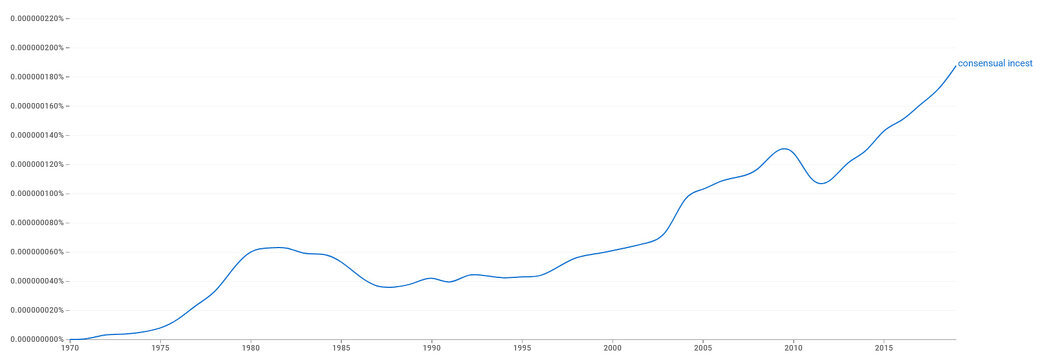
Инцеста по обоюдному согласию становится всё больше?
Изучая данные об инцесте по обоюдному согласию, была обнаружена интересная закономерность: с 1970 года интерес к инцесту по согласию возрос более чем в 190 раз. И у исследователей возник вопрос, является ли само это явление более распространенным сейчас, чем раньше, или о нем просто больше говорят? Лично я думаю, оба фактора имеют место быть.
Распространенность в порно
• Более 50% порно видео на хостинге Pornhub содержат ту или иную форму инцеста. Речь (чаще всего) не о реальном инцесте, а о названии и сюжетах видео;
• Доля инцест-видео увеличивается в среднем на 1,5% каждый год (с 2016 г.).
Источники (названия я не переводил)
• Adams, M. S., & Neel, J. V. (1967). Children of incest. Pediatrics, 40(1), 55-62.
• Adler, N. A., & Schutz, J. (1995). Sibling incest offenders. Child Abuse & Neglect, 19(7), 811-819.
• Alexander, P. C. (1985). A systems theory conceptualization of incest. Family process, 24(1), 79-88.
• Archibald, E. (2001). Incest and the medieval imagination. OUP Oxford.
• Bagley, C. (1969). Incest behavior and incest taboo. Social Problems, 16(4), 505-519.
• Baird, P. A., & McGillivray, B. (1982). Children of incest. The Journal of Pediatrics, 101(5), 854-857.
• Ballantine, M. W. (2012). Sibling incest dynamics: Therapeutic themes and clinical challenges. Clinical Social Work Journal, 40, 56-65.
• Banning, A. (1989). Mother-son incest: Confronting a prejudice. Child Abuse & Neglect, 13(4), 563-570.
• Becker, J. V., Kaplan, M. S., Cunningham-Rathner, J., & Kavoussi, R. (1986). Characteristics of adolescent incest sexual perpetrators: Preliminary findings. Journal of Family Violence, 1, 85-97.
• Bell, V. (2002). Interrogating incest: Feminism, Foucault and the law. Routledge.
• Bessa, M. M. M., Drezett, J., Adami, F., Araújo, S. D. T. D., Bezerra, I. M. P., & Abreu, L. C. D. (2019). Characterization of adolescent pregnancy and legal abortion in situations involving incest or sexual violence by an unknown aggressor. Medicina, 55(8), 474.
• Bienen, L. B. (1997). Defining incest. Nw. UL Rev., 92, 1501.
• Blume, E. S., & Lawrence, J. (1990). Secret survivors: Uncovering incest and its aftereffects in women (p. 352). New York: Wiley.
• Brand, B. L., & Alexander, P. C. (2003). Coping with incest: The relationship between recollections of childhood coping and adult functioning in female survivors of incest. Journal of Traumatic Stress: Official Publication of The International Society for Traumatic Stress Studies, 16(3), 285-293.
• Browning, D. H., & Boatman, B. (1977). Incest: Children at risk. The American Journal of Psychiatry.
• Butler, S. (1996). Conspiracy of silence: The trauma of incest. Volcano Press.
• Canavan, M. M., Meyer III, W. J., & Higgs, D. C. (1992). The female experience of sibling incest. Journal of Marital and Family Therapy, 18(2), 129-142.
• Carlson, B. E., Maciol, K., & Schneider, J. (2006). Sibling incest: Reports from forty-one survivors. Journal of child sexual abuse, 15(4), 19-34.
• Celbis, O., Altın, İ., Ayaz, N., Börk, T., & Karatoprak, S. (2020). Evaluation of incest cases: 4-years retrospective study. Journal of child sexual abuse, 29(1), 79-89.
• Choate, P., & Sharan, R. (2021). The Need to Act: Incest as a Crime Given Low Priority—A View with India as an Example. Social Sciences, 10(4), 142.
• Cohen, J. A., & Mannarino, A. P. (1991). Incest. Case studies in family violence, 171-186.
• Cole, P. M., & Putnam, F. W. (1992). Effect of incest on self and social functioning: A developmental psychopathology perspective. Journal of consulting and clinical psychology, 60(2), 174.
• Courtois, C. (1979). The incest experience and its aftermath. Victimology: An International Journal, 4(4), 337-347.
• Courtois, C. E. (1989). Healing the incest wound. New York: Guilford Press.
• Cyr, M., Wright, J., McDuff, P., & Perron, A. (2002). Intrafamilial sexual abuse: Brother–sister incest does not differ from father–daughter and stepfather–stepdaughter incest. Child Abuse & Neglect, 26(9), 957-973.
• DeMause, L. (1991). The universality of incest. The Journal of Psychohistory.
• Dietz, C. A., & Craft, J. L. (1980). Family dynamics of incest: A new perspective. Social Casework, 61(10), 602-609.
• Ellenson, G. S. (1985). Detecting a history of incest: A predictive syndrome. Social Casework, 66(9), 525-532.
• Erickson, M. T. (1993). Rethinking Oedipus: an evolutionary perspective of incest avoidance. The American journal of psychiatry.
• Everson, M. D., Hunter, W. M., Runyon, D. K., Edelsohn, G. A., & Coulter, M. L. (1989). Maternal support following disclosure of incest. American journal of Orthopsychiatry, 59(2), 197-207.
• Felitti, V. J. (1991). Long-term medical consequences of incest, rape, and molestation. Southern medical journal, 84(3), 328-331.
• Fessler, D. M., & Navarrete, C. D. (2004). Third-party attitudes toward sibling incest: Evidence for Westermarck’s hypotheses. Evolution and Human Behavior, 25(5), 277-294.
• Fox, J. R. (1962). Sibling incest. The British Journal of Sociology, 13(2), 128-150.
• Freedman, S. R., & Enright, R. D. (1996). Forgiveness as an intervention goal with incest survivors. Journal of consulting and clinical psychology, 64(5), 983.
• Gelinas, D. J. (1983). The persisting negative effects of incest. Psychiatry, 46(4), 312-332.
• Gilgun, J. F. (1995). We shared something special: The moral discourse of incest perpetrators. Journal of Marriage and the Family, 265-281.
• Goodwin, J. (1982). Sexual abuse: Incest victims and their families. Littleton, MA: J. Wright.
• Goodwin, J., Cormier, L., & Owen, J. (1983). Grandfather-granddaughter incest: A trigenerational view. Child abuse & neglect, 7(2), 163-170.
• Goody, J. (1956). A comparative approach to incest and adultery. The British Journal of Sociology, 7(4), 286-305.
• Gqgabi, R. B., & Smit, E. I. (2019). Psycho-Social Effects of Father–Daughter Incest: Views of South African Social Workers. Journal of child sexual abuse, 28(7), 840-859.
• Green, S. P. (2019). Incest. The Palgrave Handbook of Applied Ethics and the Criminal Law, 337-357.
• Groth, A. N. (1982). The incest offender. Handbook of clinical intervention in child sexual abuse, 215-239.
• Gul, H., Gul, A., Yurumez, E., & Öncü, B. (2020). Voices of adolescent incest victims: A qualitative study on feelings about trauma and expectations of recovery. Archives of psychiatric nursing, 34(2), 67-74.
• Hamer, M. (2002). Incest: A new perspective. Blackwell Publishing.
• Harkins, G. (2009). Everybody’s family romance: Reading incest in neoliberal America. U of Minnesota Press.
• Henderson, D. J. (1972). Incest: A synthesis of data. Canadian Psychiatric Association Journal, 17(4), 299-313.
• Henderson, J. (1983). Is incest harmful?. The Canadian Journal of Psychiatry, 28(1), 34-40.
• Herman, J. (1981). Father–daughter incest. Professional Psychology, 12(1), 76.
• Herman, J., & Hirschman, L. (1977). Father-daughter incest. Signs: Journal of women in culture and society, 2(4), 735-756.
• Herman, J., & Hirschman, L. (1984). Families at risk for father-daughter incest. The Gender Gap in Psychotherapy: Social Realities and Psychological Processes, 259-264.
• Herman, J., Russell, D., & Trocki, K. (1986). Long-term effects of incestuous abuse in childhood. The American Journal of Psychiatry.
• Hurley, D. L. (1991). Women, alcohol and incest: an analytical review. Journal of studies on alcohol, 52(3), 253-268.
• Jacobs, J. L. (1994). Victimized daughters: Incest and the development of the female self. Taylor & Frances/Routledge.
• Kluft, R. P. (1990). Incest-related syndromes of adult psychopathology (Vol. 140). American Psychiatric Pub.
• Koenig, W. D., & Haydock, J. O. S. E. P. H. (2004). Incest and incest avoidance. Ecology and evolution of cooperative breeding in birds, 142-156.
• Kuper, A. (2009). Incest and influence: The private life of bourgeois England. Harvard University Press.
• Laviola, M. (1992). Effects of older brother-younger sister incest: A study of the dynamics of 17 cases. Child Abuse & Neglect, 16(3), 409-421.
• Lawson, D. M., & Akay-Sullivan, S. (2020). Considerations of dissociation, betrayal trauma, and complex trauma in the treatment of incest. Journal of child sexual abuse, 29(6), 677-696.
• Lester, D. (1972). Incest. Journal of sex research, 8(4), 268-285.
• Lew, M. (1988). Victims no longer: Men recovering from incest and other sexual child abuse. Perennial Library.
• Lieberman, D., Tooby, J., & Cosmides, L. (2003). Does morality have a biological basis? An empirical test of the factors governing moral sentiments relating to incest. Proceedings of the Royal Society of London. Series B: Biological Sciences, 270(1517), 819-826.
• Lindberg, F. H., & Distad, L. J. (1985). Post-traumatic stress disorders in women who experienced childhood incest. Child Abuse & Neglect, 9(3), 329-334.
• Lindzey, G. (1967). Some remarks concerning incest, the incest taboo, and psychoanalytic theory. American psychologist, 22(12), 1051.
• Lukianowicz, N. (1972). Incest: I: Paternal Incest. The British Journal of Psychiatry, 120(556), 301-313.
• Luo, L. (2011). Is there a sensitive period in human incest avoidance?. Evolutionary Psychology, 9(2), 147470491100900213.
• LUSTIG, C. N., DRESSER, C. J. W., SPELLMAN, M. S. W., & MURRAY, M. T. B. (1966). Incest: A family group survival pattern. Archives of General Psychiatry, 14(1), 31-40.
• Madonna, P. G., Van Scoyk, S., & Jones, D. P. (1991). Family interactions within incest and nonincest families. The American journal of psychiatry.
• Maltz, W., & Holman, B. (1987). Incest and sexuality. Lexington Bks..
• McCarty, L. M. (1986). Mother-child incest: Characteristics of the offender. Child welfare, 447-458.
• McDonnell, B. H. (2003). Is incest next. Cardozo Women’s LJ, 10, 337.
• Meiselman, K. C. (1978). Incest: A psychological study of causes and effects with treatment recommendations. Jossey-Bass.
• Mondragon, N. I., Munitis, A. E., & Txertudi, M. B. (2022). The breaking of secrecy: Analysis of the hashtag# MeTooInceste regarding testimonies of sexual incest abuse in childhood. Child Abuse & Neglect, 123, 105412.
• Myer, M. H. (2016). A new look at mothers of incest victims. In Feminist perspectives on social work and human sexuality (pp. 47-58). Routledge.
• Nakashima, I. I., & Zakus, G. E. (1977). Incest: Review and clinical experience. Pediatrics, 60(5), 696-701.
• Nasjleti, M. (1980). Suffering in silence: The male incest victim. Child Welfare, 269-275.
• Parsons, T. (1963). The incest taboo in relation to social structure and the socialization of the child.
• Pendergrast, M. (1995). Victims of memory: Incest accusations and shattered lives. Upper Access.
• Phelan, P. (1995). Incest and its meaning: The perspectives of fathers and daughters. Child abuse & neglect, 19(1), 7-24.
• Phillips-Green, M. J. (2002). Sibling incest. The Family Journal, 10(2), 195-202.
• Pribor, E. F., & Dinwiddie, S. H. (1992). Psychiatric correlates of incest in childhood. The American journal of psychiatry.
• Raphling, D. L., Carpenter, B. L., & Davis, A. (1967). Incest: A genealogical study. Archives of General Psychiatry, 16(4), 505-511.
• Riemer, S. (1940). A research note on incest. American Journal of Sociology, 45(4), 566-575.
• Rist, K. (1979). Incest: Theoretical and clinical views. American Journal of Orthopsychiatry, 49(4), 680.
• Roesler, T. A., & Wind, T. W. (1994). Telling the secret: Adult women describe their disclosures of incest. Journal of interpersonal Violence, 9(3), 327-338.
• Rudd, J. M., & Herzberger, S. D. (1999). Brother-sister incest—father-daughter incest: A comparison of characteristics and consequences. Child Abuse & Neglect, 23(9), 915-928.
• Russell, D. E. (1986). The secret trauma: Incest in the lives of girls and women, Rev. Basic Books.
• Sancak, B., Tasdemir, I., & Karamustafalioglu, O. (2021). Mother–daughter incest: A brief review of literature and case report. Journal of forensic sciences, 66(5), 2054-2059.
• Sariola, H., & Uutela, A. (1996). The prevalence and context of incest abuse in Finland. Child abuse & neglect, 20(9), 843-850.
• Schaich Borg, J., Lieberman, D., & Kiehl, K. A. (2008). Infection, incest, and iniquity: Investigating the neural correlates of disgust and morality. Journal of cognitive neuroscience, 20(9), 1529-1546.
• Schneider, D. M. (1976). The meaning of incest. The Journal of the Polynesian Society, 85(2), 149-169.
• Seehuus, M., Clifton, J., Khodakhah, D., & Lander, M. (2022). The Study of Sexual Fantasy in Women: a Review of the Findings and Methodological Challenges. Current Sexual Health Reports, 1-9.
• Seto, M. C., Lalumiere, M. L., & Kuban, M. (1999). The sexual preferences of incest offenders. Journal of Abnormal Psychology, 108(2), 267.
• Simon, B. (1992). “Incest—see under oedipus complex”: The history of an error in psychoanalysis. Journal of the American Psychoanalytic Association, 40(4), 955-988.
• Sloane, P., & Karpinski, E. (1942). Effects of incest on the participants. American Journal of Orthopsychiatry, 12(4), 666.
• Smith, H., & Israel, E. (1987). Sibling incest: A study of the dynamics of 25 cases. Child Abuse & Neglect, 11(1), 101-108.
• Thorslev, P. L. (1965). Incest as Romantic Symbol. Comparative Literature Studies, 2(1), 41-58.
• Tidefors, I., Arvidsson, H., Ingevaldson, S., & Larsson, M. (2010). Sibling incest: A literature review and a clinical study. Journal of sexual aggression, 16(3), 347-360.
• Turner, J. H., & Maryanski, A. (2015). Incest: Origins of the taboo. Routledge.
• Van den Berghe, P. L. (1980). Incest and exogamy: A sociobiological reconsideration. Ethology and Sociobiology, 1(2), 151-162.
• Wagner, R. (1972). Incest and identity: a critique and theory on the subject of exogamy and incest prohibition. Man, 7(4), 601-613.
• Weinberg, S. K. (1955). Incest behavior.
• Weiner, I. B. (1964). On incest: A survey. Excerpta Criminologica, 4, 137-155.
• Wescott, S., & Kosmala, K. (2022). Current perspectives on pornography use by individuals convicted of a sexual offense. Current psychiatry reports, 24(11), 671-678.
• Westerlund, E. (1992). Women’s sexuality after childhood incest. WW Norton & Co.
• Wolf, A. P. (1966). Childhood Association, Sexual Attraction, and the Incest Taboo: A Chinese Case 1. American Anthropologist, 68(4), 883-898.
• Wolf, A. P. (2005). Inbreeding, incest, and the incest taboo: The state of knowledge at the turn of the century.
• Yates, A. (1982). Children eroticized by incest. The American Journal of Psychiatry.
Автор: Ермаков Сергей
Психолог, Природноориентированная терапия
Получить консультацию автора на сайте психологов b17.ru