Metabolism
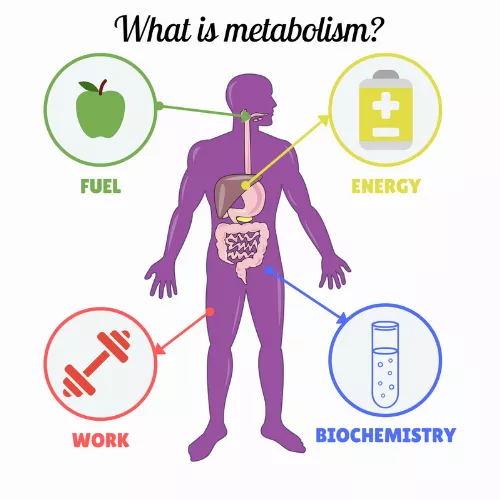
Metabolism is exchange of substances and energy between the organism and the environment. Plants get water, mineral salts, carbon dioxide and oxygen from the soil; animals get proteins, fats, carbohydrates, water, mineral salts and oxygen from the environment. At the same time plants and animals excrete waste products into the environment.
When the substances get inside the organism, they change. E.g. the green plant cells use sunlight to turn water and carbon dioxide into sugars and then – into starch, cellulose, proteins, fats and other substances. These substances produce new cells and organelles or store in the fruits and seeds.
Animals use ready organic substances for metabolism. Complex substances – proteins, fats and carbohydrates – are transformed into simple elements which can be dissolved in water and digested by cells.
Simple substances group together and make complex ones. These processes are followed by release of energy. The organism uses this energy to make the organs work and maintain the body temperature.
Fish have slow metabolism. They are cold-blooded because the heart beats very slowly and the reaction of metabolism is very slow. There is little energy released and the body temperature depends on the temperature of the environment.
Amphibians and reptiles are cold-blooded too because there is little energy released during metabolism. When the temperature of the environment decreases, they become passive and fall asleep.
Birds are warm-blooded animals. Their vascular and respiratory systems work fast and decomposition of complex substances releases a lot of energy. This energy warms the body.
Mammals are warm-blooded animals too.
Metabolism – обмен веществ
Exchange – обмен
The environment – окруж. среда
Carbon dioxide – углек. газ
The soil – почва
Proteins – белки
Fats – жиры
Carbohydrates – углеводы
At the same time – в тоже время
To excrete – выделять
Waste products – отходы
To get inside – попадать внутрь
To turn … into – превращаться
Sugars – сахары
Starch – крахмал
Cellulose – клетчатка
An organelle – органоид
To store – накапливать
Fruits – плоды
A seed – семя
Ready – готовый
Complex – сложный
To transform – превращать
To dissolve – растворять
To digest – усваивать, переваривать
Are followed by – сопровождаются
Release of energy – освобождение энергии
To maintain – поддерживать
Slow – медленный
Cold-blooded – холоднокровный
The heart beats – сердце бьется
To depend on – зависеть от
Amphibians – зменоводные
Reptiles – пресмыкающиеся
To decrease – уменьшаться
To fall asleep – засыпать
Warm-blooded – теплокровный
Vascular system – кровеносная система
Respiratory system – дыхательная система
Decomposition – распад
To release energy – освобождать энергию
To warm the body – согревать тело
A mammal – млекопитающее