The cell. Prokaryote.
Vocabulary
A cell- Клетка
A plasma membrane- Плазматическая мембрана
Cellular-Клеточный
DNA-ДНК
A living creature-Живое существо
Cytoplasm-Цитоплазма
A mammal-Млекопитающее
A theory-Теория
An insect-Насекомое
A nucleus-Ядро
To consist of...-Состоять из
A plasmid-Плазмид
An organism-Организм
A chromosome-Хромосома
To perform-Осуществлять
A ribosome-Рибосома
to be similar in ...-Быть схожим в ..
A nucleoid-Нуклид
A respect-параметр
A biofilm-Скопление клеток
To reproduce-Размножаться
A community-Сообщество
There are many living creatures on our planet. There are many plants, insects, birds and mammals. They are living organisms. Living organisms consist of cells. A cell is the smallest part of the organism. It performs very important functions. Living creatures can have one cell (single-celled organisms) or many cells (multi-celled organisms). The cell is the smallest part of the organism. All cells are similar in 3 respects: they start out life with a plasma membrane, a DNA-containing region and cytoplasm. The study of structure and lifestyle of micro organisms is called microbiology.
The CELL THEORY by Theodor Schwann and Matthias Schleiden (published 1839)
1) Every living organism consists of one or more cells
2) The cell is a unit of all organisms. A cell is the smallest unit of life, individually alive even as part of a multi-celled organism.
3) All living cells come from division of others, pre-existing cells.
4) Cells contain DNA which they pass to their offspring during the division.
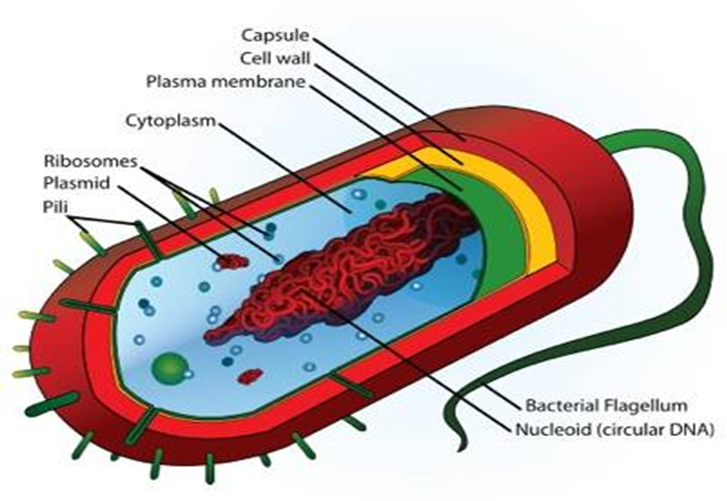
A cell can be with a nucleus (a EUKARYOTIC cell) and without a nucleus (a PROKARYOTIC cell). Prokaryotic and eukaryotic cells can live together. In this case their communities are called BIOFILMS.
The first cells had no nucleus. They were called PROKARYOTES (PRO means BEFORE, KARYON stands for THE NUCLEUS).
Prokaryotic cell Characteristics
1) No nucleus. The chromosome is in the nucleoid.
2) Only one chromosome (a DNA molecule). Many species have plasmids.
3) Ribosomes are in the cytoplasm.
Questions:
What living creatures do you know?
What do living creatures consist of? What is a cell?
Can a living organism have many cells?
What do ALL cells have in common?
What does microbiology study?
Who were the authors of the cell theory?
What are the four theses of the cell theory?
What 2 kinds of cells do you know?
What is a biofilm?
What are the main features of prokaryotic cells?
Finish the sentences.
1. The living creatures consist of ….
2. A cell is ………………..
3. An organism with one cell is called ………
4. An organism with many cells is called …..
5. All cells have a plasma membrane, a DNA-containing region and ….
6. Microbiology studies ………..
7. The authors of the Cell Theory were …..
8. The cell theory was published in ………..
9. All cells come from …………
10. Cells pass their DNA to …..
11. Cells without the nucleus are called ……..
12. Cells with a nucleus are called ……..
13. Biofilms are communities of ……….
14. In the word PROKARYOTE PRO means BEFORE and KARYON ….
15. Prokaryotes have no ……….
16. Prokaryotes have only one ………..
17. Ribosomes are in …………