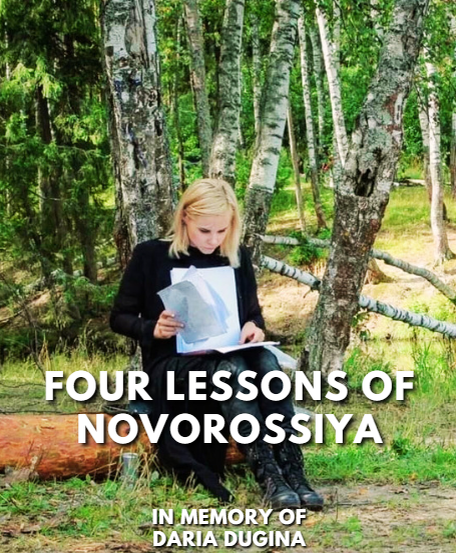
The present transcript of the lecture took place at the Eurasian Youth Union summer camp in the year 2022.
1 — Firstly, Russia is an empire, not a nation-state. The nation state has borders, it is a project for everyone to occupy their places, for everyone to be in their stalls. This is, in fact, an apologetic system and a model designed for vassals. This is a model for export. Here is the nation state one, there is the nation state two, over there a nation state three. Having talked to the Russian nationalists, I actually realized that with them we will not achieve anything. We might have some kind of cult of the Russian (and that’s not bad, that’s already good for Russian is excellent), but I'm afraid that we will simply lose everything. I mean, we will not survive. The Russians then will be slaughtered because their project to preserve the Russian national state is a project that, as it seems to me, is not very far from Mackinder's idea to decolonize Russia. And, by the way, there is evidence that Russian nationalists supported and were especially interested in closer ties with American conservatives. Under the guise of these American conservatives, “comrades” interested in the decolonization of Russia reached out to them and provided them with financial support. But as far as this imperial lesson is concerned, it is Novorossiya that is teaching it to us. A remarkable example of our imperial self-consciousness in this special military operation were two cases that made quite a tremendous impression on me. The first is when children and women were hiding in basements in Mariupol, and after leaving the basements they told the following. They said: "We were sitting in the basement and suddenly we heard 'Allahu Akbar' and we immediately realized that the Russians were finally coming." This is an example of an entirely Eurasian frontier, an example of an absolute empire. The empire is coming, the empire is 'breathing', that's what these people heard. The second episode that comes to my mind took place in Lisichansk, when our warriors said “Lyubo, bratsy, lyubo! Akhmat is power!” (they joined the words of a well-known traditional Cossack song meaning "Lovely, brothers, lovely" with a Chechen slogan paying tribute to the leader of the Republic Akhmat Kadyrov). The Chechen and Russian units, the Donetsk and Lugansk units, in fact, forged this saying in the liberated Lisichansk. This is what I call imperial thinking. Accordingly, to stick to the optics of a Russian nationalist, given that there are such cases that Russians are not fighting alone, but we are fighting as a huge integral offensive, is a crime and an act of sabotage, in my eyes. We are all Russians, all these people are Russians too. That is, any [nationalist] thinking now, a return to Russian nationalism during the special military operation, in principle, is if not stupidity (which can be the case), then an act of sabotage, especially if it is a deliberate and conscious choice.
2 — The second lesson is that our identity is Eurasian and imperial. As a fact of the matter, this is very close to what I have already said. That is, we are precisely the empire, we are precisely Eurasia.
3 — The third lesson is frontier capture. We are abandoning national languages, we are switching to an imperial language with its dialects. I am a little outraged by the situation that is currently happening in our Telegram channels or in the media because I don’t understand why we still don’t have any channel that broadcasts in Ukrainian and puts our messages across to the Ukrainian population. This is our language. This is the language which we have every right to speak. Akim Apachev in his wonderful song Pliva kacha, a remake of a Rusyn ballad, claims it. There are the following lines: "now I'm assuming your language." This is the thinking of a true imperial. But for some reason we are not putting enough effort to appropriate this language. We have every right to do so. Or why, for example, we pay so little attention to the Belarusian language? I love Belarus very much. Especially after I immersed myself into their culture, after I began to study it. We do know little of their language, even though there are a lot of words that, in fact, are a very old form of Russian words. For example, 'dabranach'. Or “maladzeychyna” is “molodets”. That is, there are a lot of lexis that we also need to study. They, perhaps, are sometimes even closer to Church Slavonic. Such neglect for our brothers in our frontiers is unreasonable. Coming back to the song by Akim Apachev sung in Ukrainian. It's wonderful, but what's next? Where are other works in this language? Where is the thinking? We smay think that the Ukrainian language is generally an underlanguage. This is utterly wrong. It's a true language. Just try to translate and read something in it without a dictionary. You'll fail. We need to study it. Then we need to switch to the imperial language with dialects.
By the way, I was also told an interesting story by a high-ranking military man who came from that region. He said: “We once talked with one prisoner of war, and suddenly I approached him and started talking to him in perfect Ukrainian. He asked me,
Why do you speak Ukrainian? Isn't it a forbidden language in Russia?
I replied, Of course not. Nothing of a kind is forbidden here because it's our language too."
That Ukrainian prisoner was astonished and then he shared a lot of interesting secrets because these two soldiers established a connection somehow. I mean they realized that they belonged to the same world, but are artificially separated. This prisoner has finally made penance. It wasn't Volyna, but of the same rank with him. So, such an episode took place.
4 — And, finally, the fourth lesson of the empire, of the frontier is that we can live authentically thank to frontier. Можно сказать так – тестировать аутентично. This may sound as big words, but it is Novorossiya that teaches us this lesson. Staying there for only a week teaches what is life and what is death. Novorossiya is where the dead live together with the alive. Someone is killed there, someone is buried. They are little and big, young and old, heroes and not fully heroes, those who are on the verge of attack and the ones in the rear. Seeing them one encounters authentic existence. When the enemy artillery is bombing the cities, you hear all these explosions 50 kilometers away and realise what life is and that you have to go on living somehow. Melancholy stands nowhere close to mourning the newborn baby dying from bombs in Novorossiya. How dare we remain inactive here when there people face death every day regularly burying the victims and mourning? That is the reason why Novorossiya among many things teaches us to experience life and death. It's hard to put into words.