What a wonderful world surrounds us today! Huge ships are sailing the seas, spaceships are diving into the blue-black abyss of space, airplanes are carring their passengers thousands of kilometers to sea and mountains. The Internet allows people throughout the world to keep in touch and find any information in the blink of an eye... The whole world is seemed to be connected by a single network, united.
Does this process of globalization have an impact on such systems as languages?

Languages and the age of globalization
Nowadays globalization generates two diametrically opposed trends, It does promote linguistic diversity and at the same time it leads to linguistic unification. Indeed, with the development of technology and the Internet, when the information field is unified, languages are not only a communication tool, but they also tend to carry an important mission - they are the means of spreading cultural values.
Russian writer Ivan Kuprin once said,
Any language is a mirror of human culture. Language is the history of people.
And this cannot but be true! Thus, the Russian language cannot be imagined without such concepts as "soul" and "conscience", which reflect the peculiarities of our culture, the value system of a Russian-speaking person, and his beliefs. At the same time, the Eskimo language has many words for different types of snow and ice, reflecting the importance of these elements in the life of the people and their cultural code.
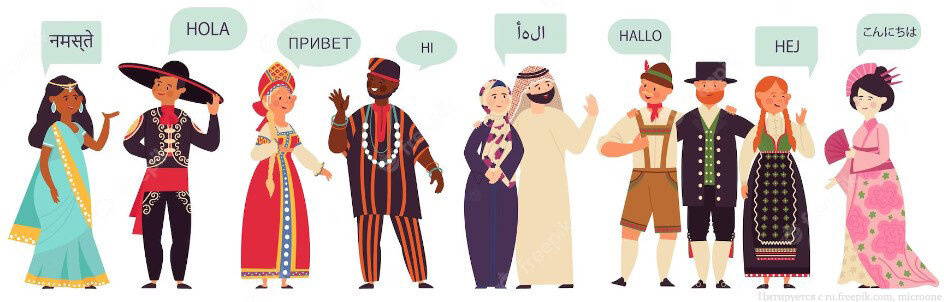
As for the most popular language, English acts as lingua franca nowadays, uniting people from all corners of the globe and allowing them to communicate and be heard. According to statistics, by 2025 there are 1.35 billion people in the world speak English!
English is convenient and relatively easy to learn, and perhaps for this reason, the lexical units of this particular language are so easily and quickly integrated into other languages. For example, in modern Russian.
The "Russian with a bit of English" language
So, the world is constantly changing. Language, as a system, is also in constant development. This tendency to "update" the language can best be traced by referring to the spoken language of teenagers.
The specific defining feature of spoken language is that it is used in conditions of unprepared, spontaneous communication, and the ambivalent social position of young people - no longer children, but also not adults - forces them to develop their own speech, their specific language of youth, of which slang is an integral part.
In Russia, youth is a socio-demographic group of people aged 14 to 35 years inclusive.
Today, most of the slang is words that come primarily from English. For example, it is impossible not to agree that quite often we express agreement with the phrase "ok", which is the American colloquial abbreviation of the phrase all correct ("everything is correct").
And there are more and more such examples! And they appear with an enviable frequency.
The slang of one school community
"Kosar" for a 1,000-ruble bill, "nishtyak" for approving a thing or a situation, "lowe" for money. Parents of teenagers know these slang units, but teenagers themselves do not use them and may have never ever heard of them, because they were used 10-13 years ago. Slang has an important distinguishing feature which is its relevance.
What words are relevant and really used by teenagers in everyday communication today?
To answer this question, a survey was conducted among students in grades 7-10 of the School where the author of the work studies.
In addition to the survey, the author conducted an interview with her younger brother, a 5th grade student.
The results were interesting and even funny. In the language of teenagers, despite their age differences, there are words that are used by everyone without exception more often than other units and in similar circumstances.
So, what if we create a brochure that could provide information about the origin of slang words in Russian and explain them?
The author is sure that it will be at least interesting!
"This is the base" or brochure
What goals were set by the author while creating the brochure?
- First of all, the brochure should be designed in the style of "zoomers", modern teenagers, in order to reflect a certain "cultural code" of this generation. Of course, the reading of this "code" can be different!
- Secondly, the brochure should not be voluminous. Being teenagers, we do not like reading long texts, and the brochure that reflects our behavior and characteristics cannot ignore this peculiarity.
- Finally, the brochure should present the information clearly to any reader, be it a teenager, a teacher, or a parent.
- We also note the importance of observing the norms of the Russian language!
The online platform VISME was chosen to create the brochure. It is said to be quite easy to use and offers a wide range of tools for creative projects.
The result of the creative impulse of the author, the product of his inspiration and daring idea is in front of you!
The brochure has been printed out and is offered for reading to teachers, parents, and students of the School.
Now we are looking forward to receiving feedback and answering the question of whether you, readers, have been able to better understand modern youth!