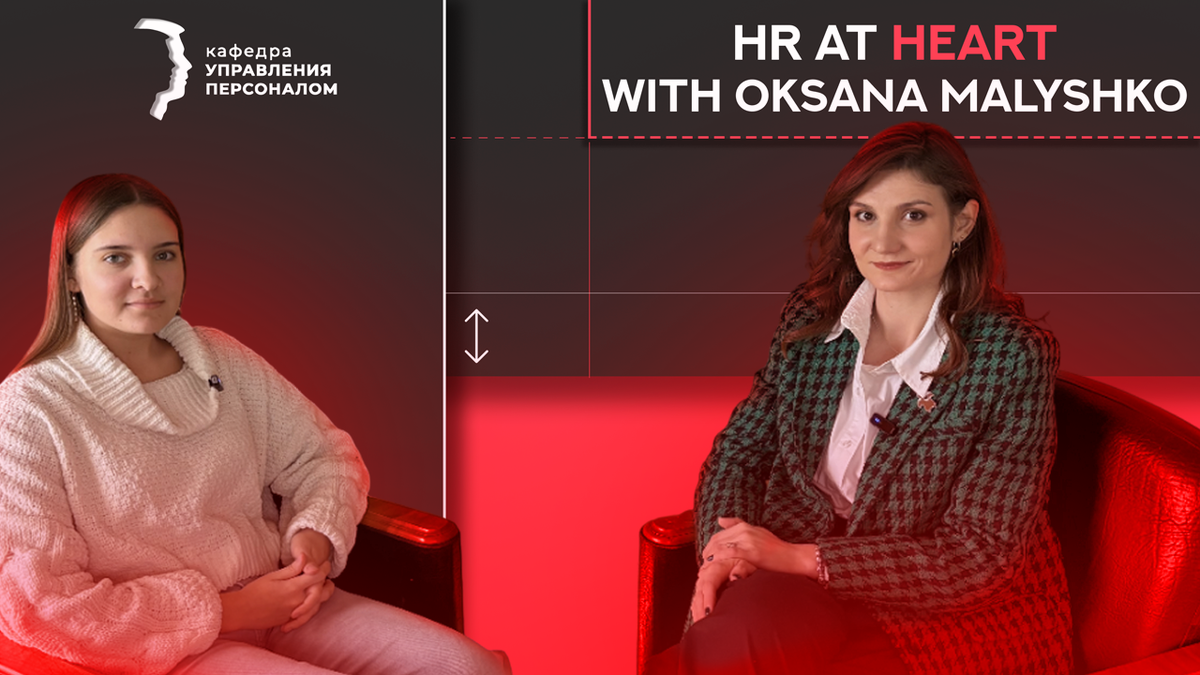
Host Polina: Hello, dear viewers and listeners of our podcast "HR at Heart." My name is Polina, and we continue our series of podcasts. Today, we have with us career consultant, personnel assessment expert, and candidate of economic sciences, Oksana Vladimirovna Malyshko. Hello, Oksana.
Oksana Malyshko: Hello, Polina!
Host Polina: Thank you for visiting us. Please tell us a bit about yourself and your experience in the HR field.
Oksana Malyshko: Thank you very much for the invitation. I have been in HR for over 17 years. I recently calculated how many years I’ve worked, where, and what I’ve done—I reviewed my life experience. I am a certified specialist in human resource management, and I have a diploma with honors stating “qualification: manager of human resource management.” I have been in HR since 2010 and have worked in various sectors, trying almost everything except C&B (Compensation & Benefits), but I think there’s still time to try that. I’ve touched on the compensation system a little, but unfortunately or fortunately, I haven’t delved deeply into it yet. I started my journey with classic personnel record management: hiring, firing, vacations, business trips, employment records—everything we love, everything dear to our hearts. Then I moved on to recruitment. I worked in the public sector and in staffing agencies. I have a record in my work book showing that I was a civil servant. This is one of the features and bonuses of public service. I then transitioned into training, assessment, and development, working in areas such as the food industry, the agro-industrial complex, the energy sector, and insurance. For the past few years, I have been actively collaborating with Fintech, mainly focusing on personnel assessment.
Host Polina: You have quite a rich and broad career experience. Please tell us about your connection with the State University of Management.
Oksana Malyshko: When you said I have a broad experience, I suddenly felt so old; it’s interesting. It seems like it all flew by so quickly, and now it's already been 17 years in HR. When I graduated from university, I thought that people who had worked in HR for more than 10 years were something incredible. Now I think “Well, everyone around me is like that”. Speaking of SUM, I taught there for 8 years while simultaneously pursuing a career. There was a period when I was building an academic career, studying in graduate school, and working at several universities, a parallel career. In the morning, I was a training and development manager, and in the evenings, I lectured students. Now I collaborate with our wonderful university as a member of the State Examination Commission of our excellent department.
Host Polina: Wonderful. Since you are an expert in personnel assessment, I would like to ask you questions about assessment tools. Please tell us in more detail about the existing assessment tools and which tools are best used for different cases.
Oksana Malyshko: There aren't many assessment tools, although I recently read an article where experts identified about 30 of them. Speaking of key types, there are tools related to the so-called observable behavior.
The most well-known of these tools is, of course, the classic Assessment Center, where we give our participant certain types of exercises, they perform them, and a group of experts observing how the participant goes through these tasks.
There is also one such subtype – secret observation, which we do not use in HR, but it is actively used by the business. Especially in retail, a mystery shopper is often used, where we have people who make purchases, check off a checklist, and thus evaluate the quality of work of the company, branch, or a specific employee.
We have assessment methods related to self-esteem. These are various questionnaires and tests where we ask a person to answer different questions. For example: "Are you smart or beautiful today? What do you like - parties or sitting with a book?".
There are also assessment methods related to a conversation between two people. These are different types of interviews. For example, there is a biographical interview. The most commonly used assessment tool, when it comes to interviews, is a competency-based interview, or a more complex level of interview.
And also, as one of the assessment tools, there is the 360 method. When we describe how a person manifests at work. 360 is a complete cycle where we ask about how a person manifests at work from the person themselves, their supervisor, their colleague, and their subordinates. This way, we describe a circle. There are different variations – 180, when only half of this circle is evaluated, or 90, when the person evaluates themselves, or maybe someone from the managers evaluates them.
These are the key four areas, and there is a fifth one – various tests, ability tests, where there are conditionally correct answers. If we talk about questionnaires, there are no correct answers there. We assess ourselves. But tests usually have some correct answers, some solutions – these are cases, and there is a limited amount of time within which a person must respond to this case. Or ability tests, various interviews. Most often, this tool is used for professional assessment, because if we are evaluating a hypothetical locksmith, we understand how he should perform his job.
These are the key five areas that are most commonly used in assessments. And for what purpose? Each tool has its limitations, with its own pros and cons. For example, the assessment center is one of the most expensive tools because it takes an average of 4-6 hours, well, from 2 to 6 hours, which involves active participation from both the participant and the observer. Then, there’s a stage where the participant is not involved; only the observer works on filling out the evaluation form, gathering information, plus the feedback process. And on average, this takes about 20 hours. Of course, if we compare the assessment center, which has a total labor intensity of about 20 hours—why "some" labor intensity? Because in each project and each company, this number can vary; I’m speaking about the average. We can compare this to a questionnaire that may take 15 minutes or an ability test that may take an hour. The difference in time is significant. It’s clear that if we talk about the assessment center, the reason this method is so expensive and labor-intensive is that it provides the most accurate measurements. Based on the results of the assessment center, we can say that a person can do this; we have seen it. In these situations, they may behave in such a way. If we talk about questionnaires, this is a predictive method. We can say that the person evaluates themselves this way, and considering that any questionnaire is now processed using artificial intelligence and compared with a large sample of other questionnaires, we can predict that if we compare this participant's response with a group of other participants, we can generally forecast that they will be successful in this activity. But again, this is just a prediction.
Host Polina: So, the assessment helps us understand the competencies of an employee, identify their strengths, and see how developed their skills are. Should we connect assessment with employee training? And if we should, then why?
Oksana Malyshko: What do you think, Polina? I'm just curious about your opinion.
Host Polina: I think that assessment helps us see the weak spots in an employee, and the training department can create an individual program for each employee based on this assessment.
Oksana Malyshko: You are absolutely right; it’s wonderful that our students are so deeply immersed in the topic of assessment, even just in their second year. You are absolutely right, assessment as a tool in itself seems great to me, but without linking it to training, to development, without including it in the overall talent cycle, meaning the talent management cycle within the company, it is less effective. Assessing just to say that: “This person has a strong side and a growth in this area” is indeed cool; many do that, however, if there’s a seamless connection to development… For example, based on assessment results, we can forecast career tracks, offer them to the employee, and collaboratively work with a talent partner, an internal career consultant, or an HR business partner to create the most comfortable development path for the employee.
In particular, this is why, within the framework of assessment enterprises, a block related to motivational research, a motivational questionnaire, is included, where we clarify what this person wants in life. So, on one hand, through assessment, we can help a person build their career path within the company. On the other hand, you are absolutely right; we can create unconditional training programs. We can teach what can either enhance their strengths—because lately, in training, development, and assessment (which we call T&D[ИЕС3] ), there’s a trend toward enhancement. Just like athletes, why focus on strengthening weaknesses when you can enhance strengths? That’s one trend. The second trend, as you mentioned, is harmonization, where we identify growth areas and compensate for them either through additional methods, especially if we understand it will be very challenging to develop those skills. This particularly concerns deep-seated values that a person has formed over their lifetime, as values change very slowly. Skills can be learned quite quickly, and in this case, we will be able to create training programs that allow a person to develop as optimally as possible, either by strengthening their strengths or by working on areas for growth. Ideally, this should provide the employee with a seamless user experience (UE). It happens smoothly—here’s the assessment, here’s the immediate development, and automatically, at every stage of development, they have harmonious training in the needed format. Everything should be beautifully aligned, propelling both the employee and the company into a bright future, in my opinion.
Host Polina: As someone who has seen many ways of assessing, training, and developing personnel, have you identified any trends or tendencies for yourself personally?
Oksana Malyshko: I can’t say that I’ve seen everything in my life. Every time I communicate with colleagues at conferences or in personal interactions, I learn something new and discover new insights. I feel like I’ve been learning 24/7. When I went to university, I chose my profession to study the least, I end up studying, I think I've been studying for more than 20 years every day and I keep wondering when it will end. If we talk about trends within the framework of the assessment, experts emphasize several of them. The first is, of course, the high role of automation AI, that is, artificial intelligence. From my observations, there’s a significant trend toward involving businesses in the assessment process. When I started my career, evaluation seemed to be something very similar from school, university. It's like you're taking out a red pen. And people were afraid. They thought you were doing an evaluation and then firing them. Because we have a tool that known as certification, and it is a state-defined personnel evaluation procedure that is quite clearly outlined,. One of the possible outcomes of certification can be dismissal. It is allowed, but it happens very rarely. And many employees and managers felt fear when they heard the word “assessment.” Boom! Like a button: “This is a certification, that’s it, we’ll all be fired!”
It took the market over twenty years to convince people that no, assessment is not about dismissal; it’s about development. Now I observe, and I read from many experts who write about assessment, a very high level of involvement of managers, involvement of employees themselves. And there are more requests from businesses. And managers themselves go to study to become observers, they themselves undergo training as assessors in order to delve deeper into the tool. But if we talk about trends, it’s automation, business involvement. And this, of course, is what experts are talking about, an increase in the level of gamification in assessment. There’s a growing desire to play games in the assessment process, where we assess while playing board games, with five assessors walking around evaluating you.
If you also happen to go through T-abilities or a motivational questionnaire in the format of quizzes, that would be fantastic. There’s a trend towards speeding up the process, along with gamification, and what I see for myself is an increasing interest in professional assessment. If earlier we were more focused on assessing soft skills, i.e. on our flexible skills, mainly on management skills, because assessment, as well as training, is a labor-intensive, rather resource-intensive activity, then usually there was more focus on managers, on key specialists, or in cases of mass assessment, then on lighter tools where a large number of people could be assessed quickly and relatively cheaply.
It became clear that soft skills were chosen because they are easier to assess and easier to train. However, I see a growing focus on professional knowledge and skills, which are harder to evaluate. Why? Because in this case, it is necessary to describe everything a person does, and a large database of cases and tests needs to be created. We all know that people share everything with each other, and we need to build a system to prevent cheating and ensure no one copies. Yet, there’s a significant trend towards assessing both soft and hard skills, professional skills, using artificial intelligence and automation, and ensuring that business remains an important player in assessment and training.
Host Polina: Wonderful. They say that great successes don’t come without high obstacles. Please tell us about one of the most challenging cases in your career, how you resolved it, and what conclusions you drew from it.
Oksana Malyshko: When I think of a challenging case, I remember a time, around 2015, 2016, or 2017 when I was just diving into the field of assessment, training, and development. There were so many interesting and wild experiences regarding my mistakes as a project and product manager. However, if we talk about assessment, the most challenging part was giving feedback—especially to a manager. It was difficult when the person sitting across from you was often two or three times older and more experienced, and back then, people were very critical of assessment. Many believed they would definitely be fired or questioned “What news could you possibly tell me, especially when you were this young and charming. And in general, it's all nonsense, it's all Tarot cards.”. It was extremely challenging to convince them otherwise. I spent a lot of time trying to prove that assessment was great, that there is a substantial scientific basis for the tools and methods used.
Of course, it was also very difficult to respond to managers' objections during feedback sessions. After each session, I would engage in significant internal work, consulting with my superiors, mentors, and coaches. I came to the conclusion that I needed to continue learning and developing. It's not for nothing that I've been studying for almost 20 years. Therefore, coaching definitely helps. Coaching tools. A wonderful tool, Clean Language, helps maintain such a stable state regardless of how the assessment participant behaves. Moreover, the skill of reflection and sharing experiences with colleagues is crucial. Because experience is wonderful, but when you have someone who call you and say, "I did this and that, and my supervisor will say that it's all nonsense, all this tarot, who I am, and I am only 20 years old.". And I be like: “What should I do?” My colleague told me: "Oksana, it's all right, just breathe and ask what’s happening to you, why it matters how old you are.” This is an experience, conducting such a deep self-analysis: what went well during the feedback, which processes were related to the manager, what characteristics and methods were involved, and where did I make mistakes.
Host Polina: So, what do you enjoy most about your work in human resources?
Oksana Malyshko: I love watching people grow and develop, especially thanks to the products and projects we create. Unfortunately, there isn’t a direct link in HR to business yet. It’s clear that there is a connection because it depends on how well we select personnel, train them, help them develop, and build a compensation and motivation system. All of this significantly influences the company’s success, and the business is aware of it. However, there’s always a desire for metrics. For example, is the increase in sales related to our hiring? On one hand, it is; on the other hand, it could be due to market conditions, a good product, effective marketing, or strong sales performance. There is no clear answer here - is the connection between HR and business direct or indirect? But when we create an environment that allows people to grow and develop, it’s incredibly inspiring. And, of course, I absolutely love helping people discover new strengths, new areas of growth, look at themselves differently, rethink their experience and create something new. It's truly inspiring when we build a team, when we didn’t just hiring a sales manager, training him how to sell, leading his evaluation, showing him what is his strengths, growth areas, building a career path for him from junior sales manager to sales director, but we also create a team, bring different people who have different goals, different objectives into a team, and they all work for the good of the business.
Host Polina: You’ve truly inspired me. I’m very glad right now that I chose to study human resource management. We know you are a member of the state examination commission. Could you share your impressions of the students' thesis works? Was there a particular work that stood out to you?
Oksana Malyshko: Every year is a showcase of stars. It’s fascinating to see how students reinterpret their experiences in human resource management. Many of our students are working and rethinking their experiences through the lens of HR. And every year we have some truly fantastic works, especially great works come out after the HR forum, where students present their projects, receive feedback from experts, and refine them for their theses. Listening to these projects is incredible, especially when some have already been implemented in companies or are planned for implementation—it’s super inspiring.
Host Polina: If you could meet a literary character from a movie, book, or series, who would it be and why?
Oksana Malyshko: The thing is, I don't have specific questions for the characters in books, movies, and series. I love cinema, I adore series, I keep up with new releases, I rewatch classics and I love literature. And here, I would probably like to meet Sherlock Holmes. My favorite portrayal is by Benedict Cumberbatch in the series "Sherlock." I absolutely adore it. I also love our wonderful series with Vasily Livanov Sherlock; it’s magnificent, truly amazing. I would want to observe how they work, how they make decisions, and how they solve complex problems. As an assessor, I’m interested in watching how others do their jobs well, and it’s fascinating to see the method unfold in real-time. It would be great to meet the real Sherlock from Arthur Conan Doyle’s works and compare how the author envisioned him with these three portrayals. Conducting a comparative analysis among them would be intriguing.
Host Polina: And I would like to ask you to give some advice to the human resources management students at the State University of Management.
Oksana Malyshko: I would like to wish our students to be honest with themselves, to love our profession, and to approach it with the appropriate level of responsibility. The thing is, HR is an interesting field with a relatively low barrier to entry. To become an HR professional, a higher education diploma is a super bonus, but unfortunately, it’s not a mandatory requirement. I have encountered many colleagues in HR who graduated from law, economics, or psychology. I even had a very good friend who was a geologist and a geographer. We have many philologists among us, representing a wide array of graduates from various universities. Of course, graduates from the State University of Management stand out in terms of professionalism and expertise. I would like our students and graduates to maintain this high standard as they enter the market, armed with deep foundational theoretical knowledge, an understanding of the essence of human resource management, and a desire to improve upon what has been done, rethinking it without discarding over a century of HR experience. I truly hope that our graduates will be super experts and superstars in the market. It would be a great pride to say, “These are our guys, they are from the State University of Management, and this HR director studied here and is now driving the best and coolest projects.” I encourage our students to learn, learn, and learn again, to participate in various student events, and definitely to take part in the HR forum. We highly recommend volunteering at the HR forum or participating as speakers. And of course, we invite our graduates to speak as experts because it’s such a great vibe when a bunch of young, talented, energectic people of different ages, all young at heart, come together and just rock the university in May.
Host Polina: Thank you for your advice and wishes for our students. Lastly, we have a quick-fire round. I will ask you questions, and you give brief, quick answers. Are you ready?
Oksana Malyshko: No. I have no choice.
Host Polina: So, what superpower would you like to have?
Oksana Malyshko: Invisibility.
Host Polina: Soft skills or professional skills?
Oksana Malyshko: Soft skills.
Host Polina: Cats or dogs?
Oksana Malyshko: Dogs.
Host Polina: Office work or remote work?
Oksana Malyshko: Both.
Host Polina: What do you want to study?
Oksana Malyshko: Coaching, psychology, clinical psychology, and a bit of physics and chemistry—I would add those.
Host Polina: What would you like to accomplish in 2025?
Oksana Malyshko: Finally write the scientific articles I promised to Anastasia Sergeevna two years ago. I need to finish them. I also has one more obligation. Remember Varvara? And I want to complete all my scientific works, conduct the research I've been planning for a long time. Well, and probably, if you remember the previous question, I would also delve a bit more into medicine. I'm interested in that too.
Host Polina: Thank you very much for visiting us, coming to our interview, and sharing your experience.
Oksana Malyshko: Thank you very much for the invitation, it was very pleasant.
Host Polina: Thank you for watching and listening to our podcast "HR at Heart."