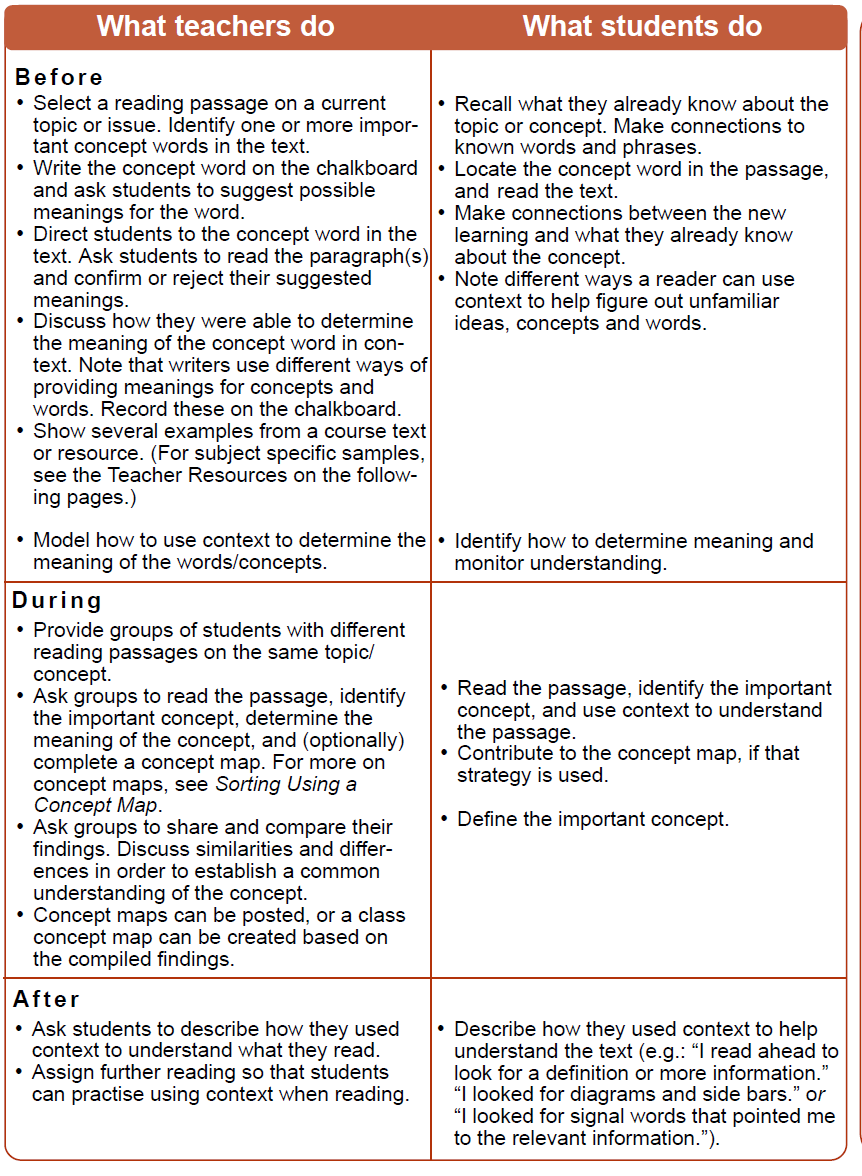
Writers use a variety of ways to convey the meaning of unfamiliar words and concepts. These include definitions, examples, descriptions, illustrations, clarifications, parenthetical notes, comparisons, elaborations, and typographical cues.
Purpose
• Help students to infer the meaning of unfamiliar words and concepts, using clues from the text.
Payoff
Students will:
• be able to read subject area texts more independently.
• discuss important concepts related to the subject.
• understand how to find context clues and make good use of them.
• monitor their understanding while reading different texts.
Tips and Resources
• Context refers to the text surrounding a word or passage, or the conditions that surround something.
• Effective readers use their knowledge about words and text structures, and their prior knowledge about a subject, to help figure out unfamiliar words and concepts in new contexts.
• For tips, see Student Resource, Clues for Using Context to Find Meaning.
• For subject-specific examples, see the following:
- Teacher Resource: Using Context to Find Meaning – Science & Technology Examples.
- Teacher Resource: Using Context to Find Meaning – Electricity Example.
- Teacher Resource: Using Context to Find Meaning – Geography Examples.
Cross-Curricular Literacy: Strategies for Improving Secondary Students’ Reading and Writing Skills,
pp. 40-41.
Cross-Curricular Literacy: Strategies for Improving Middle Level Students’ Reading and Writing Skills,
pp. 38-39.
When Kids Can’t Read, What Teachers Can Do, Chapter 9.
Words, Words, Words, pp. 16-31, 51, 55, 130-131, 136, 139.
Further Support
• At the beginning of a unit, pre-teach important concepts and unfamiliar vocabulary. For example, for a history lesson on the Great Depression, describe terms such as the economy, stock market crash, migrant, and dust bowl.
• Use graphic organizers (such as concept attainment charts, concept ladders, or concept flow charts) to help students see connections and use relevant vocabulary.
• Take five minutes at the beginning of a reading task to examine a particular paragraph or section that has an unfamiliar word or concept. Model for students how to use the context of the sentences and paragraphs to determine the meaning of the word or concept.
• Have students create and maintain a subject-specific dictionary of words, phrases and concepts with their definitions, synonyms, related words and examples.
Engaging in Reading: Using Context to Find Meaning
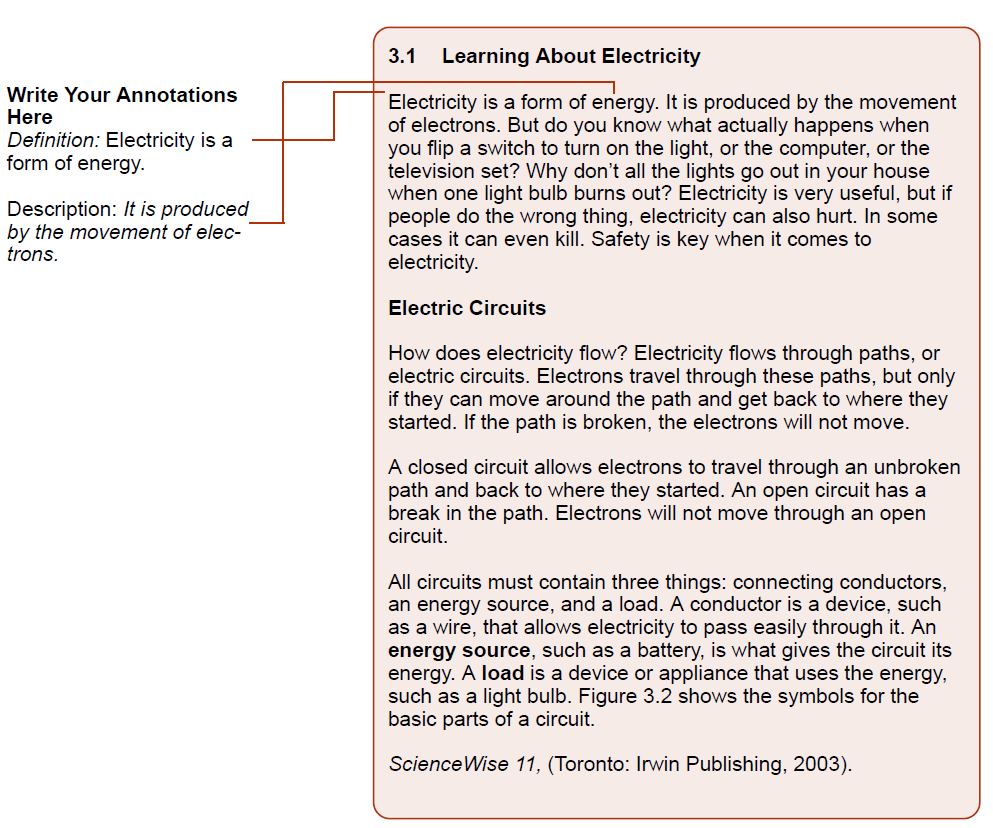
Using Context to Find Meaning - Electricity Example
In “Learning about Electricity,” the writer uses different ways to help the reader understand electricity and electric circuits. Context clues include definition, example, description, illustration, clarification, parenthetical, comparison, or elaboration.
Read the excerpt and see how many different context clues the writer provides for the different concepts and terms related to electricity and electric circuits. Write your annotations on the left-hand side of the excerpt. After reading, try to make a quick sketch of an electrical circuit.
Using Context to Find Meaning – Geography Examples
A typical textbook page may contain ten or more terms that students have difficulty understanding. Some textbooks put these terms in bold print.
Using Context to Find Meaning – Science & Technology Examples
Reading is a process of finding meaning in text. Writers use many ways to convey the
meaning of words and concepts. Some are overt and some are subtle. These clues
include definitions, examples, descriptions, illustrations, clarification, parenthetical
notes, comparison, and elaboration. Here are some samples from Science &
Technology texts: