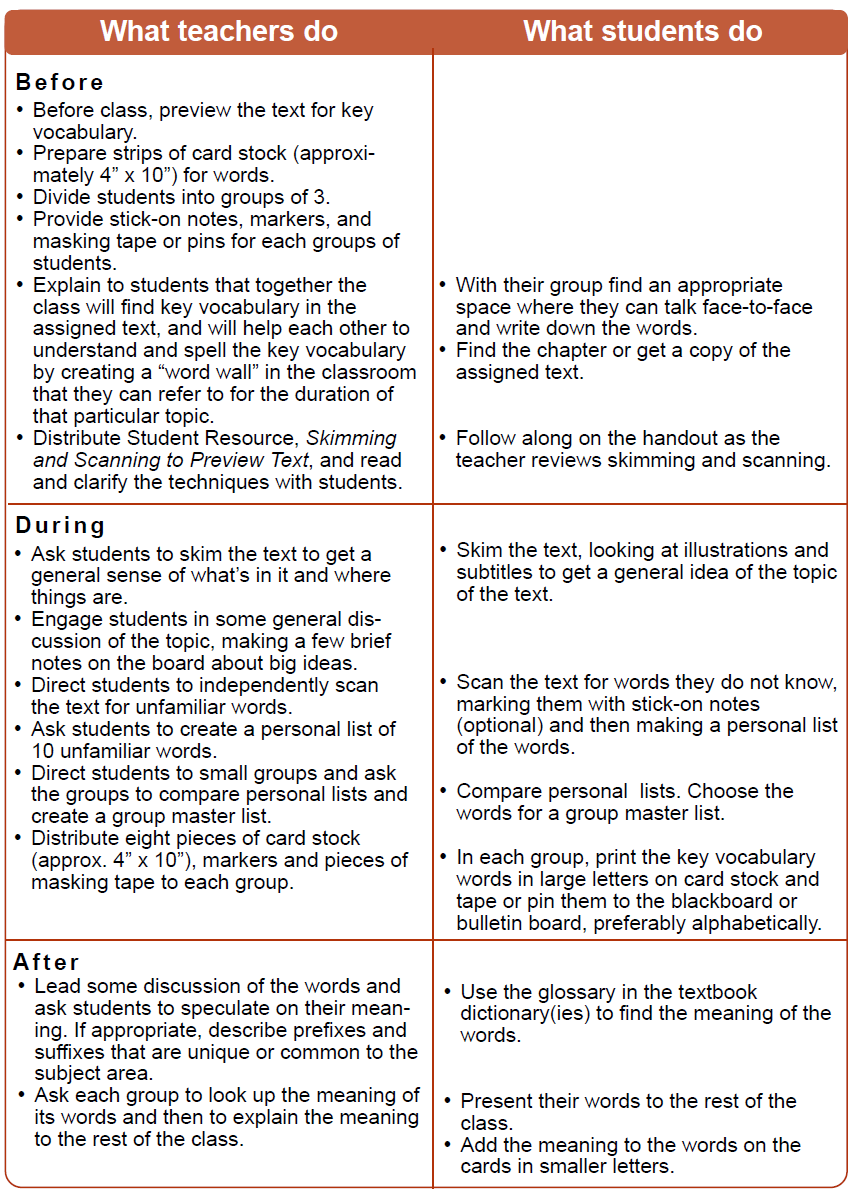
Students are required to learn, on average, over 2 000 words each year in various subject areas. Those who have trouble learning new words will struggle with the increasingly complex texts that they encounter in the middle and senior school years. A word wall is a wall, chalkboard or bulletin board listing key words that will appear often in a new unit of study, printed on card stock and taped or pinned to the wall/board. The word wall is usually organized alphabetically.
Purpose
• Identify unfamiliar vocabulary and create a visible reference in the classroom for words that will appear often in a topic or unit of study.
Payoff
Students will:
• practise skimming and scanning an assigned reading before dealing with the content in an intensive way. Students will then have some familiarity with the location of information and with various elements of the text.
• develop some sense of the meaning of key words before actually reading the words in context.
• improve comprehension and spelling because key words remain posted in the classroom.
Tips and Resources
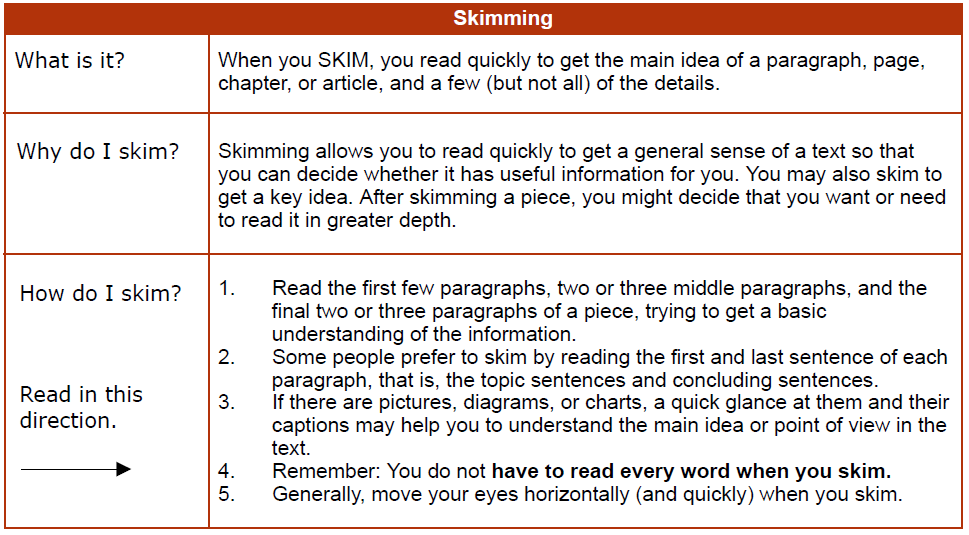
• Skimming means to read quickly – horizontally – through the text to get a general understanding of the content and its usefulness.
• Scanning means to read quickly – vertically or diagonally – to find single words, facts, dates, names, or details.
• For directions, see Student Resource, Skimming and Scanning to Preview Text.
• Before building the word wall, consider using Analysing the Features of Text to help students become familiar with the text.
• Consider posting certain words for longer periods (for example: words that occur frequently in the unit, words that are difficult to spell, and words that students should learn to recognize on sight).
• Have students refer to the word wall to support their understanding and spelling of the words.
• For a sample word wall, see Teacher Resource, Word Wall Sample for Grade 9 Science.
Words, Words, Words pp. 70-71.
When Kids Can’t Read, What Teachers Can Do, Chapter 10.
Reaching Higher – Making Connections Across the Curriculum, p. 7-8.
Further Support
• Add a picture to the word cards (preferably a photograph from a magazine) as a support for ESL students and struggling readers.
• Provide each student with a recording sheet so that they can make their own record of the key words for further review.
• If it appears that students will need additional support, review the terminology on the word wall in the two classes following this activity, using Take Five or Think/Pair/ Share, which are described in the Oral Communication section.
Getting Ready to Read: Extending Vocabulary (Creating a Word Wall)
Skimming and Scanning to Preview Text