As we are ending this course, please reflect on the course’s information:
Is there one type of assessment that has been most useful for your practice in the classroom if you are not practicing as yet, which will be useful as you start your teaching career.
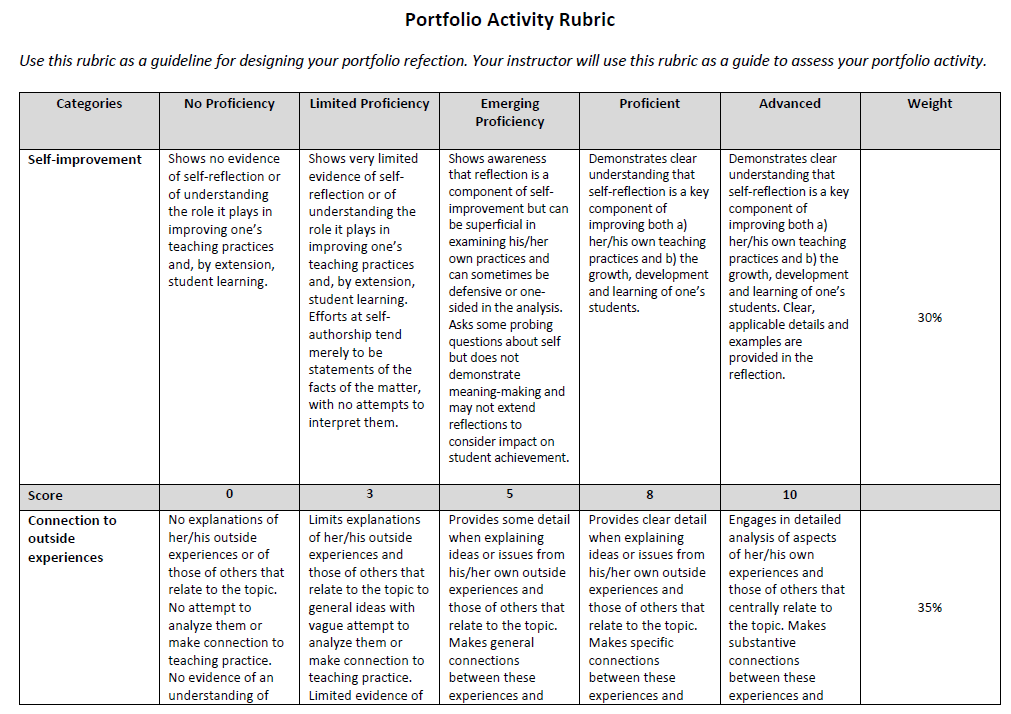
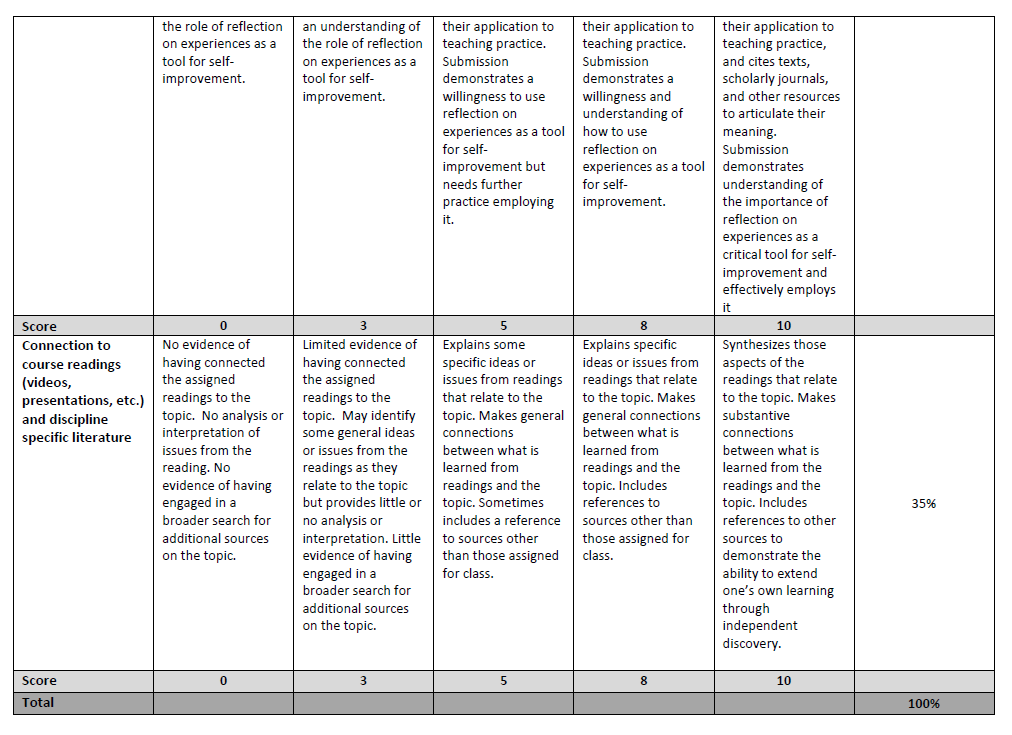
This activity will be assessed by your instructor using this rubric.
Assessment and Evaluation
Education Department, University of the People
EDUC 5440
Portfolio Activity Unit 8
Dr. Sherry Birdwell
August 08, 2023
Assessment is the systematic basis for making inferences about the learning and
development of students. It is the process of defining, selecting, designing, collecting, analyzing, interpreting, and using information to increase students’ learning and development. (Erwin, 1991) At this point in the course, I want to do a brief digest of the highlights of each week of the course.
Week 1
During this period we analyzed and learned the difference between Assessment and
Evaluation as between formal and summative assessment. The objectives of this week were 1 Examine the relationship between assessment and learning in a classroom environment, 2 Evaluate instructional attitudes and effective assessment within a school environment. I was first introduced to the concepts of assessment FOR learning, AS learning, or OF learning (Earl & Katz, 2006). It was difficult for me at first to comprehend the difference between the two, but it was a good start and a great challenge to my thought process.
Week Two
In week two, we have already looked at (Ronan, 2015):
Types of classroom assessments
- Diagnostic assessment
- Formative assessment
- Summative assessment
Types of classroom assessments:
Diagnostic: Given at the beginning of the school year, or the beginning of a new unit of study, a diagnostic test attempts to quantify what students already know about a topic.
Formative: Given throughout the learning process, formative assessments seek to determine how students are progressing through a certain learning goal.
Summative: Given at the end of the year or unit, summative assessments assess a student’s mastery of a topic after instruction.
Norm-referenced tests: These tests measure students against a national “norm” or average in order to rank students against each other. The SAT, ACT, Iowa Basic Skills Test, and other major state standardized tests are norm-referenced.
Criterion-referenced tests: These tests measure student performance against a standard or specific goal. Unit and chapter tests as usually criterion-referenced, as are the newly developed SBAC and PARCC Common Core tests.
Authentic assessment: Authentic assessment is the measurement of "intellectual accomplishments that are worthwhile, significant, and meaningful," as contrasted to multiple-choice standardized tests. Authentic assessment can be devised by the teacher, or in collaboration with the student by engaging student voice.
Question Type:
Multiple choice: These questions provide students with a stem and a set of discrete possible answers from which students must choose the correct one. The possible answers generally include one correct answer and three to four distractors, designed to mimic the common misconceptions students have about the concept being tested.
Constructed response: These questions require a written response. Usually, they include a one-part question, and students respond by writing a paragraph or short essay, or building and solving an equation.
Extended constructed response: These questions, like the constructed response, require a written answer. The reason they are “extended” is that they are multi-part questions, requiring students to answer the first part of the question before answering subsequent parts, which may require reflection on or further explanation of an answer given in a previous section.
Technology-enhanced: These items are given in computer-delivered assessments.
Technology-enhanced items require students to interact with the material in various ways —through actions like dragging and dropping information, highlighting relevant text, and completing sentences or equations from items in a drop-down menu.
Performance task: These items require students to use multiple stimuli to solve a problem or create something new. Performance tasks are usually scored with a rubric, which includes the criteria students must keep in mind while developing their solution.
Performance tasks in ELA may include reading multiple essays and synthesizing the ideas into their own writing. In math, these tasks may ask students to analyze charts and graphs and write out a plan for using the data in a real-world application.
Informal: This category covers a wide range of tasks, from checklists to observations. An informal assessment doesn’t lead to a score, but it does help teachers gather important insights about students.
Delivery type:
Pencil and paper: There’s no need for a lengthy description of this delivery method.
Examples include tests, quizzes, mind maps, and essays.
Online: Modern assessments are moving online, as can be seen with those developed for the Common Core State Standards, which are given strictly in that format. Online tests mean each student needs access to a device on which to take the assessment. Students also need strong digital literacy skills in order to successfully navigate the demands of online testing.
Adaptive: These online tests adapt as the user progresses through the questions. As a student gets answers correct, the program adjusts and gives the student increasingly more difficult questions. The converse is true, and the test will adapt to asking simpler questions to a student who is struggling with grade level topics. Adaptive testing gives educators a much broader picture of students’ ability levels. Rather than just labeling students on, above, or below grade level, a student’s actual level of knowledge can be assessed.
For me this information is valuable also because I often need to justify certain types of exercises methodologically. since I prepare students for exams, I need to develop their thinking and prepare them for the conditions of the exam, so the exercises that help them to do this are often different from the classical ones, but it is difficult to invent something really new.
Week Three
Every person is unique, and therefore it is natural that everyone has their own "route" and developmental trajectory.
Accordingly, individualized, practice-oriented education requires a new organization of the assessment process, which includes authentic assessment. This is a type of assessment that provides for the assessment of the formation of skills, skills, competence of students in situations as close to real life as possible, and the active participation of the student in the assessment procedure. The application of authentic assessment in the educational process requires new pedagogical approaches on the part of the teacher. Thus, the teacher not only controls and evaluates, as in traditional forms of teaching, but also organizes, consults, helps the learners. (Frey & Schmitt, 2012).
The accumulative assessment (rating) makes a significant contribution to the diversity of the results of educational activities. It provides for the variability of educational results, which contributes to the manifestation of individual and personal characteristics of students. Accumulative (rating) assessment includes a redundant description of the types of trainees' activities that need to be assessed, allows using this material as a baseline for the formation of the procedure of VET assessment. In addition, the weighting factor used in the rating system allows to make a conclusion about the significance of a particular result.(Frey & Schmitt, 2012).
Week Four
In order to analyze if and how assessment guides curricular decisions, we need to think of assessment as low-stakes and high-stakes. Low-stakes assessments are diagnostic, formative, performance-based, authentic assessments. High-stake assessments are summative and standardized assessments. Low-stakes assessments are used and administered by the classroom teacher and these assessments will inform the teacher's instructional decisions and thereby influence teaching the curriculum. (Oberg, n.d.)
Unlike the United States of America, Russia has an interest in nationwide instruction, i.e., the curriculum is the same throughout the Russian Federation, which makes it much easier to work within the existing education system. However, in order to find out, I had to complete the tasks of week four.
Week Five
Feedback means explaining to learners what they are doing right and wrong. However, the focus of feedback should be mainly on what learners are doing right. Learning is most productive for the learner when they are provided with an explanation and example of what is accurate and inaccurate in their work. To be effective, feedback must be constructive and fair. Many teachers are reluctant to give feedback because they don't know how to discuss different situations properly, they worry about offending students. In the process of giving feedback, it is worth separating the individual from the situation. Also, the teacher needs to realize (first of all for himself) that the person does not want to harm, but has good intentions. At this stage you should also analyze whether you perceive the person impartially. And then the seven principles of good feedback (Nicol & Macfarlane-Dick, 2005) will help.
1. Helps clarify what good performance is.
2. Facilitates the development of self-assessment (reflection) in learning.
3. Delivers high quality information to students about their learning.
4. Encourages teacher and peer dialogue around learning.
5. Encourages positive motivational beliefs and self-esteem
6. Provides opportunities to close the gap between current and desired performance.
7. Provides information to teachers that can be used to help shape the teaching.
I enjoyed this week the most because I felt like I knew and did everything right.
Week Six
By the end of this unit I can:
1. Examine the purpose and use of the Program for International Student Assessment (PISA) when implemented globally
2. Analyze the purpose and use of Trends in International Mathematics and Science Study (TIMSS), and of Progress in International Reading Literacy Study (PIRLS) when implemented globally
3. Evaluate the purpose and use of technology-supported formative assessments for their effectiveness in regular classrooms
It got me thinking about the role of education and its opportunities in the world.
Week Seven
This week was the final week of the collaborative group work on the project, so I spent most of my time on this. As for the role of assessment in improving teacher performance, this is a familiar topic for me, as well as the role of teacher reflection and Professional Learning Communities (PLCs). In Kazakhstan and in Russia PLCs play a significant role in training, developing and rewarding any teacher.
Week Eight
Suddenly, however, I find Fair, non-discriminatory classroom assessments to be my most valuable assessment tool. I am involved in preparing students for the IELTS and SAT international exams.
Since I am considered a Russian-speaking teacher and my native language is Russian, I largely understand my students who cannot use English academically. I am lucky in this case, because I understand the academic level of the language in Russian and can understand the same essence expressed in English. And many of the tools I use for depth of understanding are appropriate for my students as well. I find Equitable Accommodations (Alrubail, 2016) very useful and teach my students to use them correctly.
References
Alrubail, R. (2016). Equity for English-language learners.
EDUTOPIA. https://www.edutopia.org/blog/equity-for-english-language-learners-rusulalrubail
Earl, L., & Katz, S. (2006). Rethinking classroom assessment with purpose in mind: Assessment for
learning, assessment as learning, assessment of learning. Manitoba Education, Citizenship and
Youth. https://www.edu.gov.mb.ca/k12/assess/wncp/full_doc.pdf
Erwin, T.D. (1991). Assessing Student Learning and Development: A Guide to the Principles, Goals,
and Methods of Determining College
Outcomes.https://www.semanticscholar.org/paper/Assessing-Student-Learning-and-
Development%3A-A-Guide-Erwin/94f483260500be8443fea7ad647b8216de8fb704
Frey, B., Schmitt, V., Allen, J. (2012) Defining authentic classroom assessment. Practical Assessment,
Research and Evaluation, Volume 17, Number 2. Retrieved
from: https://core.ac.uk/download/pdf/239584693.pdf
Oberg, C (n.d.) Guiding classroom instruction through performance assessment. Journal of Case
Studies in Accreditation and Assessment. https://files.eric.ed.gov/fulltext/EJ1055507.pdf
Nicol, D., & Macfarlane-Dick, D. (2005). Formative assessment and self-regulated learning: A model
and seven principles of good feedback practice. Studies in Higher
Education. https://www.fammed.wisc.edu/files/webfm-uploads/documents/facultydev/
seven-principles-of-good-feedback-practice.pdf
Ronan, A. (2015). Every teacher’s guide to assessment. Edudemic. https://www.moedusail.
org/wp-content/uploads/2014/02/CFA-Handouts-for-C-Assessment-Design.pdf