For this assignment, refer to the two articles listed in this weeks reading assignment,
‘Teacher professional learning communities: going beyond contrived congeniality toward challenging debate and collegial learning and professional growth’ and ‘Using student assessment to improve teaching’. Then, write a short paper on ‘teacher reflective practice’ addressing the following:
Examine the value of reflecting on a teaching practice
If you are part of a Professional Learning Community (PLC) at your school, analyze the benefits it has provided you as a teacher.
If there are no PLCs in your school or you are currently not teaching, examine whether or not you would like to start one
Submit a paper which is 2-3 pages in length, exclusive of the reference page, double-spaced using 12 point, Times New Roman font. Thepaper must be well written and cite at least 2 outside sources in APA format. Check all content for grammar, spelling and to be sure that youhave properly cited all resources (in APA format) used.
Purdue University’s Online Writing Lab (OWL) is a free website that provides excellent information and resources for understanding and usingthe APA format and style. The OWL website can be accessed here:
Purdue writing lab - resources. (n.d.). Purdue University.
http://owl.english.purdue.edu/owl/resource/560/01/
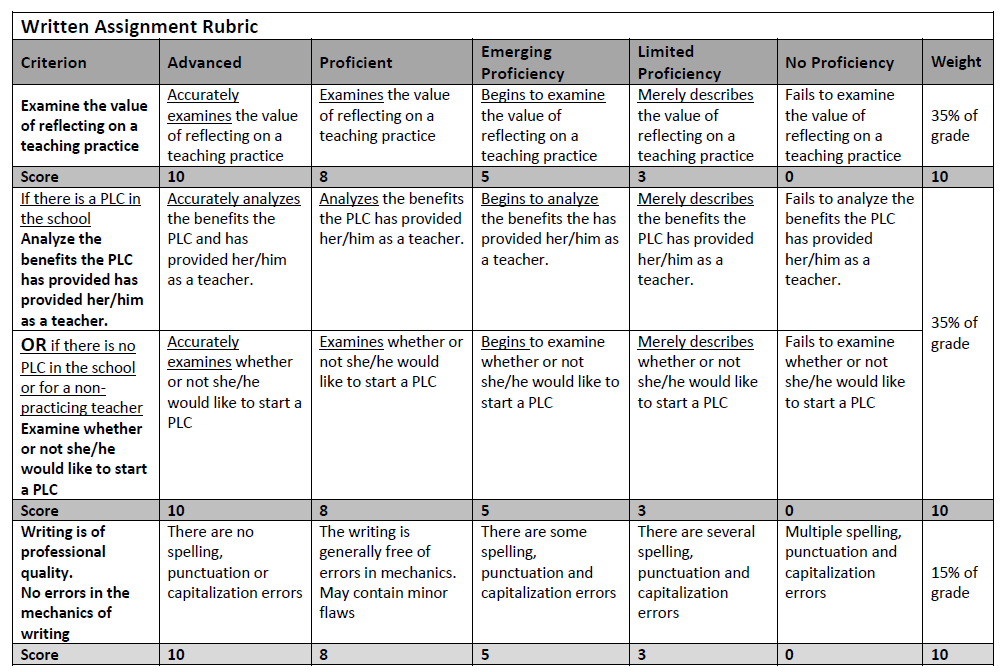
Papers will be peer-assessed using this rubric

Assessment and Evaluation
Education Department, University of the People
EDUC 5440
Written Assignment Unit 7
Dr. Sherry Birdwell
August 02, 2023
The professional and personal development of a teacher is impossible without
reflection. Special attention is paid to the content of reflexion and its role in
the formation of psychological and pedagogical skills, as well as its
mechanism.
The role of reflexion in creative, thinking activity consists in goal-setting,
establishing, and regulating adequate requirements for oneself on the basis of
the correlation of externally imposed requirements and the situational
specificity of the subject itself (Owen, 2014). Since the main thing in the
pedagogical process today is the development of the personality of the process
subjects, and development is an internal process, judging its progress is
available, first of all, to the subject himself, and the assessment of such
development allows for reflexion as an act of self-observation, self-analysis,
and self-reflection. In the pedagogical process, reflexive skills allow its
subjects to organize and record the result of the state of development,
self-development, as well as the reasons for the positive or negative dynamics
of such a process.
It is known that reflexivity, as a property of a teacher's professional thinking, is
not open to outside observation outside of his or her activity. Among many
pedagogical situations, there are those that "provoke" the teacher to a greater
extent to enter a reflexive position in relation to them. These include
problematic, conflicting situations in which the teacher is faced with the
necessity of making a decision in the "here and now" mode. Unfortunately, in
such conditions, the right decisions are not always made. However, in this
situation, it is not so much the teacher's mistake itself that is of particular
importance as his or her subsequent behavior.
It is clear that the full implementation of person-centered learning requires the
high professionalism of the teacher, who can comprehend and "decode" the
emotional and personal codes of his students and incorporate them into the
context of learning (Bovell, 2014). Reflexive ability is the professional
practical tool that allows solving such tasks. The insufficient level of its
manifestation, unfortunately, hinders the successful implementation of
educational reforms. Thus, the problem of developing pedagogical reflection
acquires not only a professional but also a broad social meaning.
Professional learning communities in our country are called teacher
development courses, and there are entire institutes founded for this purpose.
Every five years, teachers of educational institutions have a planned attestation
of educational workers, which includes a whole list of actions that a teacher
must perform in order to receive the next category.
The qualification category is the main indicator of a teacher's professionalism,
which reflects competence and has an impact on salary (MAST, 2020). The
purpose is to stimulate professional growth with material support.
The procedure for assigning a category is defined by the order of the Ministry
of Education and is mandatory. It stipulates equal conditions for all certifiers,
principles, general and special conditions, and evaluation criteria. Employers
and parents pay special attention to this category when hiring.
Attestation is a personal matter for the teacher, and no one has the right to
force or oblige him. When hiring, the presence of a category can be a decisive
factor, and perhaps the employer will be interested in the other competencies
of a potential employee. But without confirmation of compliance with the
position held, you will not be able to do without it; it is a mandatory condition
of activity.
Another mandatory element is professional development. According to
current legislation, teachers must undergo training every five years. The initial
stage is to submit an application with a reasoned position on why the teacher
considers it possible to receive the first category.
Requirements for the applicant:
● stable results of pupils in the control of knowledge;
● Pupils show results in Olympiads, competitions, and other events.
The teacher broadcasts pedagogical experience among his or her colleagues at
the level of the institution and at the level of pedagogical communities. Higher
requirements are imposed on a specialist in the highest category:
● Active participation in the work of methodological associations, their
organization and holding of meetings, the development of programs and
methodological support, and participation in competitions of
pedagogical excellence;
● Stable positive dynamics in learning, the results of students at the
Olympiads at the regional level and above, and the availability of
publications in pedagogical communities at the regional level and above
● It is obligatory to have the first qualification category for at least two
years.
After five years, the procedure for confirmation is similar, but points are
awarded only on the basis of the provided self-analysis of activity.
In conclusion, we would like to note that the presence of a state organization
that monitors the development, successes, and education of teachers at the
state level forms in teachers the skill of self-reflection from the very beginning
of training in this profession. To be a professional teacher in our country is
possible only with a very high level of self-reflection skills, which are
necessarily tested and evaluated. The creation of an additional community of
professional teachers, such as mentioned by Susanne Owen (2014), is possible
only when obtaining a license from the state for educational activity after
providing a curriculum that meets all the norms of state accreditation.
References
Bovell, M. (2014, February 4). Using student assessment to improve teaching.
Australian Council for Educational Research (ACER).
https://rd.acer.org/article/using-student-assessment-to-improve-teaching
Owen, S. (2014). Teacher professional learning communities: going beyond contrived
congeniality toward challenging debate and collegial learning and professional growth.
Australian Journal of Adult Learning, 54,(2), pp 54-77.
https://files.eric.ed.gov/fulltext/EJ1033925.pdf
MAST, Modern Academy of Science and Technology (2020)Qualification categories of
teachers
https://www.snta.ru/press-center/kvalifikatsionnye-kategorii-uchiteley
.