Instructions for submission
Review Table 3: Instructional approaches for activating prior knowledge (p. 8) in the Strangman, Hall, and Meyer reading:
- Strangman, N., Hall, T., & Meyer, A. (2004). Background knowledge instruction and the implications for UDL implementation. Retrieved from Cast.org
AEM: Background Knowledge Instruction and the Implications for UDL Implementation. (2021, February 24). Web.archive.org. https://web.archive.org/web/20210224031539/https://aem.cast.org/about/publications/2004/ncac-background-knowledge-udl.html
The table identifies six evidence-based approaches teachers can consider using in order to better engage students in the classroom:
- Reflection and recording
- Interactive discussion
- Answering questions
- K-W-L
- CONTACT-2
- Interpretation of topic-related pictures
Select two of the six approaches and investigate how the approach is used in the classroom. In your paper:
- Illustrate how each approach is intended to be used in the classroom by creating an example to demonstrate the methodology. Whatdoes each approach look like in practice?
- Identify at least one limitation of each approach you selected. Why might employing these approaches be challenging for a teacher?
Submit a paper which is 3-4 pages in length, excluding the Title and References pages. Your paper should be double-spaced and cite at least2 outside sources in APA format. Table 3 includes several references for each of the approaches. You can draw from these references or youcan find other sources for the same approach. You are not limited to the references included in Table 3. Your paper should be well-writtenand free from grammar, spelling, and content errors. Be sure that you have properly cited (in APA format) all resources used.
Purdue University’s Online Writing Lab (OWL) is a free website that provides excellent information and resources for understanding andusing the APA format and style. The OWL website can be accessed here:
http://owl.english.purdue.edu/owl/resource/560/01
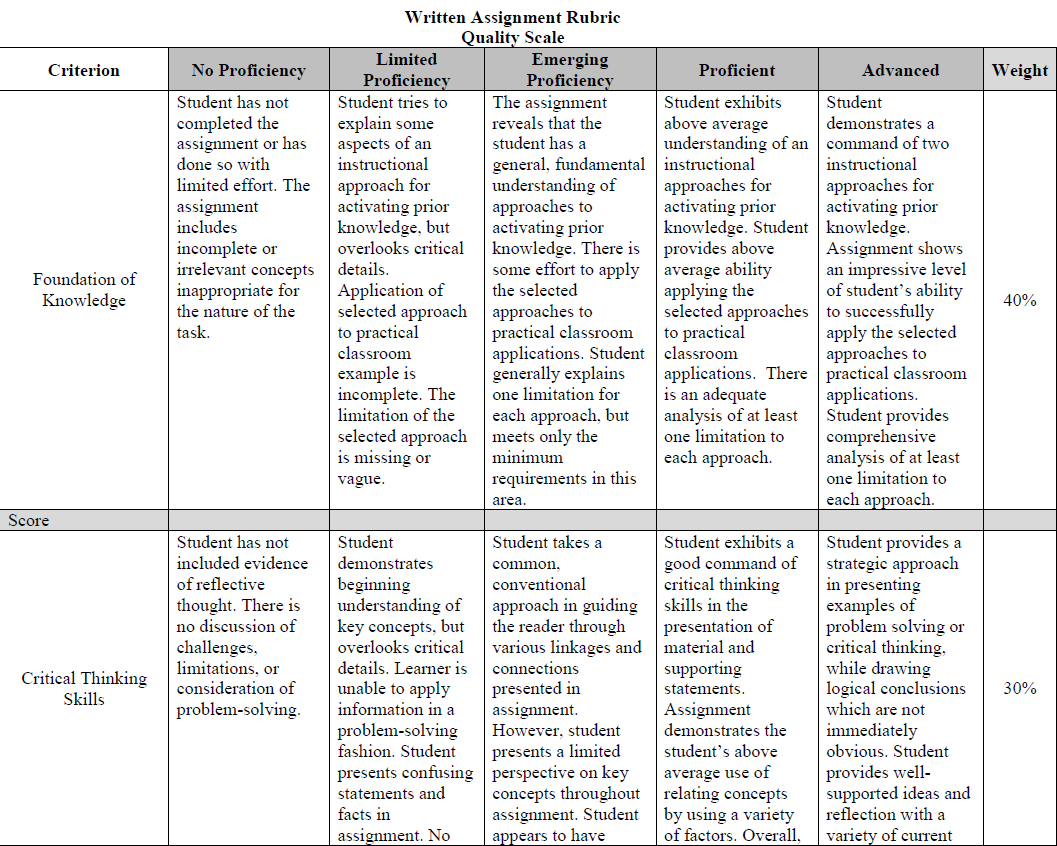
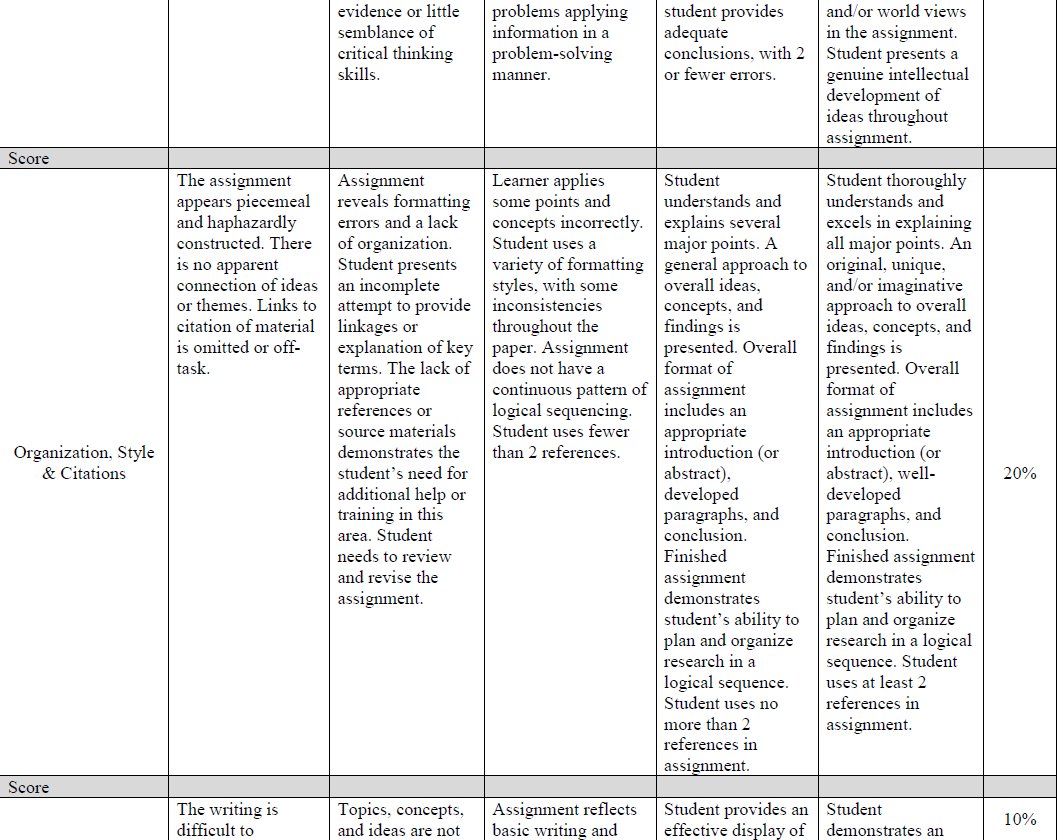
This paper will be peer-assessed using this rubric.
All teachers know that listening is one of the most important skills for learners of a foreign language, because it's one thing to speak the language, and quite another to understand what is being said to you. You can use real audio and video without spending a lot of time preparing. If you are using youtube videos (Listening Comprehension), they probably do not have any special tasks. In this case, it is best to use the KWL format of working with authentic texts for listening (Yougen Lou, August 2016). It stands for Know / Want to know / Learnt. In order to use it in a lesson, all you need to do is find a video, watch it yourself, make sure it meets the goals of the lesson and the interests of the students, and that is enough. Let's look at an example of how this works.
You and your students go through the topic of City Life, touching on the topic of graffiti in the city. If you see that students are interested in the topic, you can watch a video with them (Ice Age 3 | Street Art Wins Guinness World Record). Take a whiteboard or sheet and divide it into 3 columns. Students can do the same with an A4 sheet or the spread of a notebook. If you are working online, you can do the same in google docs, word, Paint, or any other program. The columns are titled Know / Want to know / Learnt (KWL method). In the first column, write what students already know about graffiti. This will help activate their knowledge of the topic, set them up for the topic, and get them interested. Students can suggest the following ideas:
- I know graffiti is popular in big cities.
- Mr. X is a famous graffiti painter in my city.
- It is predominantly popular among young people.
In the second column, "Want to know," students make up questions they would like the video to answer. You can ask them to come up with the questions first, without showing them the name of the video or the thumbnail picture. Students make up questions that interest them. At this point, you can give them time to think on their own and then share with you. You can then show students the video title and thumbnail picture for more accurate questions and predictions. Examples of questions:
- How popular is graffiti?
- Who is the man in the picture?
- What kind of graffiti is it?
- Is it famous graffiti? If yes, why?
- How much time did the artist spend on it?
- How much paint did he use?
This is followed by the first audition. This is the first time we listen and watch, focusing on the first speaker. Students need to understand in general terms whether the video covers the assumptions and general knowledge they made in the first column or whether the video is about something else. They don't need to understand the details and every word. After watching, they check off the boxes that the video did and did not cover according to the first column. With strong students, you can try to put forward a conclusion about what the video is about (in this case, a specific graffiti). The second time students listen and focus on the questions in the second column. Again, they can tweak them after the first listen and complete new ones. Since the audio is authentic, students can be given a chance to listen twice at this point. The answers are then discussed again in pairs or individually. You can make it harder by asking students to tell you how the video differs from their expectations.
In the third column, students formulate answers about what they learned from the video. Preferably they do this in their own words, although you can help them with key words. After this step, you can ask one student or more (if there is a lot of information) to retell what the video was about. This assignment can be a homework assignment. However, keep in mind the authenticity and relevance of the assignment. Therefore, we divide the group into pairs. Pupil A has watched the video and he or she cannot wait to recommend it to a friend. You can start with, "I watched this awesome video the other day, you gotta watch it..." and then tell them what it is about and why they should watch it. Student B listens, asks questions and finally decides if he or she will watch it or not and explains why. If you are not working with a group, your individual student will be student A and you will play the role of B. A continuation of this assignment could be discussion, discussion (is graffiti art?), stories about graffiti in their city that struck them, or graffiti in cities they have traveled to. The options are many.
So you can use any unadapted video or audio for educational purposes. You just need to remember that the task should be tied to the theme of the lesson, chosen according to the interests, knowledge and skills of students, should not be too difficult. It doesn't take much time to prepare for such a lesson, and if properly organized, students get incredibly excited (and even begin to give you videos and ideas for parsing in the lesson).
Teachers are always on the lookout for ways to set original learning objectives, formulate successful questions, and appropriate pedagogical situations that affect the quality of the educational process. Natural curiosity and appropriate cognitive questions are what help keep students interested in learning and motivated.
The ability to ask questions is important for many practical reasons: We ask questions to gather objective information about students' learning levels, and it helps us build further educational trajectories. Questions are our faithful assistants in communicating and understanding our students. What they breathe, how immersed they are in the educational space we have created.
Asking the right questions is at the heart of effective teaching. By using them in specific pedagogical situations, you can influence the formation and development of all students' learning competencies. (Michael Pressly, Eileen Wood, 1992)
OPEN-ENDED AND CLOSED-ENDED QUESTIONS
Closed-ended questions are usually phrased so as to get a short and unambiguous answer. For example:
- Name the capital city of France. How many months are there in our calendar?
- When did the first manned space launch occur?
Open-ended questions imply longer answers. They usually begin with "how," "why," "what happened." An open-ended question seeks to reveal the student's procedural knowledge, opinion, or attitude about something. "Tell me," "Describe..." can also be called open-ended questions. Here are some examples:
- What happened on September 1, 1939?
- Why did the main character react this way?
- Describe the dissimilation process...
- Tell me what happened next.
- Describe the circumstances of this process in more detail.
Open-ended questions are good for developing a problematic discussion, brainstorming, getting more detailed information and consequently students' knowledge about some phenomenon, process, finding out students' opinions about the designated problem: "What do you think about your friend's arguments?"
Closed questions are good for: checking the level of students' learning, completing the brainstorming or discussion and making a decision: "Now we know the facts, do you agree that this is the right solution to the problem?", setting a certain framework: "So, do you agree with this statement? Argue." An inappropriate closed question, on the other hand, can kill the discussion and lead to awkward silence, so it's best to think through your strategy of closed and open questions beforehand.
Finally, the instructor should make sure the student has enough time to respond. His answer should definitely include time for reflection. Skillful questioning must be accompanied by the ability to listen to the student in order to understand how immersed the student is in the topic, knows the answers, and has his or her own position.
The student's body language and tone of voice can also show us how confident the student is in his or her answers.
References
Listening Comprehension LearnEnglishFeelGood.com
http://www.learnenglishfeelgood.com/eslvideo/
Ice Age 3 | Street Art Wins Guinness World Record
https://www.youtube.com/watch?v=A6Wkwby6La4
Yougen Lou, Liansong Wu, Honglian Liu, Liyou Chen, August 2016, Improving Non-English-Majored College Students’ Writing Skills: Combining a Know-Want-Learn Plus Model of Meta-Cognitive Writing Strategy Instruction and Internet-Based Language Laboratory Support
https://www.scirp.org/(S(351jmbntvnsjt1aadkposzje))/journal/paperinformation.aspx?paperid=69887
Mihael Pressly, Eileen Wood, 1992, Encouraging Mindful Use of Prior Knowledge:
Attempting to Construct Explanatory Answers Facilitates Learning
https://commons.hostos.cuny.edu/mtrj/wp-content/uploads/sites/30/2018/12/htrt-Encouraging-mindful-use-of-prior-knowledge.pdf