Review the reading from Schwartz (2012). Best practices in experiential learning
https://www.mcgill.ca/eln/files/eln/doc_ryerson_bestpracticesryerson.pdf
Focus on pp 1-2: Experiential learning: An expanded definition. In this section of the reading, Schwartz outlines nine activities thathave the potential to be experiential learning experiences depending on the situation. Select one of the nine activities and post ascenario or short lesson that clearly illustrates how your selected activity fulfills the definition of experiential learning. Because theactivity must be embedded in the context of the situation to be truly experiential, be sure to include sufficient details in your postto justify your example.
As you reply to your peers, share your thoughts about the experiential activity described in the post. How do you feel about the activity that was posted—was it clearly described in such a way as to reflect experiential learning? Are there changes you would recommend or problems you might foresee with its execution in a classroom?
Hello, Dr. Aisha Siddiqa,
Having carefully studied the definition of empirical methodology and its characteristics (Schwartz, M., 2012), I came to the conclusion that I already have experience with characteristic number five, which draws attention to the role of reflection. This means that students should be able to reflect on their own learning by putting "theory into practice" and gaining insight into themselves and their interactions with the world.
Moon provides 20 or more examples in The Reflective and Experiential Learning Guide, of which items #1, #3, #10, #13, and#15 have traditionally been chosen as the most effective and popular (Schwartz Michelle, 2018):
1. maintenance of a learning journal or a portfolio
3. presentation on what has been learned
10. Self-evaluation of a task performed
13. An interview of the learner as a potential worker in the workplace
15. A request that students take a given theory and observe its application in the work place
Of these five points, the first may be considered the most acceptable in all circumstances.
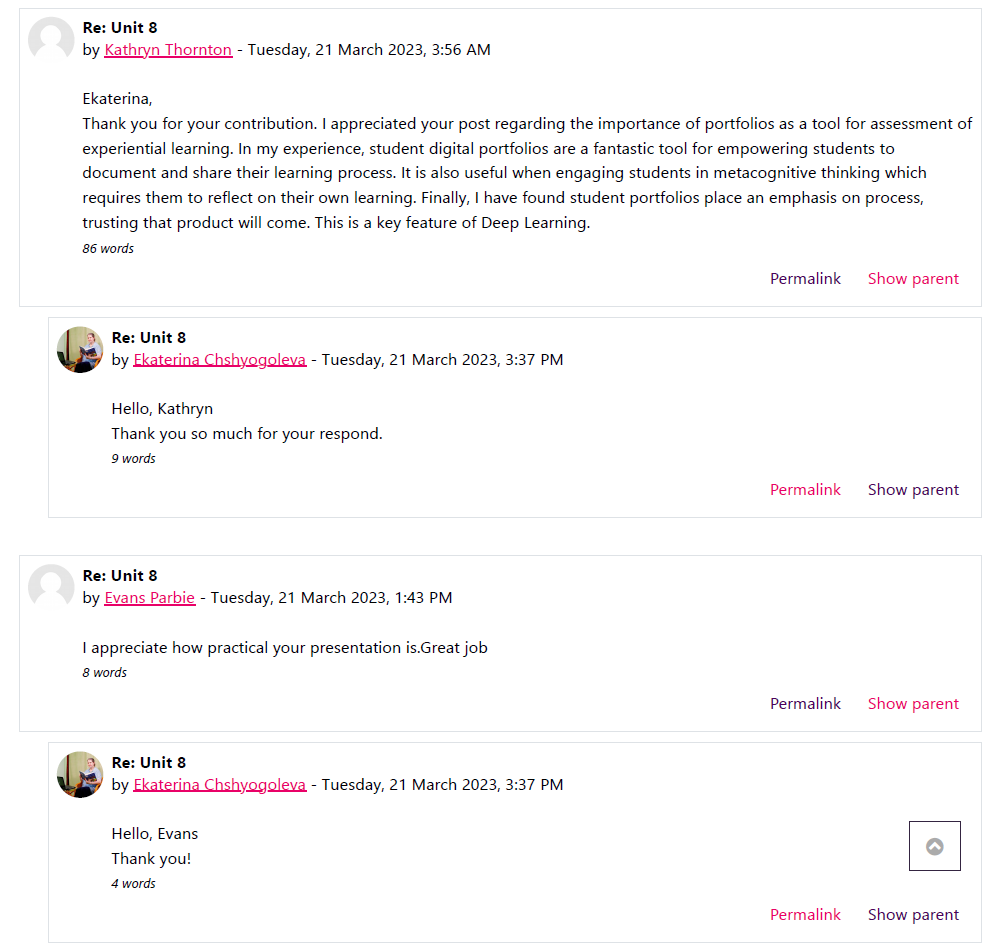
More focused on the learning process, portfolios are a better tool than any other traditional way to document learning achievements. It is an assessment tool for evaluating the results of the continuing education process that is useful indocumenting the entire learning process because it can show how a student learns specific knowledge and skills and whatprogress they have made while striving to achieve established standards. Another advantage of portfolios is that students cananalyze their competencies, their level, and their learning process and thus learn more. The following questions can be askedto conduct self-reflection: what task do I have to accomplish?, what are my achievements?, what are my abilities?, what do Ilack?, how can I assess my professional competencies? As a result of the analysis new skills and abilities can be identified. It isimportant to note that naming competencies does not necessarily speak to an awareness of knowledge, skills, and certain abilities. The concept of competency requires a deeper understanding because it touches on deeper levels, including thevalues, qualities, and attitudes of the individual. Students' ability to reflect on their own experiences and to analyze and applynew knowledge enhances learning. The learning achievement portfolio method involves a well-organized and planned activitydesigned to provide a more complete picture of students' achievements and outcomes, taking into account their individualaccomplishments. Among the possible purposes to which a portfolio contributes are the following: it can be used as a tool tostimulate discussion about final learning outcomes, student self-reflection and planning for further study, as a document andconfirmation of the student's creative potential, and even to demonstrate intellectual abilities or signs of cultural sensitivity orlearning styles, as well as to make connections between acquired knowledge and skills and new material. Some of theseaspects are discussed in more detail in the paper, with particular emphasis on the claim that portfolios are useful in assessingand evaluating not only final outcomes but also other aspects of learning: they can be used to monitor academic achievementand the development of social competencies.
What materials can be stored in a portfolio folder?
1. Samples of children's works - formal and creative - made during compulsory classes in all subjects studied as well as duringelective classes attended by students as part of the educational program of the school (both its general education componentand the supplementary education program). A mandatory component of the portfolio is the materials of the startingdiagnostics, interim and final standardized works on individual subjects. Other works should be selected so that their totalitydemonstrates the increasing success, volume and depth of knowledge, achievement of higher levels of formed educationalactions.
2. Systematized materials of observation of the process of mastering of universal learning actions (evaluation sheets, materialsand observation sheets, etc.) maintained by teachers, school psychologist, organizer of educational work and other directparticipants of educational process.
Materials describing students' achievements in extracurricular (school and out-of-school) and leisure activities. The analysis,interpretation and evaluation of the individual components of the portfolio and the portfolio as a whole are done from theperspective of the achievement of the planned results and taking into consideration the main results of primary education, asdefined by the requirements of the standard.
The portfolio is filled out by the students in their lessons, homeroom lessons, extracurricular activities, and at home. Theportfolio is not a textbook and has a structure that requires systematic work throughout the school year.
The structure of a portfolio of an elementary school student according to the Federal State Educational Standard.
The portfolio may consist of the following sections (Publishers of educational and methodical literature for schools, n.d.):
The title page of the portfolio contains some basic information (first and last name, school, class, etc.).
The "Meet Me" section is the beginning of the portfolio, where the child gets an idea of what a portfolio is, how and why it should be maintained. This section could have a theme of "My Family. Under the roof of my house. My family tree. My mommy/daddy line age."
This theme is intended for joint work of parents and children. It is necessary to plan this work in advance, and it is desirable toprepare both parents and children for work with this topic in advance. For this purpose it is possible to spend one or two classhours, joint collective creative business "Parents + children" or a parent meeting with participation of children.
The section of the portfolio "my school" in this section can include topics on health preservation. This includes concepts suchas: routines, exercise, information on healthy eating, and safety rules
The My Class section of this section covers the topics: "School Laws" and "Traditions of My Class.
The section "My learning achievements" is the largest section, because it is at the expense of the main components of theeducational process (subjects, presented in the invariant part of the basic plan) provides the achievement of meta-disciplinaryresults. The main object of assessment of these results is the formation of a number of regulatory, communicative andcognitive universal actions, i.e. such mental actions of students, which are aimed at analysis and management of their cognitiveactivity. The pages of this section will help the teacher form the children's skills:
accept and retain the learning goal and task;
plan their own activities in accordance with the task;
look for the means to accomplish it.
Work with this section goes on all school year at lessons, class hours, and extra curricular activities in the subject.
The section "my achievements" in this section is recommended to note when and in what event the pupil participated. Toassess a student's achievements it is not necessary to look at all of the works in the folder. The information in this section can tell you about a student's activities.
The section "my project and research works" allows the teacher not only to form, but also to develop already formed in the students universal educational actions. This section can describe the participation and the projects and researches of the pupil.
Section "wishes and feedback" in this section you can leave wishes of the teacher, parents, classmates and their feedback onthe portfolio of the pupil.
References
Publishers of educational and methodical literature for schools , n.d., Portfolio of an elementary school pupil according to theFSES (Federal State Educational Standard)
https://www.planeta-kniga.ru/blog/portfolio-uchenika-nachalnoy-shkoly-po-fgos/
Schwartz, M. (2012). Best practices in experiential learning.
https://www.mcgill.ca/eln/files/eln/doc_ryerson_bestpracticesryerson.pdf
Schwartz Michelle, 2018, Best Practices in Experiential Learning - McGill University
https://www.smartsims.com/wp-content/uploads/2018/05/best-practices-in-experiential-learning.pdf
1259 words