Based on The Empathetic School (Tomlinson & Murphy, 2018), how does empathy and compassion fit into your own needs andthe needs of others? Defend your beliefs, comparing and contrasting Maslow and this new belief. How does this new belief helpyou to take a different look at the students in your classroom? How does it affect your educational practice?
Reference
Tomlinson, C. A., & Murphy, M. (2018, March). The empathetic school. Educational Leadership,75 (6), 20-27.
http://www.ascd.org/publications/educational-leadership/mar18/vol75/num06/The-Empathetic-School.aspx
Dear Dr. Sushma Murthy and Colleagues,
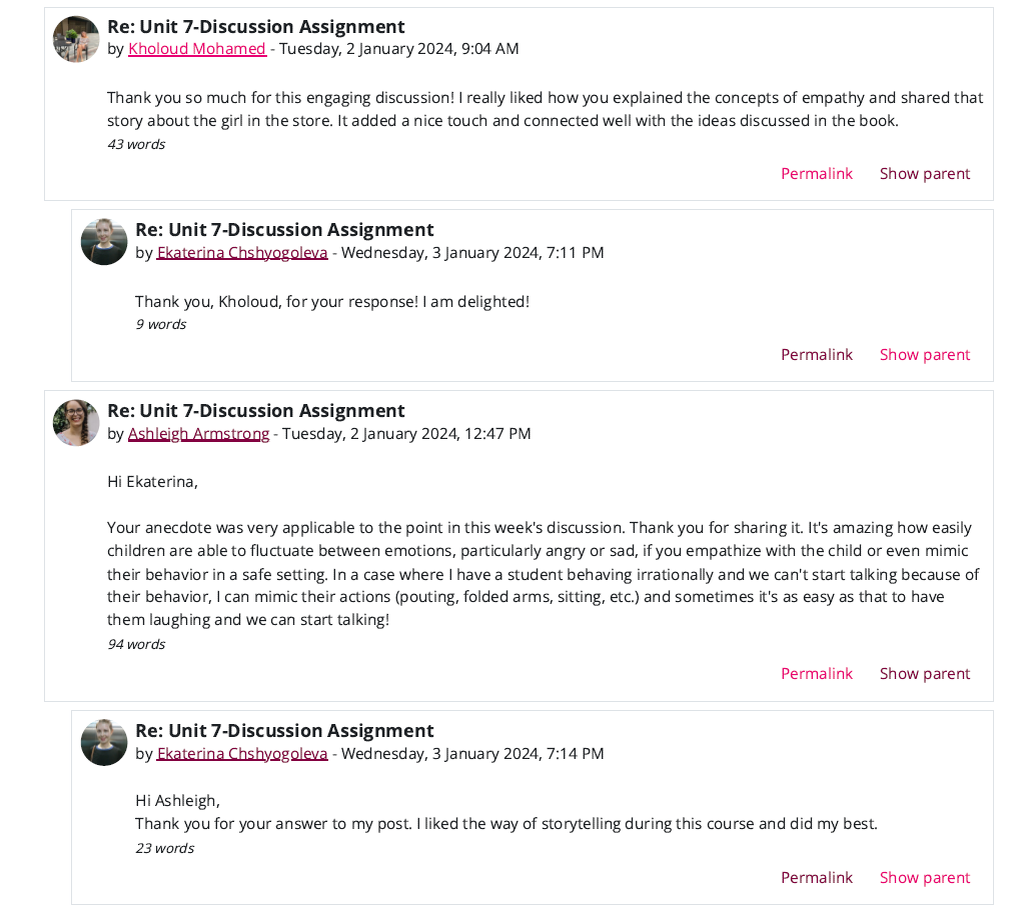
Yesterday was a very busy day with lots of things to get done in a pretty tight time frame. I went shopping first thing in the morning. While queuing for the checkout, my path took me past a stand of lollipops on a stick. I quickly seized four of them at once, took a closer look, but the green lollipop with the face of a dragon did not appeal to my Christian upbringing at all, I frowned and returned them with a disgruntled look. Behind me, a girl of about seven years old started to get naughty, her mum started to comfort her and said: "Well, so what?! Who cares how she looked at you! She didn't do anything bad to you!". I turned to the child's mother and it turned out that the girl thought I looked at her with angry eyes. I smiled, waved and said,"Hi." The girl calmed down and started to look at the candy and lollipops next to me at the cash register.
The first thought I had now while reading The empathetic school (Tomlinson & Murphy, 2018) suggested to me that the girl in the queue yesterday had the empathy inherent in children under a certain age. She sensed my displeasure but could notidentify why I was displeased. Yes, the article is about the capabilities of teachers and the mission of the empathy school. An empathy-based school asks everyone in it - teachers, administrators, staff, and students - to reduce some of their self-focusand respond more fully and consciously to those around them (Tomlinson & Murphy, 2018). However, being an empath myself, feeling the difference between empathy and co-creation, it took me a long time to find a way to not get involved in other people's emotions. And then I learnt how to work with my own.
My advice from personal experience to all colleagues is to never forget that for children we are like the palm of their hands.
We are under the microscope of their ability to feel us, but not to explain us. Thus, the interaction of each teacher does notstart at the moment of communication, but when approaching the school. It is necessary to tune oneself to the right wave to which others, especially children, can connect. This is like inviting the dearest people to a holiday party, after which memories will remain. This is how I started every school year in my office, this is how I prepare myself psychologically for each lesson online. Here I would like to quote: "The healthy, normal, fortunate adult in our culture is largely satisfied in his safety needs"(Zhou & Brown, Spring 2015) and add that such an adult influences the groups around him/her with his/her state of mind.After the change of state of consciousness, all problems seem less serious and are much easier to solve.
Tomlinson, C.A. & Murphy, M. (2018). The empathetic school. Educational Leadership,75(6) 20-27.
http://www.ascd.org/publications/educational-leadership/mar18/vol75/num06/The-Empathetic-School.aspx
Zhou, M. & Brown, D. (Spring 2015). Educational learning theories. Educational Psychology Commons.
https://oer.galileo.usg.edu/cgi/viewcontent.cgi?article=1000&context=education-textbooks