- In Wood’s (1988) paper, Curriculum Evaluation Models, you are presented with three (3) models of curriculum evaluation. Whichone or ones do you see within your learning community as being legitimate? Share the details of why you think so. If you arenot a teacher then what model or combinations of models do you feel would best suit the needs of the learning community? Share the details of your reasoning.
Reference
Woods, J. D. (1988). Curriculum Evaluation Models : Practical Applications for Teachers. Australian Journal of Teacher Education,13(1).
http://dx.doi.org/10.14221/ajte.1988v13n2.1
Good morning, Dear Colleagues!
We have witnessed the formation of a stable motivation of a number of employers to change the practice of work on thedevelopment of personnel potential of their own enterprise in the direction of identifying competencies when hiringemployees, assessing the quality of work and improving the qualifications of employees based on diagnostically formulatedrequirements for the results of professional activity of holders of professions/positions
within the industry. The employers' aspiration to obtain trained specialists of all levels, streamlining, systematizing anddocumenting the modern description of employers' community requirements to perform certain job duties within theframework of certain types of labor activity is realized by developing professional standards - qualification characteristics of anew type. The emergence of corporate or industry-specific, as well as nationally approved professional standards inevitablyaffects the process of designing professional educational programs.
Considering the three models of curriculum assessment, we can condense the general concepts to key (Woods, J. D. 1988)
Davis' Process Model is needed as a whole range of well-organized, universal assessment schemes Stake's Countenance Model focuses on the prerequisites and intentions of curriculum planners, that is, under scrutiny is notthe outcome, but the goal of the work.
But more curious is Eisner's Connoisseurship Model, aimed at organizing self-reflection and qualitative feedback with teacheranalysis and self-regulation.
The latter model is quite interesting from a psychological and pedagogical point of view, but it is better to apply in practice allthree models in an integrative form.
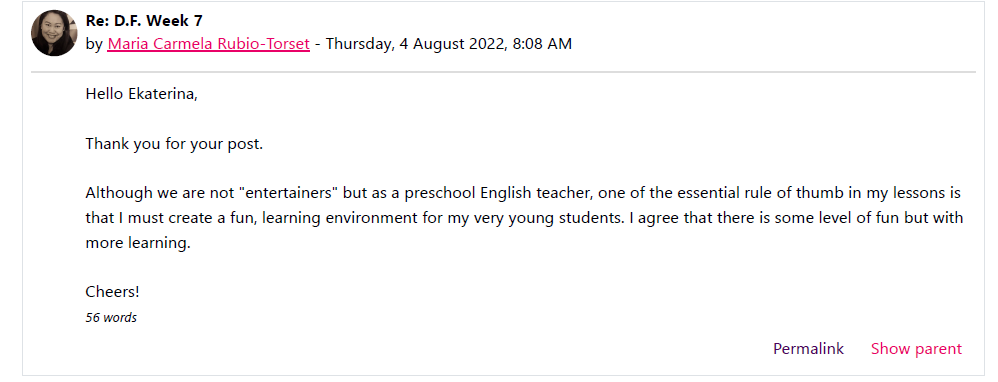
The goal of any training or online course is to teach, not to entertain the listener, not limited to a fun classroom environmentor quality animation without useful data. You can tell if your corporate training program is successful and has proven relevantto employees by using four metrics (Stepan Dobrodumov, 2022) :
- Response to training.
- Knowledge gained.
- Work behavior.
- Impact on business outcomes.
This evaluation model applies to both classroom training and eLearning programs.
In conclusion, the methods of control depend on (G.V. Lavrentev)
- which learning procedure is being monitored;
- what is being monitored - the course of the procedure or the result;
- what tasks are used to check the progress and results of the learning procedure;
- what answers of students are used when performing control tasks;
- what is the frequency and periodicity of control.
References
Lavrentev G.V. , Lavrenteva N.B. ,Neudakhina N.A. INNOVATIVE TEACHING TECHNOLOGIES IN PROFESSIONAL TRAINING (PART2) Assessing the quality of learning outcomes
http://www2.asu.ru/cppkp/index.files/ucheb.files/innov/Part2/ch6/glava_6_1.html
Stepan Dobrodumov 12.04.2022 How to assess the quality of curricula
https://uprav.ru/blog/kak-otsenit-kachestvo-uchebnykh-programm/
Woods, J. D. (1988). Curriculum evaluation models: Practical Applications for Teachers. Australian Journal of Teacher Education,13(1).
http://dx.doi.org/10.14221/ajte.1988v13n2.1