EDUC 5220 - Curriculum design and Instructional Decision Making
Portfolio Activity Unit 6
University of People
Instructor: Dr. Rochelle Massingill
July 26, 2022
Portfolio Activity Unit 6
Compare and contrast the advantages of integrating technology into the curriculum. Compose three (3) pros and three (3) cons. You mayinclude your own personal and professional experiences to support your points of view if you are currently teaching. If you are not teaching,analyze your own experience as a student using technology in the classroom or the experiences of a family member or friend as a teacher orlearner.
Submit a paper that is 750 – 1000 words in length, exclusive of the title and reference pages. The paper should be double-spaced. Cite atleast 1 additional source in APA format. The paper should be well-written using Times New Roman, 12-point font. Check all content forgrammar, spelling to be sure that you have properly cited all resources (in APA format) used.
Purdue University’s Online Writing Lab (OWL) is a free website that provides excellent information and resources for understanding andusing the APA format and style. The OWL website can be accessed here:
http://owl.english.purdue.edu/owl/resource/560/01/
Proofread your work to make sure your responses are clear and coherent. Your instructor will be looking at your chosen questions, yourthought negotiations, and your overall connection to the reading. Please be mindful of the quality of work you compose and turn in at thegraduate level. Contact your instructor if you have any questions or concerns.
This assignment will be assessed using the rubric below.
Education is a very important field for any country. It is through education that success in further development is ensured.
Considering that in this area it is especially necessary to take into account the trends of the modern century, information technology in education is especially popular.
Information technology (IT) was introduced relatively recently, but now it is impossible to imagine any school or even kindergarten without it, not to mention higher education (Prensky, M., 2008).
Information technology in education can be in several forms. Each is necessary for full learning, as well as to make the process comfortable and enjoyable for all parties.
First of all, information technology has helped teachers a lot. It's a great way to get all the information you need, as well as competently compose relevant and up-to-date lessons.
Teaching systems are constantly changing and there is a huge amount of discovery, but with the help of the internet it is easy to always be up-to-date and make your lessons as useful as possible just for modern people (Montessori, M., 2013) . It is also impossible not to mention the form of teaching itself.
Information technology in education allows you to find not only texts, but also videos, slides, and much more on the topic. Now the training is interesting and fun, because it is not only in the form of stories, but with the help of computers and televisions, as well as projectors, the information is presented in the most convenient format for children. Many have even begun to go to school and other educational institutions with pleasure, although before it was a great difficulty.
It is impossible not to pay attention to the second side, the students. This can be very young children, children or even adults, it does not depend on the benefits of the latest discoveries.
Technology has made it possible to receive information in any quantity, and not be limited to the words of the teacher and the textbook. The ability to use the web has become indispensable.
Also, students were able to exercise their creative abilities through a variety of presentations and the rest (Henson, A., 2012, May 1).
Separately, it is worth talking about the fact that new information technology in education allowed the emergence of completely new projects:
Self-learning. Now you can learn almost any field on your own thanks to a huge amount of open information. And you do not need to go to archives and libraries for this - it is enough to have a personal computer with Internet connection.
Distance learning. Higher education is certainly very important, but there are people who live too far away from institutes, or they do not have enough time. Doing assignments, projects, and sessions remotely is a great way to replace the classic form of education.
Students are digital natives (Andrews, D., 2013, March 6). They have grown up with technology.
Technology is woven into their lives. But technology in education is more than just the use of digital devices - it is something that facilitates teacher-student interaction, which increases the effectiveness, and therefore the quality, of the learning process. The younger generation's desire to learn and work is at an all-time low, and educators are competing with countless entertainment devices on phones, tablets, and laptops. Technology can be seen as the culprit behind many educational problems, or it can be used to improve interaction and efficiency.
Digital education is creating new opportunities for learning. Opportunities for personalized learning are emerging, new models of collaboration are emerging, and a wider range of innovative and engaging learning strategies for students is becoming available. But besides the obvious pluses of modern technology in education, there are also minuses - pitfalls that educators face in implementation.
Advantages:
1Technology allows for more experimentation with pedagogy and instant feedback.
Modern technology allows children to become more active participants in the educational process, and educators can create new approaches, methods, and models of learning and education. For example, a teacher can conduct an online survey at any stage of a lecture to find out the level of mastering of the material being studied.
The learning process becomes more dynamic with the use of digital textbooks, when the student can use links to relevant materials or resources. Children can search for answers to the questions asked, form their own position, and then defend it.
The use of technological tools to organize project activities allows for significant changes in
learning outcomes. Teachers have an opportunity to implement new models of educational
process organization, for example, "flipped classroom". In this educational technology of the 21st
century the teacher gives students an opportunity to learn new material at home first and then
organizes practical consolidation of this material in the classroom.
2 Technology helps ensure that students are actively engaged in the learning process.
Online surveys and other digital tools help engage all students, including those who are shy, unsure, and generally lack initiative. Online systems allow for regular feedback, including student feedback on the accessibility of learning materials and assignments. Analyzing the data allows the teacher to easily and quickly identify each child's difficulties and provide timely assistance, identify areas where students can compete, and therefore easily adjust each student's work or group work.
For example, technology can greatly increase the effectiveness of using such an active learning method as a quiz. At the beginning of a lesson, a teacher can administer a quiz using technological devices and quickly assess students' starting level, taking only a few minutes to obtain reliable information and analyze it. Then the teacher can make adjustments in the organization of the educational process objectively understanding where to focus their efforts and how to organize the work of students. Conducting the same quiz at the end of the lesson again will allow with minimal time to get feedback, and students to assess the results and success of learning.
3 Technology can help an educator automate or simplify a number of tedious duties.
Automation can simplify and reduce the time spent on routine but time-consuming tasks, such as tracking student attendance and performance (Delaney, M. 2011, November 1). Modern technological tools make it easier to systematize and select individual student assignments, help track student participation in discussions, etc.
The ability of modern technological tools to visualize difficult to perceive and understand educational material reduces the teacher's time and effort to explain. For example, the technology of augmented reality allows students to create molecules of complex chemical compounds from atoms in a virtual environment using their own hands. Through the effect of presence, created by influencing the human senses, the technology can more effectively demonstrate the process of creating a molecule or substance than a presentation on a screen or a picture on paper.
Disadvantages:
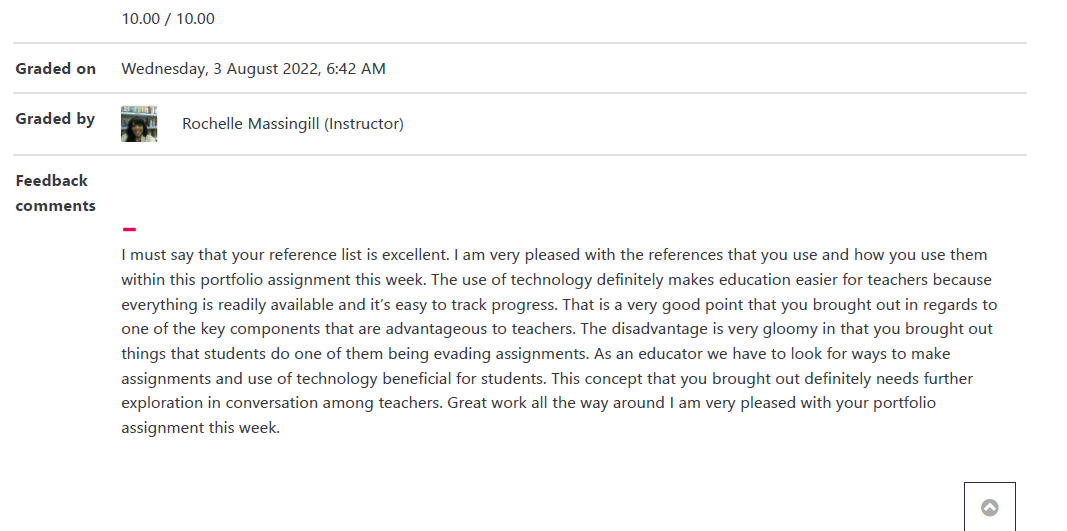
1 Technology can provoke cheating and evasion of assignments.
Students have always found ways to evade assignments, and digital technology will make it even easier, from copying and using someone else's work to buying a finished essay or presentation online. A teacher can always structure assignments and quizzes in a way that minimizes risks.
For example, if a quiz is made open-ended, i.e., if technology is used to search for factual information and the main emphasis is shifted to problem solving using it, then the teacher can not only test students' understanding of the material studied, but also their skills in working with information. A number of software products allow individual assignments to be selected for each student, which unwittingly directs his or her attention to the work rather than searching for a solution in someone else's notebook or on the Internet.
2 Students do not have equal access to technology resources.
Not all students can afford a tablet, laptop, smartphone, or even constant access to the Internet.
You can offer them assignments that allow them to work in a group and share resources, and encourage them to use libraries or other organizations where they can access technology.
Don't make technology a focus of the learning process or a hindrance. Incorporate technology into a holistic educational system.
3 The quality of sources on the Internet leaves much to be desired.
The Internet is a boon and a curse. Your students will benefit from knowing how to distinguish quality sources from unreliable ones. Educational institutions can create a list of electronic educational resources, information from which students can trust, use, copy and adapt.
Teachers can use educational resources that are freely available. Usually such resources are classified by sections according to the main disciplines of general education or areas of additional education. They contain educational and reference material. Students can also use these resources. Electronic tests, interactive models, colorful illustrations, ready-made elaborations, simulators and other educational-methodical materials in the resource sections will help teachers to prepare and conduct interesting, informative and bright lessons, and students to do homework, research projects or other kinds of independent work.
TECHNOLOGY IN EDUCATION: THE FINAL VERDICT
It is clear that the benefits outweigh the cons, but the key to implementing technology in education will always be determined by the teacher-student relationship, because that is where education takes place. Technology can be a very effective tool, but it is only a tool. Technology is not meant to replace the teacher; rather, the idea is to create a learning environment that will shift the organization of the learning process from a "one-actor theater" to a collaborative and productive learning activity.
Today we are in the first phase of introducing technology into education. The process of implementation can be frustrating, irritating, time consuming, but in the end technology can "open doors" to new experiences, discoveries, ways of learning and collaboration between students and teachers.
References
Andrews, D. (2013, March 6). iPads in the classroom: embedding technology in the primarycurriculum. The Guardian.
https://www.theguardian.com/teacher-network/teacher-blog/2013/mar/06/ipad-ipod-technology-primary-curriculum
Delaney, M. (2011, November 1). Training teachers to integrate technology. EdTech.
https://edtechmagazine.com/k12/article/2011/11/training-teachers-integrate-tech
nology
Ellis, B. (2017, January 30). Which comes first: the curriculum or the technology? Technotes.
https://blog.tcea.org/comes-first-curriculum-technology/
Henson, A. (2012, May 1). Why technology is essential in curriculum and content alignment. Internetatschools.
https://web.archive.org/web/20200812014123/http://www.internetatschools.com/A
rticles/Editorial/Features/Why-Technology-Is-Essential-in-Curriculum-and-Content-Alignment-5bAvailable-Full-Text2c-Free5d-82253.aspx
Montessori, M. (2013). A critical consideration of the new pedagogy in its relation to modern science. In: D. J. Flinders & S. J. Thornton (eds.), Curriculum Studies Reader (4th ed.), pp. 19–31. RoutledgeFalmer.
https://acurriculumjourney.files.wordpress.com/2014/04/montessori-1912-a-critical-consideration-of-the-new-pedagogy-in-its-relation-to-modern-science.pdf
Prensky, M. (2008). The role of technology in teaching and the classroom. Educational Technology.
http://marcprensky.com/writing/Prensky-The_Role_of_Technology-ET-11-12-08.pdf