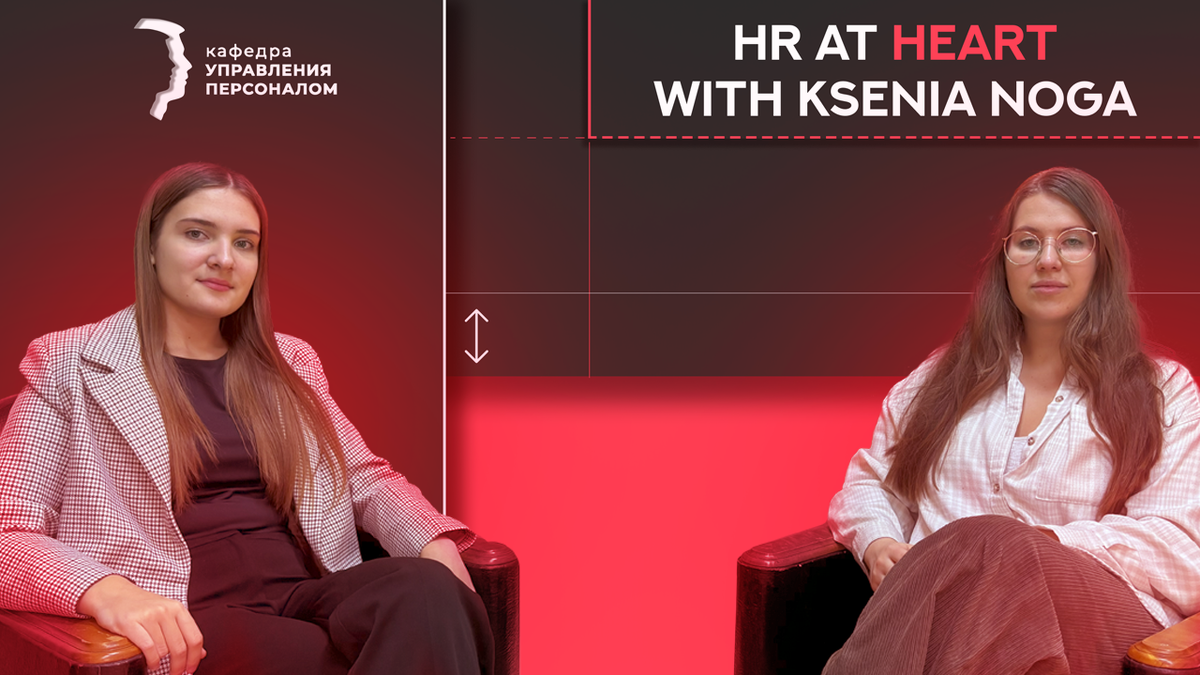
Interviewer: Hello, dear listeners and viewers of our podcast “HR at Heart”. Today we have with us Ksenia Noga, the Senior Manager of Internal Communications at Ozon. Hi, Ksenia!
Ksenia Noga: Hi!
Interviewer: Tell us a little about yourself and the company you work for.
Ksenia Noga: I have been working in internal communications for almost 7 years. I spent 4 years at Sber and I have been at Ozon for 3 years now.
Interviewer: Oh, wonderful! We know that you studied marketing at the State University of Management. How did it happen that you decided to connect your life more with human resource management rather than marketing?
Ksenia Noga: Yes, I thought about this a bit and prepared… I think they are somewhat related because marketing is about promoting and strategizing for customer products, while I create strategies and promote internal communications for employees. In marketing, you work externally; here, you work internally. How did it happen? I guess the answer is simple.
When you go to study, you don't yet know what you want, what you like. At that time, I knew for sure that I am creative, that I am positive, that I am empathetic, and I needed something related to people, to creativity. Why not human resources management? Because at that time, precisely at that moment (it was many, many years ago), it seemed to me that marketing was more creative, so I went there. Then, when I joined Sber, my manager asked me, “What do you want more?”
I was very lucky that she offered me three different directions and allowed me to try them out. My manager observed what resonated more with me, and it turned out that internal communications were closer to my interests. Communication is probably my thing.
Interviewer: The more your heart is in something, the more comfortable and interesting it will be to work on it. The work will bring more joy.
Ksenia Noga: Of course, it's 100%.
Interviewer: Are there any skills or knowledge you gained in marketing that have been useful in human resource management?
Ksenia Noga: First of all, I don't remember what I studied. Rather, at university, you acquire some communication skills with supervisors. All the credits, all the exams show how you go through certain steps, preparation, and discipline. My education looked exactly like that. When you learn to interact with professors, as with your future manager, you still have to negotiate. You have to know how to find an approach in some situations, and of course, learn in others. But in any case, these are communications that will be very useful for you in the future. As for what I use in my work, to be honest, I can’t recall anything specific. But I think it’s also because I work internally rather than externally. I'm sure that colleagues who work in marketing at Sber surely apply everything they studied. I just took a slightly different path, closer to HR.
Interviewer: I agree, everyone has their own path. What do you do to build corporate culture? What does it consist of? And how does it affect the hiring process?
Ksenia Noga: I’ll start by saying that I’m not exactly an HR person. I have a small focus on HR branding. Of course, we participate in all employer rankings. We know that everyone is currently looking at reviews and how the company presents itself externally. Nowadays, everyone is searching for a non-toxic modern culture, which is very important for candidates. And, of course, we try to present ourselves as a modern brand, a brand without a dress code, with informal communication.
Interviewer: Without strictness?
Ksenia Noga: Without strictness, yes, of course, without strictness. We want to appear exactly like that to the outside world. So, what do we use? Of course, external promotion. This includes videos, reviews, and articles on VC, Zen, Pikabu, and so on. What do we do internally? We try to immerse people in the business culture, meaning we explain more about who we are as a company so that they understand where they work. Of course, we entertain: we organize activities, communications, use memes, games, landing pages, quizzes, but we always fill them with business content so that colleagues know what kind of company we are, what our figures are, and what our indicators are, because it’s very important to understand that you are part of a large mechanism, a big company.
Interviewer: Recently, our department also introduced a section with memes, and there are other sections you can read. I've even noticed that people are now paying more attention to the team. If before they focused more on the salary, now they are more interested in what the team will be like. Whether it is friendly or if there is any toxic atmosphere..
Ksenia Noga: Of course. Undoubtedly, they also look at the voluntary health insurance package and various "perks." Many companies now offer perks (voluntary health insurance, dental care, benefits, discounts, gyms), but unfortunately, such things won’t retain an employee. If your culture doesn’t adapt to the employee, doesn’t accept them, and doesn’t ensure their comfort, then, unfortunately, no benefits or packages of perks will keep that employee. So yes, retention now comes through empathy, HR work, and working with the individual: hearing their needs and understanding what they need.
Interviewer: Wonderful! Let's talk not only about work but also about something pleasant. Maybe you've been on some business trips or traveled somewhere? Are there any places you really liked when you were there?
Ksenia Noga: I have been to many places. I have been to Spain, Italy, France, Germany, Turkey, Egypt, Montenegro. Let's put it this way, the last place I visited and really liked was Pyatigorsk. I was in Pyatigorsk and Kislovodsk, and I was absolutely thrilled. If anyone from Pyatigorsk is reading this, I really liked it there. It was wonderful; I didn’t think there would be so many walking paths. I spent the whole day out and had so much to see. It’s very clean, with good architecture and delicious food. And the people, of course. The mountains are a whole different kind of enjoyment. I was completely recharged, breathed in the fresh air, and I highly recommend everyone to go there.
Interviewer: I agree! I also traveled to Irkutsk; the mountains are mesmerizing. I think I might even prefer the mountains to any beach.
Ksenia Noga: By the way, we went to the gopher valley, which was interesting. There are a lot of gophers there, they run up to you, and you can feed them. At first, I thought that a maximum of three well-fed gophers would come, but it turned out to be dozens.
Interviewer: That sounds like quite a sight.
Ksenia Noga: Yes, yes, it’s fun.
Interviewer: We definitely have to go there sometime
Ksenia Noga: And it’s not far; it’s really close.
Interviewer: Tell us about your experience implementing changes in HR processes. How do you deal with employee resistance?
Ksenia Noga: First, let me tell you a bit about our company, Ozon. We are currently a rapidly growing e-commerce platform with a large logistics network and IT expertise. To clarify what this means: it means we are at the intersection of a startup and IT. We are an IT company with over 80,000 employees, 6,000 of whom are IT specialists. I wanted to mention that Ozon is not just about the employees at pickup points or couriers. We have 21 floors in Moscow City where our employees work. This includes marketers, PR specialists, advertisers, IT professionals, product analysts, and so on.
Regarding the question of what kind of resistance and what kind of HR implementation there is: well, first of all, there is always resistance because what is the goal of internal communications? What do they want most in internal communication? They want all employees to be happy. And that is impossible to achieve. So, the first resistance you must be prepared for is criticism, and quite a bit of it. You organize events and communications, and people will definitely leave feedback, and you will never achieve 100% loyalty. And probably, HR should also understand that they will constantly encounter some resistance in the form of unpleasant feedback or maybe some negativity.
This is normal; you just need to get used to it and understand that this feedback makes you better. For example, last year we celebrated Ozon's 25th anniversary, and we had a big activation. We created a landing page with various games. We had five and a half thousand items of merchandise that we gave away. There were all sorts of things—videos, crosswords, and quizzes. There was something for everyone. And still, we received some feedback like: “I wanted not a quiz, but I wanted, I don’t know…”
Interviewer: Charades.
Ksenia Noga: Charades, yes. And you think: "I did everything to make the employee happy. I thought of everything, but still there weren't enough charades.". And probably this is the kind of resistance that an empathetic person sometimes finds difficult to deal with because you understand that you put your heart into it. But that’s okay; people leave their feedback, and you have to draw conclusions and move on. For example, I made monochrome merchandise and was sure that minimalism was in fashion—monochrome white, gray-mint, oversized. In the end, I was told: “We want bright colors; we wanted blue and pink. And why is this sweater so huge on me?”
I said: “It’s oversized; it’s fashionable.” And this year, I made everything in size and bright. I’m looking forward to different feedback. This is probably something I often encounter in my work. As for implementations, mostly my implementations involve events and activations—something entertaining for employees. This year, we received the INTERCOMM award. The project I did with my manager took third place. And this was the activation for Ozon 25. I’ve already mentioned it: how to tell about the business and the company through activation, through games, through something humorous. Play, have fun, and learn something new.
Interviewer: Yes. I'm thinking about resistance, the fact that the human factor is really the most sensitive topic in HR and in any work with people, in general. Therefore, you always need to be prepared for this and be close to it, for sure.
Ksenia Noga: Yes, and this happens very often in communications. You write: "FRIENDS, BY THE 21ST," and no one sees it.
Interviewer: And often, people are afraid to be the first to respond.
Ksenia Noga: What I want to say is that, No matter how hard you try, no matter how well you polish the communication, no matter how perfectly you do everything, there will always be some resistance. You need to accept this calmly, not take it personally, and keep working.
Interviewer: Speaking of internal communications, it’s winter now, December, and New Year is approaching. How is your New Year mood?
Ksenia Noga: Oh, I haven’t figured it out yet, to be honest. First of all, winter started so quickly. But I will go to my dacha, then I’ll go to Perm on January 1st in a sleeper train. So, yes, I’m in the mood for celebrating the New Year. Although you know, it’s not so much about celebrating the New Year as it is about waiting for something interesting.
Interviewer: It's always such a mystery during the New Year. Please tell us about the most memorable New Year you organized for the company.
Ksenia Noga: Oh, I haven’t had that many New Years at the company. I’m finishing my third year now, and we’ve had only last New Year and this one. First of all, it’s not customary for our company to have the office celebrate. We have many remote employees, including support staff and warehouse workers who are far from the office. Therefore, we try to create activities that everyone can participate in. For the second year in a row, we are holding a New Year quiz. The quiz is in an online format, so it can be played from anywhere in Russia. You can play in teams, meaning you can gather in a café, at friends’ places, in the office, or connect online. Last year we had 275 teams, over 1,500 participants. Today I was just tallying the results of this year, and we already have 600 teams. So that’s twice the number of participants, totaling three and a half thousand—quite a lot.
To this day, people still write to me saying they want to join the quiz. And how could we do without business? As I mentioned, we have a tour about Ozon, a tour about business, and other themes like memes, media, cartoons, and movies—things that everyone loves. So we don't implement any complex mechanics to allow as many people as possible to join, because, of course, people are different, employees are different, and their working hours vary. Therefore, we try to make it comfortable for everyone.
Interviewer: Well, that’s actually hard work, coming up with something that everyone can enjoy.
Ksenia Noga: It's practically impossible, as I mentioned before, to please everyone, but yes. Yes, we consider the audience, we analyze the audience, meaning we understand that we have an office employee who has access to all networks and infrastructures. We have warehouse employee who don't have access to a computer because they work in the warehouse, they don't have phones, they only have a workplace, so we need to somehow adapt to them. We have support staff who work remotely from different parts of Russia. It's a very diverse audience, and we need to know them, understand them, and work with that.
Interviewer: I think everyone makes mistakes, learns from them, and gains experience. Tell us about a mistake you made and what you learned from it.
Ksenia Noga: There are some, you know, funny cases at work. Something like: I forgot to add the chairperson to the birthday mailing list. But it's not such a global mistake. At that moment, it was, of course, tough. Or some funny stories from my practice. I'll share a story, but again, we're talking about humor, it's not something global that made me realize and think that I'll do it differently in the future. Of course, there are such situations, but I haven't made any major mistakes, just experience.
So, I had just joined one company, and I needed to call the TOP managers for a video shoot. The very top TOPs. I found the assistant’s number for this TOP, called the assistant, but her phone was unavailable. I turned to my colleagues: “Colleagues, can you tell me how to contact the assistant?” They said: “Just call the TOP directly; she will intercept the call.” I said: “Are you sure?” I was a student at the time, I think I had just defended my thesis, and I had already interned and done my practical training there. And they said, "Yes, they will intercept the call." So I called, called, and I didn't even remember the TOP's name. I mean, I didn't even remember because I thought I was calling the assistant. I called to schedule him for the video shoot, and he answered, and I said, "Hello, can I speak to the assistant?" And I thought, "Oh my God, you called the TOP to ask for the assistant!" He was so surprised and said, "Then call him." Well, yes, that was a bit of a blunder. I don't know what conclusion I drew from that. Well, don't call the TOP directly.
Interviewer: Don’t call the TOP to ask for his deputy.
Ksenia Noga: And know that the assistant won’t intercept the call. Oh, there was another awkward situation. I had a video shoot, and for this video shoot, I needed to turn off the lights. I turned off the lights. At that moment, I didn’t know that it turned off the power for the entire floor—one button cuts off the electricity for the whole floor. But it was bright, so I thought it wouldn’t be a problem (just that people would sit in the dark for a bit). I turned it off, and someone turned it back on. I turned it off, and someone turned it back on. I said: “I have a video shoot; turn off the lights.” Until a top manager came to me. He said: “I actually have a meeting; you need to turn the lights back on.” And I was like: “Hello!” That was my first introduction to him. What did I conclude? Don’t turn off the lights on this floor because it powers down the whole floor.
Interviewer: Still, that’s some experience.
Ksenia Noga: Well, yes, there were many awkward situations, but somehow I managed to come out unscathed. Everyone just laughed, and that was it.
Interviewer: Well, it's good that there weren't any major, serious situations.
Ksenia Noga: No, there wasn't. I might have drawn some conclusions, but maybe I just don't remember anymore because I've gained some experience now. They give me a task, and I do it.
Interviewer: Yes. Maybe you can give some advice to the HR management students at GUU?
Ksenia Noga: Yes, I’ve been thinking about what to recommend. First of all, enjoy it; don’t worry. A lot of stress accumulates when you’re studying, and there are some worries. Everything will be fine, 100%. I can’t say I was a very diligent student in marketing, but I definitely knew what I wanted. I pursued that goal; I started working early, and I was very diligent in what I liked. You will encounter different subjects and various situations. My main message is: don’t worry; everything will be fine. If you know exactly what you want and are pursuing your goal, everything will be great.
And probably, another piece of advice I’ve noticed in my practice is that right after studying, you should go for an internship, or even better, during your studies. I’m not talking about the first, second, or third year; you’re studying 100% then. I’m more about the fourth year when you’re finishing your studies—you should start looking for internships, check out companies because I was noticed after my internship. I didn’t go for an internship, but I did my first and second internships at one company, and afterwards, I was immediately hired. Now I have an intern, a colleague who is studying at the university and interning at the same time. I see great potential in her; we noticed her right away.
Of course, in many companies now, it’s much easier to nurture a candidate from the beginning, hiring them while they’re still a student. They get into the company, see, learn, and so on. Internships are very important. Keep an eye out, and don’t get discouraged if you’re not accepted. I understand that many face the issue of not having experience or participating in competitions. “I’m a student; no one is hiring me.” Keep trying. You might apply a hundred times, get invited to three interviews, be rejected by two, and accepted by one. It can indeed take a long time. I can say that after my first job, I searched for my second job for quite a while, about six months, and I didn’t get discouraged; I approached it responsibly but never gave up. So don’t give up, enjoy it, be fearless, and don’t stress out.
Interviewer: Wonderful advice! Now it’s time for our quickfire round. I’ll ask a question, and you give a quick answer. First question: Favorite color?
Ksenia Noga: Pink.
Interviewer: Favorite teacher from GUU?
Ksenia Noga: Konks. I honestly just don’t remember any more of the last name.
Interviewer: So, that means he’s your favorite. He made the biggest impression on you?
Ksenia Noga: Yes, yes, I remember him.
Interviewer: Favorite dish?
Ksenia Noga: Rolls.
Interviewer: Favorite season?
Ksenia Noga: Summer.
Interviewer: What did you have for breakfast?
Ksenia Noga: I had a sandwich, an egg, and yogurt.
Interviewer: What made you happy today?
Ksenia Noga: A large number of quiz applications.
Interviewer: Oh, wonderful. And three words about GUU?
Ksenia Noga: Soulful, homely, wonderful.
Interviewer: Well, that's it, our interview has come to an end. Thank you for coming!
Ksenia Noga: Thank you for inviting me!
Interviewer: It was very pleasant!
Ksenia Noga: Me too!