Part A
This week you have read about the constructivist and pedagogical approaches for classroom instruction. Whether one is a pre-service or in-serviceteacher, each individual has a personal philosophy of education.
In your paper, Reflect upon the readings about constructivist approaches .
In two to three paragraphs, compare and contrast these approaches withyour own philosophy of education and teaching. Define learning, as related to K-8 students.
Explain why constructivist learning leads to higher outcomes for students.
As related to the readings, explain why this practice is effective in a constructivist classroom.
Part B
Provide a complete lesson plan for one content-area lesson using the
constructivist approach to learning. For the lesson plan template, Log into the UoPeople library and go to LIRN. Click on Access to Library and Information Resource Network, go to Education andclick on EBook Central.
Search for the complete name of the book (Constructivist learning design: Key questions for teaching tostandards).
Refer to p. 5 (p. 32, Table 1.1 Constructivist Learning Design Template).
While designing a lesson plan using the constructivist approach, start by asking yourself, How do I want my students to be able to apply this knowledge? Think about
real-world or career-based applications.
Include at least two scholarly references within the lesson plan
The lesson plan should be the final pages of your paper, after your references.
This paper must be between 4 and 5 pages, not including the lesson plan or the required title and reference pages.
Submit for peer review uponcompletion. Cite at least two course readings and
two outside resources (at least four total). The paper must be double-spaced using 12 pointTimes New Roman font. Check all content for grammar, spelling and to be sure that you have properly cited all resources (in APA format) used, referto the
UoPeople APA Tutorials in the LRC for help with APA citations.
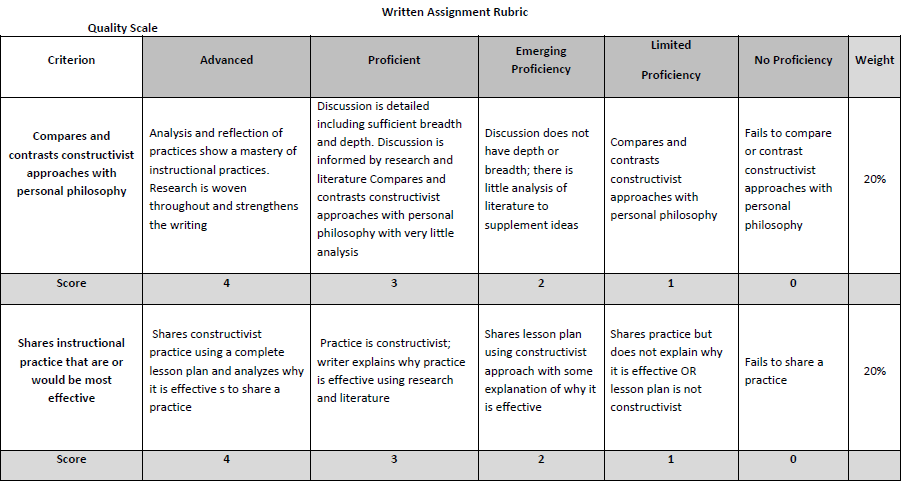
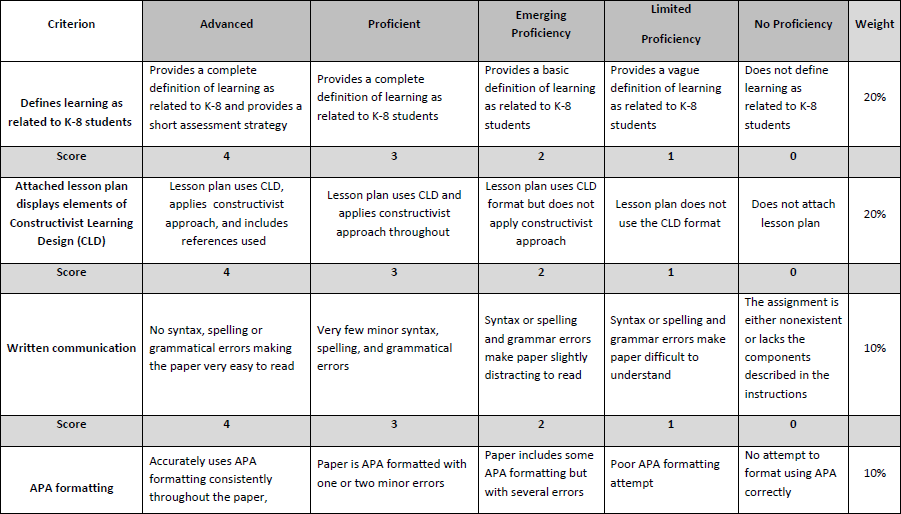
Papers will be peer-assessed using the Written Assignment Rubric 1
In the Traditional approach (Botarev, n.d.), the study of a topic begins with parts of the whole, from smaller to larger, which is strictly based on following the curriculum. The main teaching materials are textbooks and workbooks, and learning itself is built on repetition. The teacher is an authority; he or she speaks in the form of a monologue and leads the students, as if imposing information on them. The teacher seeks to encourage students to repeat the material by means of rewards and punishments. Tests with correct and incorrect answers are developed to assess knowledge. In this case, information is seen as something permanent, and students are more likely to work individually.
The Constructivist approach (Botarev, n.d.) assumes that the teacher is a facilitator, i.e. facilitates the conditions for students' independent discoveries with the help of guiding questions.In this way, the teacher shows himself as an interlocutor, a moderator of discussion, he encourages dialog, walks alongside the students.Pupils study primary sources and do hands-on work in groups on their own questions and topics of interest.Knowledge is seen as something dynamic, constantly changing with our experience, and learning about a topic begins with general ideas - from more to less.Moreover, learning is interactive, building on what students already know, and the teacher helps students construct their own knowledge through dialog.In addition to test scores, students' opinions matter. The process is as important as the result
Moreover, learning is interactive, building on what students already know, and the teacher helps students construct their own knowledge through dialog. In addition to test results, students' opinions are important. The process is as important as the result.
I like both approaches as in the case of traditional and non-traditional medicine. It's just that each of these approaches serves its own purpose. If knowledge is divided into static, unchanging knowledge and knowledge that changes with time and technology, then each information block can be taught in its own way.
To define learning, as related to K-8 students it suitable to cite: long-term memory is not about a collection of skills and knowledge, but connections among skills and knowledge built upon over time (Learning Progressions in K-8 Classrooms: How Progress Maps Can Influence Classroom Practice and Perceptions and Help Teachers Make More Informed Instructional Decisions in Support of Struggling Learners N a T I O N a L c E N T E R O N E D U c at I O O N a L O U T c O M E S in Collaboration With: Council of Chief State School Officers (CCSSO) National Association of State Directors of Special Education (NASDSE), n. d.). Therefore, learning at this age is a process of acquiring important skills in retrieving, analyzing, and organizing information, where the student not only memorizes or repeats blocks of information (Benefits of K-8 Education | Calvert School, n.d.), but can connect them in context. To assess outcomes, it is not enough to test knowledge; it is necessary to observe the process of learning through the efforts students make as they work. We can cite a case from practice, when a first grade student in the first lesson repeated everything during the lesson, played games and spontaneously did a lot of exercises, but at the end of the lesson she could not remember the words she had learned. To be more precise, she remembered, but in her own language, not in English. This is an indicator of putting information into long-term memory, when short-term memory is not yet developed to the necessary level. But pupils who have been studying for several weeks remember words much easier, recognize and use them in various situations. Thus, it is logical to evaluate the attitude to the subject than the words learned.
References
Benefits of K-8 Education | Calvert School. (n.d.). Www.calvertschoolmd.org. Retrieved February 4, 2024, from https://www.calvertschoolmd.org/benefits-of-a-k-8-education
Learn to Read with Phonics | Starfall Education. (n.d.). Www.starfall.com. https://www.starfall.com/h/ltr-classic/?mg=m
Learning Progressions in K-8 Classrooms: How Progress Maps Can Influence Classroom Practice and Perceptions and Help Teachers Make More Informed Instructional Decisions in Support of Struggling Learners N A T I O N A L C E N T E R O N E D U C AT I O N A L O U T C O M E S In collaboration with: Council of Chief State School Officers (CCSSO) National Association of State Directors of Special Education (NASDSE) . (n.d.). https://conservancy.umn.edu/bitstream/handle/11299/173798/SynthesisReport87.pdf
To be: present simple forms - elementary level esl . (n.d.). Agendaweb.org. https://agendaweb.org/verbs/to-be-exercises.html
Ботарёв, С. (n.d.). Конструктивизм в обучении: почему этот прекрасный педагогический подход не стал массовым . Skillbox.ru. Retrieved February 4, 2024, from https://skillbox.ru/media/education/konstruktivizm-v-obuchenii-pochemu-etot-prekr asnyy-pedagogicheskiy-podkhod-ne-stal-massovym/