After reviewing the readings for Unit 1 and Unit 2, please choose one of the two prompts and post an initial response (Prompt A or Prompt B).
When you respond to three of your peers’ posts, choose at least one peer who responded to the other post. For example, if you post an initial response to Prompt B, then reply to at least one peer’s post who chose Prompt A.
After analyzing the readings for Unit 1 and Unit 2, please address the following points in your discussion:
Prompt A
- If you are currently teaching, which type of active learning approach (e.g., role-playing, reflective journals) has been successful in your classroom and how do you know it is successful?
- Support your explanation with examples.
- If you are currently not teaching, which learning approach would you use and why?
Prompt B
- Discuss your strategy(ies) to ensure students are held accountable during collaborative learning.
- How do your strategies compare and contrast with Team-Based Learning?
Your initial discussion should be a minimum of 250 words in length and no more than 750 words. Respond to three of your peers by developing a shared understanding of what constructivism looks like in an ideal classroom. Following the APA standard, use references and intext citations for any sources.
Prompt B
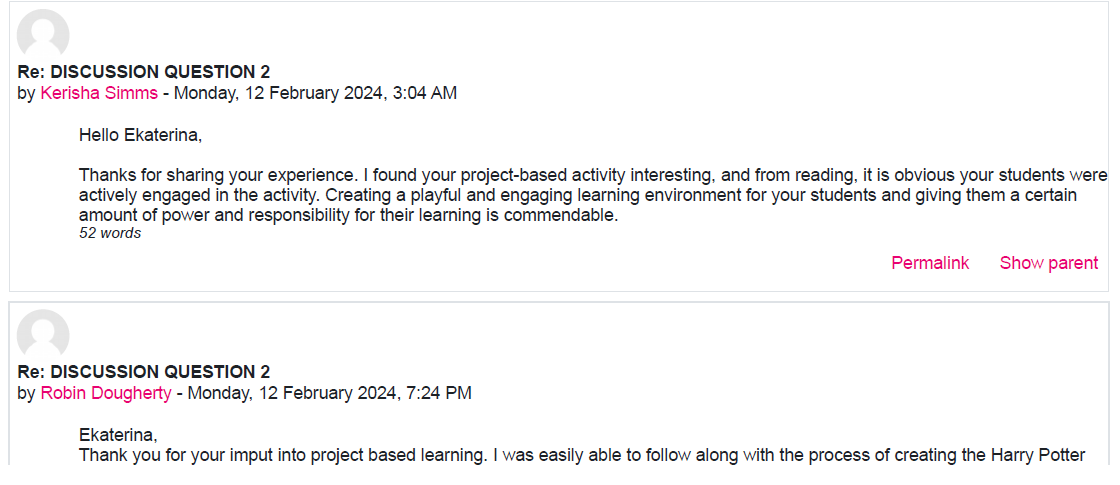
Today I would like to share with you the story of my work with the ninth grade students of the Arman Educational Complex, with whom I worked in the 2013 academic year.
That year I was invited to take the place of my colleague who had gone on maternity leave and I needed to quickly find a common language with the children. The first task I gave them was to make a project, a presentation or simply talk about their hobby. The guys were keen and showed a lot of creative solutions to this task.
However, there were 16 people in the class and it was difficult for me personally to work with all of them, and every student had to show the result. "The premise of active learning is that students learn better and are more engaged when they interact directly with material than when they sit passively and only watch or listen. As instructors, we can find myriad ways to integrate active learning into our sessions" (Saunders & Wong, 2020).
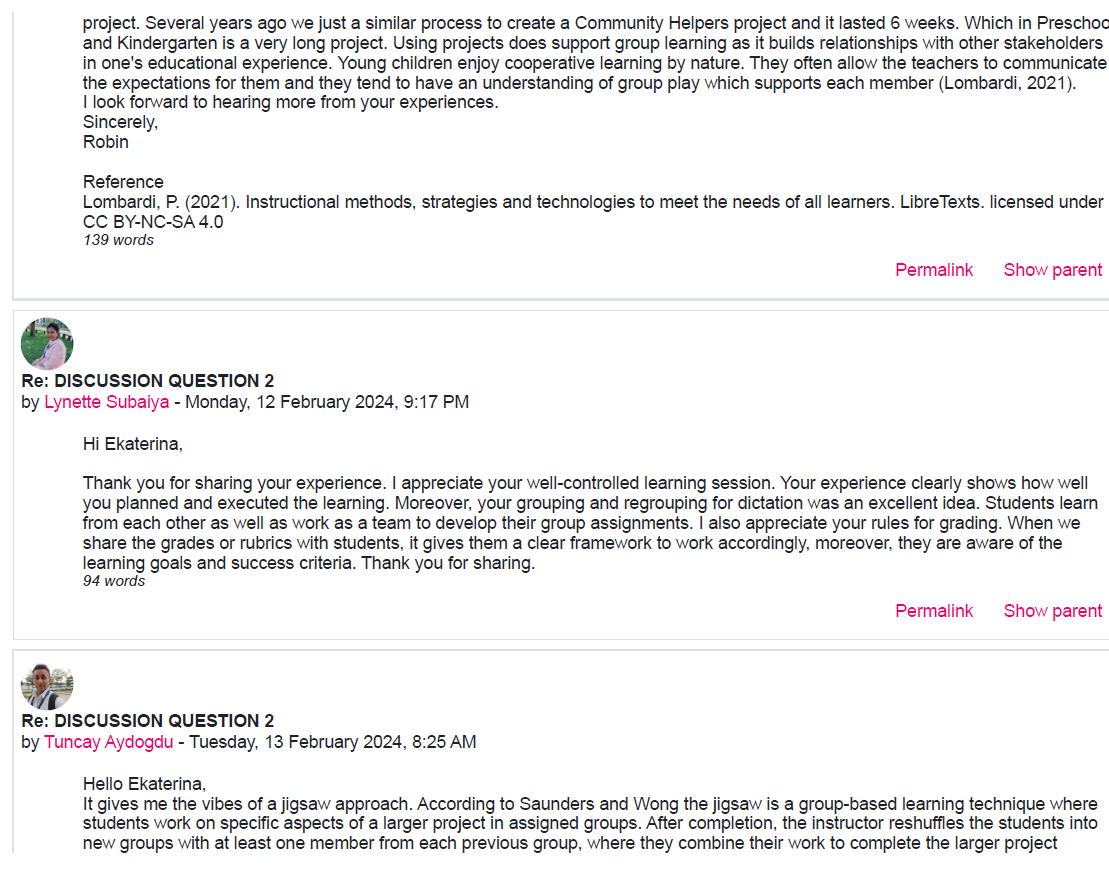
So we came up with a game based on the Harry Potter story. Sixteen people were divided into four groups of four, each group took the name of one of the faculties mentioned in the film, drew posters with symbols and other attributes of their faculties, and coloured buttons were used as answer points, which students themselves attached to the posters for each high mark.
Many things that were done can be found in Chapter 7 (Lombardi, 2021) and defined as a cooperative learning organisation.
But the most interesting thing happened next. Each of the "faculties" had to work together and help everyone in the group. For example, I gave them a list of words they had to learn in order to write a dictation. For the next lesson, all the students were mixed together so that students from different "faculties" were paired together. Accordingly, the dictation was written by taking turns dictating words and checking them with a neighbour. I carefully controlled the quality of checking so that everything was fair and without offence. As a result, each team received points according to the number of 100 per cent quality for the result. The grades were also given according to the grading rules, when the number of correct answers was divided by the number of total questions. For example, if the total number of words is 15 and the number of words written correctly is 12, then the quality percentage will be 80%. This is very high, but it is not possible to score points for one's "faculty" because there is still a 20% underperformance (Khan, 2015).
Thus, by carefully determining a maximum workload that was appropriate to the age, general development and abilities of the students as well as their interests, I was able to organise a playful environment that engaged each student in the process. Moreover, each of the four group members had a certain amount of power and responsibility, which made the process of working in the classroom even more vivid. I regard this experience as project-based learning that allows students to make sense of why content is useful and how it might be applied (De Vivo, 2022).
Lombardi, P. (2021). Instructional methods, strategies and technologies to meet the needs of all learners. LibreTexts. licensed under CC BY-NC-SA 4.0
De Vivo, K. (2022, January 24). A new research base for rigorous project-based learning. Phi Delta Kappan.
Saunders, L., & Wong, M.A. (2020). Instructions in libraries and information centers. Windsor & Downs Press. https://doi.org/10.21900/wd.12 USE DOI licensed under CC BY-NC-SA 4.0
Khan, S. (2015, November). Let’s teach for mastery – not test scores [Video]. TED Conferences.